Capítulo 1
When Risk Management Becomes the Risk: The Hidden Dangers of Flawed Methods
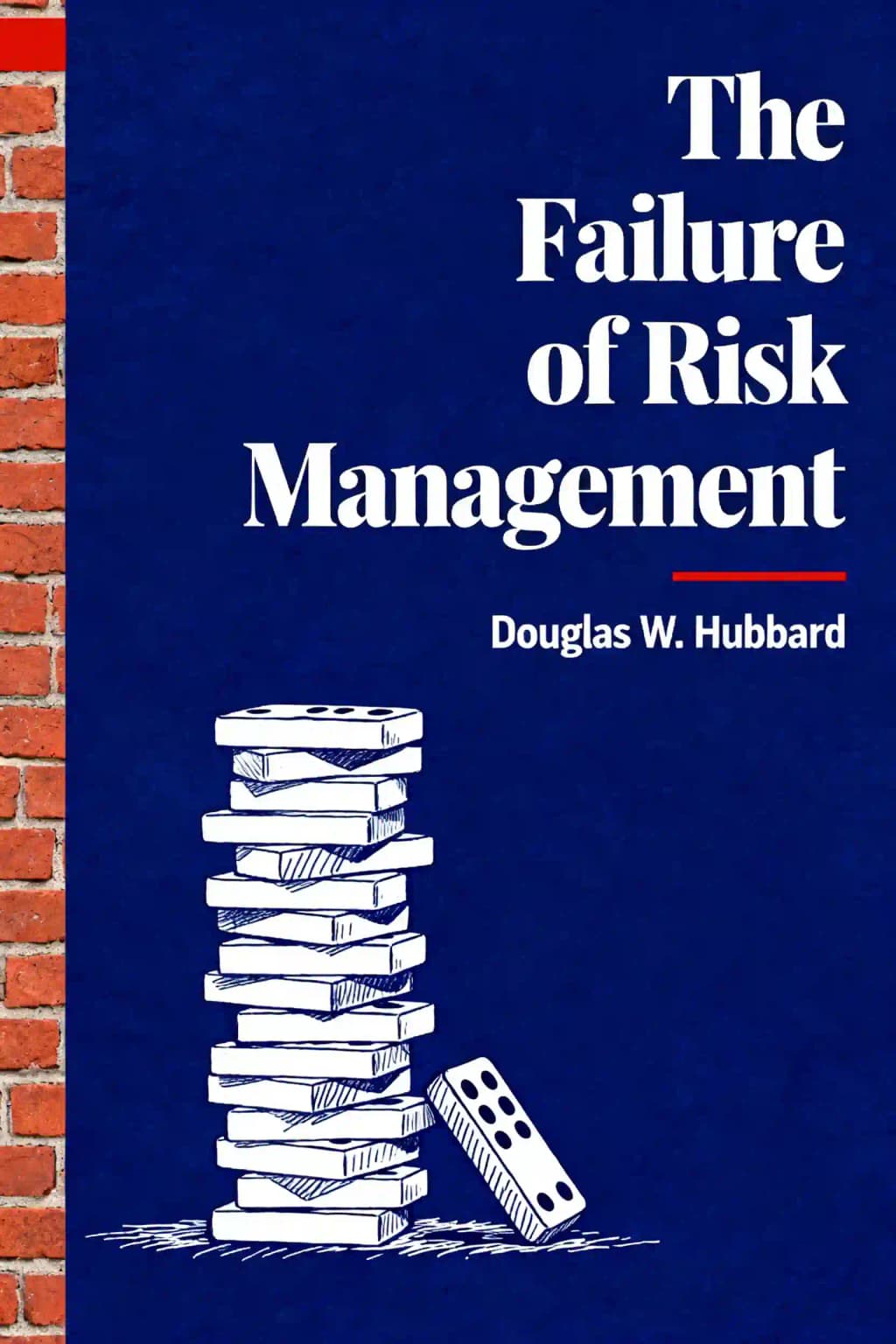
Risk management seems straightforward: identify threats, assess their likelihood and impact, then take appropriate action. Yet as Douglas Hubbard reveals in "The Failure of Risk Management," this critical business function is often built on fundamentally flawed foundations. Since its publication, this groundbreaking work has become required reading at major corporations and business schools worldwide. Warren Buffett reportedly keeps a copy on his desk, while tech leaders like Elon Musk have cited it when discussing Tesla's approach to risk. The book's cultural impact extends beyond business-it fundamentally changed how organizations from NASA to the Department of Defense approach uncertainty. What makes this work so powerful is Hubbard's unflinching examination of why the most popular risk management methods are not just ineffective but potentially dangerous, offering a mathematically sound alternative that has since transformed how forward-thinking organizations handle risk.
Capítulo 2
The Crisis in Risk Management: Why Most Methods Don't Work
The 2008 financial crisis exposed catastrophic failures in risk management across industries, serving as a stark wake-up call about the inadequacy of existing approaches. Despite sophisticated systems, complex models, and armies of dedicated professionals, organizations consistently fail to anticipate and prepare for major threats. Hubbard argues this isn't due to the inherent unpredictability of disasters but rather stems from fundamental flaws in how we assess and manage risk.
Most organizations rely heavily on qualitative approaches - particularly risk matrices with high/medium/low ratings or weighted scoring systems - that create what Hubbard terms an "analysis placebo effect." These methods feel rigorous and scientific but lack empirical validation. They spread virally through organizations, becoming entrenched as "best practices" or even codified into regulations and standards. The comfort they provide is illusory, masking deeper vulnerabilities while creating a false sense of security.
The consequences of these flawed approaches manifest in devastating ways. When Boeing's 737 MAX 8 was introduced, two crashes killed 339 people within months. The investigation revealed what engineers call a "common mode failure" - multiple safety systems compromised by a single point of failure. In this case, faulty sensor data led to catastrophic system responses. Similarly, the Deepwater Horizon oil spill and the Fukushima nuclear disaster demonstrated how risk management itself can become a common mode failure, introducing systematic blindness across entire organizations through shared but flawed assessment methods.
What makes this crisis particularly dangerous is the widespread lack of performance measurement in risk management. Unlike other business functions such as marketing, operations, or finance, risk management effectiveness is rarely evaluated objectively. In a comprehensive survey of organizations claiming to be "extremely" or "very" effective at risk management, 69% admitted they made no attempt to measure whether their methods actually worked. Of those who claimed to measure effectiveness, 63% relied solely on subjective staff surveys rather than concrete outcomes or empirical data.
Without objective measurement and validation, organizations operate in a dangerous vacuum, unable to distinguish between effective risk management and the mere illusion of security. This problem is compounded by cognitive biases that lead people to overestimate their ability to predict and control risks. As Frederick Smith, FedEx's CEO, noted: "Leaders get out in front and stay there by raising the standards by which they judge themselves-and by which they are willing to be judged." By this standard, most risk management programs are flying blind, relying on methods that provide comfort rather than genuine protection.
The proliferation of standardized risk management frameworks like ISO 31000 and COSO ERM, while well-intentioned, may actually exacerbate the problem by legitimizing unproven methods and creating a false sense of rigor. Organizations need to fundamentally rethink their approach to risk assessment, moving beyond subjective ratings and matrices to embrace quantitative methods and empirical validation.
Capítulo 3
The Tower of Babel: How Confusion About Risk Creates Vulnerability
Before solving risk management's problems, we must first understand what "risk" actually means. Surprisingly, different fields define this fundamental concept in contradictory ways, creating what Hubbard calls an "Ivory Tower of Babel" where practitioners speak past each other, leading to miscommunication and potentially costly mistakes in risk assessment.
Economist Frank Knight's influential 1921 definition distinguished "risk" (measurable uncertainty) from "uncertainty" (unmeasurable). This contradicts both common usage and established practice across multiple disciplines. Knight's definition omits the critical element of potential loss that most fields consider essential to risk. For example, while we can measure the probability of rolling specific numbers on dice, we wouldn't call this a "risk" unless something valuable was at stake.
In project management, organizations like PMI define risk as "an uncertain event that has positive or negative effects on objectives." This contradicts every English dictionary definition, which all define risk in terms of peril, danger, or harm. As Hubbard explains to project managers: "There's already a word for all possible outcomes-uncertainty." This confusion often leads project teams to waste time documenting "positive risks" instead of focusing on genuine threats to project success.
Finance often equates risk with volatility or variance. But this definition is problematic for several reasons. First, volatility only creates risk when you have a stake in the outcome - market fluctuations don't matter if you're not invested. Second, volatility doesn't necessarily mean risk-if all possible outcomes are positive, there's uncertainty but no risk. For instance, uncertainty about whether a company's profits will be "high" or "very high" represents volatility but not risk.
These competing definitions create practical problems in real-world situations. When a team conducts a risk assessment, members may be speaking entirely different languages without realizing it. One manager defined "very likely" as just 20% probability-shocking his colleague who considered "very likely" to mean at least 80%. When questioned, he explained, "Well, this is a very high impact event and 20 percent is too likely for that kind of impact." This miscommunication could have led to severely underestimating project risks.
Hubbard proposes a clear lexicon to resolve these issues: Risk must include some probability of loss, involve only losses (not gains), and can include both discrete events and continuous ranges with associated probabilities. Risk tolerance should be mathematically explicit-either as a maximum bearable risk curve or a function converting uncertain outcomes to fixed dollar amounts. For example, a company might specify that it can tolerate a 10% chance of losing $1 million, but only a 1% chance of losing $10 million.
This clarity is essential because risk management must be a subset of decision analysis. Decisions require consideration of potential benefits alongside risks, making precise terminology the foundation of effective risk management. Organizations that fail to establish clear definitions often find themselves making inconsistent decisions or focusing on the wrong threats entirely. For instance, a healthcare organization might overemphasize rare but dramatic risks while underestimating more common but less visible threats to patient safety.
The solution lies in establishing standardized risk definitions within organizations and ensuring all stakeholders understand and use these definitions consistently. This includes creating clear scales for probability and impact assessment, and explicitly defining terms like "high risk" and "risk appetite" in quantifiable terms.
Capítulo 4
The Limits of Expert Judgment: Why We're Overconfident About Uncertainty
Our reliance on expert judgment for risk assessment requires understanding the limitations of human expertise. While we can't avoid using subjective judgment, we need objective assessments of these subjective estimates-we need to "calibrate" our experts just as we would calibrate any measuring instrument.
Research by Daniel Kahneman and Amos Tversky-work so influential that Kahneman became the first psychologist to win the Nobel Prize in Economics-reveals how the human mind deals with uncertainty through heuristics (mental shortcuts) and biases that operate below our awareness.
The representativeness bias leads us to judge odds based on what seems representative rather than actual probabilities. We confuse patterns and randomness, as shown during WWII when Londoners mistakenly perceived bombing patterns as non-random when the distribution matched what random bombing would produce.
Perhaps most dangerous is what Kahneman calls "catastrophic" overconfidence. When people state the probability that their predictions will come true, they systematically overestimate their accuracy. Studies consistently show that when uncalibrated people claim 90% confidence in their answers, they're correct only about 66% of the time.
This overconfidence extends to range estimates. When asked to provide 90% confidence intervals (ranges so wide that the actual answer should fall within them 90% of the time), most people create ranges so narrow that they capture the true answer only 30-60% of the time.
The consequences can be severe. Richard Feynman, investigating the Challenger disaster, found management estimated the probability of failure at an astonishingly optimistic 1 in 100,000, while engineers estimated 1 in 100-a thousand-fold difference.
Even successful executives may be overconfident due to luck rather than skill. Given the large number of candidates competing for few upper-management positions, some will have strings of successes purely by chance-like winners of a coin-flipping tournament-yet attribute their success to special insight rather than luck.
Our judgments are also remarkably inconsistent. In IT project risk assessments, experts gave wildly different probability estimates when unknowingly evaluating identical projects twice in the same session. Only 22% gave the same answer both times, with differences often exceeding 10 percentage points.
The good news is that calibration training significantly improves people's ability to assess odds accurately. Yet most risk assessment methods make no attempt to address these fundamental issues of human judgment.
Capítulo 5
Worse Than Useless: The Fatal Flaws in Risk Matrices
The most popular risk assessment method-the risk matrix-may be doing more harm than good. These simple visual tools display risk along two dimensions (likelihood and impact) using verbal labels or numerical scales (usually 1-5). The resulting matrix is often divided into zones classifying total risk as high-medium-low or red-yellow-green.
Despite their popularity, research shows these methods often make decisions worse than they would have been without any analysis at all. Tony Cox, one of the earliest PhDs in risk management from MIT, has identified five major problems with these methods:
First is range compression-scoring methods lump together vastly different values under single categories. For example, the NIST scale would categorize both a 1% and an 18% likelihood as "low," and risks with dramatically different impacts (like $100 million vs. $250 million losses) receive identical ratings.
Second, most scoring systems assume regular intervals between scale points (1-2-3-4-5), which rarely reflect true relative magnitudes. In one federal agency, their IT project risk scale assigned a C-level executive sponsor three times the value of a VP sponsor, but historical data showed the actual difference was only about 30%.
Third, qualitative methods universally ignore correlations between risks. Two "medium" risks that could occur simultaneously due to the same cause represent a much higher combined risk than the matrix suggests.
Fourth, research shows responses on five-point scales cluster heavily-about 80% of responses fall on just 3 or 4 points, meaning small arbitrary changes can dramatically alter risk rankings.
Fifth, seemingly minor differences in scale design (like using 0-3 versus 1-4) can significantly change how risks are prioritized.
When using verbal scales like "very likely," "likely," "unlikely," and "very unlikely," people interpret these terms vastly differently. Research by David Budescu found that even when specific probability guidelines were provided (e.g., "likely" means "greater than 66%"), respondents' interpretations varied wildly-"likely" was interpreted to mean anything from 45% to 84%.
This creates what Budescu calls an "illusion of communication"-when everyone "agrees" that an event is "very unlikely," they aren't actually agreeing at all, as their interpretations differ dramatically.
After extensive analysis, Cox concludes risk matrices can mistakenly assign higher ratings to quantitatively smaller risks and lead to worse-than-random decisions. Thomas, Bratvold, and Bickel's comprehensive review of thirty risk matrices in the oil and gas industry found most distorted risks by a factor of at least ten. They recommended the industry rely instead on "risk- and decision-analytic procedures that rest on more than 250 years of scientific development and understanding."
Capítulo 6
Obstacles to Better Risk Management: Bears, Swans, and Mathematical Misconceptions
Even if we accept the flaws in current methods, significant conceptual obstacles to improved risk management remain. Many perceive risk as immeasurable and any attempt to manage it as infeasible. Hubbard argues that measurement is simply a quantitatively-expressed reduction in uncertainty based on observation-not perfect clairvoyance but an improvement on unaided intuition.
People often commit what Hubbard calls the "exsupero ursus" fallacy (Latin for "beat the bear"), illustrated by the joke about two hikers-one wearing running shoes to outrun bears. When the other points out you can't outrun bears, the first replies, "I don't have to outrun the bear, just you."
This fallacy appears when evaluating models-rejecting a better option because it fails to meet an impossible standard. Berkeley Dietvorst's research shows people exhibit "algorithm aversion"-they're less forgiving of algorithmic errors than human ones, even when algorithms perform better.
Philip Tetlock's massive 20-year study tracking 284 experts making 82,000 forecasts about elections, wars, and economics delivered a powerful conclusion: "It is impossible to find any domain in which humans clearly outperformed crude extrapolation algorithms, less still sophisticated statistical ones."
Despite this evidence, many still prefer human judgment over algorithms. Critics point to single failures like 9/11 or market crashes as "proof" algorithms don't work, ignoring that a single error doesn't prove one model is worse than another.
Other common fallacious arguments include "garbage in, garbage out," "each situation is unique," "we lack data," or "this is too complex to model"-all failing to acknowledge that human intuition faces identical limitations.
The greatest resistance to quantitative methods comes from those who hold misconceptions they believe are correct. One fundamental misconception is the belief that we must know "exact probabilities" to use quantitative methods. This misunderstands that probabilities exist precisely because we are uncertain.
Many managers claim their environments are uniquely complex and that quantitative methods won't work for them, despite these methods being successfully applied across diverse fields from nuclear power to software development. Even actuaries frequently work with limited data, especially when assessing their greatest exposures. Insurance companies regularly insure rare events with minimal historical data, including Olympic cancellation insurance, rocket launch insurance, and credit risk insurance in developing nations.
Capítulo 7
A Simple Solution: The One-for-One Substitution Model
To bridge the gap between qualitative and quantitative risk methods, Hubbard introduces a simple quantitative model that can serve as a starting point. The "one-for-one substitution model" offers the simplest probabilistic alternative to a risk matrix, serving as a direct replacement that still captures subjective estimates of likelihood and impact, but in probabilistic terms.
Instead of using qualitative scales like high/medium/low for risk assessment, we substitute actual probabilities and monetary values. For each risk on a conventional matrix, we create a row in a spreadsheet where we define the risk, specify a time period, assign a probability of occurrence within that period, and estimate a 90% confidence interval for monetary loss if the event occurs.
The same subject matter experts who populate conventional risk matrices can provide these quantitative estimates. They now express their uncertainty using probabilities and ranges instead of vague scales.
When working with ranges of uncertain values rather than exact numbers, we need probabilistic modeling methods like Monte Carlo simulation to combine them meaningfully. This approach generates thousands of random scenarios based on our probability inputs, allowing us to answer questions like "What's the chance we'll lose more than $X next year?"
The results can be visualized as a Loss Exceedance Curve (LEC), which shows the probability of exceeding various loss thresholds-a mathematically unambiguous way to visualize risk already used in financial, actuarial, and engineering fields.
To determine how much risk we can bear, we use a "risk tolerance curve" to compare against the Loss Exceedance Curve. If our LEC stays under this curve, the risk is acceptable. This curve is best gathered from management in about a 90-minute meeting, asking them to establish points like "Would you accept a 10% chance per year of losing more than $5 million?"
The ultimate purpose of risk analysis is to support decisions, but traditional risk matrices make specific resource allocation difficult. Organizations need a "return on control" calculation: the monetized value of reduced expected losses divided by the control cost.
Even this simple quantitative model improves risk assessment by avoiding qualitative ambiguity, decomposing uncertain quantities, and using Monte Carlo simulations. How much detail you add depends on your risks' size and criticality.
Capítulo 8
Building a Risk-Intelligent Organization: From Models to Culture
While improving risk assessment methods is crucial, organizational implementation requires breaking down silos, establishing quality procedures, and incentivizing good analysis. Risk management improvement demands commitment beyond superficial measures like appointing risk czars.
Organizations need someone responsible for assessing all uncertainties across departments-whether called a Chief Risk Officer, Chief Decision Analysis Officer, or Chief Probability Officer. This person should define roles and documentation, determine training requirements (including calibration training for estimators), manage model development across the organization, and track forecast performance.
Creating an organization-wide risk model that crosses departmental silos may seem daunting but can begin either with seed models that gradually expand or with a top-down design approach. The Global Probability Model (GPM) serves as a central repository for all uncertainty analysis in the organization, allowing different departments to use consistent models for shared variables like revenue forecasts or economic indicators.
A calibrated culture requires more than just training estimators-it demands tracking predictions, reporting results, and incentivizing accurate forecasting. The Brier score provides an objective method for evaluating forecasters based on both accuracy and confidence. This scoring system rewards forecasters who are both accurate and appropriately confident, while penalizing overconfidence when wrong.
The most critical issue for creating a calibrated culture is aligning incentives with better risk management. Management bonuses should consider risk exposure, not just profits. Risk experts like Andrew Freeman of McKinsey identify improper incentives as a major culprit in the 2008 financial crisis, where bonuses were paid without regard to increased risk exposure and never reclaimed after catastrophes occurred.
Some critical risk management issues require solutions beyond individual firms, involving standards organizations, professional associations, and legal changes. Unlike actuaries, who have legally recognized professional status with standardized testing and ethical codes, other risk modeling professionals lack similar standards. Standards organizations like PMI and NIST currently promote ineffective risk methods and should involve quantitative decision analysts in developing better standards.
Organizations should evolve toward constantly tested models that support both risk management and broader decision-making, managed by specialists with high organizational visibility. Ideally, these models and their data sources should be shared across firms and industries to reduce systemic risk.
Capítulo 9
The Path Forward: Embracing Quantitative Risk Management
Hubbard's central message is that quantitative methods, even with subjective components, consistently outperform intuition, ordinal scales, and risk matrices. The solution to risk management's failures isn't abandoning structure but embracing more rigorous approaches grounded in probability theory and decision science. This becomes particularly evident when organizations face complex, interconnected risks that defy simple categorization.
To implement better risk management:
1. Speak the language of probabilities-what Sam Savage calls "the arithmetic of uncertainty." This means using actual probabilities to represent uncertainty and performing proper calculations to avoid common intuitive errors. For example, instead of labeling a risk as "high likelihood," specify "70% chance of occurrence within 12 months." This precision enables meaningful comparison and aggregation of risks across different domains.
2. Get your probabilities calibrated. Calibration training not only improves experts' probability assessments but builds their intuitive understanding of probabilistic models. The key to calibration is repetition and feedback through structured testing, comparing expected results to actual outcomes. Research shows that experts who undergo formal calibration training can improve their accuracy by 25-30% within just a few months of practice.
3. Use data for initial benchmarks. Even with calibration training, experts benefit from data-based benchmarks for their estimates. Hubbard proposes three working assumptions: it's been measured before, you have more data than you think, and you need less data than you think. Organizations often overlook valuable data sources like industry reports, historical records, and analogous situations in other sectors. Even small samples can provide meaningful insights - sometimes as few as 12 data points can establish a useful baseline.
4. Break it down, then do the math. When estimates are extremely uncertain, decomposing the problem into quantities that are easier to estimate makes sense. Studies by MacGregor and Armstrong found that for highly uncertain variables, simple decomposition into no more than five variables could reduce error by an astonishing 96.3 percent. For instance, instead of estimating total project risk, break it down into schedule risk, resource risk, technical risk, and stakeholder risk components.
5. Apply a filter. Not everything should be classified as a risk. Good filtering rules include: risks typically don't happen every year (usually less than 50% annual probability); impacts should be large enough to report to top management (typically affecting 1% or more of annual revenue); be careful about including missed opportunities like failing to reach sales goals; avoid listing management decisions as risks; and watch for overlapping risks that might double-count impacts. This filtering process helps focus attention on truly significant risks rather than routine operational variations.
As Laplace noted two centuries ago, probability theory-which began with games of chance-has become "the most important object of human knowledge," essential for making decisions under uncertainty where potential losses are significant. Modern applications have proven this across fields from insurance to investment banking, where quantitative risk management has become standard practice. By embracing this powerful mathematical framework, organizations can transform risk management from a compliance exercise into a genuine strategic advantage, enabling better resource allocation and more confident decision-making under uncertainty.
The transition to quantitative risk management requires investment in training, tools, and cultural change, but organizations that make this shift typically see improvements in decision quality within 12-18 months. Success stories range from major infrastructure projects reducing cost overruns by 40% to pharmaceutical companies better predicting clinical trial outcomes.