Capítulo 1
The Timeless Dance of the Psyche: Exploring Jung's Psychological Cosmos
Carl Jung's ideas have quietly infiltrated our culture, appearing everywhere from Myers-Briggs personality tests to Star Wars' concept of "the Force." Though less famous than his contemporary Freud, Jung's impact may ultimately prove more profound. His exploration of the collective unconscious has influenced figures from filmmaker George Lucas to novelist Hermann Hesse, while his concept of synchronicity has become a touchstone for spiritual seekers worldwide. What makes Jung particularly relevant today is his integration of scientific rigor with spiritual depth-a balance increasingly sought in our fragmented world.
Capítulo 2
Mapping the Psychic Underground
Jung's revolutionary contribution to psychology began with his discovery of dissociation-the splitting of personality into subsidiary parts unaware of each other. While working at the Burgholzli mental hospital in Zurich starting in 1900, Jung observed this phenomenon in both hysterical patients (who might behave as different persons) and schizophrenics (whose personalities fragmented so completely that the ego became just one "voice" among many).
His pioneering word-association tests provided objective evidence for unconscious mental contents. In these tests, subjects responded to stimulus words while Jung measured reaction times and noted disturbances like delayed responses, physical reactions, or memory failures. These disturbances revealed "complexes"-emotionally charged groups of ideas that operate autonomously within the psyche.
What made these complexes fascinating was their independence from conscious control. Jung observed that complexes behave like "animated foreign bodies" within consciousness, disrupting our intentions and memories despite our best efforts to suppress them. They function as "splinter psyches" with remarkable autonomy, sometimes manifesting as auditory hallucinations in psychoses-personified voices beyond conscious control.
This led to Jung's groundbreaking application of psychoanalytic ideas to schizophrenia. While conventional psychiatry viewed delusions and hallucinations as meaningless symptoms of brain disease, Jung demonstrated they could have profound psychological meaning. His work with schizophrenic patients revealed that their seemingly incomprehensible symptoms often paralleled myths and religious symbols across cultures, suggesting common underlying patterns in the human psyche.
Consider the case of a paranoid schizophrenic man who believed himself to be the Savior. During a hallucination, this patient described seeing the "sun's phallus" creating wind when he moved his head. Years later, Jung discovered an ancient Greek text describing a remarkably similar vision of a "tube" hanging from the sun that was the "origin of the ministering wind." Such parallels convinced Jung that psychotic symptoms weren't random but represented "the revival of possibilities of ideas that have always existed" across diverse minds and epochs.
Capítulo 3
The Collective Unconscious: Our Shared Psychic Heritage
These observations led Jung to his most revolutionary concept: the collective unconscious. Beyond the personal unconscious (containing forgotten or repressed contents from one's lifetime), Jung proposed a deeper layer of psyche containing "an ancestral heritage of possibilities of representation" common to all humans.
The collective unconscious manifests through archetypes-universal patterns or motifs that appear in dreams, myths, and religious symbolism across cultures. These archetypes aren't inherited ideas but innate tendencies to form certain types of images and emotions. Jung described them as "deposits of constantly repeated experiences of humanity" that function both as impressions of typical experiences and as agents compelling their repetition.
Jung emphasized that archetypes are determined by form rather than content-like a crystal's axial system that preforms crystalline structure without having material existence itself. An archetype becomes filled with content only when it enters consciousness and incorporates material from personal experience. This explains why archetypal images vary across cultures while maintaining recognizable patterns.
The evidence for archetypes comes from their spontaneous appearance in dreams, psychotic episodes, and creative work across cultures without possibility of direct transmission. Jung observed how patients with no knowledge of mythology would produce images and narratives strikingly similar to ancient myths. Even more compelling was the appearance of identical symbolic patterns in cultures separated by geography and time.
This collective unconscious isn't merely theoretical-it manifests in powerful emotional experiences that can transform lives. When an archetype enters consciousness, it carries a numinous quality that fascinates or impels to action. These experiences form the basis of religious and spiritual traditions worldwide, from Polynesian concepts of mulungu to the Holy Ghost's "fiery tongues" in Christianity.
Capítulo 4
The Divided Self: Jung's Psychological Types
While confronting his own unconscious after breaking with Freud, Jung simultaneously developed his theory of psychological types. Puzzled by how Freud and Adler could interpret identical psychological material so differently, Jung concluded that human beings belong to fundamentally different psychological types.
His typology identifies two basic attitudes-extraversion and introversion-and four orienting functions: thinking, feeling, sensation, and intuition. The extravert's interest flows naturally toward the external object and objective facts, while the introvert's energy moves toward the subject and subjective factors. Neither attitude is superior; both represent valid ways of engaging with reality.
The four functions represent different ways of processing experience: sensation establishes what exists, thinking provides meaning, feeling determines value, and intuition perceives origins and destinations. These functions form a cross with rational (thinking/feeling) and irrational (sensation/intuition) axes.
Every person possesses all four functions, but typically one function predominates, creating eight possible function-types when combined with the attitudes of extraversion or introversion. The dominant function becomes highly developed and conscious, while its opposite remains primitive and largely unconscious.
This creates a natural compensation within the psyche. The extravert's conscious focus on external reality is balanced by an unconscious introversion; the thinking type's rational judgments are complemented by unconscious feeling. When conditions trigger this inferior function, a dramatic reversal can occur-the hesitant introvert suddenly becomes enthusiastic, or the bold extravert becomes moody and withdrawn.
Jung emphasized that typology wasn't meant to classify humans into rigid categories but serves as a critical tool for understanding individual differences. By recognizing our own psychological type, we become aware of our natural biases and blind spots, allowing for more balanced development and better relationships with those of different types.
Capítulo 5
The Shadow: Confronting Our Darker Half
The journey toward psychological wholeness begins with confronting what Jung called the shadow-the "negative" side of personality containing qualities we hide from ourselves and others. The shadow encompasses our undeveloped functions, personal unconscious contents, and aspects of ourselves we find morally objectionable. This includes repressed emotions, primitive impulses, and unfulfilled desires that society deems unacceptable.
Jung observed that the shadow typically appears in Europeans' dreams as a same-sex figure who is dark-skinned, alien, or primitive. These dream manifestations often embody characteristics opposite to one's conscious personality - if someone identifies as rational and controlled, their shadow might appear as chaotic and passionate. Making the shadow conscious doesn't eliminate these aspects but allows their integration into a more complete personality, leading to greater self-awareness and psychological maturity.
Everyone carries a shadow, and the less it's embodied in conscious life, the blacker and denser it becomes. Common shadow traits include anger, jealousy, greed, and sexual desires deemed inappropriate by society. When repressed, these shadow qualities never get corrected and may suddenly erupt, sabotaging even well-intentioned efforts. For instance, a person who denies their aggressive impulses might unexpectedly explode in rage at minor provocations. In neurosis, we face an intensified shadow, requiring a way for conscious personality and shadow to live together.
The shadow isn't wholly evil but merely inferior, primitive, unadapted, and awkward. It contains childish qualities that could vitalize human existence - spontaneity, creativity, and raw emotion - but convention forbids them. A businessman might repress his artistic inclinations, or a teacher might deny their competitive nature. Confronting the shadow presents a moral challenge requiring considerable effort, as it demands recognizing dark aspects of personality as real and accepting responsibility for them.
Shadow characteristics have an emotional, autonomous nature, revealing where adaptation is weakest. On this primitive level, one becomes victim to affects and incapable of moral judgment. For example, when in the grip of shadow emotions, people often act out of character, later wondering, "What came over me?" Though some shadow traits can be recognized as one's own, others resist moral control through projections - seeing our own unacceptable qualities in others.
The projection-making unconscious isolates the subject from genuine environmental relationships, creating an illusory world-a vicious circle intensifying isolation. People might consistently blame others for their problems, seeing their own faults reflected in everyone around them. This often creates tragic situations where people remain incapable of seeing how their own actions perpetuate their suffering, trapped in patterns of behavior they cannot recognize as self-created. Breaking free requires the courage to withdraw these projections and own one's shadow aspects.
Capítulo 6
Persona, Anima, and Animus: The Masks We Wear and the Souls Within
The persona represents our social mask-a complex system of relations between individual consciousness and society. It's designed both to impress others and conceal our true nature. Society expects each person to play their assigned role perfectly, providing surety of reliability and competence.
This necessity to present an unequivocal face to the world leads to constructing an artificial personality. The division between public mask and private life creates psychological repercussions. Many identify so completely with their persona they believe they are what they pretend to be, but the unconscious never tolerates this shift in center of gravity.
Those with excellent personas pay through irritability or private lapses-Bismarck's hysterical weeping, Wagner's obsession with silk dressing-gowns, or saints whose wives develop neuroses. The "strong man" publicly often becomes childish privately; his discipline, morality, and altruism appear woefully different behind closed doors.
The more one identifies with the persona, the more the anima (inner feminine aspect in men) or animus (inner masculine aspect in women) develops compensatorily and is projected. The man playing the strong role outwardly becomes inwardly a woman, often projecting this feminine aspect onto his wife. Similarly, a woman who identifies completely with her feminine persona projects her masculine qualities onto men.
For a man, a woman best carries his soul-image due to his soul's feminine quality; for a woman, it will be a man. Wherever passionate, almost magical relationships exist between sexes, a projected soul-image is involved. The object rarely meets the soul-image's demands indefinitely, though many women succeed by disregarding their own lives, assisted by feminine biological instinct.
The anima appears in dreams and fantasies as a personified feminine being-not a conscious invention or mother-substitute, but a spontaneous unconscious product. Similarly, the animus manifests as masculine figures or voices expressing opinions and judgments. When anima-possessed, men argue "womanishly" about vanity; women argue about power, truth, justice or other "isms" when animus-possessed.
Capítulo 7
Dreams as Messengers from the Unconscious
Jung's approach to dreams differed radically from Freud's. While Freud saw dreams primarily as disguised expressions of repressed wishes, Jung viewed them as communications from the unconscious that compensate for conscious attitudes-"organs of information and control" that aid in building the personality.
Jung established a crucial heuristic rule for dream interpretation: always ask what conscious attitude the dream compensates. Without knowledge of the conscious situation, dreams cannot be interpreted with certainty. Dreams reveal "the inner truth and reality of the patient as it really is," comparing dream content to physiological facts: "if sugar appears in the urine, then the urine contains sugar"-they are "diagnostically valuable facts."
Consider the case of a man suffering anxiety and physical symptoms resembling mountain sickness. This patient, having risen from humble origins to prominence, brought two revealing dreams: one showing him ignoring childhood acquaintances from his village, another depicting a train derailment caused by excessive speed. These dreams clearly revealed his psychological predicament-having climbed too high too quickly, with his neurosis serving as a warning to slow down.
Jung challenged the purely causalistic approach that obsessively searches for childhood trauma, arguing this often neglects "things of immediate importance." Dreams offer not just etiology but prognosis and treatment direction. He demonstrated this with three dreams from a patient beginning treatment with different analysts, each dream anticipating the course of the respective therapeutic relationship.
Jung emphasized that dreams should not be forced into preconceived theoretical frameworks. True understanding must be mutual-a joint reflection between patient and analyst-rather than the doctor imposing interpretations. He rejected unlimited "free association" that often leads nowhere, instead advocating for conscious illumination of associations objectively grouped around particular dream images.
Capítulo 8
Individuation: The Journey Toward Wholeness
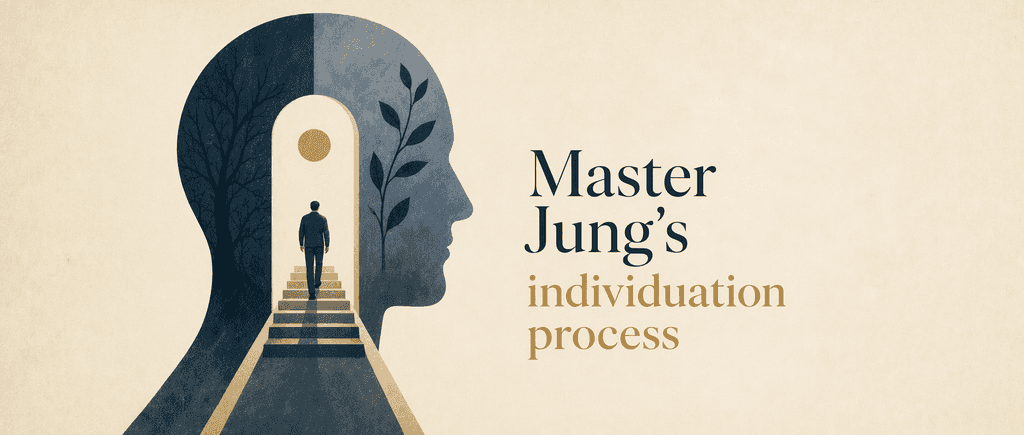
Jung's later work centered on "individuation"-the profound psychological journey toward wholeness that becomes particularly significant in life's second half. This spiritual process involves the complex integration of conscious and unconscious aspects of the psyche, symbolically represented through mandalas and quaternities. The ultimate goal is a fundamental shift in the personality's center from the ego to what Jung termed the "self"-the archetype of unity that he equated with "the God within." This transformation represents not merely personal growth but a fundamental reorganization of the psyche.
Individuation stands distinctly apart from individualism. While individualism might lead to isolation or self-centeredness, true individuation paradoxically brings deeper "consciousness of human community" by connecting us to the collective unconscious that unites all humanity. This process reveals our shared psychological heritage while simultaneously developing our unique individual nature. However, Jung emphasized that the individuation path is not universal-it's particularly contraindicated for neurotics whose unconscious already dominates their conscious life. The journey becomes meaningful primarily around middle life (35-40 years), when individuals have established sufficient ego strength. Pursuing this path too early can be psychologically destabilizing and potentially harmful.
The process addresses life's fundamental conflicts not through logical problem-solving but through psychological transcendence-reaching a higher level of consciousness where previous conflicts lose their immediate urgency. Jung used the metaphor of seeing a storm from a mountaintop rather than being caught in it, suggesting a shift in perspective that allows for broader understanding and acceptance of life's contradictions.
Jung discovered the symbolic representation of this process through mandala drawings-circular images often containing a quaternity or multiple of four. These patterns emerge spontaneously in dreams during periods of psychological conflict, in meditation, and even in psychotic states. In Tibetan Buddhism, mandalas serve as sophisticated instruments for meditation and concentration, helping practitioners focus their consciousness and connect with deeper spiritual realities.
Psychologically, mandalas typically manifest during periods of psychic dissociation or disorientation. They appear in children struggling with parental divorce, in adults grappling with psychological opposites during therapy, and in schizophrenics experiencing overwhelming unconscious content. The circular pattern serves as a compensatory mechanism, establishing a central point of reference that helps organize psychic chaos into meaningful order.
This manifestation represents an instinctive attempt at self-healing, drawing upon a fundamental archetypal schema that appears across diverse cultures without requiring direct transmission through tradition. The "squaring of the circle"-a common mandala motif-represents the archetype of wholeness, forming the underlying pattern for God-images across religious and spiritual traditions. This universal symbol suggests that the drive toward psychological integration is inherent in the human psyche, transcending cultural and historical boundaries.
The individuation process often involves confronting and integrating the shadow (personal unconscious), engaging with anima/animus figures (contrasexual aspects), and ultimately relating to the self archetype. This journey requires sustained psychological work, typically supported by analysis, active imagination, and engagement with dreams and symbolic material.
Capítulo 9
The Self and the God-Image: Jung's Religious Psychology
Jung defined religion as "a careful and scrupulous observation of the numinosum"-a dynamic agency not caused by arbitrary will but which seizes and controls the human subject. The numinosum is experienced as external to the individual, causing profound alterations in consciousness through overwhelming emotional and spiritual experiences. These experiences often manifest as visions, dreams, or powerful intuitive insights that feel divinely inspired rather than self-generated.
Modern mandalas reveal not worship of external objects but symbols representing a sacred center within oneself. These circular designs, appearing spontaneously in dreams and artwork, serve as representations of psychic wholeness. People who experience such visions report feelings of harmony, peace, and self-reconciliation-similar to making peace with God but without submission to deity. Instead, the wholeness of the person takes the deity's place, creating an internal sacred space where psychological integration can occur. The mandala becomes a template for psychological wholeness, reflecting both cosmic order and individual completeness.
Jung challenges the notion that man is merely his consciousness, introducing the "self" to designate the totality of conscious and unconscious contents-an ineffable whole expressible only through symbols. This self encompasses not only what we know about ourselves but also the vast unknown territories of the unconscious mind. The self differs essentially from the Christ-symbol in being "a union of opposites par excellence." While Christianity maintains an open conflict between good and evil, the self represents thesis, antithesis, and synthesis simultaneously, embracing both light and shadow aspects of the psyche.
Jung's exploration of alchemy revealed profound connections to analytical psychology. The experiences of alchemists, in their quest to transform base metals into gold, mirrored his own psychological discoveries, giving historical substance to his psychology of the unconscious. Their symbolic language and processes paralleled the stages of psychological transformation he observed in his patients. While the Church alienated consciousness from its unconscious roots through rigid dogma, alchemy preserved this vital connection through rich symbols that projected archetypes unsuited to Christian doctrine, including the sacred feminine and the shadow.
The mysterium coniunctionis of alchemy represents a restoration of the original cosmic state-the Western equivalent of the Chinese principle of yang and yin uniting in tao, and a premonition of what Jung calls "synchronicity." This ultimate union of opposites in alchemy symbolizes the integration of conscious and unconscious elements in the psyche. Synchronistic phenomena manifest independence from time and space determinants, showing meaningful coincidences between causally unrelated events. These occurrences suggest a deeper ordering principle in the universe, connecting psyche and matter in ways that transcend conventional causality. Jung observed numerous examples in his clinical practice, such as patients dreaming of events before they occurred or experiencing meaningful coincidences that defied statistical probability.
Capítulo 10
Synchronicity: Meaningful Coincidences Beyond Causality
Jung's concept of synchronicity addresses meaningful coincidences that cannot be explained by causality, representing a principle that connects events through significance rather than cause and effect. He illustrates this through several compelling cases, with two particularly notable examples standing at the forefront of his research.
In the first case, while treating a highly educated woman with an excessively rational worldview, she described dreaming of a golden scarab. At that precise moment, a scarabaeid beetle-the closest European equivalent to the Egyptian scarab-inexplicably flew into Jung's window, tapping against the glass. This remarkable timing proved therapeutically significant, as it helped break down the patient's rigid rationalistic attitude. The scarab, being an ancient Egyptian symbol of rebirth and transformation, served as a powerful catalyst for her psychological development.
The second case involved a patient's wife who observed an unusual gathering of birds outside their house. She noted dozens of black birds settling on their roof and filling nearby trees-a sight that deeply disturbed her. Shortly after, her husband died unexpectedly. She later revealed similar bird gatherings had preceded the deaths of her mother and best friend. This pattern of bird appearances before deaths aligned with ancient spiritual beliefs about birds as soul messengers.
Jung extensively documented how these synchronistic events often cluster around significant life transitions, emotional intensity, or deep psychological work. He observed that they frequently occur during major life changes, psychotherapeutic breakthroughs, or moments of spiritual awakening. The meaningful coincidences typically involve archetypal themes-universal symbolic patterns embedded in the collective unconscious.
These synchronistic phenomena led Jung to propose a more profound connection between psyche and matter than conventional science acknowledged. He suggested that living matter inherently possesses a psychic aspect, while the psyche contains a physical dimension. This perspective points toward an underlying unity where both material and psychic realities emerge from a common source-what he termed the unus mundus or "one world."
Jung's theory challenges the traditional Cartesian split between mind and matter, suggesting instead a unified reality where psyche and matter are complementary aspects of the same underlying phenomenon. This perspective helps explain synchronistic events not as mere coincidences but as manifestations of a deeper ordering principle in nature. The theory also aligns with certain findings in quantum physics, particularly the concept of quantum entanglement, where particles can maintain instantaneous connections regardless of distance.
Through numerous clinical observations, Jung noted that synchronistic events often carried profound personal meaning for those who experienced them, frequently providing guidance, insight, or confirmation during crucial life decisions. These experiences typically transcend rational explanation while maintaining their significance in the individual's psychological development.
Capítulo 11
The Individual and Society: Jung's Vision for Humanity's Future
Jung's late work continued his commentary on society while investigating the unconscious. His 1957 essay "The Undiscovered Self" reaffirms his belief in the individual's importance, suggesting that self-knowledge and human relationships are the only powers strong enough to resist collective state dominance.
Jung warns that Western civilization is threatened by subversive minorities sheltered by our humanitarianism, with only a thin layer of critically thinking people standing against them. When emotionality exceeds a certain threshold, rational argument becomes ineffective, replaced by slogans and wish-fantasies leading to collective possession and psychic epidemics.
The statistical worldview diminishes the individual in favor of mass formations, replacing moral responsibility with state policy. The individual loses the ability to make moral decisions about their own life, becoming merely a social unit maintained and entertained according to mass standards.
Jung argues that religion serves as a crucial counterbalance to mass-mindedness by providing individuals with a transcendent reference point outside worldly authority. The dictator State, recognizing religion's power, attempts to replace God with itself, turning political ideology into a pseudo-religion with fanatical worship.
The solution lies in individuals knowing their shadow rather than projecting it. Jung emphasizes that for adults in the second half of life, the challenge isn't transferring parental imagos to new figures (as with youth) but developing the function of opposites lying dormant in the unconscious, which offers renewal through confronting psychological opposites rather than resolving infantile ties.
"Resistance to the organized mass can be effected only by the man who is as well organized in his individuality as the mass itself," Jung declares. Though it might seem more impressive to address thousands rather than a single individual, Jung reminds us that nothing truly happens unless the individual changes.