Capítulo 1
The Wisdom of Warren Buffett: A Masterclass in Business and Investment
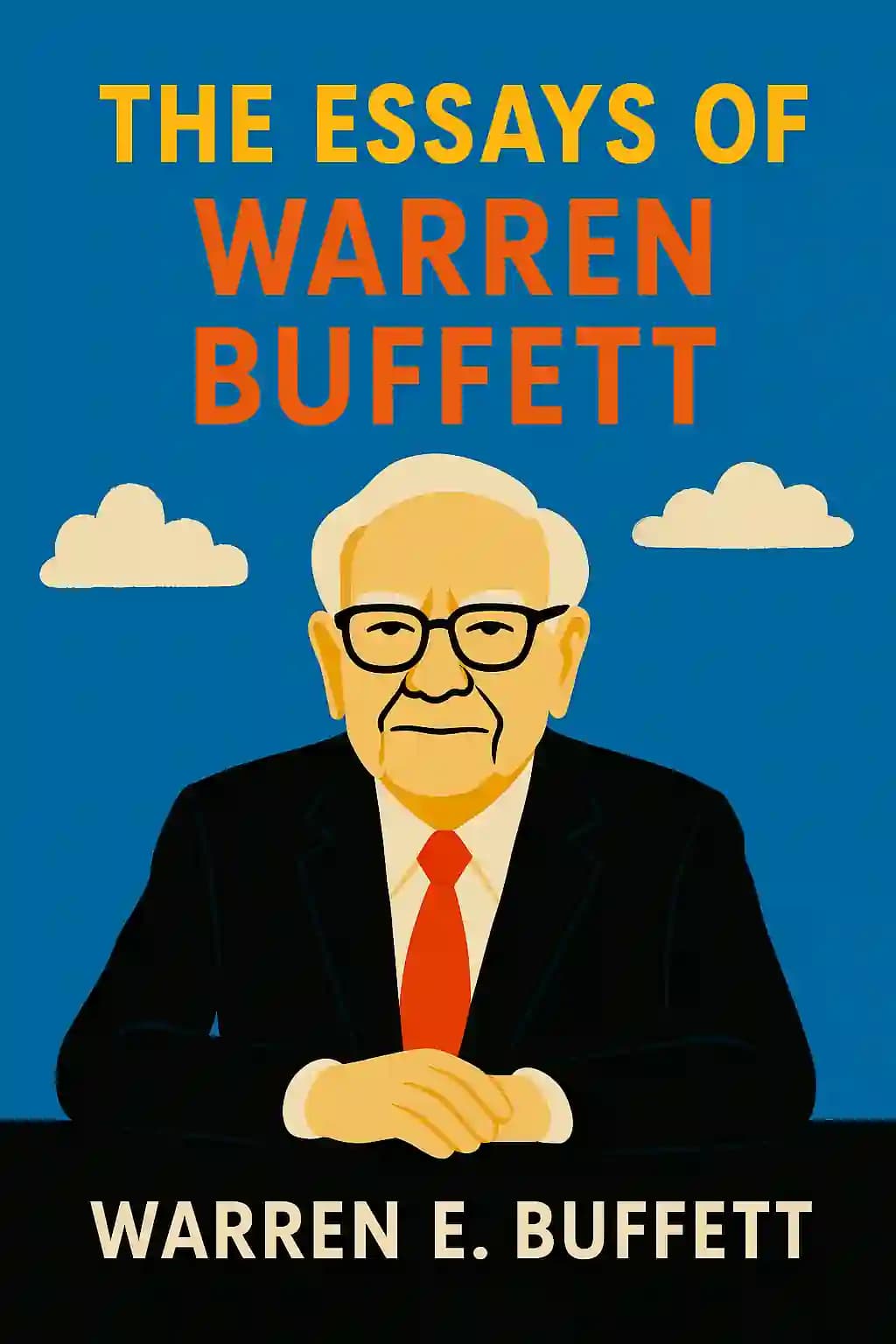
Warren Buffett's letters to Berkshire Hathaway shareholders have become required reading far beyond the company's investor base. What began as routine corporate communications has evolved into America's most sought-after business education, distilling decades of wisdom from the "Oracle of Omaha." The Essays of Warren Buffett, now in its fourth edition, celebrates both Berkshire's fiftieth anniversary under Buffett's leadership and twenty years as his most frequently autographed book. This collection has become standard reading in university investment courses and professional training programs worldwide. Even Bill Gates has called these letters "the best business writing ever," noting how they transformed his understanding of business and investing. What makes these essays particularly valuable is their ability to articulate timeless principles through practical examples, offering readers a front-row seat to one of history's greatest wealth-creation stories - the transformation of a struggling textile company into a conglomerate worth over half a trillion dollars.
Capítulo 2
The Fundamentals of Sound Business Thinking
At the heart of Buffett's philosophy lies a deceptively simple approach: apply fundamental business analysis to investment practice. While modern finance theory suggests studying individual investments is futile in "efficient" markets, Buffett follows the Graham and Dodd approach, emphasizing that price and value are distinct concepts. He illustrates this through real-world examples, such as the 1973-74 market crash, where many excellent businesses traded at fractions of their intrinsic value. He rejects the academic equation of risk with volatility, noting the absurdity that a stock becomes "riskier" by this measure when its price drops, even though a lower price might actually represent a better buying opportunity, as demonstrated by his successful purchases of American Express during its salad oil scandal and GEICO during its near-bankruptcy.
Buffett introduces readers to Graham's concept of Mr. Market - a manic-depressive hypothetical partner who offers to buy or sell at prices that often diverge significantly from value. Some days Mr. Market is euphoric, offering high prices; other days he's depressed, willing to sell at bargain prices. The intelligent investor exploits these price-value discrepancies rather than being influenced by them. This concept proved particularly valuable during market extremes like the dot-com bubble of the late 1990s and the 2008 financial crisis, where emotional trading created substantial opportunities. Similarly, Graham's margin-of-safety principle guides Buffett to invest only when price is substantially below value, providing protection against miscalculation or bad luck. He typically seeks a 30-50% discount to intrinsic value before investing.
For Buffett, "value investing" is redundant since all true investing must assess price-value relationships; anything else is speculation. He rejects artificial distinctions between "growth" and "value" investing, noting growth is simply a component of value. His investments in See's Candies and Coca-Cola demonstrate how high-quality growth companies can be excellent value investments when purchased at reasonable prices. Buffett advocates concentration rather than diversification, citing Keynes' belief in putting substantial sums into a few well-understood businesses with trustworthy management. His own portfolio typically consists of 15-20 major positions, with his top 5 holdings often representing 60-80% of his portfolio.
"Most of those who lose money in the stock market are not beating the system; they are just beating themselves," Buffett explains. Success requires staying within one's "circle of competence" - investing only in businesses one can understand - and resisting the "institutional imperative" that drives herd behavior. He demonstrates this through his avoidance of technology stocks during the dot-com bubble, despite criticism that he was "out of touch." His compelling essays on debt explain both the temptation and perils of leverage in personal and corporate finance, emphasizing that "any string of positive numbers, no matter how impressive, is reduced to zero when multiplied by a single zero." This wisdom was particularly evident during the 2008 financial crisis, when excessive leverage led to the collapse of several major financial institutions. Buffett's Berkshire Hathaway, by contrast, maintained substantial cash reserves and was able to make opportunistic investments when others were forced to sell.
Capítulo 3
The Corporate Governance Revolution
Buffett's approach to corporate governance rests on the fundamental principle that managers are stewards of shareholder capital who must think and act like owners when making business decisions. This owner-oriented philosophy stands in stark contrast to the typical corporate culture where managers often prioritize short-term gains or personal advancement. Unlike standard corporate reports filled with glossy photos, marketing jargon, and PR-crafted language, Berkshire's annual reports use plain, straightforward language accessible to people of average intelligence, with all investors receiving identical information simultaneously.
"We believe that telling the truth is not only morally right but commercially sensible," Buffett explains, highlighting how transparency builds long-term trust and reduces friction in business relationships. This commitment to transparency extends beyond written communications to Berkshire's legendary annual meetings, where Buffett and Munger spend five-plus hours answering shareholder questions without time limits, prepared responses, or filtered questions. This "Woodstock for Capitalists" has become a model for open dialogue between management and shareholders.
Buffett dismisses conventional wisdom about formulaic management structures and rigid corporate hierarchies, emphasizing instead the paramount importance of selecting able, honest, and diligent people. CEO selection receives particular attention because traditional performance standards often prove inadequate, no one in the organization is senior to the CEO, and board relationships typically become overly congenial rather than appropriately oversight-oriented. While popular reforms like independent directors, separated Chairman/CEO roles, and complex committee structures are common prescriptions, Buffett maintains that the best solution is identifying capable CEOs with integrity who will perform excellently regardless of structural constraints.
On executive compensation, Buffett is particularly critical of practices that have become standard in corporate America. He strongly condemns stock options that reward retention of earnings rather than superior capital deployment, noting how they can incentivize artificial earnings manipulation and risk-taking. Instead, he prefers performance-based pay measured by profitability after appropriate capital charges. "Compensation committees too often are tail-wagging puppy dogs meekly following recommendations by consultants, a breed not known for allegiance to the faceless shareholders who pay their fees," he writes, highlighting how this creates a self-perpetuating cycle of escalating executive pay divorced from actual performance.
Buffett advocates for logical compensation systems tied directly to areas managers actually control, with bonuses that are uncapped but based purely on performance rather than seniority or age. He implements this at Berkshire through simple, straightforward compensation plans that align manager and shareholder interests. For example, managers' bonuses are often tied to returns on capital employed in their specific business units, ensuring they focus on efficient capital allocation rather than empire building or accounting manipulation. This approach has helped Berkshire attract and retain exceptional managers while maintaining one of the lowest executive compensation structures among major American corporations.
Capítulo 4
The Berkshire Business Model: A Unique Approach to Capital Allocation
Berkshire's operating companies enjoy unique autonomy, with CEOs instructed to run their businesses as if they were sole owners holding their only asset for fifty years. This long-term orientation contrasts sharply with public companies focused on quarterly earnings. Buffett balances short-term results with long-term prospects, demonstrated in his handling of Berkshire's declining textile business, which he maintained until 1985 despite its economic challenges.
"I've never been in a business where I've felt the need to make a daily decision," Buffett explains. This patience extends to Berkshire's acquisition approach. Unlike most corporate acquirers who feel pressure to justify high premiums through synergies and cost-cutting, Berkshire offers sellers a unique proposition: their businesses can continue operating largely as before, with the same management teams and corporate cultures intact.
This approach has made Berkshire the "buyer of choice" for business owners who care about their companies' futures. As Buffett puts it: "You can sell it to Berkshire, and we'll put it in the Metropolitan Museum; it'll have a wing all by itself; it'll be there forever. Or you can sell it to some porn shop operator, and he'll take the painting and he'll make the boobs a little bigger and he'll stick it up in the window, and some other guy will come along in a raincoat, and he'll buy it."
The results speak for themselves. Berkshire has transformed from a struggling textile operation with $19.46 book value per share in 1965 into a holding company engaged in 80 distinct business lines worth around $100,000 per share - a 20% compound annual growth rate. Berkshire's interests span insurance (GEICO, General Re), railroads (Burlington Northern Santa Fe), energy companies, and numerous other businesses, with ten subsidiaries large enough to qualify for the Fortune 500 independently.
Capítulo 5
The Art of Intelligent Investing
Buffett champions inactivity as intelligent behavior in investing, a counterintuitive stance in today's fast-paced market environment. Just as business managers wouldn't frantically trade profitable subsidiaries based on interest rate predictions or pundit opinions, investors shouldn't behave differently with minority positions in excellent businesses. The art lies in acquiring wonderful businesses with strong economics and honest management at sensible prices, then simply monitoring that these qualities remain intact. This approach requires extraordinary patience and discipline, often running counter to human nature's desire for constant action.
"Lethargy bordering on sloth remains the cornerstone of our investment style," Buffett quips. This approach naturally leads to concentrated portfolios dominated by a few exceptional performers - selling these winners merely because they've become large positions would be as foolish as the Chicago Bulls trading Michael Jordan for becoming too important to the team. Consider Berkshire's own portfolio, where holdings like American Express and Coca-Cola have remained core positions for decades, demonstrating the power of this philosophy in practice.
Buffett and Munger favor businesses unlikely to experience major change, seeking operations virtually certain to maintain competitive strength decades into the future. While they welcome innovation as citizens, as investors they prefer predictability - like See's Candies, where despite surface-level changes since their 1972 purchase, the fundamental reasons people buy boxed chocolates remain unchanged. This preference extends to other consumer staples like Gillette (now part of P&G) and Dairy Queen, where basic consumer behaviors persist through generations.
Buffett calls certain dominant companies "The Inevitables" - businesses like Coca-Cola that will undoubtedly dominate worldwide for an investment lifetime. Though high-tech businesses may grow faster percentage-wise, Buffett prefers certainty of good results over hope of great ones. He points to companies like GEICO, which benefit from enduring competitive advantages and simple, understandable business models. For most investors, Buffett recommends low-cost index funds, but for those building their own portfolios, he emphasizes staying within one's circle of competence and purchasing, at rational prices, easily-understandable businesses whose earnings will grow substantially over decades.
The wisdom of this approach becomes particularly evident during market downturns, where quality businesses with strong competitive positions typically weather storms better than their peers. Buffett's emphasis on long-term ownership also brings tax advantages, as unrealized gains compound tax-free until sale. This patient approach has helped Berkshire achieve its remarkable long-term record, demonstrating that sometimes the best investment action is simply to do nothing.
Capítulo 6
The Danger of Financial Weapons of Mass Destruction
Years before the 2008 financial crisis, Buffett warned about derivative financial instruments with remarkable foresight. While proponents claimed derivatives reduced systemic risk by distributing it across many parties, Buffett presciently noted they might have the opposite effect due to their complexity, rapid valuation changes, and the intricate interconnections they create between financial institutions. He cautioned that problems in one sector could spread rapidly to others with devastating consequences, likening the situation to a complex house of cards.
"Derivatives are financial weapons of mass destruction, carrying dangers that, while now latent, are potentially lethal," Buffett wrote in 2002. He meticulously explains how derivatives create "daisy-chain risk" where credit exposures that seem diversified can suddenly correlate during crises, threatening the entire financial system. Using the example of Long-Term Capital Management's collapse in 1998, he demonstrated how a single failing institution could endanger dozens of major banks due to derivative connections. Unlike traditional banking, where the Federal Reserve can prevent domino effects through emergency lending, derivatives and insurance markets have no central backstop or circuit breaker.
Derivatives also make financial institutions nearly impossible to analyze, even for sophisticated investors. After closing Gen Re's derivatives operation at a $404 million loss, Buffett gained firsthand experience with their complexity and dangers. He particularly criticizes how they allow manipulation of reported earnings through subjective mark-to-market valuations and complex accounting treatments. The opacity of these instruments means that even regulators cannot effectively monitor their risks, as dramatically demonstrated by OFHEO's failure to detect massive accounting problems at Fannie Mae and Freddie Mac despite regular examinations.
The time dimension adds another layer of risk. Unlike normal stock trades that settle within days, derivatives contracts can remain unsettled for decades, creating what Buffett calls "a frightening web of mutual dependence" among highly-leveraged institutions. He points to credit default swaps and interest rate swaps that might not settle for 20-30 years, leaving counterparties exposed to risks that are impossible to fully evaluate. This interconnection virtually ensures government bailouts for the largest players, leading to Buffett's "First Law of Corporate Survival": only "mind-boggling screw-ups" by major derivatives dealers will receive state assistance - a prediction that proved eerily accurate during the 2008 financial crisis when AIG and other major institutions required massive government intervention.
The complexity of derivatives also creates operational risks that Buffett highlights through specific examples, such as the case of Procter & Gamble's losses on custom interest rate swaps and the collapse of Barings Bank due to unauthorized derivative trading. These cases demonstrate how even sophisticated organizations can fail to understand and control their derivative exposures, leading to catastrophic losses that ripple through the financial system.
Capítulo 7
The Accounting Games That Destroy Value
Buffett skewers opposition to treating stock options as expenses with characteristic directness: "If options aren't compensation, what are they? If compensation isn't an expense, what is? And if expenses shouldn't go into earnings calculations, where should they go?" He highlights how "restructurings" have become the latest accounting machination allowing managers to engage in earnings management with unprecedented deftness, often masking true operational performance.
The "restructuring charge" has become the distortion du jour - dumping costs that should be spread across years into a single disappointing quarter. This practice allows companies to artificially depress earnings in one period, creating an easier benchmark for future comparisons. Buffett illustrates this with a golf analogy: it's like a golfer recording an artificially terrible score (140) in his first round, then ignoring bad holes in subsequent rounds to maintain a consistent 80 average. Such managers become addicted to these accounting games rather than focusing on improving actual business performance. This behavior often creates a vicious cycle where companies need increasingly creative accounting to maintain the illusion of steady growth.
The manipulation extends beyond restructuring charges. Companies frequently engage in "cookie jar" accounting, creating reserves during good times that can be released to smooth earnings during downturns. Another common practice is the strategic timing of asset sales to offset operational weaknesses, creating an illusion of steady performance that masks underlying business challenges.
Buffett particularly criticizes companies' unrealistic pension fund return assumptions, which allow them to report inflated earnings. In 2006, S&P companies averaged an 8% return assumption, but this math doesn't work: with 28% in bonds yielding about 5%, the remaining 72% in equities would need to earn 9.2% after fees to achieve the overall 8% target. Looking at historical performance, the Dow's 20th century advance from 66 to 11,497 represents just 5.3% annually when compounded. These optimistic assumptions can lead to significant future funding shortfalls and mask real corporate obligations.
The problem extends to acquisition accounting, where companies often use purchase accounting to create instant earnings through the write-down of acquired assets, followed by their sale at higher prices. This practice, while legal, distorts the true economic picture of both the acquisition and the ongoing business operations.
Despite these inherent limitations and accounting shenanigans, Buffett emphasizes that financial information remains essential for investors. With knowledgeable judgment and appropriate adjustments for concepts like look-through earnings, owner earnings, and intrinsic value, investors can make sound decisions based on available financial data. The key is developing the ability to see through accounting manipulation and focus on the underlying economic reality of the business. Successful investing requires understanding both the limitations of accounting numbers and how to adjust for them, just as Buffett has done in allocating billions of dollars throughout his career.
Capítulo 8
The True Meaning of Value in Business
Buffett argues that "value investing" is redundant since all intelligent investing fundamentally seeks value sufficient to justify the price paid. He rejects the artificial separation between "value" and "growth" investing, noting they're "joined at the hip" - growth is always a component in calculating value, with importance ranging from negligible to enormous. This false dichotomy, he argues, has led many investors astray by forcing them to choose between two approaches that should be unified.
The true determinant of value isn't found in simplistic metrics like price-to-book ratios, dividend yields, or P/E multiples. Growth itself tells little about value - it benefits investors only when businesses can invest at incremental returns that create over a dollar of long-term market value for each dollar invested. For low-return businesses, growth actually destroys shareholder value, as demonstrated by the airline industry's disastrous performance despite massive expansion. The textile industry provides another stark example, where growth led to increased competition and lower returns on capital.
Following John Burr Williams' foundational formula, value equals the sum of discounted future cash flows, requiring analysts to estimate future "coupons" for stocks. This approach demands careful consideration of both quantitative factors and qualitative elements like competitive advantage and management quality. The best businesses can employ large amounts of incremental capital at high returns, though these are rare. Companies like See's Candies and Coca-Cola exemplify this ideal, generating substantial returns on minimal capital requirements.
At Berkshire, Buffett addresses valuation challenges through a two-pronged approach: sticking to simple, understandable businesses within his "circle of competence," and insisting on a significant margin of safety in purchase price - the cornerstone of investment success. This margin of safety provides protection against analytical errors, changing business conditions, and the inherent uncertainty in all forecasting.
Buffett introduces his concept of "owner earnings," which he defines through a precise formula: reported earnings + depreciation/amortization and non-cash charges - capital expenditures needed to maintain competitive position and unit volume. This formula produces identical valuations regardless of accounting treatment, cutting through the noise of various accounting conventions. He particularly criticizes Wall Street's deceptive "cash flow" presentations that add back depreciation but fail to subtract necessary capital expenditures, calling this practice "absurd" and "meaningless" for most businesses. Companies like capital-intensive manufacturers or utilities demonstrate why this adjustment is crucial - their reported depreciation often understates true capital requirements.
To illustrate the importance of owner earnings, Buffett points to businesses like See's Candies, which requires minimal ongoing capital investment, versus capital-intensive industries like airlines or steel manufacturers. This distinction helps explain why seemingly similar earnings can represent vastly different economic realities and, consequently, different intrinsic values.
Capítulo 9
Berkshire Beyond Buffett: The Next Fifty Years
As Berkshire Hathaway celebrates its fiftieth anniversary under Warren Buffett's leadership, the question of succession has become increasingly significant. Unlike the typical conglomerates of the 1960s that collapsed after their founders' departures - such as Gulf & Western and ITT - Buffett has methodically structured Berkshire to outlast him. The company's distinctive culture, deeply decentralized structure, and formidable financial strength provide a robust foundation for continued success across generations.
"Berkshire is built to last," Buffett consistently assures shareholders, backing this claim with concrete safeguards. The company maintains a minimum of $20 billion in cash equivalents - far exceeding industry norms. This conservative approach extends to avoiding short-term debt maturities and potentially dangerous derivative contracts that might require collateral posting. Insurance contracts are carefully structured to prevent sudden policyholder withdrawals that could strain liquidity. While this level of conservatism might seem excessive during normal times, it proved invaluable during the 2008 financial crisis when Berkshire deployed $15.6 billion in just 25 days following Lehman's collapse, making strategic investments in Goldman Sachs, General Electric, and other blue-chip companies while other investors remained paralyzed.
The selection of Berkshire's next CEO is paramount to its future success. The role demands exceptional skills in three critical areas: rational capital allocation across diverse businesses, identifying and retaining outstanding subsidiary managers, and deep understanding of human behavior and motivation. Character stands as the foremost qualification - the future CEO must demonstrate complete dedication to the company rather than personal gain, while actively combating what Buffett calls the ABCs of business decay: arrogance, bureaucracy, and complacency. Berkshire's extraordinary delegation of authority serves as a powerful antidote to bureaucratic inefficiency. The company operates without the common corporate structures - no committee meetings, no mandatory budgets, no centralized legal office, and no dedicated departments for human resources, public relations, or investor relations. Instead, it relies on a culture of trust, allowing managers to operate their businesses with remarkable autonomy and stewardship.
Looking to the future, Buffett has carefully planned the distribution of his personal Berkshire holdings, directing them to five foundations, including the Gates Foundation, with instructions for complete distribution within approximately two decades after his death. This approach reflects his philosophy that perpetual foundations may become ineffective over time. He believes future philanthropists should be free to evaluate and support organizations based on their contemporary effectiveness in addressing societal challenges, rather than being bound by decades-old directives. This approach applies a market test to philanthropic effectiveness, ensuring resources flow to the most impactful initiatives of each era. In the meantime, Buffett continues to relish his role at Berkshire's helm, often joking that if enjoying life truly promotes longevity, "Methuselah's record is in jeopardy."