Capítulo 1
A Tale of Sisters, Secrets, and Stories Within Stories
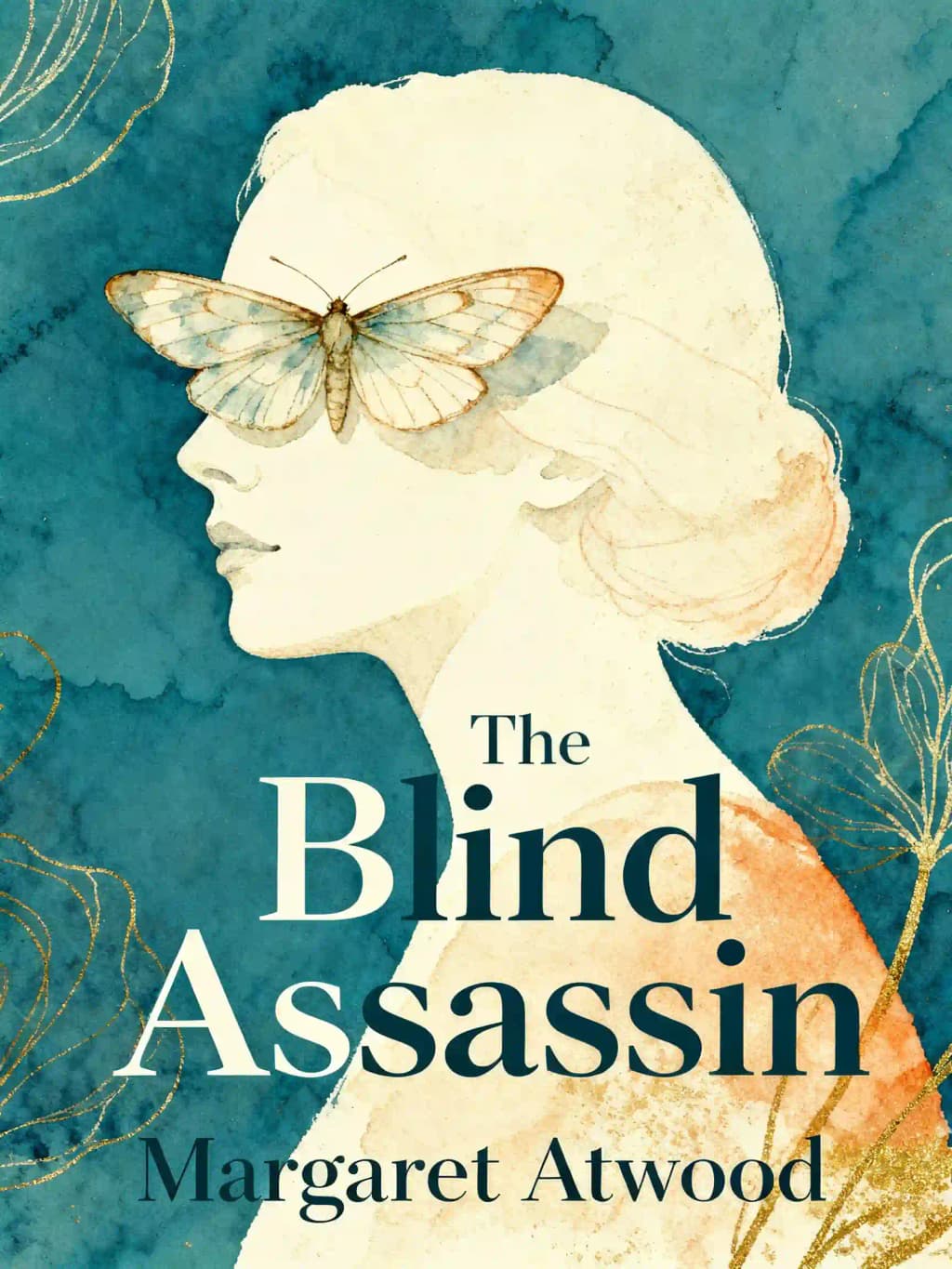
Have you ever found yourself captivated by a novel that refuses to let you go, even long after you've turned the final page? Margaret Atwood's "The Blind Assassin" is precisely that kind of literary masterpiece. Winner of the prestigious Booker Prize in 2000, this intricate narrative has been hailed by critics as Atwood's most accomplished work. The Chicago Tribune called it "a tour de force," while Harper's Bazaar described it as "the kind of story so full of intrigue and desperation that you take it to bed with you." Even Oprah Winfrey selected it for her book club, cementing its status as both a critical darling and a commercial success. What makes this novel so compelling is not just its complex structure-weaving together memoir, newspaper clippings, and a novel-within-a-novel-but its profound exploration of memory, power, and the stories we tell ourselves to survive.
Capítulo 2
The Last Survivor: Iris Chase Griffen's Confession
Iris Chase Griffen is an elderly woman approaching the end of her life in small-town Port Ticonderoga, Ontario. Through her first-person narrative, we learn that ten days after World War II ended, her younger sister Laura drove off a bridge in what appeared to be a deliberate act of suicide. This tragedy haunts Iris throughout her life, becoming the central mystery around which the entire narrative revolves.
As Iris approaches her own death, she decides to finally record the truth about her family's history. Her narrative alternates between her present-day struggles with aging and heart problems and her memories of the past. We learn about the sisters' privileged but emotionally barren childhood at Avilion, their family estate named after King Arthur's final resting place. Their mother died when they were young, leaving them in the care of their distant father Norval Chase, a button factory owner, and their housekeeper Reenie.
The Chase family's fortunes decline dramatically during the Great Depression. When their father's business faces bankruptcy, Iris is essentially sold into marriage at eighteen to Richard Griffen, a wealthy industrialist and her father's competitor. This loveless union is portrayed as a business transaction-her youth and social standing exchanged for financial security for her family. Richard is controlling and emotionally abusive, while his sister Winifred manipulates both Iris and Laura for their own social advancement.
Throughout her confession, Iris reveals her complicity in events that led to Laura's death, her own unhappy marriage, and the publication of Laura's posthumous novel "The Blind Assassin"-a scandalous book that shocked society and ruined Richard's political ambitions. But the greatest revelation comes at the end: Laura wasn't the author of the novel at all. It was Iris who wrote it as a memorial to her secret lover Alex Thomas and their forbidden relationship.
Capítulo 3
The Novel Within: A Clandestine Love Affair
Interspersed throughout Iris's memoir are excerpts from the novel "The Blind Assassin," which tells the story of a wealthy young woman having a passionate affair with a working-class political radical who is on the run from the authorities. These lovers meet in secret locations across Toronto - in dim rented rooms, abandoned warehouses, and forgotten cafes - stealing precious moments together while navigating the dangerous political climate of the 1930s. During their clandestine meetings, he weaves elaborate science fiction stories about a distant planet called Zycron and its mysterious capital city Sakiel-Norn, where blind children are trained as assassins and young virgins are sacrificed to appease ancient gods.
The unnamed lovers in this embedded narrative initially appear to be Laura and Alex Thomas, a charismatic left-wing writer who enters the Chase sisters' lives during a time of social upheaval. Alex becomes a fugitive after being falsely accused of orchestrating the destruction of the Chase button factory during a period of intense labor unrest. The sisters, moved by both political conviction and personal attachment, risk their privileged position by hiding him in their attic, smuggling food and information to him, before ultimately helping him escape through a network of sympathetic workers.
The novel-within-a-novel functions on multiple levels: as a passionate love story, a political allegory, and a commentary on class warfare. The science fiction tale the man tells his lover becomes increasingly complex, centered on a blind assassin who falls in love with a sacrificial virgin he's been assigned to kill. This narrative mirrors the larger themes woven throughout the main novel: power imbalances between classes and genders, the nature of sacrifice and betrayal, and the unexpected ways love can transform even the most hardened hearts. The embedded narrative also reveals the raw emotional intensity between the lovers, creating a stark contrast with the cold, oppressive atmosphere of Iris's marriage to Richard Griffen, a union built on political convenience rather than affection.
What makes this intricate structure particularly masterful is its gradual revelation of truth. The passionate affair we read about isn't between Laura and Alex as we're initially led to believe, but between Iris and Alex - a truth that emerges like a slow-developing photograph. This stunning revelation forces readers to reexamine every interaction, every glance, and every word exchanged between the sisters. The truth transforms our understanding not only of the narrative but of Iris herself, revealing her capacity for both passion and deception. The novel-within-a-novel becomes both confession and testimony, exposing how class expectations and societal pressures can force people to live double lives, hiding their true selves behind carefully constructed facades.
The science fiction elements serve as more than mere entertainment; they provide a safe space for the lovers to discuss forbidden topics - politics, class warfare, and revolution - through the lens of an imaginary world that bears striking parallels to their own. Through these stories, they create a private language of love and resistance, turning their affair into both a personal rebellion and a political act.
Capítulo 4
Sisters Bound by Secrets: Iris and Laura
The relationship between Iris and Laura forms the emotional core of the novel. Eight years older than Laura, Iris promised their dying mother she would look after her sister, a burden she both resents and embraces throughout her life. The sisters are portrayed as fundamentally different yet inextricably linked-Iris practical and conformist, Laura idealistic and unconventional.
Laura is depicted as ethereal and otherworldly, with an unusual moral compass that often confounds those around her. As a child, she attempts to drown herself in the river, believing her sacrifice might bring their mother back to life. She takes words literally, questions everything, and maintains an unshakable faith in God despite her traumatic experiences. Her peculiar beauty and intensity make her both fascinating and troubling to others.
Iris, by contrast, is the dutiful daughter who sacrifices her own happiness for her family's security by marrying Richard. She describes herself as "the responsible one," making practical choices while Laura pursues moral absolutes. Yet beneath Iris's conformity lies a capacity for passion and rebellion that emerges in her affair with Alex.
The sisters' relationship is complicated by their shared love for Alex Thomas. When Laura returns after escaping from BellaVista, the mental institution where Richard had her committed, she reveals that she had sex with Richard as a "sacrifice" to save Alex, believing that Callie Fitzsimmons had informed Richard of Alex's whereabouts. In a moment of cruelty, Iris tells Laura that Alex is dead and that he had been her lover for years. This devastating revelation leads directly to Laura's suicide.
The novel explores how the sisters both love and betray each other, keeping secrets that ultimately destroy them both. Their relationship embodies the novel's central themes of sacrifice, betrayal, and the devastating consequences of silence.
Capítulo 5
Power and Its Abuses: The Social Landscape
Atwood masterfully portrays the social and political landscape of Canada from the 1920s through the post-World War II era. The novel examines various forms of power-economic, social, sexual, and political-and how they shape individual lives.
The Chase family's button factory represents traditional paternalistic capitalism. Norval Chase tries to be a benevolent employer, refusing to lay off workers during the Depression's early years and hiring veterans when other businesses wouldn't. This contrasts sharply with Richard Griffen's ruthless business practices. Richard represents modern corporate capitalism at its most exploitative, viewing workers as disposable and using his economic power to crush labor movements.
The novel also explores gender power dynamics in a society where women have few options. Iris's marriage to Richard is essentially a business transaction arranged by men. Once married, she has no control over her finances, her household, or even her own body. Winifred, Richard's sister, wields power through manipulation and social connections, teaching Iris that "Grace comes from indifference" and that she must never show fear.
Class divisions are starkly portrayed throughout the novel. The contrast between the wealthy Griffens in their Rosedale mansion and the struggling workers in Port Ticonderoga highlights the economic inequalities of the time. During labor unrest at the button factory, workers burn effigies of the Chase family, while Richard brings in men who appear to be detectives for protection.
The political backdrop includes the Great Depression, the Spanish Civil War, and World War II. Richard supports Franco's Nationalists and Chamberlain's appeasement policy toward Hitler, seeing both as bulwarks against Communism. Alex, on the other hand, fights for the Republicans in Spain and represents left-wing resistance to fascism. Through these characters, Atwood examines how personal relationships are shaped by larger political forces.
Capítulo 6
Memory and Storytelling: The Power of Narrative
"The Blind Assassin" is fundamentally about storytelling-who gets to tell stories, how stories shape our understanding of the past, and how narrative can be both redemptive and destructive. Iris's memoir is her attempt to reclaim her own narrative after decades of silence and to pass the truth to her estranged granddaughter Sabrina.
The novel explores how memory works-selective, unreliable, yet essential to identity. Iris acknowledges the limitations of her account: "The only way you can write the truth is to assume that what you set down will never be read... not even by yourself at some later date." She describes writing as "a long scroll of ink" spinning from her finger, while her other hand erases it.
The embedded novel "The Blind Assassin" represents another kind of storytelling-fiction as a way to express truths that cannot be spoken directly. Through this novel-within-a-novel, Iris can articulate her passion for Alex and her critique of the society that constrained her choices. Similarly, the science fiction tales Alex tells his lover about Sakiel-Norn allow him to indirectly comment on real-world power structures and exploitation.
Newspaper clippings and society columns provide yet another narrative perspective, showing how public stories often distort or conceal private truths. The contrast between these official accounts and Iris's memoir highlights the gap between public perception and lived experience.
By the novel's end, storytelling becomes Iris's final act of love and rebellion. Her memoir is intended for her granddaughter Sabrina, who has been raised by Winifred to believe lies about her family. Iris hopes that by telling the truth, she can free Sabrina from the weight of family secrets: "By the time you read this last page, that's the only place I'll be. Of course, you may decide to destroy these pages unread. But I hope not. I hope you'll see this through."
Capítulo 7
Blindness and Sight: Metaphors of Perception
Throughout "The Blind Assassin," Atwood employs imagery of blindness and sight as metaphors for understanding and willful ignorance. The title itself refers to a character in Alex's science fiction story-a blind child trained as an assassin who falls in love with the sacrificial victim he's meant to kill. This character represents how love can transform perception, allowing us to "see" in new ways despite physical or metaphorical blindness. The assassin's heightened other senses - touch, hearing, smell - suggest that true understanding often comes through channels beyond mere visual perception.
Iris's narrative journey is one from blindness to sight-from a young woman who doesn't understand the political and personal forces shaping her life to an elderly woman who sees with painful clarity. She reflects on her younger self: "I was so ignorant, so unknowing, so blind." Her memoir represents her attempt to finally see and acknowledge the truth. This transformation is gradual, marked by moments of revelation: her growing awareness of Richard's manipulation, her understanding of Laura's perspective, and finally, her recognition of her own complicity in events.
Laura's perception is different-she sees things others miss but struggles to articulate them in ways others understand. Her hand-tinted photographs of the wedding party reveal her unique vision: Richard painted with flames shooting from his head, Iris bleached to a foggy blur, herself glowing yellow "like phosphorus." These altered images express truths she couldn't put into words. Laura's artistic alterations become a form of prophecy, predicting the fiery destruction of relationships and the eventual fading of identities. Her seemingly eccentric behavior often masks an uncanny ability to perceive underlying truths that others refuse to acknowledge.
The novel explores multiple forms of willful blindness-characters choosing not to see uncomfortable truths. Iris blinds herself to Richard's true nature and to Laura's suffering, creating elaborate justifications for her inaction. Society turns a blind eye to exploitation and abuse, particularly in the button factory workers' conditions and the treatment of young women. Even readers are initially "blind" to the true identity of the lovers in the embedded narrative, mirroring the characters' own journey from ignorance to understanding.
The epigraph describing children blinded to make carpets in Kerman establishes this theme from the outset, serving as both literal example and powerful metaphor. These children, like the blind assassin in Alex's story, develop other ways of perceiving once their sight is gone. Their fingers become their eyes, learning to feel the patterns they can no longer see. Similarly, characters in the novel must find alternative ways to "see" when conventional perception fails them. This adaptation suggests that truth can be accessed through multiple channels - memory, touch, intuition, and art - not just through what is visibly apparent.
The metaphor extends to the novel's structure itself, with its multiple narratives requiring readers to piece together truth from fragments, much like a blind person assembling understanding through touch. The newspaper clippings, society announcements, and personal recollections create a complex tapestry that must be felt rather than merely seen to be understood fully.
Capítulo 8
Sacrifice and Survival: The Cost of Living
The concept of sacrifice permeates "The Blind Assassin," from personal sacrifices characters make for love or family to ritualized sacrifices in Alex's science fiction tales. The novel meticulously examines what individuals surrender for survival and whether these sacrifices ultimately justify their devastating personal costs. This theme manifests in both literal sacrifices and metaphorical ones, weaving through every layer of the narrative.
Iris's marriage to Richard represents perhaps the most central sacrifice in the novel. She surrenders not only her freedom and happiness but her very identity, transforming from a young woman with dreams and potential into a carefully controlled society wife. Her sacrifice extends beyond personal comfort - she gives up her relationship with her sister, her autonomy, and ultimately, her voice. The marriage, intended to secure her family's financial future, becomes a Faustian bargain that haunts her entire life.
Laura's sacrifice takes on an even more tragic dimension. Believing she can save Alex through a devil's bargain with Richard, she offers her body as currency in a transaction that proves both futile and devastating. Her sacrifice is based on a misunderstanding, yet its consequences are irreversible. The parallel with the sacrificial virgins in Alex's tales of Sakiel-Norn becomes particularly poignant - both involve young women whose bodies become commodities in transactions they don't fully understand.
The novel particularly emphasizes how sacrifice becomes gendered, with women bearing the heaviest burdens. Iris's mother literally sacrifices her life caring for wounded soldiers, her health deteriorating as she fulfills her perceived duty. Reenie, despite her intelligence and capability, sacrifices any chance of personal advancement to remain loyal to the Chase family, becoming a living testament to the way class structures perpetuate patterns of sacrifice. Even Winifred, though privileged, sacrifices authentic human connection in her relentless pursuit of social status and control.
The futility of these sacrifices forms a central question in the novel. Each sacrifice seems to set off a chain of unintended consequences that negate its intended purpose. Iris's marriage fails to save the button factory or protect her sister. Laura's submission to Richard doesn't ensure Alex's safety. The ritualized sacrifices in Alex's science fiction stories don't bring the promised prosperity to Sakiel-Norn, just as the characters' personal sacrifices fail to achieve their hoped-for outcomes.
Survival itself becomes a complex form of sacrifice in the narrative. Iris survives by burying truths, by accepting compromise, by living with the weight of guilt and complicity. Her observation that "Some people can't tell where it hurts. They can't calm down. They can't ever stop howling" speaks to the cost of this survival - the necessity of suppressing one's true feelings and accepting imperfect solutions to impossible situations.
In her final years, Iris grapples with whether her survival was worth its price. Her memoir, written for her granddaughter Sabrina, represents both a final sacrifice - the sacrifice of comfortable lies for uncomfortable truths - and an attempt to redeem her survival by ensuring the truth survives with her. This act of writing becomes both confession and legacy, a final effort to give meaning to a life shaped by sacrifice.
Capítulo 9
Love and Betrayal: The Heart's Complexities
"The Blind Assassin" portrays love in all its contradictory forms-passionate but doomed, dutiful but empty, possessive and destructive. No relationship in the novel is simple or purely positive; all are complicated by power imbalances, misunderstandings, and betrayals.
The central love story between Iris and Alex is passionate but ultimately tragic. Their affair represents a brief escape from social constraints, but it cannot survive the political realities that separate them. Alex goes to fight in Spain and dies there, while Iris remains trapped in her marriage. Their love is preserved only in the novel Iris writes after his death.
Laura's love for Alex is portrayed as idealistic and sacrificial. She believes she loves him purely, without the physical desire that characterizes Iris's feelings. When she learns that Alex and Iris were lovers, her worldview collapses, leading to her suicide.
The novel also explores familial love-between the sisters, between father and daughters, between mothers and children. These relationships are marked by both deep attachment and profound betrayal. Iris loves Laura but fails to protect her from Richard. Laura loves Iris but feels betrayed by her relationship with Alex.
Betrayal shadows every significant relationship in the novel. Richard betrays Iris by intercepting telegrams about her father's death and by sexually abusing Laura. Iris betrays Laura by marrying Richard and by her affair with Alex. Laura betrays Iris by running away with her car after their confrontation. Even Alex, in some sense, betrays both sisters by loving one while being idealized by the other.
The novel suggests that love and betrayal are often inseparable-that to love is to risk betrayal, and that we often betray those we love most deeply. As Iris reflects: "The only way you can write the truth is to assume that what you set down will never be read. Not even by yourself."
Capítulo 10
The Legacy of Silence: Breaking the Cycle
In her final years, Iris confronts the devastating consequences of silence and secrecy. Her memoir represents her attempt to break the cycle of silence that has destroyed three generations of women in her family-herself, her daughter Aimee, and potentially her granddaughter Sabrina.
Throughout her life, Iris remained silent about crucial truths: Richard's abuse of Laura, her own affair with Alex, the true authorship of "The Blind Assassin." This silence allowed Richard and Winifred to control the narrative of their lives and to continue their manipulation of the next generation.
Aimee, Iris's daughter, grows up damaged by these family secrets. She becomes an alcoholic who neglects her own daughter Sabrina. Before her death from a fall (which might have been suicide), Aimee confronts Iris with her suspicion that Laura was her real mother and Alex her father. Though incorrect, this theory reveals how destructive family secrets can be across generations.
Sabrina, raised by Winifred after Aimee's death, represents Iris's last hope for breaking this cycle. Iris writes her memoir specifically for Sabrina, hoping that the truth, however painful, will free her granddaughter from the weight of family mythology. She imagines Sabrina appearing at her door: "You'll knock and I'll shuffle to the door, my heart will flutter in my chest like a blind bird. I'll know you. At last. I'll take you in."
The novel ends with uncertainty about whether Sabrina will ever read Iris's account or whether the cycle of silence will finally be broken. This ambiguity reflects the novel's larger themes about the difficulty of truly communicating across the barriers of time, social convention, and personal fear.
Through Iris's determined effort to tell her story before death claims her, Atwood suggests that breaking silence-however belatedly-offers the possibility of redemption, not for the teller but for those who come after. As Iris writes in her final pages: "I leave myself in your hands. What choice do I have? By the time you read this last page, that's the only place I'll be."