Capítulo 1
When Death Teaches Us How to Live
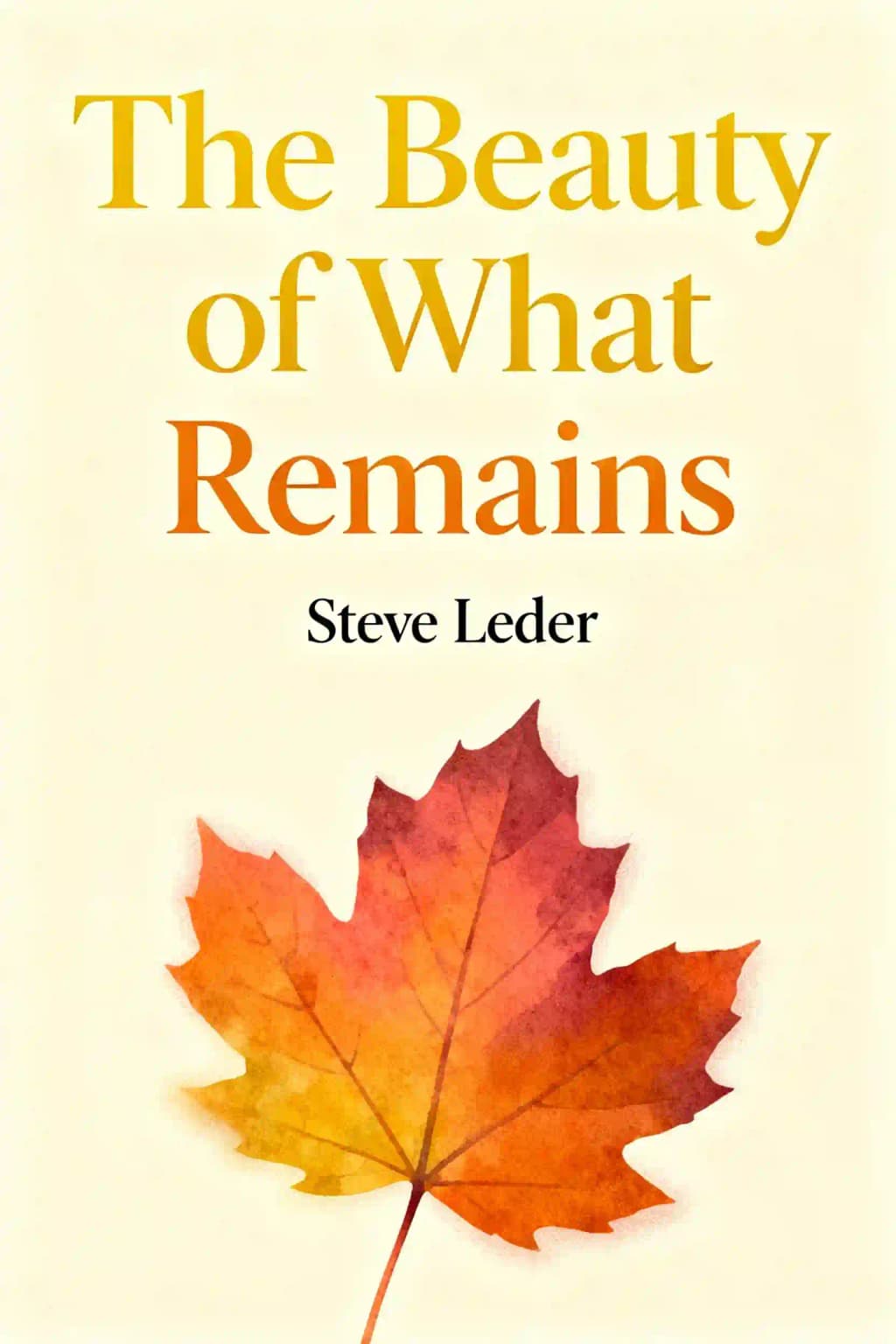
The moment Rabbi Steve Leder handed a balloon to his father in a nursing home, something profound shifted. His once-strong father-a man who had never played catch with him as a child-sat waiting with arms raised, hoping to catch that simple balloon. In this heartbreaking yet illuminating instant, Leder began his transformation from rabbi to son, from professional grief counselor to someone experiencing grief firsthand. "The Beauty of What Remains" emerged from this journey, becoming a New York Times bestseller that resonated with readers across faiths and backgrounds. Oprah Winfrey called it "a spiritual companion during hard times," while thousands have found solace in Leder's wisdom drawn from thirty years of guiding over a thousand families through grief. What makes this book extraordinary isn't just Leder's professional expertise, but how his father's death forced him to apply his own teachings to his personal loss-revealing that understanding death can help us lead more meaningful lives.
Capítulo 2
The Perfect Peace of Letting Go
That first afternoon in the nursing home, my dad played a game with me-his arms aloft, welcoming something offered by his son, with regret and love. I finished the service, walked into the hallway, and wept. I had begun the journey from rabbi to son-from all that death takes away to the beauty of what remains.
After visiting nearly a thousand dying people over three decades, I've made a surprising discovery: not one has expressed fear of death. Most summon me because they want to speak openly about their impending passing. When Lionel, at ninety-two, called to share his decision to stop dialysis three years after his beloved wife Terry died, he wasn't afraid. "I feel happy about it. I feel relieved," he said with genuine peace.
For the dying, death makes perfect sense-like breathing underwater makes sense to fish. Most people are ready for death the way we're ready for sleep after an exhausting day. Disease, age, and life itself prepare us. If you're afraid of dying, it's not your day yet. That anxiety belongs to the living, not the dying.
Although the dying usually have no worries for themselves, they worry deeply about those they'll leave behind. Julie faced her colon cancer with remarkable grace, even hosting "Champagne and Shitting" parties with friends. After three years of treatments, she chose peace over more pain. "I'm not afraid to die," she told me, her frail body thin but her blue eyes still beautiful. Julie had no unfinished business-her family knew how completely she loved them.
In retrospect, Alzheimer's didn't distance me from my dad. I grew closer, learning the value of holding his hand in perfect silence until he fell asleep. Disease, age, and decline have their own rhythm that, without our knowing it, prepares us for death-the perfect peace.
Capítulo 3
Being Present When It Matters Most
For families of the dying, I've learned crucial ways of being during those final days. Once basic end-of-life decisions are made, stop planning and treat your loved one like the fully alive, beautiful person they still are. Assume they hear everything. Stay present rather than catastrophizing the future. When you find yourself imagining worst-case scenarios, pull yourself back to the moment. Ask what you can do in the next hour that will be meaningful, comforting, or loving. Keep yourself on a short time leash-the present is where you're needed.
Take your dying loved one on mental vacations through memory. Ask about their first kiss, greatest vacation, or funniest experience. These conversations lift people above their current sorrow into transcendent meaning. Even with my father's Alzheimer's, I'd remind him of meals we'd enjoyed-pancakes at Town Talk, mostaccioli at Cafe di Napoli. I think about watching Blazing Saddles with him, how he laughed with tears streaming down his face. Despite illness showing us the missing piece, we must remember the whole beautiful circle of who our loved ones were.
Death is serious, but laughter affirms life and signals healing. When I see mourners laughing about something funny their loved one did, I know they'll survive their grief. With dying people, I often share humorous memories or jokes. Laughter offers a brief escape for the dying and reminds the living that life continues. I keep a repertoire of jokes ready, like the one about three elderly women by the pool identifying a naked sleeping man, or two bored women in church whispering about their "sleeping behinds." Laughter is truly a gift for both the dying and those who remain.
The dying fear not for themselves but for whether their loved ones will be okay. Even if you must pretend, assure them: "You did a great job. We'll be fine. We'll take care of each other." Tell them they succeeded and can rest peacefully. These conversations aren't therapy for the living but gifts for the dying. I've witnessed countless times how, after families gather to give their blessing and permission to let go, death arrives peacefully within hours-like a soft breeze, barely there, then gone.
My father's inability to speak taught me about the importance of touch. When nothing else pierced his dying brain, a scalp massage or shoulder rub made his face light up. Holding his hand in silence created a connection more intimate than we'd ever had. Touch is a wordless language of love, especially crucial during times of isolation like the 2020 pandemic. After decades of visiting the dying, I've learned you don't need prepared speeches-just show up with an open heart.
Capítulo 4
We Die As We Have Lived
Death doesn't change who we are-it simply magnifies our essential nature. I keep a red ceramic bowl on my office coffee table to collect tear-soaked tissues and to illustrate a painful truth: people don't fundamentally change, even when facing death. Many harbor the fantasy that impending death will heal dysfunctional relationships, but experience has taught me otherwise.
My father and his brother Mort exemplified this reality-business partners whose relationship deteriorated into a decades-long competition that ended with the tragic sign "Leder v. Leder" on an arbitration room door. Their rivalry continued until death, with each waiting for the other to die first. When young people come to me hoping a terminal diagnosis will transform a difficult parent, I must gently explain that dying doesn't give someone a new personality. Making peace with death means accepting what cannot be changed.
When my friend Paul, dying from his third cancer, worried about not starting a journal for his children despite his promise to himself, I asked if he'd ever journaled before. He hadn't-he'd always preferred experiencing life over writing about it. I advised him to enjoy his remaining time with his family rather than trying to become someone different at life's end.
Similarly, when Ali complained about her father Ben continuing to take her stroke-debilitated mother everywhere despite her declining health, I reminded her that her parents had always been inseparable companions. Their deep connection wouldn't suddenly change just because death approached. People generally die as they have lived-the tough remain tough, the funny find humor even in death, and the loving remain loving. This simple insight changes death from something foreign to something familiar.
Most of us can plan for our deaths since we'll likely die from long illness or old age. To die according to your values, appoint uncompromising advocates who can speak for you when you can't. Though 80% of Americans say they want to die at home, most don't-saying isn't planning. Create a medical directive, appoint advocates who can make difficult decisions, and empower them to manage your caregivers.
People around the world create deaths that reflect their lives-from New Orleans jazz funerals to Irish wakes to Ghana's fantasy coffins shaped like objects representing the deceased's vocation. Some choose unconventional approaches like artist Jae Rhim Lee's "Infinity Burial Project" using mushrooms to decompose and detoxify bodies. The green burial movement is growing, with more people choosing biodegradable willow caskets or linen shrouds over traditional embalming and concrete vaults.
Capítulo 5
When Prolonging Life Becomes Prolonging Death
I was driving home through terrible traffic from a clergy retreat when Dave called. His wife Tara, once a kick-ass attorney reduced by years of ALS, wanted to see me right away. She wanted my permission to kill herself. Tara had already researched California's End of Life Option Act, which permits terminally ill adult patients with decision-making capacity to be prescribed aid-in-dying medication under certain conditions.
The End of Life Option Act allows terminally ill Californians to request aid-in-dying medication if they meet strict requirements: being an adult California resident with an incurable disease expected to cause death within six months, capable of making medical decisions, voluntarily requesting the medication without outside influence, and able to self-administer it. The process involves multiple steps including two oral requests 15 days apart, a written request with witnesses, consultations with physicians to confirm eligibility, and discussions about alternatives like hospice care.
When I arrived at Tara's home, I saw the markers of her decline-the wheelchair ramp, pill bottles, adult diapers, and her existence shrunk to the confines of a hospital bed. She could no longer speak or even point to an alphabet chart. Dave explained she wanted my permission to take the pills.
Mark described the agonizing process of administering end-of-life medication to his suffering father Ted. After completing all the paperwork and medical requirements, he mixed the medications and returned to his father's room. "Daddy, once we start here, we have to move quickly," he explained before Ted quickly consumed the final vial. Within minutes, Ted was gone.
For me, sitting beside the suffering Tara, I faced the impossible choice between being Rabbi Leder or Steve Leder-between religious teaching and human compassion. Jewish tradition forbids active euthanasia, yet watching her struggle for breath like "a fish on land," I made my decision: "Tara, you should take the pills." In that moment, "I violated my faith and confirmed my humanity."
Capítulo 6
Crafting Meaningful Farewells
When preparing a eulogy, I gather families to create what I call "a big stew of stories"-happy, sad, funny, embarrassing, sweet and bitter. I start with simple questions about birth, parents, and childhood to help them begin remembering their loved one beyond their loss.
I then move toward more intimate memories: "Do you remember the first second you laid eyes on each other?" I ask spouses, transporting them back to when they first fell in love. Children often react with surprise and laughter, discovering their parents' early passion.
For adult children, I ask about their earliest memories with the deceased: "What was it like to be with him? What did you do together? Who was the disciplinarian?" I explore what made their loved one happy, asking how they would have spent a responsibility-free day twenty years ago, before illness took its toll.
Finally, I address imperfections: "What wasn't so perfect about him?" This allows families to express a whole truth about a whole person, acknowledging flaws alongside virtues. This truth-telling, done artfully, validates the family's complex feelings rather than presenting a sanitized, theatrical version of the deceased.
Truth-telling at funerals is essential-with sensitivity and compassion, but truth nonetheless. When families trust me with their loved one's complete story, including flaws, it lifts the weight of secrets and becomes a blessing.
Sometimes families hide painful truths. Once, I arrived at a funeral only to learn from the mortuary director that the deceased had died during autoerotic asphyxiation while cross-dressing-information his sons had concealed, telling me only about a heart attack. I could have helped them process this truth in a way that might have unburdened them while maintaining dignity in the eulogy.
The eulogy I felt most privileged to write was for my own father. During his ten-year battle with Alzheimer's, I watched him diminish with each visit, which revealed not just what I would lose but also the beautiful essence of who he truly was beneath life's details.
Despite how draining this work can be-sometimes making me tell my wife, "I hate my job. Who willingly walks into rooms so full of other people's pain?"-guiding families through their stories has taught me profound lessons about life, not death. I've learned that loved ones remember and miss the seemingly little things most-the things that made them laugh, a simple hug that showed they weren't alone. Life and love are essentially about time-time spent consciously, deliberately, mundanely, lovingly together when you could otherwise have been apart.
Capítulo 7
Embracing Death's Physical Reality
Death forces us to let go of the physical. While Buddhists spend lifetimes embracing impermanence, for most of us, it remains numbing, painful, and strange to be in the presence of a dead body and return it to the earth. Having seen over a thousand dead bodies, I'm convinced the body is not the person-there is more to us than our corporeal being. The impermanence of the body has convinced me of the soul's eternality.
When my father died, I finally understood how all the thousands I've helped at funerals felt-surreal, empty, helpless. Sitting in the front row at his funeral, I could only weep. He didn't look like himself in the casket, yet perhaps he did. We sanitize death with embalming and cosmetics, a practice dating back to the Civil War, but this makes embracing death's reality harder, not easier. Looking at my father, I saw my own mortality with perfect clarity-I would someday look just like him when dead. This realization propelled me to take my remaining time more seriously and pursue lifelong dreams.
Funerals help us say goodbye and celebrate the soul's passing. The Hebrew word for funeral is l'vayah-"to accompany" the deceased from one realm to another. I always begin services with the Twenty-Third Psalm, powerful because it reminds us we can walk through grief's valley rather than remain there forever, and because shadows prove light still exists.
Children old enough to remember should attend funerals of loved ones. They don't naturally fear funerals-they learn that from adults. Unprompted, they'll approach graves with curiosity, not fear. Parents should prepare children by explaining they might hear crying, which is normal. Never say the deceased is "sick" or "sleeping," as this creates unnecessary fears. Instead, explain that something happened to their body doctors couldn't fix.
Every culture has rituals for gathering after burial or cremation. The Jewish tradition of shiva-seven days of mourning at home while being cared for by community-creates what psychologists call a "holding environment" where it's safe to grieve. Visitors shouldn't approach mourners directly but wait to be summoned, then speak about the deceased rather than making distracting small talk. When my father died, being surrounded by people who shared memories consistent with the loyal, generous, tough, hilarious man I knew pierced my isolation.
With tragic deaths like suicide or accidents, avoid harmful platitudes. Don't call suicide selfish or accidents foolish. Don't say "I can't imagine how you feel"-especially to parents, who have all imagined losing a child. Instead try: "This is every parent's worst fear, and I'm so sorry it has become reality for you." Don't arrive with exaggeratedly sorrowful faces-be yourself as you were in their life before.
Capítulo 8
Navigating the Unpredictable Waters of Grief
Grief follows no straight line. Even after burying my father following his twelve-year battle with Alzheimer's, I was unprepared for grief's unpredictable nature. The disease had already begun my grieving process as I watched my father deteriorate-making phone calls with TV remotes, having car accidents, struggling with bills, experiencing confusion and anger. Despite Mom's best efforts to care for him at home, a bathroom fall led to hospitalization and then nursing home care.
Grief ambushes you when you least expect it-not in the initial shock when you're prepared for pain, but months later in ordinary moments. At dinner with friends, wiping my plate clean with bread just like my father would have done, I suddenly fought back tears. "I really miss my dad," I told my wife, wanting to leave but pushing the feelings down instead.
Death takes half our memories-those shared only with the person now gone. The trips taken together, the babies' first steps, that old white Ford from our youth. If the love was deep, the grief is equally profound. After thirty days, I removed my torn black ribbon, and no one could tell I was in mourning. Sometimes I wish they could-like a neon sign above my head saying "Be gentle with me. I'm missing my dead father right now." We who mourn walk in fog, wearing masks of normalcy while our minds are elsewhere.
I don't know how people navigate grief without ritual-some vessel to contain sadness enough to function. For me, it was Kaddish, but it could be lighting a candle, gazing at a photo, reciting a psalm, or holding something that belonged to your loved one. The Victorians even wove their deceased's hair into jewelry. Find anything that gives permission to remember, to grieve, and then to say: now I can go on, at least for today.
Reaching out helps heal grief's isolation. While on sabbatical in Palm Springs, writing this book in my sister's empty house, I walked the same golf course where I'd walked with Dad countless times, asking aloud, "Where are you, Dad?" Spotting a sign with lyrics to "You Are My Sunshine," I texted my siblings. Each responded in their own way-Sherry with a sketch of Dad, Greg with lyrics to Dad's favorite Hank Williams song, making Marilyn cry. Somehow, knowing they miss him too helps me. I'm not alone in loving him, remembering him, feeling grateful to him.
Time helps, but not as we think. The truth isn't that grief won't always hurt so much-it will. But it won't always hurt so often. That's the honest promise I can make after my father's death. You want to remember all the time, and you want to forget. Memory in grief is exquisite, and it hurts.
Capítulo 9
What Truly Matters in the End
After her mother died, my friend Debra shared what she'd learned: "Nobody wants your crap!" Though we know we can't take possessions with us, we spend our lives working endlessly to acquire things that ultimately amount to nothing. When American tourists visited the famous Rabbi Israel Kagan in his simple study with just a rickety desk and few books, they asked where all his stuff was. He smiled and asked where theirs was. When they explained they were just passing through, he nodded and said, "Me too."
What truly matters becomes clear when reading headstones in cemeteries. These stone markers, limited to just a few lines, almost always highlight the same simple things: loving husband, father, grandfather, friend; loving wife, mother, grandmother, sister. Never once have I seen someone's net worth, GPA, resume, or Instagram likes on a headstone.
When houses catch fire, people instinctively grab "people, pets, and pictures" before fleeing. Photos win the bronze because they represent priceless moments with loved ones-my dad's sparkling blue eyes in a cowboy hat eating grapefruit, my mom hovering over an enormous soup pot, my children's vacation faces, my wife on our honeymoon. These moments are more precious than jewels.
Workaholism has become our last acceptable addiction, and it's killing us-with emails nagging at all hours, phones constantly demanding attention, and stress-induced illnesses mounting. The first use of "holy" in the Bible isn't for an object but for time-the seventh day. Working six days is enough; even God needed to rest. The Sabbath is defined not by what one does but by what one refrains from doing-no phones, emails, spending money, or "kindling fires" between people. It's a day devoted to being better, not better off.
The COVID-19 pandemic forced a global pause that paradoxically set many free-to study, meditate, walk, call friends, bake, and spend sacred time with loved ones. It stripped away nonsense and awakened us to what truly matters. During lockdown, I made promises to myself: drive less, work from home more, decline unnecessary social obligations, buy less, save more, express love more freely, and remain grateful for small pleasures.
A ham radio operator shares a story about an older man who calculated he had about 1,000 Saturdays left in his life, so he bought 1,000 marbles and removed one each week. Watching the marbles diminish helped him focus on what truly matters. "There is nothing like watching your time here on earth run out to help get your priorities straight," he explained before signing off, having just used his very last marble.
Capítulo 10
The Eternal Presence of Those We've Lost
Memory is the quintessential act of being human-not instinctual like animals, but willful and meaningful, summoning the past into the present and bringing the dead back to life. During a memorial service, I guided two thousand congregants through a visualization to remember their loved ones, resulting in a room awash in tears as people reconnected with those they'd lost.
An elderly woman named Sophia once asked me to preside over her funeral and to display her 1840 Giuseppe Sgarbi violin in a glass case after she and her son died. Years later, when they both passed away, I learned that violins "die" if not played-they need regular use to maintain their tone and structure. Rather than just displaying Sophia's violin as promised, we now play it at special moments throughout the year, especially during memorial services. This honors the deeper truth that we must actively remember our loved ones, or they too will suffer a second, more permanent death beyond the physical one.
We should live our lives as good ancestors. I illustrate this concept using two props: beer brewed with ancient glacier water ("The earth is doomed. Let's drink.") and environmentally-friendly soap from Seventh Generation, named after the Iroquois principle of considering decisions' impact seven generations ahead. What separates humans from other species is our ability to live on two levels-present and future. The happiest people know they're living lives with meaning beyond themselves.
The dead speak to us through everyday objects, like Caitlin's mother speaking through her worn Pyrex measuring cup, revealing years of pancakes and cookies made with love. They not only speak to us but see through us-"They sit in the pupils of your eyes," as poet Rabindranath Tagore wrote. In one remarkable case, LoAnn Meza literally sees through her murdered husband Richard's cornea, transplanted after his death. This physical reality mirrors our spiritual challenge: to keep our loved ones alive by letting them see and experience life through us.
Memory is our most complex inheritance-both blessing and curse. In Jewish tradition, villains are cursed with "May his name be blotted out," while the honorable receive "May his memory be a blessing." Yet both phrases acknowledge the same truth: to be remembered is to live beyond death.
In my father's eulogy, I captured his essence through small moments: his frugality (reusing paper plates and dental floss), his Yiddish wisdom ("A bissel aun a bissle vert a full schissel"-a little and a little fills the container), his crude humor and perfect Yiddish descriptors for people, his surprising compassion for the downtrodden, his fierce loyalty to friends and family, and his ability to find pleasure in simple things. Despite his harshness, he taught me persistence ("Az m'schtuptis, gatis"-If you push, it goes), to beware of phonies, and to enjoy each moment. His dementia, ironically, sharpened my memory of who he truly was-the roller rink Sundays, his love of butter brickle ice cream, and the sweetness at his core. Our hearts remain full with "the beauty of what remains."