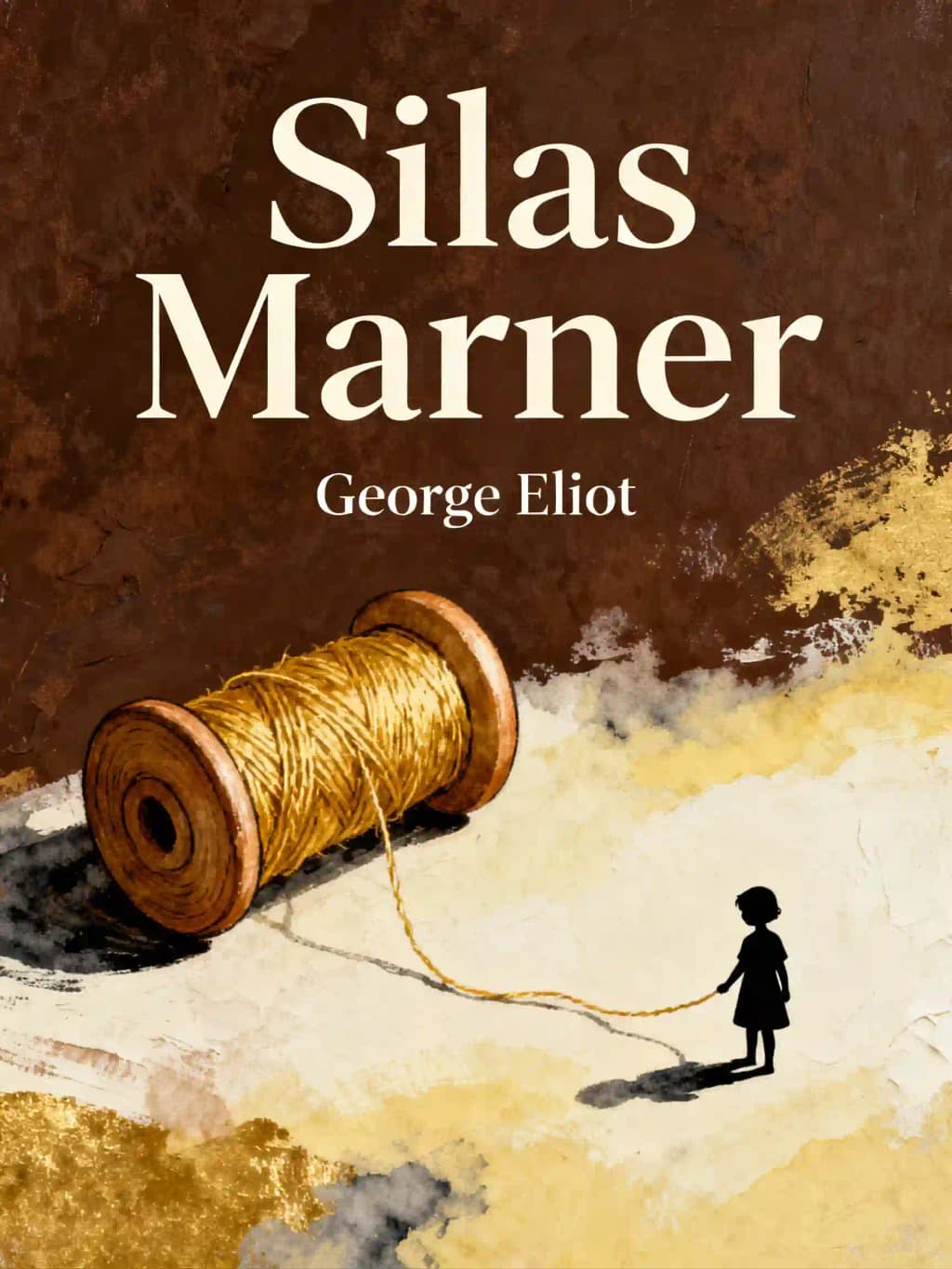
Capítulo 1
The Weaver's Golden Thread: A Tale of Loss, Redemption, and Unexpected Joy
George Eliot's "Silas Marner" has captivated readers for over 160 years with its profound exploration of isolation, community, and the redemptive power of love. This Victorian masterpiece remains a staple in literary education and has been adapted numerous times for stage and screen. The novel's enduring appeal lies in its timeless message about how human connections can heal even the most wounded souls. J.K. Rowling has cited it as an influence on her Harry Potter series, particularly in themes of an orphaned child transforming a reclusive adult's life. Beyond its literary significance, the novel offers a window into rural English life during the early 19th century, making it a cultural touchstone that continues to resonate with modern readers seeking authentic portrayals of human transformation.
Capítulo 2
A Weaver Unraveled: Silas's Tragic Past and Isolated Present
In the early 19th century English countryside, Silas Marner lives as an outsider in the village of Raveloe. His protruding eyes and cataleptic fits make him an object of fear and superstition among the villagers, who believe he possesses mysterious powers. Though they value his weaving skills, they keep their distance, reinforcing his isolation. This wasn't always Silas's fate. Fifteen years earlier, he belonged to a tight-knit religious community in Lantern Yard, where he was respected and engaged to marry Sarah, a servant woman.
Silas's world collapsed when his closest friend, William Dane, betrayed him. After Silas experienced one of his cataleptic fits during a prayer meeting, William suggested it might be Satan's work rather than divine favor. Later, when the senior deacon fell ill and died during William's watch, Silas was framed for stealing church money. Despite his protests of innocence, the congregation drew lots that declared him guilty. Devastated by this injustice and William's treachery (who soon married Sarah), Silas declared there was no just God and left Lantern Yard with his faith shattered.
In Raveloe, Silas's reputation as a healer brought unwanted attention. After reluctantly helping Sally Oates with an herbal remedy, he was besieged by villagers seeking cures. His refusals only deepened their suspicion of him. Over fifteen years, Silas's life narrowed to the mechanical functions of weaving and hoarding money. His body bent to his work, his eyes adapted to see only tiny things, and though not yet forty, village children called him "Old Master Marner." His beloved brown water pot breaking after twelve years of use caused him deep grief, revealing how objects had replaced people in his affections.
The gold coins Silas accumulated became his sole comfort. Each night he would remove them from their hiding place beneath his loom, counting and arranging them in piles, fondling them "like unborn children." This ritual provided structure in his bewildering world, marking periods of his weaving like a prisoner scratching days on a wall. His life had shrunk "like a rivulet cutting through barren sand," devoid of human connection or spiritual meaning.
Capítulo 3
The Squire's Sons: Entangled Lives and Moral Choices
While Silas lives in isolation, the village's social hierarchy centers around Squire Cass, Raveloe's greatest man, who occupies the large red house opposite the church. Without a wife's civilizing influence, the Squire's household lacks refinement, explaining both the unrefined abundance of holiday provisions and his frequent presence at the Rainbow tavern. This absence of maternal guidance has contributed to his sons' poor character development.
The Squire's eldest son Godfrey, once expected to marry Nancy Lammeter and bring proper management to the Red House, has noticeably changed. His fresh-colored, open countenance has dimmed, and his frequent unexplained absences have made Nancy wary. The source of Godfrey's troubles is his secret marriage to Molly Farren, an opium addict he now despises, and his younger brother Dunstan's knowledge of this secret, which he uses for blackmail.
When Godfrey needs to recover rent money he's given Dunsey to avoid their father's wrath, Dunsey suggests selling Wildfire, Godfrey's prized horse. Despite his distrust, Godfrey reluctantly agrees, desperate to pacify both his father and his secret wife. This decision sets in motion a chain of events that will intertwine with Silas's life in unexpected ways.
Dunstan's character reveals itself fully when he takes Godfrey's horse. Rather than proceeding directly to sell Wildfire as promised, he joins a hunt where his reckless riding results in the horse's death. Walking home through the misty evening, Dunstan passes Silas Marner's cottage and notices light gleaming from within. Finding the door unlocked and the cottage empty, he discovers Silas's hidden treasure-two heavy leather bags filled with guineas-and flees into the rainy darkness.
The contrast between the brothers is striking: Godfrey, essentially domestic in nature, longs for the order and affection of Nancy's household yet lacks the moral courage to face the consequences of his actions. Dunstan, cunning and remorseless, thinks nothing of stealing from a poor weaver. Both represent different forms of moral failure that will have lasting consequences.
Capítulo 4
The Theft and Its Aftermath: A Community Revealed
Returning from a routine errand to find his precious gold missing, Silas Marner experiences a devastation that shakes him to his very core. After frantically searching every corner of his cottage multiple times, overturning furniture and checking familiar hiding spots with trembling hands, he lets out "a wild, ringing scream of desolation" that echoes through the empty house. He then totters back to his loom-the only remaining certainty in his suddenly shattered world-clutching its familiar wooden frame as if it were a lifeline to sanity.
When the initial paralyzing shock subsides, Silas stumbles through the winter night to the Rainbow tavern, where the village authorities typically gather. His desperate journey through the darkness mirrors his internal state of disorientation and loss, each step taking him deeper into a community he has long held at arm's length.
Silas's dramatic entrance at the Rainbow interrupts an animated debate about ghosts and supernatural occurrences, led by the landlord and featuring heated contributions from various villagers. The men initially mistake him for an apparition, their pipes moving "like the antennae of startled insects," while some even draw back from the fire's light in fear. The landlord, Mr. Snell, is the first to recognize Silas's genuine distress, marking a turning point as the community's attention shifts from supernatural speculation to real-world crisis.
The village's response reveals the intricate social hierarchy and complex interpersonal dynamics of Raveloe. Mr. Dowlas, the farrier, seizes the opportunity to assert his self-proclaimed authority as parish constable. The wealthier residents, like Mr. Crackenthorp, offer measured suggestions tinged with condescension, while others like Jem Rodney bristle at being named as potential suspects. Through these varied reactions, the author exposes both the warmth and the prejudices that characterize rural village life.
The investigation quickly focuses on a swarthy peddler who passed through the village a month earlier, revealing how readily the community unites against outsiders. The collective memory becomes increasingly elaborate and unreliable-suddenly everyone "remembers" the peddler's distinctive earrings, though they argue about whether they were gold rings or yellow glass, demonstrating how group psychology can manufacture false certainties. This rush to judgment against an outsider painfully echoes the earlier injustice Silas suffered in Lantern Yard, though he's now on the other side of the equation.
Meanwhile, in a parallel crisis, Godfrey Cass receives the devastating news from Bryce about Wildfire's death and Dunstan's disappearance. Facing both financial ruin and the possible exposure of his secret marriage to Molly Farren, Godfrey spends a tormented night contemplating full confession to his father. Though he initially musters the resolve to reveal everything, his courage ebbs with the approaching dawn. Instead, he retreats into familiar patterns of procrastination, clinging to the hope that Dunstan's continued absence might allow everything to "blow over."
When Godfrey finally approaches his father with a partial confession about the lost money and horse, he carefully orchestrates his revelation to avoid any mention of his secret marriage. The Squire's reaction is predictably explosive-he threatens to disinherit both sons and remarry, his face turning purple with rage as he paces his study. Yet ultimately, he dismisses Godfrey with mere orders to sell Dunsey's horse and banish his brother from returning. Godfrey leaves the encounter further entangled in his web of deceptions, still desperately hoping for some favorable turn of fortune-"a common refuge of weak minds" who lack the moral courage to face the consequences of their actions head-on.
Capítulo 5
A Child in the Snow: The Turning Point
On New Year's Eve, while Godfrey Cass revels in the warmth and respectability of the Red House party, basking in Nancy Lammeter's refined presence, his estranged wife Molly struggles through the bitter winter night. The contrast between their situations could not be starker - inside, the gentry dance and celebrate; outside, a desperate woman battles exhaustion and addiction. Molly's journey through the snow-laden lanes is both a physical ordeal and an act of vengeance, her determination fueled by years of abandonment and shame. Her plan to expose their secret marriage to Squire Cass would shatter Godfrey's carefully maintained facade of respectability and force him to acknowledge both wife and child.
Though Molly recognizes that her descent into degradation stems from her increasing dependence on opium, her self-awareness only intensifies her bitterness toward Godfrey. His cruel declaration that he would "sooner die than acknowledge her as his wife" echoes in her mind, driving her forward despite the numbing cold. The snow falls thicker now, transforming the familiar landscape into a treacherous maze of white.
When fatigue and cold finally overcome her, Molly collapses against a frost-covered furze bush near Silas Marner's cottage. The child, a golden-haired toddler, awakens to find herself wet with snow and is drawn to the inviting light streaming from Silas's open door - a beacon of warmth in the darkness. The little girl, showing remarkable instinct for self-preservation, toddles toward the light and makes herself at home by his hearth while Silas experiences one of his cataleptic fits, a remnant of his troubled past in Lantern Yard. Upon regaining consciousness, Silas's first confused impression is that his stolen gold has mysteriously returned, as he mistakes the child's bright curls for his lost treasure. This moment of misrecognition quickly transforms into something more profound as the sight of the child triggers memories of his beloved little sister, creating an instant emotional connection that will reshape his solitary existence.
This convergence of circumstances becomes the narrative's turning point, binding together previously separate lives. When Silas discovers Molly's body half-buried in snow while following the child's tiny footprints, he carries the girl to the Red House seeking help, unknowingly bringing Godfrey face-to-face with his secret past. Godfrey's reaction - "a great throb" of terror followed by desperate hope for Molly's death - reveals the moral corruption beneath his outwardly "kindly disposition." This "evil terror" marks him as a man willing to wish death upon his wife rather than face the consequences of his choices.
Mrs. Kimble's well-meaning suggestion that Silas leave the child at the Red House meets with an unexpected and passionate refusal. Silas's declaration - "It's come to me-I've a right to keep it" - marks his transformation from a recluse obsessed with gold to a man claiming his right to human connection and responsibility. Meanwhile, Godfrey, confirming his wife's death with barely concealed relief, embraces the chance to escape his past. With Molly unrecognized and the marriage registry safely distant, he sees a clear path to Nancy. His rationalization that the child might be happier unclaimed represents another moral failure, as he chooses once again the path of least resistance, abandoning his responsibilities in favor of preserving his social position and pursuing his desires.
Capítulo 6
Eppie's Transformative Influence: Rebirth Through Love
The nameless woman-Molly-receives a pauper's burial, yet her death profoundly shapes several lives. Silas's determination to keep the child becomes the village's new fascination. Dolly Winthrop proves most helpful, providing Aaron's old baby clothes and gentle guidance without "bustling instruction." When the child embraces Silas, Dolly observes, "See there, she's fondest o' you," and Silas feels "the gold had turned into the child."
Dolly raises the crucial point about raising the child "like christened folks's children," taking her to church and teaching her catechism. This creates anxiety for Silas, who must consider the child's spiritual upbringing despite his estrangement from religion. After discussion, the baby is christened Hephzibah after Silas's mother and sister, though they called his sister "Eppie"-a name Dolly finds more practical.
Unlike his gold, which "needed nothing" and kept his thoughts in "an ever-repeated circle," Eppie is "a creature of endless claims and ever-growing desires," forcing his thoughts forward to new possibilities. She calls him away from his loom, making every pause "a holiday," taking him outdoors to gather flowers where she delights in birds and blossoms. As her mind grows into knowledge, Silas's "soul, long stupefied in a cold narrow prison," unfolds into "full consciousness."
By age three, Eppie develops "a fine capacity for mischief." When Dolly advises punishment-either smacking or brief confinement in the coal-hole-Silas cannot bear to hurt her. After one failed attempt at discipline when Eppie treats the coal-hole as a game, Silas abandons punishment, telling Dolly, "If she makes me a bit o' trouble, I can bear it."
Eppie transforms Silas's standing in the community. No longer treated as "a useful gnome or brownie" approached with "wondering curiosity and repulsion," he now meets "open smiling faces." Children approach without fear, and "there was love between him and the child that blent them into one, and there was love between the child and the world." The narrator concludes poetically: Though we see no "white-winged angels" leading men from destruction as in old tales, men are still led away from ruin by gentle hands-sometimes the hand of a little child.
Capítulo 7
Years of Growth: Parallel Lives and Hidden Connections
As years pass, Godfrey Cass observes Eppie's growth under Silas's care with hidden but keen interest, his heart torn between duty and denial. He carefully maintains a delicate balance in his attention-showing enough interest to appear as a benevolent local Squire, but never so much as to raise suspicions. During chance encounters in the village, he watches her from afar, noting her golden hair that so resembles his own, and tells himself that someday he might find a way to help his daughter without revealing their true connection. He justifies his silence by observing her evident happiness, her rosy cheeks and ready laugh, reasoning that the simple life she leads with Silas might indeed be preferable to the complicated existence she would have as his acknowledged daughter.
Meanwhile, Godfrey's own life flourishes in stark contrast. His marriage to Nancy Lammeter brings him the respectability he's long craved, and their home at the Red House becomes a symbol of his apparent redemption. With Dunsey's continued absence, the shadows of his past begin to fade, and the village increasingly views him as a model of reformation. He builds a life of outward perfection-hosting dinner parties, managing the estate, and playing the role of devoted husband. Yet beneath this veneer, thoughts of "that other child" persist. He sets aside small sums of money, planning for her future from a safe distance, convincing himself that this financial provision fulfills his paternal obligations.
Silas, in his own journey of healing, gradually opens up to Dolly Winthrop about his past in Lantern Yard. In their conversations by the hearth, often while Eppie sleeps nearby, he describes the betrayal that led to his exile-the drawing of lots that wrongly branded him a thief, the loss of his faith, and his subsequent isolation. Dolly, though struggling to comprehend such complex matters, offers her profound simple wisdom. Her belief in a higher purpose becomes a balm to Silas's old wounds, as she encourages him to "trusten" in divine wisdom beyond human understanding. Her practical faith, expressed in homely metaphors about bread-making and child-rearing, helps Silas reconcile his past with his present happiness.
As Eppie blossoms into young womanhood, her relationship with Silas deepens through shared confidences. He tells her the story of finding her by his hearth, describing the transformation her presence brought to his life. Their unique bond, forged in their relative isolation from village society, gives Eppie a distinctive character-she develops a gentleness and thoughtfulness unusual for her station. While she occasionally examines her mother's wedding ring, stored carefully in Silas's lacquered box, she shows little curiosity about her biological father. For her, Silas's love and care have filled any void that might have existed, creating a completeness that requires no additional explanation or presence.
Capítulo 8
Truth Revealed: The Reckoning of Past Choices
Sixteen years after Dunstan's disappearance, the Stone-pit near Silas's cottage undergoes a significant transformation. As part of the agricultural improvements ordered by Godfrey Cass, now the respected master of the Red House, workers begin draining the murky waters that had concealed dark secrets for so long. In the muddy bottom, they make a grim discovery: Dunstan's skeleton, preserved in the watery grave, wedged between moss-covered stones. Alongside the bones lie telling artifacts - his tarnished watch, distinctive personal seals, and most significantly, Godfrey's gold-handled hunting whip, its ornate handle still gleaming after all these years. Most damning of all, they find Silas Marner's stolen money, the coins now green with age but still bound in their original leather bags.
This discovery sends shockwaves through Raveloe, but none feel its impact more than Godfrey Cass. The physical evidence of his brother's crime and his own complicity forces him to confront the web of lies he's maintained for nearly two decades. In the quiet of their elegant drawing room, he finally breaks his silence to Nancy, his voice heavy with years of suppressed guilt: "That woman Marner found dead in the snow-Eppie's mother-that wretched woman was my wife: Eppie is my child." Nancy, always dignified in crisis, sits motionless, her hands clasped tightly in her lap, her face pale but composed. When she finally speaks, her response reveals her true character - there is no anger or indignation, only profound regret that he hadn't trusted her with the truth years ago, when they could have properly cared for the child.
Emboldened by Nancy's understanding, they decide to act immediately, making their way through the winter evening to Silas's cottage. They find a touching domestic scene: Silas and Eppie seated together by the hearth, the recovered gold arranged in neat piles on the table, a physical reminder of how life's true treasures often come in unexpected forms. The atmosphere grows tense as Godfrey, struggling to maintain his composure, reveals his intention to claim Eppie as his daughter and offer her a life of privilege at the Red House.
The revelation produces a profound effect on both Silas and Eppie. Silas, trembling with emotion, demonstrates remarkable restraint and wisdom by allowing Eppie to make her own choice. Eppie, now a self-assured young woman, responds with both courtesy and conviction. She curtsies respectfully but declares firmly: "I can't leave my father, nor own anybody nearer than him. And I don't want to be a lady." Her words cut through Godfrey's carefully constructed plans, leading him to reveal the full truth in frustration: "I've a claim on you, Eppie-the strongest of all claims. It's my duty to own Eppie as my child. She is my own child-her mother was my wife."
Despite Godfrey's increasingly desperate arguments about providing Eppie with education, refinement, and social position, both father and daughter remain unshaken. Eppie not only reaffirms her loyalty to Silas but also reveals her plans for the future - her upcoming marriage to Aaron Winthrop, who has promised to live with them and help care for Silas in his advancing years. This final revelation forces Godfrey and Nancy to depart, their grand plans defeated by the simple but unshakeable bonds of love and loyalty that have grown between Silas and Eppie over their years together.
Capítulo 9
Full Circle: Closure and New Beginnings
Walking home under the starlight, Godfrey finally accepts the consequences of his past actions: "While I've been putting off and putting off, the trees have been growing-it's too late now." He acknowledges Marner had been right about turning away a blessing-it falls to someone else. "I wanted to pass for childless once," he admits, "I shall pass for childless now against my wish."
Seeking closure on another front, Silas and Eppie journey to Lantern Yard, hoping to clear his name of the robbery accusation and learn more about the drawing of lots that condemned him. When they arrive, Silas is bewildered by the changes thirty years have brought. To his distress, they discover Lantern Yard has completely disappeared, replaced by a factory. Neither the chapel nor the graveyard remains, and no one in the area can tell them anything about the old inhabitants.
Returning home, Silas laments to Dolly that he will never know the truth about the robbery or gain clarity about the drawing of lots. Dolly wisely responds that though some things remain dark to us, it doesn't mean there isn't truth behind them. Silas concludes that since Eppie came into his life, he's had "light enough to trusten by," and with her promise to never leave him, he will continue to trust until he dies.
The story concludes with Eppie's wedding to Aaron during the perfect season in Raveloe-when lilacs and laburnums bloom above lichen-tinted walls. Dressed in white cotton with tiny pink sprigs (provided by Mrs. Godfrey Cass), Eppie walks through the churchyard with one hand on Aaron's arm and the other clasping Silas's hand. She has assured her father that he isn't giving her away but gaining Aaron as a son.
After a celebration at the Rainbow, the couple returns to their home at the Stone-pits, which they have chosen over any new dwelling. Looking at their pretty home with its garden of flowers that seem to mirror their happiness, Eppie declares that nobody could be happier than they are-a fitting conclusion to a story that began in isolation and despair but ends in community and joy.