Capítulo 1
The Power of Doing What's Right When It Matters Most
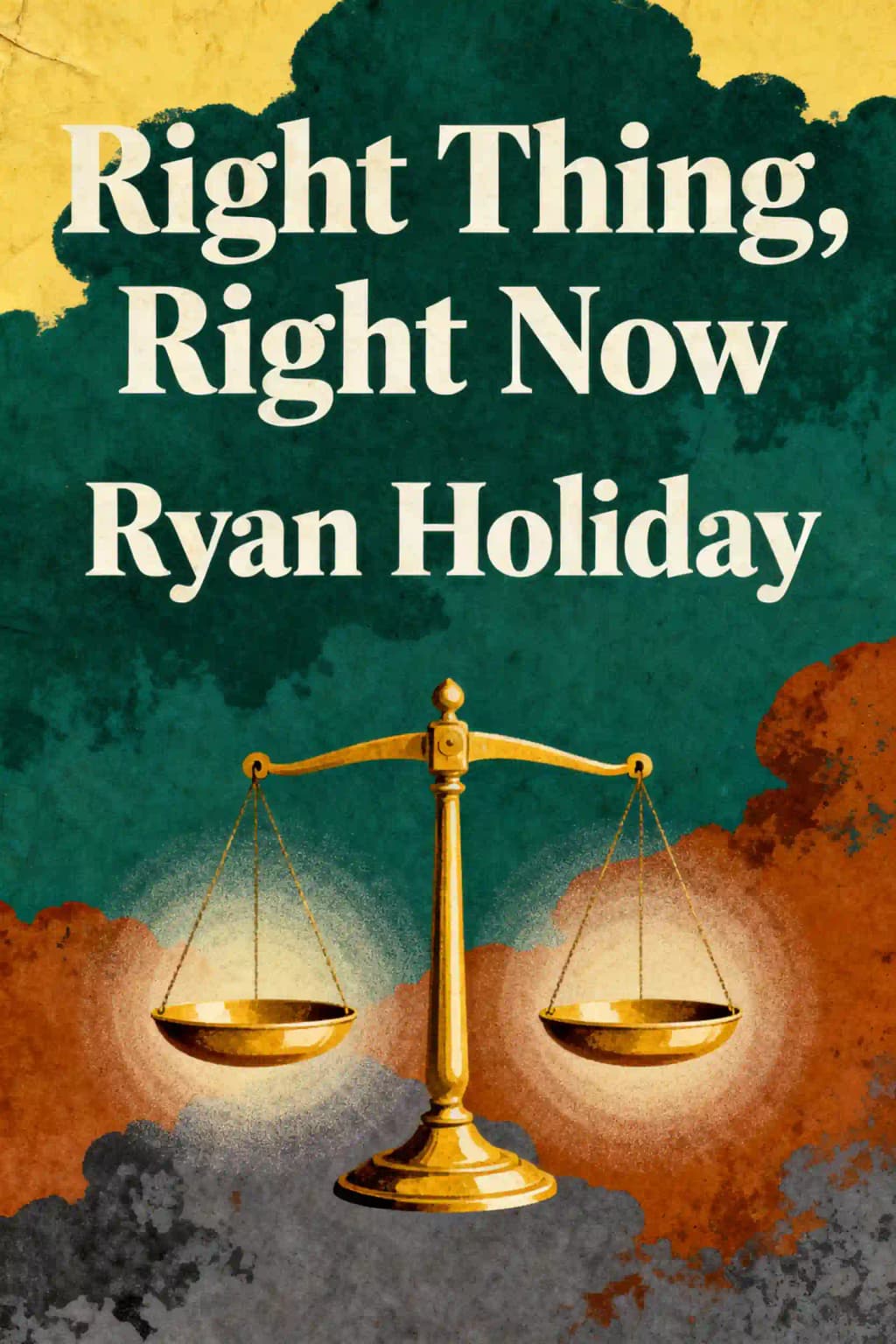
In a world where ethical compromises seem increasingly common, Ryan Holiday's "Right Thing, Right Now" stands as a clarion call to reclaim the ancient virtue of justice. This book has quietly become a touchstone for leaders across industries - from CEOs seeking ethical frameworks to military officers training future commanders. Beloved by figures like Tim Ferriss and Maria Popova, it draws from Holiday's decade-long study of Stoicism while expanding beyond philosophy into practical ethics. What makes this work particularly compelling is how it transforms abstract moral concepts into actionable wisdom through vivid historical examples. At a time when many feel moral drift in our institutions and leadership, Holiday offers something increasingly rare: a roadmap for living with integrity that doesn't sacrifice effectiveness in the real world.
Capítulo 2
The Four Pillars of a Virtuous Life
Justice stands as one of the four cardinal virtues that have guided human conduct across cultures and millennia. Alongside courage, temperance, and wisdom, justice serves as a "hinge" upon which a good life turns. These virtues aren't gendered or dependent on intelligence-they're universal ideals found in both Western philosophy and Eastern traditions. From Aristotle's writings in ancient Greece to Buddhist teachings in Asia, these four pillars have consistently emerged as fundamental to human flourishing. Without justice, all other virtues become meaningless or even dangerous. What good is courage if used for unjust ends? What value does wisdom have when divorced from fairness? A brave but unjust person becomes a tyrant; a wise but unfair leader becomes a manipulator.
Unlike abstract philosophical concepts, justice manifests as practical action-not merely understanding what's right but consistently doing it. It's about establishing your "Flat-Ass Rules" about what you will and won't do, regardless of convenience or consequence. These are the non-negotiable principles that guide behavior even when no one is watching. Despite cultural differences, there's remarkable universal agreement about right action: keeping your word, sacrificing for others, rejecting selfishness. The golden rule appears across traditions, from Hillel's "Love thy neighbor as thyself" to Confucian teachings, Islamic hadith, and Native American wisdom. This convergence suggests something fundamental about human nature and our shared understanding of fairness.
Admiral Hyman Rickover, who rose from Jewish immigrant to nuclear navy pioneer, embodied this approach to practical justice. He transformed the U.S. Navy's nuclear program through unwavering adherence to principles, refusing to compromise safety standards despite political pressure. He guided generations of officers with a simple moral code that provided focus amid complexity, demanding absolute honesty and accountability. His legacy shows how personal integrity shapes institutional excellence. Justice shouldn't be abstract theory but practical action-something we do rather than get, a North Star guiding us through uncertainty. As Rickover would command: "Do what is right! Do it right now." His leadership demonstrated how individual commitment to justice can create lasting positive change in organizations and society.
The practical application of justice requires daily choices and consistent behavior. It means paying workers fairly even when profits are tight, speaking truth to power despite potential consequences, and maintaining ethical standards even when shortcuts seem tempting. Modern examples abound, from whistleblowers who risk careers to expose wrongdoing to business leaders who prioritize environmental responsibility over short-term gains. These choices, while often difficult, reinforce the timeless truth that justice isn't just an ideal-it's a practical framework for decision-making and living.
Capítulo 3
The Ordinary Man Who Stood Before Kings
In perhaps history's most precarious moment-with a president dead, world war raging, nuclear weapons emerging, and racial reckoning looming-destiny produced Harry S. Truman, an unlikely leader: a small-town Missouri farmer with thick glasses who had failed at nearly everything. While many dreaded this seemingly ordinary man taking such monumental responsibility, those who knew him weren't concerned. Truman's character had been shaped by studying Marcus Aurelius, whose Meditations taught him "the four greatest virtues are moderation, wisdom, justice, and fortitude."
Truman lived by a strict personal code, considering honor and ethics their own reward. After high school, he cycled through jobs as a mailroom boy, drugstore cashier, timekeeper, bank clerk, and farmer, facing rejection from both West Point and his beloved Bess Wallace. At 33, despite numerous exemptions available, he enlisted for WWI, becoming captain of Battery D. There, his character first faced public scrutiny as he balanced strict discipline with compassion for his men.
Despite entering politics through Kansas City's notoriously corrupt Pendergast machine, Truman proved himself "the contrariest goddamn mule in the world." Overseeing county construction projects, he drove thousands of miles inspecting sites, refused kickbacks, demanded competitive bids, and denied special treatment even to his own mother when her property was affected by road construction. This stubborn honesty eventually got him "kicked upstairs" to the Senate, where his Subcommittee on War Mobilization investigated wartime contracts, saving taxpayers $15 billion while maintaining his personal rule: "I won't sell influence and I'm perfectly willing to be cussed if I'm right."
As president, Truman's character remained unchanged. He maintained his punctuality and showed remarkable personal kindness. Facing history's most consequential decisions, Truman embodied "The Buck Stops Here." After Germany's surrender in 1945, he resolved to economically rescue Europe through the Marshall Plan-giving billions to war-torn nations, including former enemies. Though raised with racial prejudices in a former slave state, Truman transformed, desegregating the armed forces in 1948, banning discrimination across federal government, and becoming the first president to address the NAACP. His example shows that justice isn't what we demand of others, but what we demand of ourselves.
Capítulo 4
The Foundation of Personal Integrity
Personal integrity forms the bedrock of justice. The ancient Roman Marcus Atilius Regulus exemplifies this principle. After being captured by Carthaginians and held prisoner for five years, Regulus was sent to Rome to negotiate peace terms. Though finally free, he advised the Roman Senate to reject the offer because Carthage was weak. Then, shocking everyone, he returned to captivity because he had sworn to do so, explaining: "I will not transgress my oaths, not even when they have been given to enemies."
A person's word should be their bond-a literal deposit, a contract. A handshake should be enough. Beat poet Diane di Prima demonstrated this when she left a legendary party to relieve her babysitter, despite Jack Kerouac mocking that she'd "never be a writer" unless she forgot such commitments. Di Prima understood that being a good parent and good writer required "the same discipline throughout."
Keeping your word isn't always easy-vows about sickness and health, promises to family, political pledges, agreements that become expensive-all will test you. But there should be no escaping a word freely given. You said it, they're counting on you, do it-even when difficult or painful.
This integrity extends to telling the truth. Whistleblowers like Cynthia Cooper, Daniel Ellsberg, Tyler Shultz, and Dr. Li Wenliang aren't just exposing wrongdoing-they're doing something much more fundamental: telling the truth. Ernie Fitzgerald, who exposed Pentagon cost overruns, preferred being called a "truth-teller" rather than a whistleblower. Before testifying to Congress despite pressure to stay silent, his wife told him she couldn't respect him if he lied.
Despite legal protections, truth-tellers are often doubted, pressured, and attacked. Fitzgerald became "the most hated man in the air force" and was fired after Nixon was caught saying "get rid of that son of a bitch." This reveals how honesty, though praised in theory, can be dangerous in practice. True honesty means refusing to participate in lies, as Solzhenitsyn put it: "Let that come into the world, let it even reign supreme-only not through me."
Capítulo 5
The Courage to Be Good, Not Just Great
When struggling medical student Walker Percy wrote to his accomplished uncle for advice, he expected a lecture about his mediocre grades. Instead, William Alexander Percy replied: "My whole theory about life is that glory and accomplishment are of far less importance than the creation of character and the individual good life."
Similarly, Marcus Aurelius, despite having the power to rival Alexander the Great, focused his private writings on being "a good human being" rather than achieving greatness. He questioned himself: "A better wrestler? But not a better citizen, a better person, a better resource in tight places, a better forgiver of faults?"
While most people compete professionally, few compete to be more trustworthy, ethical, or helpful. The Spartan king Agesilaus measured himself against other rulers not by wealth or conquests but by justice. As the aphorism goes: "It's easier to be a great man than a good one."
This recalibration requires courage. While bank balances and field goal percentages are easy to measure, integrity and teamwork are harder to quantify. Yet virtue must be our compass in any profession. Marcus Aurelius, by focusing inward on goodness, ultimately achieved external greatness-his statue in Rome shows him pardoning enemies, not conquering them. By being good consistently, he became great.
This goodness manifests in transparency. In corrupt Rome, Marcus Livius Drusus stood apart as a reformer who expanded citizenship rights and gave generously of his wealth. When an architect offered to redesign his partly exposed home for more privacy, Drusus replied: "Double your fee and make my whole house visible, so that every citizen may see how I live my life."
This transparency is rare among today's powerful, who hide behind mansion walls, shell corporations, and tax havens. Politicians refuse to disclose conflicts of interest, meet in secret, and employ publicists to spin the truth. Why? To get away with things they know wouldn't go over well with the public. As Joseph Pulitzer said, "There is not a crime, there is not a dodge, there is not a trick, there is not a vice which does not live by secrecy."
Capítulo 6
The Social Responsibility of Justice
Justice extends beyond personal integrity to how we treat others. When Clarence Darrow experienced poor service from a train steward, his son asked if he would report the man. "No, no, son," Darrow replied. "Never hurt a man who is working for his living."
This simple decency seems distant in our world where flight attendants face assault and service staff are treated poorly. Darrow's decency extended beyond mere politeness-when he discovered a promoter was making little profit from his speaking tour, he voluntarily reduced his own fee, explaining it was just "the decent thing to do."
Justice requires recognizing others as sovereign individuals with dignity. How we treat people when stressed or inconvenienced reveals our character. Harry Truman exemplified this-amid the pressures of suddenly becoming president, his first thoughts were for Mrs. Roosevelt and his apartment neighbors.
"It seems ridiculous," Albert Camus wrote, "but the only way to fight the plague is with decency." In a world of cruelty, ordinary decency stands out like a small light in darkness. Everyone wants dignity, security, respect. Let's remember that all of us feel pressed for time and insecure, and treat people accordingly.
This decency extends to doing our jobs with integrity. Floyd Mann, a southern police commissioner, stunned everyone by protecting Freedom Riders in 1961 despite pressure. While others focused on grand notions of equality, Mann simply took his duty seriously: "My purpose was law enforcement, trying to make sure nothing tragic happened to those people while they were in Alabama."
It's powerful when someone does their duty in the face of pressure-when they say, "As long as I have this authority, I am going to do what's right." Today, "I was just doing my job" has become more excuse than explanation for heroic behavior. Your job is to keep people safe, show up, be honest, care. You swore an oath to yourself. Now keep it.
Capítulo 7
Building a Legacy Through Others
Gregg Popovich may be basketball's greatest coach by traditional metrics-most wins, five championships, twenty-two consecutive winning seasons-but his most significant legacy is his "coaching forest." Nearly 30 percent of all NBA coaches once worked for or played under Popovich, with his proteges winning eleven championships as head coaches. Seven of the twenty-three Black head coaches and GMs in the NBA came from his program, as did Becky Hammon, the first female assistant coach in NBA history who went on to win WNBA Coach of the Year. His influence extends beyond just wins and losses - he created a culture of development, mentorship, and inclusion that transformed the landscape of professional basketball.
This isn't just impressive-it's revolutionary. While operating at the highest level of a cutthroat profession, Popovich opened doors and extended ladders to diverse leaders, helping his potential competition succeed. Commissioner Adam Silver noted that the Spurs weren't just a team but an "academy" for future coaches and executives. The Spurs' practice facility became known as "Popovich University," where assistant coaches were encouraged to challenge conventional wisdom and develop their own coaching philosophies. He insisted his assistants run practices, make crucial in-game decisions, and lead film sessions - experiences that proved invaluable in their future roles.
Too often we focus on getting our own opportunities rather than creating them for others, trapped in "Highlander syndrome" where "there can only be one." But life isn't zero-sum. George Marshall advanced to the top of his profession precisely because he built an army of talented officers, nurturing men like Omar Bradley, George Patton, and most significantly, Dwight Eisenhower. Marshall's leadership development program transformed the U.S. military, identifying and promoting talent regardless of background or connections. His willingness to promote others, even at the cost of his own advancement, ultimately made him indispensable.
This pattern repeats throughout history: Socrates mentored Plato who taught Aristotle who guided Alexander, creating a chain of philosophical influence that shaped Western thought for millennia. Emerson supported countless writers including Walt Whitman, providing both spiritual and material support during crucial early years. Thomas Higginson helped publish Emily Dickinson, recognizing her genius when few others did. Frederick Douglass mentored Ida B. Wells, sharing his platform and expertise to amplify her anti-lynching campaign. Denzel Washington paid for Chadwick Boseman's college education, enabling a transformative talent to emerge. George Carlin encouraged Garry Shandling who later mentored Judd Apatow and countless comedians, creating a comedy lineage that continues to influence entertainment.
Our greatest legacy isn't what we accomplish alone, but who we help succeed. We must be the candle that lights another, which lights another, creating multigenerational impact that extends far beyond our own lives. This approach requires us to view success not as a finite resource to be hoarded, but as an expanding universe of possibility. By investing in others' growth, we create ripples of influence that continue long after we're gone, transforming not just individual lives but entire fields and industries.
Capítulo 8
The Transformative Power of Persistence
Raphael Lemkin's relentless crusade against mass atrocities exemplifies how persistence can reshape human consciousness and law. In 1943, he created the word "genocide" - combining the Greek "genos" (race/tribe) with the Latin "cide" (killing) - to define what Winston Churchill had frustratingly called "a crime without a name." This linguistic innovation, like Thomas Clarkson's detailed technical drawings of slave ships that exposed the horrors of the Middle Passage, gave people the vocabulary to comprehend and condemn an unspeakable evil.
Lemkin's subsequent campaign for legal recognition was extraordinary in its intensity. He slept on benches in the corridors of the Nuremberg trials, cornered diplomats in UN hallways, and wrote hundreds of letters to newspapers and world leaders. He sacrificed his health, career, and personal life, living in near poverty while devoting himself entirely to this cause. His persistence paid off when the UN General Assembly passed the Genocide Convention in 1948, though he would not live to see its full implementation.
The battle continued on American soil, where the treaty faced fierce opposition. Senator William Proxmire emerged as an unlikely champion, beginning his campaign in 1967 with a promise to speak about genocide every day the Senate was in session. He delivered 3,211 speeches over two decades, weathering ridicule and political costs, until the US finally ratified the treaty in 1988. During this period, genocides in Cambodia, Uganda, and elsewhere demonstrated the urgent need for international legal frameworks.
This same determined spirit animated civil rights attorney John Doar's methodical approach to justice. His mantra, "You've just got to keep going back," guided his team through thousands of court filings, hostile judges, and violent resistance. They documented every violation, filed every possible motion, and appealed every adverse ruling. When James Meredith was shot while attempting to integrate the University of Mississippi, he returned to campus, refusing to let violence deter his historic mission.
The Stoic philosophers understood that meaningful change requires sustained effort over time. Marcus Aurelius wrote that progress comes "not in sudden leaps but by small steps." External forces - whether bureaucratic obstruction, violent opposition, or public indifference - may create obstacles, but they cannot force us to abandon our principles. The key is to start with achievable goals, build networks of supporters, and maintain momentum through inevitable setbacks. Often, the fiercest resistance indicates we're challenging deeply entrenched injustices.
As Proxmire remarked after his final genocide speech, "I'm going to look around for something else" - recognizing that the work of justice is never complete. Each victory opens new frontiers for human rights and dignity, requiring fresh commitment from new generations of persistent advocates.
Capítulo 9
The Transcendent Power of Love and Forgiveness
Gandhi's life was paradoxically defined by constant battle despite being a man of peace. Facing powerful adversaries like the British Empire with nothing more than sandals and a loincloth, he consistently emerged victorious-not just winning but winning over his enemies.
Born in 1869 to an important family in Porbandar, Gandhi could have lived a life of ease but was called to something greater. His journey began with conquering himself. As a schoolboy, he refused to cheat on a test even when his teacher encouraged it, preferring to fail with integrity. At fifteen, after stealing money from his brother, he wrote a confession to his dying father, who wordlessly tore up the letter in forgiveness, moving Gandhi to tears.
Gandhi's transformation from successful lawyer to selfless activist was complete. Despite flourishing financially in South Africa with "an enormous income and a house on the beach," he chose to live communally on an ashram, dedicating himself fully to serving others. Though fighting for Indians' travel rights, he deliberately traveled third class to experience the same hardships as the poor. He refused gifts of jewels for his children's future, directing them instead to emergency funds for the cause.
Gandhi's nonviolent resistance proved more powerful than any weapon. Though he could have incited riots or violence with a word, he remained strictly nonviolent for over thirty years despite British brutality against his supporters. His five-fingered approach addressed equality for untouchables, women's rights, Hindu-Muslim cooperation, sobriety, and economic self-sufficiency-all bound by nonviolence.
Gandhi's greatness lay not just in his tactics but in his character. He treated opponents with consideration and always sought negotiation before confrontation. His hunger strikes proved particularly effective because no one wanted responsibility for his death. Even his former adversary General Smuts became an ally, urging the British to negotiate in good faith.
Forgiveness is perhaps our most difficult yet transformative duty. When Jimmy Carter pardoned Vietnam draft dodgers, he wasn't thinking of politics but reconciliation. The civil rights movement's true power lay in its vision of reconciliation-keeping eyes on the prize of a world where blacks and whites could love each other despite horrific injustices. James Lawson embodied this when he not only forgave Martin Luther King Jr.'s assassin James Earl Ray but even officiated his prison wedding. When Lawson's son was asked about this decision, he simply said, "if you believe all the stuff you've been preaching all these years, then you'll do it."
Capítulo 10
The Right Thing, Right Now
The right time to do the right thing is always right now. Jimmy Carter demonstrated this at his 1971 Georgia governor inauguration when, after a conservative campaign, he stunned everyone by declaring, "The time for racial discrimination is over."
We often procrastinate justice because we know it will be hard or costly. We comfort ourselves with lies: I'll do it later, when I'm more secure, when it will really count. But as Marcus Aurelius reminded himself, "You could be good today. Instead you choose tomorrow."
Aristotle viewed virtue not as a destination but as a daily practice-a habit through which we become who we are. The longer we delay, the harder it becomes to act. Like standing too long on a diving board, we get in our own heads, lose courage, and find excuses.
Eventually, we'll have to do the right thing-make the apology, the hard decision, the first move. So why not just get it over with? We'll have to pay the price at some point. Let's start making the payments not later, but right now.
Einstein's letter to a grieving father reveals a profound truth: we are all part of a unified whole, our separation merely an "optical delusion of consciousness." This interconnectedness is something physicists, philosophers, and priests agree on-we share an animating force that binds us together even in suffering. James Baldwin found this connection through books, discovering his personal torments were shared across humanity throughout time. Astronauts experience this "overview effect" directly, seeing Earth as one organism without borders. Gandhi called it "the great oneness."
This realization makes us more generous and less concerned with petty distinctions, though it can also be devastating-as William Shatner discovered at age ninety when finally seeing Earth from space and feeling profound sadness at how we take it for granted. From Pericles in 431 BC to Marcus Aurelius viewing the world as "one nature and soul," this understanding that "what's bad for the hive is bad for the bee" reminds us we are all mortal, all flawed, all gifted with potential, and all deserving of justice-unique individuals yet inseparable parts of humanity past, present, and future.