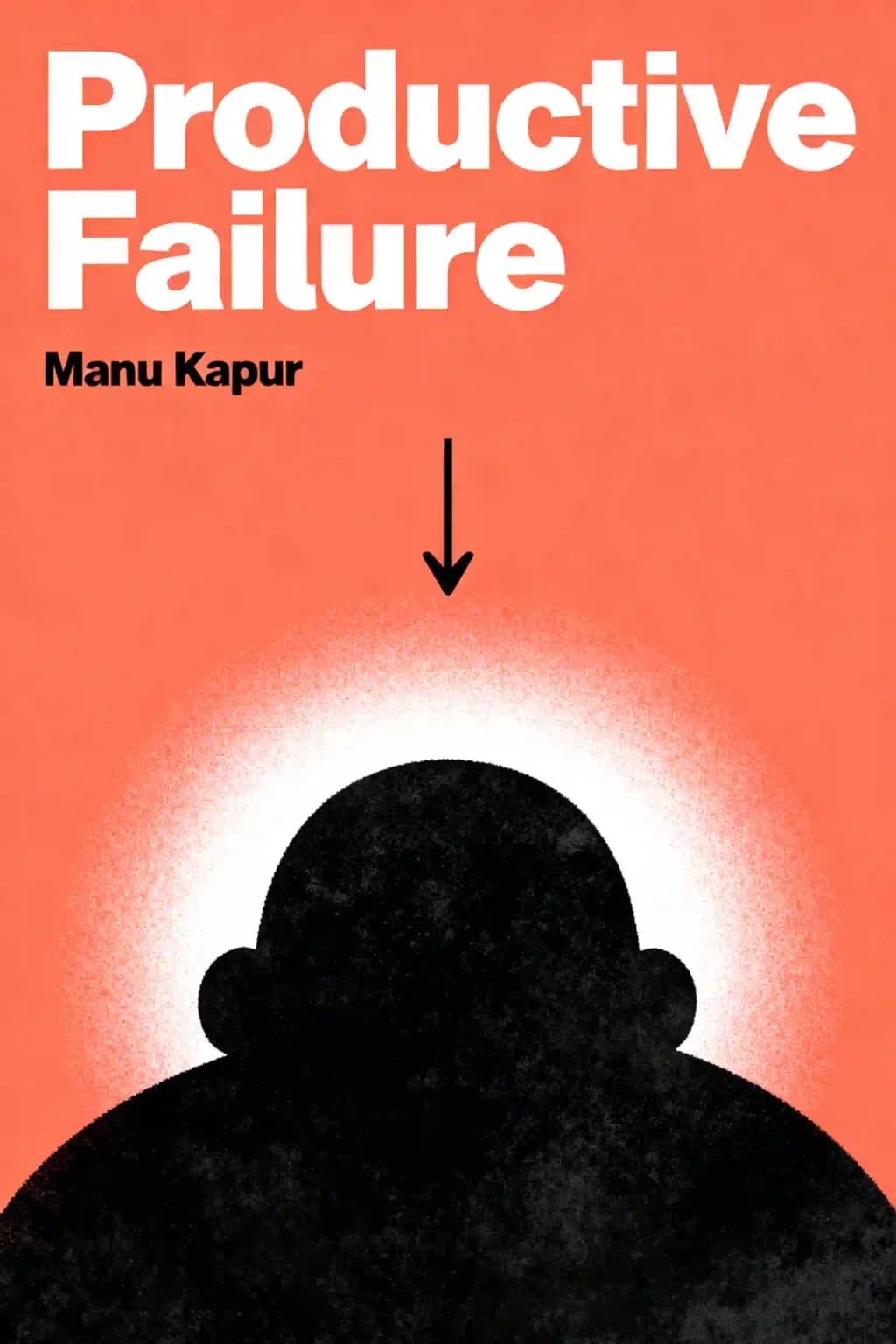
What if failure is our greatest teacher? "Productive Failure" revolutionizes learning by intentionally designing failure experiences that spark deeper understanding. Embraced by Singapore's education system and celebrated by leadership experts, Kapur's counterintuitive approach transforms how we learn, teach, and grow through embracing our mistakes.
Manu Kapur, author of Productive Failure, is a globally recognized learning scientist and educational innovator. A mechanical engineer turned math teacher turned academic, Kapur holds a doctorate in learning sciences from Columbia University and directs the Singapore-ETH Center as a professor at ETH Zurich.
His groundbreaking work on Productive Failure redefines how struggle and iterative problem-solving enhance deep learning, drawing from his multidisciplinary background and leadership roles at institutions in Singapore, Hong Kong, and Switzerland. Kapur’s research has been featured in TEDx talks, Times Higher Education, and peer-reviewed journals, while his frameworks influence STEM curricula and corporate training programs worldwide.
His forthcoming book expands on evidence-based strategies for designing failure-driven learning ecosystems. Born in Lucknow, India, Kapur’s insights blend Eastern educational rigor with Western pedagogical research, cementing his status as a bridge between theory and practice. Productive Failure has been adopted by educators and institutions across 15 countries, with translations in progress.
Productive Failure explores how intentionally designing challenges beyond current skill levels fosters deeper learning and resilience. Drawing on 20+ years of research, Kapur argues that strategic failure activates problem-solving skills, identifies knowledge gaps, and prepares individuals for high-stakes scenarios through controlled struggle. The book contrasts traditional “direct instruction” with frameworks for structured failure in education, leadership, and personal growth.
Educators, corporate leaders, coaches, and parents seeking evidence-based methods to cultivate growth mindsets will benefit. Kapur’s strategies apply to STEM education, organizational training, and parenting. Those interested in Carol Dweck’s work or Angela Duckworth’s grit research will find actionable extensions of these theories.
Yes—its principles address contemporary challenges like AI-driven workforce reskilling and remote team resilience. Kapur blends academic rigor with practical tools, offering a fresh alternative to toxic positivity or “fail fast” Silicon Valley tropes. The 2024 updated edition includes case studies from Fortune 500 companies and school districts.
While Carol Dweck’s mindset focuses on beliefs about intelligence, Kapur provides tactical designs for creating failure-rich learning ecosystems. He operationalizes growth theory through specific classroom protocols, leadership training modules, and feedback systems validated in 14 countries.
“Your ambition should always exceed your talent—not as arrogance, but as a compass pointing to the next frontier of growth.” This mantra underpins Kapur’s argument for systematic skill-stretching in teams and individuals.
Some educators argue it risks demoralizing learners if poorly implemented. Kapur counters with data showing 73% higher retention rates when failures are properly scaffolded. Critics also note the approach requires more facilitator training than traditional instruction.
His mechanical engineering training (BS) and applied statistics mastery (Columbia MS) shape the book’s systems-thinking approach. Case studies feature algorithmic precision in designing failure cycles, contrasting with anecdotal leadership books.
As automation reshapes jobs, Kapur’s methods teach adaptive problem-solving—the skill least likely to be replaced by AI. The 2024 edition includes protocols for using ChatGPT to generate “productive failure” coding challenges and debate scenarios.
It reframes resilience not as bouncing back, but as preemptive strengthening through controlled adversity. Kapur’s research shows teams using his methods solve novel crises 40% faster than conventionally trained groups.
Siente el libro a través de la voz del autor
Convierte el conocimiento en ideas atractivas y llenas de ejemplos
Captura ideas clave en un instante para un aprendizaje rápido
Disfruta el libro de una manera divertida y atractiva
Failure, when properly designed, can be our most powerful teacher.
Learn, forget, retrieve, relearn, repeat.
Experts see deep structures where novices see only surface features.
Solve first, learn later.
Making initial learning hard improved outcomes.
Desglosa las ideas clave de Productive Failure en puntos fáciles de entender para comprender cómo los equipos innovadores crean, colaboran y crecen.
Destila Productive Failure en pistas de memoria rápidas que resaltan los principios clave de franqueza, trabajo en equipo y resiliencia creativa.

Experimenta Productive Failure a través de narraciones vívidas que convierten las lecciones de innovación en momentos que recordarás y aplicarás.
Pregunta lo que quieras, elige la voz y co-crea ideas que realmente resuenen contigo.

Creado por exalumnos de la Universidad de Columbia en San Francisco
"Instead of endless scrolling, I just hit play on BeFreed. It saves me so much time."
"I never knew where to start with nonfiction—BeFreed’s book lists turned into podcasts gave me a clear path."
"Perfect balance between learning and entertainment. Finished ‘Thinking, Fast and Slow’ on my commute this week."
"Crazy how much I learned while walking the dog. BeFreed = small habits → big gains."
"Reading used to feel like a chore. Now it’s just part of my lifestyle."
"Feels effortless compared to reading. I’ve finished 6 books this month already."
"BeFreed turned my guilty doomscrolling into something that feels productive and inspiring."
"BeFreed turned my commute into learning time. 20-min podcasts are perfect for finishing books I never had time for."
"BeFreed replaced my podcast queue. Imagine Spotify for books — that’s it. 🙌"
"It is great for me to learn something from the book without reading it."
"The themed book list podcasts help me connect ideas across authors—like a guided audio journey."
"Makes me feel smarter every time before going to work"
Creado por exalumnos de la Universidad de Columbia en San Francisco

Obtén el resumen de Productive Failure como PDF o EPUB gratis. Imprímelo o léelo sin conexión en cualquier momento.
A career-ending soccer injury forced Manu Kapur to become a teacher - a role he never wanted. Standing before students struggling with mathematics, he watched traditional instruction fail repeatedly. What if, he wondered, the entire premise was backwards? What if making learning harder actually made it better? This counterintuitive question launched a research journey that would challenge centuries of educational wisdom. Across four continents and over 50 rigorous studies, his findings revealed something remarkable: students who failed first, then learned, outperformed traditionally taught peers by up to two academic years. Bill Gates called it revolutionary. But here's what matters most - this isn't just about classrooms. It's about how we all learn, grow, and transform struggle into mastery.