Capítulo 1
The Marketing Revolution You've Been Waiting For
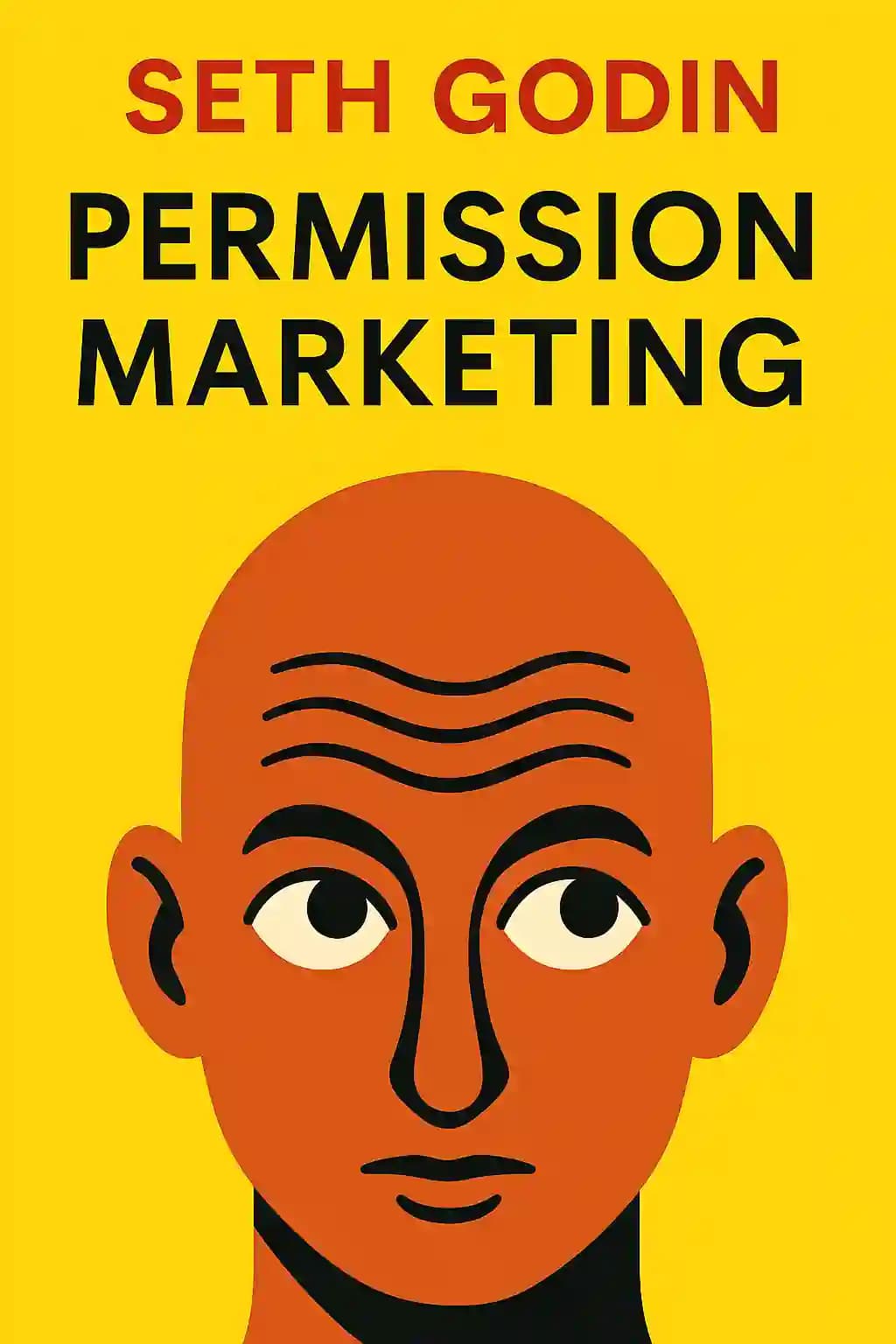
In 1999, Seth Godin published a book that would forever change how businesses connect with customers. "Permission Marketing" arrived at the perfect moment-just as the internet was transforming commerce and traditional advertising was losing effectiveness. The book quickly became a business sensation, endorsed by marketing legends like Don Peppers and praised by Fortune 500 executives desperate for new ways to reach increasingly distracted consumers. Unlike most marketing books that fade into obscurity, Godin's principles have only grown more relevant with time. Today, his concepts form the foundation of content marketing, email marketing, and social media strategy used by companies worldwide. Even tech giants like Facebook and Google have built their advertising empires on permission-based principles. What made this book so revolutionary wasn't just its ideas-it was Godin's uncanny ability to predict how digital technology would transform the relationship between businesses and consumers forever.
Capítulo 2
The Attention Crisis That Money Can't Solve
We live in a world drowning in marketing messages. With 17,000 new food products launched annually and companies spending roughly $1,000 per year in advertising for every consumer, our attention has become the scarcest resource in the marketplace. Television screens in airports, advertisements in restrooms, newsletters on every conceivable topic, and omnipresent mobile phones have created an environment where the average person is exposed to thousands of marketing messages daily.
In the past, when there were only three major television networks, capturing attention was relatively easy. We all memorized TV schedules and advertisements easily caught our attention. We shared the same advertising references and bought the same products. But that formula no longer works.
For the past 90 years, marketers have practiced almost exclusively what Godin calls "Interruption Marketing"-advertisements that interrupt a consumer's activity to divert their attention. But in today's overcrowded advertising market, it's becoming increasingly difficult to interrupt effectively. Like in a crowded airport where we eventually ignore solicitations, consumers have developed selective deafness to the advertising deluge.
Modern consumers spend less time searching for alternatives because product quality has improved dramatically. Having already found satisfactory brands in most categories, why would they seek replacements? Facing this challenge, marketers have doubled down on interruptions, dramatically increasing their budgets and the aggressiveness of their messages.
The mass market is dead, fragmented into countless niches. On the internet, an average site receives only nine visits per page per month despite colossal investments. To survive, mass marketers employ four desperate strategies: investing in bizarre media, creating more entertaining advertisements, constantly renewing campaigns, and replacing traditional advertising with direct mail and promotions.
But these remedies prove ephemeral in the face of growing saturation. Databases allow for more targeted marketing, but this technique will also lose its advantage once competitors adopt it. Films like Titanic represent the extreme limit of Interruption Marketing-investing insane sums to overcome market congestion. This "roll of the dice" strategy where the winner takes all is adopted by companies like Nike and on the internet, but it only aggravates the vicious cycle: the more you spend, the less it works, and the less it works, the more you spend. Mass marketing is heading for catastrophe.
Capítulo 3
Permission Marketing: Rediscovering Effectiveness
What if you could transform market saturation into an advantage? That's precisely what Permission Marketing practitioners do, leveraging the obstacles that paralyze Interruption Marketing. The more critical the situation becomes, the more profitable this approach proves to be.
Permission Marketing unfolds in five essential stages. First, give customers a valid reason to volunteer their attention. Next, use their attention to build an educational relationship about your product. Third, reinforce incentives to maintain attention when the initial appeal fades. The fourth step involves obtaining a higher level of permission-convincing customers to authorize more personal information or try new products. Finally, transform this permission into profits by gradually changing purchasing behavior.
Unlike Interruption Marketing, permission represents a genuine investment. Companies like AOL spend up to $300 to acquire a customer, American Express $150. These costs are justified by the long-term value of the established relationship. Even some Wall Street brokers invest $15 simply to be able to call a prospect, knowing that an expected call generates infinitely more than an unsolicited one.
Permission Marketing, while requiring more patience and infrastructure than traditional methods, offers the crucial advantage of being measurable and gaining power over time. The internet, with its low cost of frequent communication, constitutes the ideal medium for this approach, explaining why this ancient method is experiencing a strategic revival today.
Think of it this way: traditional marketing is like trying to propose marriage on the first date-awkward and unlikely to succeed. Permission Marketing is about building a relationship gradually, earning trust before asking for commitment. It's about transforming strangers into friends, then friends into customers.
Capítulo 4
The Evolution of Mass Advertising
A century ago, small local businesses dominated retail. Effective and attentive, they inspired trust and served customers who had no telephones or credit cards. Without modern communication infrastructure, these businesses remained small and local, acquiring customers one by one, often through word-of-mouth or door-to-door sales. They knew precisely the value of a new customer and devoted the necessary time to cultivating relationships.
The Industrial Revolution changed everything. Economies of scale made it imperative to grow or perish. Automobiles and trucks facilitated delivery over long distances. To sell this massive production, companies had to abandon personalized sales in favor of large-scale advertising.
Surprisingly, it wasn't mass production or transportation that generated the greatest profitability, but advertising itself. Companies discovered that the more they advertised, the more they sold, and the value of these sales far exceeded advertising costs. This discovery directly contributed to the development of mass media, which served as platforms for interruption.
Procter & Gamble's launch of Crisco in 1908 illustrates this evolution perfectly. Initially, P&G used Permission Marketing methods: partnerships with railroad companies, testimonials from doctors and rabbis, organizing fashionable tea parties, and distributing free cookbooks. This campaign was brilliantly successful.
However, strategists realized that permission-based campaigns alone couldn't rapidly develop product popularity. They converted to Interruption Marketing, buying advertising space everywhere to quickly expand their customer base.
Marketers became dependent on Interruption Marketing for several simple reasons: it's easy to implement, allows scaling up, offers predictable results, aligns with the hierarchical vision of large companies, and proves profitable for good products.
This orientation has reinforced the supremacy of established brands-more than 87% of American advertising expenditures come from the 100 largest advertisers, 80% of which have been active for over twenty years. These large companies recruit young people whom they train to reproduce winning formulas rather than reinvent marketing.
Permission Marketing thus represents both a challenge and an opportunity. While established firms cling to their traditional methods, they create enormous opportunities for new entrants and companies flexible enough to adopt this new approach.
Capítulo 5
Getting Started with Permission Marketing: Focus on Customer Share, Not Market Share!
Don Peppers and Martha Rogers revolutionized the marketing landscape with their book "One-to-One," proposing to focus on increasing revenue from existing customers rather than acquiring new ones. This approach, reminiscent of old-time business practices, can now be combined with modern technologies to reach a broader clientele.
Relationship marketing focuses on four key questions: increasing customer share, sustaining customer relationships, expanding offerings, and establishing an interactive relationship that satisfies more needs. This approach requires massive investment in technologies, discipline, and a strong dose of tenacity.
Unlike relationship marketing that begins after the first transaction, Permission Marketing starts from the first contact, transforming strangers into friends, then into customers. Both approaches are complementary: one renounces gaining the most customers possible to maximize each acquired customer, the other transforms as many prospects as possible into lasting customers.
Permission Marketing and relationship marketing work in perfect synergy. Without the customer's explicit consent, it's impossible to build a lasting personalized relationship. By tracking the degree of permission granted by each customer, companies can measure the return on investment of this approach.
Amazon perfectly illustrates this strategy. Rather than focusing solely on selling books, the company builds a permission-based tool, collecting data on reading preferences. This strategy could allow them to venture into publishing, eliminating advertising costs, shipping, and managing unsold inventory that traditionally burden this sector.
Imagine Amazon sending an email to a million mystery novel readers offering them exclusive access to an author's next book. If one-third responds favorably, Amazon could offer the author a million euros while making a net profit of 4 million euros. This approach, multiplied by hundreds of titles, could completely reconfigure the book industry by retaining only two links: the writer and Amazon. That's the power of permission-using technologies to personalize communications and leverage databases of consenting customers.
Traditional marketing aims to increase market share, seeking to sell to the greatest number. Relationship marketing pursues a greater "customer share"-getting each existing customer to buy more, building loyalty to your brand and fully satisfying them. A customer's value depends on their future purchases across all your products and services.
Some customers have negative value for the company. The anecdote of an online seller responding "Leave us alone!" to a customer requesting her order illustrates this fundamental error: this merchant sacrificed not just $10 in sales, but potentially thousands in future sales. Conversely, another seller who promptly responds to complaints and offers compensation cultivates a lasting and profitable relationship.
Permission Marketing allows focusing on customers most likely to grant their permission and translate it into repeated purchases. Sometimes, this means "thanking" a customer who costs too much in resources-but never discourteously.
Capítulo 6
Permission Marketing Develops Advertising Frequency, Which Builds Trust
How do you establish trust? That's the fundamental question in marketing. Without trust, no sales. Trust isn't a single event but a slow progression that requires time, money, and perseverance. It begins with awareness that leads to familiarity.
Awareness is essential to combat consumer distrust, but it must be acquired intelligently. The most important dimension of advertising is frequency-how many times the same individual sees your ad. The problem is that 90% of consumers won't notice or will forget your advertisement, regardless of its quality. The memorization rate of a successful campaign rarely exceeds 10%, and among those who remember, few truly understand the message.
Frequency is the secret that marketers fear to disclose. A single ad, even a brilliant one, almost never suffices to sell a product. Like Muhammad Ali who won not by hitting twenty opponents once, but by delivering twenty blows to one man, repetition is essential.
High frequency overcomes market clutter and pushes consumers to focus on your message. According to Nicholas Negroponte of MIT, doubling the frequency of your ads generally multiplies effectiveness by four.
Yet, many professionals prefer reach (touching more people once) to frequency (touching fewer people multiple times). This is a costly mistake. The stadium vendor who disperses throughout the stadium rather than concentrating on one section makes the same error-missing the opportunity to convert non-consumers into loyal customers.
Permission is the tool that makes frequency effective. Frequency generates awareness, which leads to familiarity, which creates trust. And trust, almost without exception, leads straight to profit. Brands like Crisco, Tabasco, and Campbell's, present in American homes for over fifty years, are living proof-they built their profitability on this trust acquired through frequency.
In a saturated environment, Permission Marketing allows transforming the attention economy into profitable frequency. The internet, particularly suited to direct marketing, offers the possibility of sending free frequent messages by email, thus building the permission that leads to trust.
Capítulo 7
The Five Levels of Permission
Permission Marketing evolves like a relationship, transforming strangers into loyal customers through increasing levels of consumer permission. Godin outlines five levels, from highest to lowest: intravenous, point acquisition, personal relationships, brand trust, and situational.
The intravenous level represents supreme permission, where marketers make purchasing decisions for clients. Like a patient authorizing medical treatment, this privilege aims to save time and prevent stockouts. Examples include subscription services, water delivery, and automated printer cartridge ordering.
Purchase under acceptance requires secondary authorization before billing. The "negative option" model, exemplified by Columbia Club, automatically ships products unless explicitly refused. While some customers may pay without using services, companies should leverage this permission to encourage larger purchases rather than exploit payment invisibility.
Points permission systems maintain engagement through accumulation programs, like stamp collecting for rewards. This approach creates lasting engagement and allows precise measurement of marketing investment and impact. It's most effective when aligned with natural purchasing behaviors, unlike traditional advertising whose impact is harder to measure.
Personal relationships, though ranked third, are valuable but limited by their non-scalable nature. They excel in capturing attention and modifying behavior but require sustained contact. Examples include neighborhood service providers and Cambridge Technology Partners' targeted approach to IT managers. While essential for complex sales, poor service can permanently damage these relationships.
Brand trust, though favored by interruption marketers, is difficult to verify and expensive to establish. It enables brand extension but can be easily destroyed by short-term marketing tactics, as demonstrated by Bell Atlantic's deceptive mailings and AOL's intrusive advertising screens.
Situational permission, while temporary, occurs when customers initiate interaction, such as asking for help or calling support. McDonald's "Would you like fries with that?" exemplifies successful situational permission. The key is training staff to convert these brief opportunities into higher permission levels.
Spam, the lowest level, refers to any unsolicited marketing, regardless of relevance. Traditional interruption marketing largely falls into this category. With near-zero costs for electronic communication, spam threatens to overwhelm channels, making interruption marketing increasingly ineffective. The most crucial element of permission marketing remains the expected nature of the message, which spam fundamentally violates.
Capítulo 8
Permission as a Product... to Preserve and Develop
To maintain and extend the permission obtained, four fundamental rules apply: permission isn't transferable, it's based on selfishness, it constitutes a process rather than an event, and it can be canceled at any time.
Just as you can't delegate a date, permission marketing can't be transferred to a third party. This rule frustrates direct marketing practitioners accustomed to renting, selling, or transferring customer data-a multi-billion dollar industry. Today, you can rent the contact information of virtually any demographic segment, from armed New York women to users of a specific brand of dental floss. Supermarkets track your purchases via loyalty cards. With $1.2 trillion in annual direct marketing sales in the United States, the stakes are considerable. But this practice of secretly transferring data contradicts the spirit of Permission Marketing and generates mistrust and concern among more than 80% of consumers. The problem isn't so much ethical as a matter of effectiveness: unsolicited advertising, even relevant, will never have the impact of an expressly consented message.
Permission Marketing reverses traditional power relationships: power belongs to the buyer, not the seller. The buyer, fundamentally selfish, cares little about your company or products. The heart of Permission Marketing consists of giving consumers a reason to listen, unlike Interruption Marketing which takes consumers hostage. Faced with today's information overload, consumers jealously protect their time and attention. Effective Permission Marketing practitioners understand this selfishness and structure each interaction around the question "What's in it for me?"-offering tangible rewards like lotteries, exclusive information, or practical guides. Robert Half perfectly illustrates this approach with its free salary guide that triggers a mutually beneficial relationship.
Unlike Interruption Marketing which focuses on immediate impact, Permission Marketing unfolds over time. It begins with an interruption but quickly evolves into an ongoing dialogue, comparable to courtship. Constant evaluation and improvement of communication techniques can radically transform results-Yoyodyne thus increased its response rate from 2% to 36%. The low cost of frequency on media like email allows focusing on the process, experimenting, and observing results. Companies like Robert Half and Marshall Industries illustrate this progressive approach, offering increasingly personalized services in exchange for growing permission. Marshall Industries notably offers a secure online laboratory and 24/7 technical assistance that continuously deepen the relationship with its customers.
In Permission Marketing, the balance of power reverses: consumers can withdraw their permission whenever they wish. The marketer must therefore design each communication as if it could be the last. The story of Scheherazade perfectly illustrates this strategy: faced with the king who beheaded his wives the day after the wedding, she told a captivating story each evening that she interrupted before the end, promising to finish it the next day. For a thousand and one nights, she maintained the king's interest, until he completely forgot his plan to execute her. Through this strategy of progressive engagement, she had won a "customer for life."
Capítulo 9
Everything You Know About Cybermarketing Is Wrong!
Contrary to the widespread idea that the Internet is simply a new advertising medium like television, Seth Godin denounces this erroneous vision that leads to wasting billions of euros. This traditional conception of marketing applied to the Internet is fundamentally misleading. The assimilation of the Internet to television reinforces unsuitable marketing approaches, while the two media function in radically different ways. The problem is aggravated by several actors: advertising agencies that maintain the Web as a broadcasting medium, technology manufacturers that finance startups to promote their innovations, and content providers that produce massively without adapting to the medium. Meanwhile, commercial sites proliferate due to marketing managers' anxiety, creating a costly bubble of exaltation that diverts from the Web's true potential.
Godin demystifies two additional myths about digital marketing: 1) Contrary to popular belief, you can't make money selling advertising banners-supply always exceeds demand and even major sites like Excite have 85% unsold inventory; 2) Online activity isn't good in itself-many companies constantly modify their website and add forums without a coherent strategy, confusing this agitation with genuine marketing work.
The Internet represents the most powerful direct marketing tool ever invented, not an extension of television. Godin identifies six major advantages: no delivery costs to prospects, tests 100 times faster, response rates 15 times higher, possibility of marketing-training via writing, free frequency allowing continuous dialogue, and no printing costs.
A Permission Marketing campaign on the Internet follows five steps: 1) Offer an incentive to obtain the prospect's voluntary participation, using advertising banners as an economical way to attract attention; 2) Propose continuous training via email, the preferred communication method for 80% of internet users; 3) Reinforce the incentive to maintain permission; 4) Offer additional personalized incentives to expand this permission; 5) Gradually transform this permission into a source of profits. A database of consenting prospect emails can become a company's most valuable asset, allowing targeted and instantaneous communications as Pizza Hut could do with 2 million customers. Godin warns against buying email lists without explicit permission, which constitutes spam and can ruin a company's reputation.
A commercial site should have only one objective: to obtain prospect permission to promote products to them. This perspective allows precisely calculating the cost of acquiring permission: (cost of banners for 1,000 people) / (number of visitors among these 1,000) = cost per visit. Multiplied by the inverse of the acceptance percentage, you get the cost per permission. Godin illustrates with an example: with a cost of $40 per thousand prospects, a response rate of 2% and an acceptance rate of 33%, each permission costs $6. If 50% of prospects become customers, customer acquisition costs $12, profitable if the customer lifetime value exceeds $100. For complex or expensive products like those from HP or Hyundai, this approach is particularly advantageous, reducing the cost of acquiring a qualified prospect from $100-1000 to about $5.
Capítulo 10
Permission Marketing in Action: Case Studies
This section presents several concrete examples illustrating companies that have understood or failed in applying Permission Marketing.
Godin criticizes a kosher caterer who repeatedly publishes the same advertisement in the New York Times for Passover. This Interruption Marketing approach wastes resources since 95% of readers aren't concerned. A permission strategy would have been more effective: soliciting permission from existing customers throughout the year and collaborating with synagogues to access their community, thus creating permission capital that would make costly advertising placements unnecessary the following year.
The investment fund sector, like Dreyfus with its expensive full-page lion advertisements, uses ineffective interruption methods without a clear reason to respond. Managers now regret this approach as the market matures. A permission strategy would establish a dialogue with interested prospects and avoid the telephone spam practiced by some dubious brokers who try to bypass filters to reach their targets. These practices sacrifice the long term for immediate gains.
Automobile manufacturers spend fortunes on generic television advertisements without response mechanisms or personalization. Some notable exceptions exist: Lester Wunderman created a targeted mailing campaign for Lincoln targeting Cadillac owners, and Mercedes-Benz engaged in dialogue with potential buyers a year before launching its SUV, involving them in the design and creating a relationship of trust that allowed immediately selling 40,000 vehicles. Godin suggests that a manufacturer could revolutionize automobile distribution by replacing dealerships with direct showrooms and offering a monthly subscription service where the customer always receives a recent, maintained, and insured vehicle-an approach that would cost less than traditional purchasing thanks to reduced risks and marketing costs.
Joe Girard, recognized by the Guinness Book as the world's greatest car salesman, uses a simple but effective Permission Marketing method: he sends greeting cards to all his customers on different occasions (birthdays, holidays) about ten times a year. This approach allows him to capture his prospects' attention for about twelve minutes a year, transforming strangers into friends and generating powerful word-of-mouth. This simple but regular technique has had a considerable impact on his career, creating a relationship where customers anticipate his messages.
American Airlines' AAdvantage program represents one of the oldest and most successful examples of Permission Marketing. The company collects data on its regularly traveling customers and offers them a loyalty system that rewards their loyalty. Customers eagerly await updates on their miles and special promotions. Beyond the simple loyalty program, American Airlines has extended this trust relationship by offering complementary services: car rentals, hotel reservations, co-branded credit cards with Citibank, and even offers unrelated to travel such as florist services. The success is such that customers request their monthly statements if they don't receive them.
Bell Atlantic implemented a Permission Marketing strategy by offering a $5 reduction on the phone bill of customers who agree to fill out a simple questionnaire about their interests. This approach allows the company to send more relevant direct mail, thus increasing the chances that they will be read and generating an additional revenue stream thanks to a better response rate.
Starfish, manufacturer of the Sidekick electronic planner, uses the product registration card to obtain permission to send information about updates and special offers. Customers, eager to improve their software, willingly accept. Starfish exploits this permission by offering free complementary downloads, useful extensions, and gradually broader offers. Similarly, 3Com offers a free stylus to Palm Pilot buyers who register and provide their email address. These companies thus create an interconnected network of Permission Marketing where several affiliated brands (Puma, IntelliSync, Netcom) can communicate with the user, always with relevance since their products work together.
Catholic charities perfectly illustrate Permission Marketing. In just a few weeks, a parish reaches its fundraising goals thanks to parishioners' explicit permission to be solicited. The priest exploits this permission by adapting his message to each individual, speaking their language and understanding their concerns. His message is expected, relevant, and personalized, asking each to give according to their means.
Columbia Record Club has practiced Permission Marketing for years by offering free albums to obtain the consumer's initial permission, then using the negative option (automatic sending unless explicitly refused) to sell records over time. Although very profitable, Godin suggests that the club could further improve its strategy by creating more specific niches than its current four clubs (pop, classical, jazz, country), by exploiting the Internet for more frequent and personalized communications, and by offering different subscription formulas. The club could even order albums directly from artists based on identified preferences of its subscribers.
American Express is a pioneer of Permission Marketing where consumers pay ($40 to $300 per year) for the privilege of being members while authorizing the company to send them commercial proposals. American Express exploits this permission by selling aggregated data to merchants, sending luxurious magazines with advertisements to Platinum cardholders, and offering various special offers with monthly statements. This trust relationship allows the company to develop and sell new products that would never have found buyers without this permission base. Despite its successes, American Express now merely consumes the permission already granted without further innovation, sacrificing its permission capital for short-term benefits.
Capítulo 11
Evaluating Your Permission Marketing Program
To evaluate the effectiveness of a Permission Marketing program, ten fundamental questions must be asked. These questions allow measuring performance and optimizing results of permission-based campaigns.
The ideal bait should be easy to describe, coveted by a large portion of the target market, and inexpensive to launch. It must be tangible enough to convince the consumer to sacrifice their attention and privacy. The bait should also resonate with the final product or service-like the beach trip offered by Yoyodyne for AT&T to students, which evoked the conviviality associated with the telephone. A bait can take various forms: prizes, coupons, exclusive information, entertainment, or access to a privileged group.
The cost of additional permission is calculated by dividing advertising expenses by the number of expected participants. For an online campaign, one analyzes support costs divided by the number of permissions obtained. This measure is essential for optimizing return on investment.
Frankness and precision about what the prospect can expect are crucial to avoid misunderstandings and permission cancellations. The exact extent of the permission obtained must be clearly defined.
The cost of increasing frequency represents sending an additional message to one person. In traditional direct mail, it can vary from $0.3 to $2, while on the Internet, it's practically zero. Choosing the frequency and medium adapted to the audience allows optimizing yield.
The active response rate to communications evaluates how many people respond to messages and take action. Tests can multiply this rate by 2 or 5. A feedback loop can progressively increase the personalization and relevance of messages.
Regarding compression, it's about anticipating a feedback loop and technological means to improve the bait when it loses effectiveness. For example, American Airlines could detect when a customer begins using their services less frequently and offer additional rewards to revive their interest. Spending a small amount to retain a customer is much more profitable than investing a large sum to acquire a new one.
Companies must evaluate their permission capital as they monitor their inventory and cash flow. All marketing specialists in the company should have a precise idea of the extent and depth of the permission they benefit from. This capital can be exploited and made to grow over time.
Once permission capital is established, it's possible to exploit it on a higher scale. The permission to communicate relevantly and personalized to a vast audience allows transmitting other messages and achieving a considerable increase in profit margins. For example, Orvis can offer clothing to loyal fishing equipment buyers, thus exploiting its right to communicate with passionate individuals with well-filled wallets. American Airlines also illustrates this practice by featuring hotel chains in its monthly mailings to loyal customers rather than transmitting its file.
Without proper care, permission vanishes, but by tirelessly reinforcing customer trust, it can be developed and transformed into an increasingly valuable asset. Amazon perfectly illustrates this process: starting from thin permission, the online bookseller uses modest but fun promotions to obtain more active participation. The next step is to introduce personalization and relevance, then get customers to join book clubs, thus obtaining authorization to offer them preselected books.
The lifespan of permission determines the investment that can be devoted to it. If it's ephemeral, like in a tourist location, the investment should be less than for lasting permission. The marketer wins when they can convert a normally short permission cycle into a longer cycle. For example, supermarkets collaborate with Catalina Marketing to transform a one-time visit into a loyalty program lasting months or even years, allowing amortizing the acquisition cost over a much longer period.
Capítulo 12
Frequently Asked Questions About Permission Marketing
This section answers common questions about the practical application of Permission Marketing in different business contexts.
Do you need a website to apply this technique? No. Permission Marketing works in any context allowing dialogue with the consumer: airports, direct advertising, telephone, or online. You can even integrate a dose of permission into any traditional marketing campaign. Skytel's example in the Cincinnati airport perfectly illustrates this approach: offering a free pager for one month without commitment, then gradually developing the relationship through personalized follow-ups.
Is Permission Marketing limited to the consumer market? Permission Marketing applies with as much, if not more success to business-to-business relationships. The challenge lies in the high cost of contacting qualified prospects. The initial interruption remains necessary, but the essential part is capitalizing on this first contact through structured follow-up. Too many companies neglect to implement attention and loyalty programs after collecting information at trade shows or following information requests, thus wasting significant business opportunities.
In what circumstances (and how) should you use the Internet? Many companies use the Internet to reduce their costs or to communicate with their existing customers but fail to make it an acquisition tool. The common trap is creating a single site that addresses customers and prospects indifferently, like Microsoft with its crowded homepage. A better approach is creating two distinct sites: one for acquired customers and another for prospects, the latter having the sole objective of obtaining permission for follow-up work. To attract traffic, it's preferable to combine traditional media with the web, encouraging prospects to visit the site to obtain a premium or detailed information, then using email for personalized follow-ups.
Can Permission Marketing improve our brand image? Brand image is basically just an indicator of your access to consumers. With strong and lasting permission, the brand becomes secondary to access and personalization. Large insurance companies derive their strength from the direct relationships their brokers maintain with millions of customers, creating a synergy where the broker gains credibility through the brand image, which they in turn reinforce through their work. However, for low-unit-price products that wouldn't benefit from lasting relationships, Interruption Marketing remains preferable for developing the brand. Traditional advertising expenditures are often ineffective: an ad in a high-circulation magazine costs about $0.70 per real impact on a consumer. Permission Marketing allows extending this initial impact over weeks or months at a much lower cost.
What distinguishes Permission Marketing from our current approach? The dominant Interruption Marketing transforms its practitioners into hunters, while Permission Marketing adopters are farmers. Hunting for new customers consists of loading your gun and shooting until you hit game, with results that remain constant even after a period of inactivity. Cultivating new customers requires regular and thoughtful efforts-hoeing, planting, watering, harvesting-where a month of rest can compromise the entire harvest. On the other hand, this approach is more predictable and scalable: with experience, you can plant on a larger scale and obtain even more abundant harvests.
Why not sell the collected data? Although selling customer files can generate immediate profits, this practice devalues the granted permission. True permission arises from an exclusive relationship that encourages trust and sharing personal information in exchange for targeted and relevant messages. Transmitting this data to third parties produces two harmful consequences: market clutter at least doubles, sabotaging the privileged relationship patiently built, and the customer suffers a betrayal of trust that often disgusts them with both sellers. The only acceptable exception is when the consumer gives explicit agreement (positive option) for their data to be shared, in exchange for clearly defined benefits.