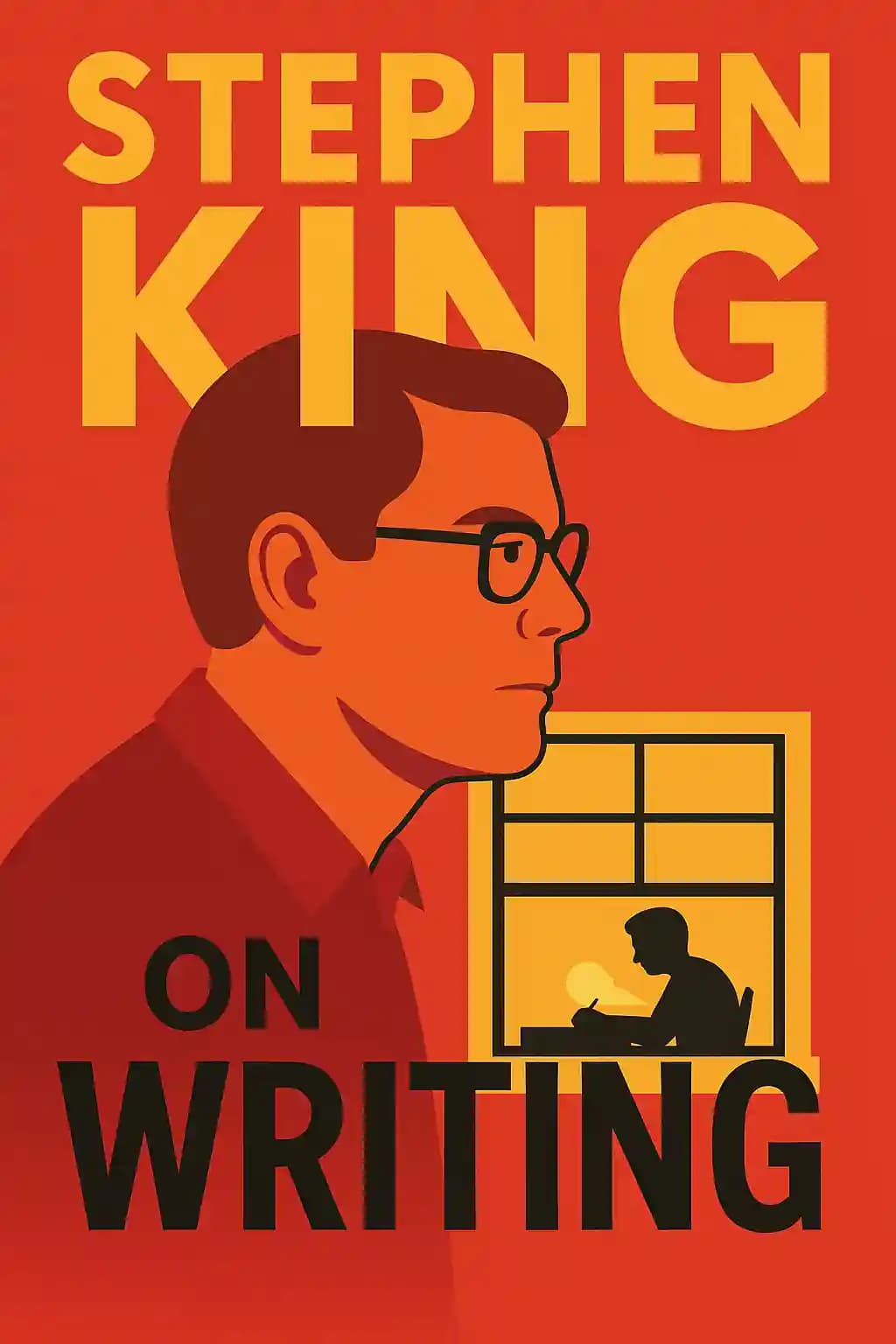
Master storyteller Stephen King reveals the alchemy of writing in his memoir-meets-masterclass. Beloved by fantasy author Brandon Sanderson for its organic approach to narrative, this book's enduring wisdom - "You must not come lightly to the blank page" - has guided countless writers since 2000.
Stephen Edwin King, bestselling author of On Writing: A Memoir of the Craft, is a titan of modern horror and suspense fiction. Born in Portland, Maine, in 1947, King’s career spans over five decades, marked by iconic novels like Carrie, The Shining, and IT, which have collectively sold more than 350 million copies worldwide.
On Writing blends memoir and practical advice, reflecting King’s journey from a struggling English teacher to a literary legend, offering insights into his creative process and resilience.
A master of blending psychological depth with supernatural elements, King’s works explore themes of trauma, resilience, and societal fears. His prolific output includes the fantasy-epic Dark Tower series, crime thrillers like Mr. Mercedes (winner of the Edgar Award), and recent titles such as Holly and Fairy Tale.
Over 100 film and TV adaptations, including The Shawshank Redemption and CBS’s Under the Dome, cement his cultural impact. Translated into 33 languages, King’s books remain staples in global literature, with On Writing hailed as a seminal guide for aspiring authors.
On Writing blends memoir and practical advice, offering Stephen King’s insights into the craft of writing. It covers his journey as an author, foundational techniques like grammar and storytelling, and philosophical principles such as writing with honesty. The book emphasizes “writing the truth” and prioritizing compelling situations over rigid plots, illustrated by King’s experiences with works like Carrie.
Aspiring writers, fans of King’s fiction, and anyone interested in creative writing will find value. The book’s mix of autobiographical anecdotes and actionable tips—like avoiding adverbs and focusing on character-driven narratives—resonates with both beginners and seasoned authors seeking to refine their voice.
Yes, On Writing is widely praised for its candid, no-nonsense approach. King’s advice on storytelling mechanics, revision strategies, and perseverance through rejection provides timeless guidance. Critics note its limited depth on advanced techniques, but it remains essential for understanding writing fundamentals.
King compares a writer’s skills to a multi-level toolbox. The top layer holds basics like vocabulary and grammar, while deeper layers contain advanced tools (e.g., narrative pacing). He stresses mastering simple tools first, advocating for active verbs and minimal adverbs to create vivid, uncluttered prose.
King writes for his wife, Tabitha, whom he calls his “ideal reader.” He envisions her reactions to refine his work, ensuring clarity and emotional impact. This approach helps writers tailor content to a specific audience, fostering authenticity over broad appeal.
King argues adverbs weaken prose by over-explaining dialogue or action (e.g., “she shouted angrily”). He believes strong verbs and context should convey meaning, urging writers to “trust the reader” to interpret subtext without over-direction.
This quote emphasizes drafting freely without external input, then revising with feedback. King advocates isolating oneself during initial creation to preserve authenticity, followed by collaborative refinement to polish the work.
King revises manuscripts to strengthen themes and symbolism after completing the first draft. He recommends cutting 10% of content to eliminate fluff and focusing on coherent narrative flow. Trusted readers then provide critiques to identify blind spots.
Critics argue the book lacks granular advice for advanced writers and glosses over technical aspects like structural editing. Some find King’s “write what you know” mantra restrictive, though others appreciate its emphasis on authenticity.
The book’s focus on storytelling fundamentals—character, truth, and simplicity—remains timeless. As AI tools rise, King’s human-centric advice on voice and emotional resonance offers a counterbalance, ensuring its relevance for new generations of writers.
King insists writers must “tell the truth” through authentic emotions and experiences, even in fiction. He advises drawing from personal knowledge to create relatable characters and scenarios, then expanding into imaginative realms while maintaining emotional honesty.
King’s focus on clarity, audience-centricity, and concise storytelling translates to commercial writing. Identifying a target audience (like King’s “ideal reader”) ensures messaging resonates, while his revision tactics help polish marketing narratives for maximum impact.
Siente el libro a través de la voz del autor
Convierte el conocimiento en ideas atractivas y llenas de ejemplos
Captura ideas clave en un instante para un aprendizaje rápido
Disfruta el libro de una manera divertida y atractiva
Write a lot, read a lot, and tell the truth.
It's good enough to be in a book.
Omit needless words.
If you don't have time to read, you don't have time to write.
Reading is the creative center of a writer's life.
Desglosa las ideas clave de On Writing en puntos fáciles de entender para comprender cómo los equipos innovadores crean, colaboran y crecen.
Experimenta On Writing a través de narraciones vívidas que convierten las lecciones de innovación en momentos que recordarás y aplicarás.
Pregunta cualquier cosa, elige tu estilo de aprendizaje y co-crea ideas que realmente resuenen contigo.

Creado por exalumnos de la Universidad de Columbia en San Francisco
"Instead of endless scrolling, I just hit play on BeFreed. It saves me so much time."
"I never knew where to start with nonfiction—BeFreed’s book lists turned into podcasts gave me a clear path."
"Perfect balance between learning and entertainment. Finished ‘Thinking, Fast and Slow’ on my commute this week."
"Crazy how much I learned while walking the dog. BeFreed = small habits → big gains."
"Reading used to feel like a chore. Now it’s just part of my lifestyle."
"Feels effortless compared to reading. I’ve finished 6 books this month already."
"BeFreed turned my guilty doomscrolling into something that feels productive and inspiring."
"BeFreed turned my commute into learning time. 20-min podcasts are perfect for finishing books I never had time for."
"BeFreed replaced my podcast queue. Imagine Spotify for books — that’s it. 🙌"
"It is great for me to learn something from the book without reading it."
"The themed book list podcasts help me connect ideas across authors—like a guided audio journey."
"Makes me feel smarter every time before going to work"
Creado por exalumnos de la Universidad de Columbia en San Francisco

Obtén el resumen de On Writing como PDF o EPUB gratis. Imprímelo o léelo sin conexión en cualquier momento.
A car accident nearly ended Stephen King's life in 1999. Lying in a hospital bed with his leg shattered in nine places, spine chipped, ribs broken, he faced a question that haunts every creator: would he ever write again? Five weeks later, drenched in sweat and trembling with pain, he sat at his laptop for an hour and forty minutes-his longest time upright since the crash. The words came slowly, like an old man crossing a stream on slippery stones. But they came. This moment of defiance against despair became the second half of "On Writing," a book that has sold over a million copies and transformed how we think about the craft. What makes King's advice so powerful isn't just his 60 novels or 350 million books sold-it's his refusal to romanticize the work. Writing isn't mystical. It's a job requiring two things: read a lot, write a lot. Everything else is just showing up.
Before terrifying millions, Stephen King was a sick kid in Maine copying "Combat Casey" comics word-for-word into a Blue Horse tablet. An ear infection kept him home from first grade, and boredom drove him to imitation. When his mother found him hunched over these pages, she asked why he wasn't writing his own stories. That question unlocked everything. His first creation featured Mr. Rabbit Trick, a magical bunny leading forest animals on adventures. His mother laughed at the right moments, then said words that would sustain him through decades of rejection: "It's good enough to be in a book." She mailed copies to her four sisters, who sent back a dollar-King's first payment as a writer. Later, inspired by "The Pit and the Pendulum," he "novelized" the film, selling three dozen copies at school for twenty-five cents each before the principal shut him down. These early hustles taught him writing was work that could be rewarded. The lesson crystallized when John Gould, editor of the Lisbon Weekly Enterprise, hired teenage King as a sports reporter. Gould's ruthless editing-slashing unnecessary words with red pen-taught King that rewriting meant "taking out all the things that are not the story." That principle would anchor his entire career.
Writers need a well-stocked toolbox. At the top sits vocabulary-not fancy words to impress, but the right words to communicate. King warns against dressing up language out of misguided shame. Use "end" instead of "terminate," "use" instead of "utilize." Hemingway and Steinbeck built empires with straightforward language because writing is about clarity, not performance. Grammar sits beside vocabulary. While you needn't always write complete sentences, following basic rules creates understanding. King particularly despises passive voice ("The meeting will be held" versus "The meeting's at seven") and adverbs cluttering dialogue attribution. Instead of "he said angrily," let the dialogue itself convey emotion. Below these fundamentals lies style-the art of paragraphs, pacing, rhythm. Fiction paragraphs breathe with the narrative's needs. Sometimes a paragraph is one sentence, creating a beat, a pause, a transition. King uses paragraph length like a musician uses tempo. When these tools harmonize, words become sentences, sentences become paragraphs, and those paragraphs quicken and begin to breathe.
If you want to be a writer, you must do two things: read a lot and write a lot. There's no shortcut. King reads seventy to eighty books yearly, mostly fiction-not to study craft but because he loves stories. Yet every book teaches something, and bad books often teach more than good ones by showing what doesn't work. If you don't have time to read, you don't have the tools to write. King's routine is uncompromising: mornings for new writing, afternoons for naps and letters, evenings for reading and family. Once he starts a project, he doesn't stop unless absolutely necessary. Daily writing keeps characters feeling like real people rather than constructs. He sets a daily goal of 2,000 words-about ten pages-which yields a novel in three months. Your writing space doesn't need to be fancy-King wrote his first novels in a trailer's laundry room-but it absolutely needs a door you're willing to close. That closed door tells the world and yourself that you mean business.
Write what you know - not your resume, but your emotional truths and observations. King distrusts plot because life rarely follows neat structures. He sees stories as fossils to excavate, not construct. Instead of plot, he prefers situation - a "What if?" premise. What if vampires invaded a small town? What if a rabid dog trapped a mother and son? *Misery* began with a dream about a captive writer, but the characters took over and created something more complex than planned. Creating characters requires observing real people - how they talk, move, and reveal themselves through small actions. Characters aren't drawn directly from life but must behave reasonably given what we know. Well-developed characters come alive and make their own decisions, often surprising the author and solving storytelling problems. The core ideas: practice is invaluable, honesty is indispensable.
Writing requires two drafts and a polish. After finishing your first draft, celebrate-then set it aside for at least six weeks. This distance is essential. When you return, read the entire manuscript in one sitting if possible. With fresh eyes, you'll spot plot holes and character inconsistencies invisible during daily composition. Make mechanical corrections while asking deeper questions: Is the story coherent? What recurring elements form a theme? Most importantly, identify what you meant so you can reinforce that meaning while cutting material that strays. After revisions, show the manuscript to trusted readers. King's ideal reader is his wife Tabitha-supportive yet unflinching. He also sends manuscripts to four to eight trusted friends. When multiple readers identify the same problem, fix it. If opinions contradict, the tie goes to the writer. One valuable revision principle: "Formula: 2nd Draft = 1st Draft - 10%." Every story is collapsible. If you can't cut 10% while maintaining the essence, you're not trying hard enough. The effect is immediate and amazing-literary Viagra.
Writing isn't about money or fame-it's about enriching lives. King writes for the buzz and pure joy of creation, never thinking about payment. If you write for joy, you can do it forever. The second half of "On Writing" was written during his recovery from a near-fatal accident, proving that writing can be a way back to life. Writing is magic, as much the water of life as any creative art-and the water is free. King's approach strips away the mystique: there are no secret formulas, only the work. Read widely, write regularly, tell the truth as you see it. That's what separates writers from wannabes-the willingness to do the work, day after day, whether inspiration strikes or not. King's final gift is permission: permission to try, to fail, to keep going anyway. So pick up your pen. Close your door. And write.