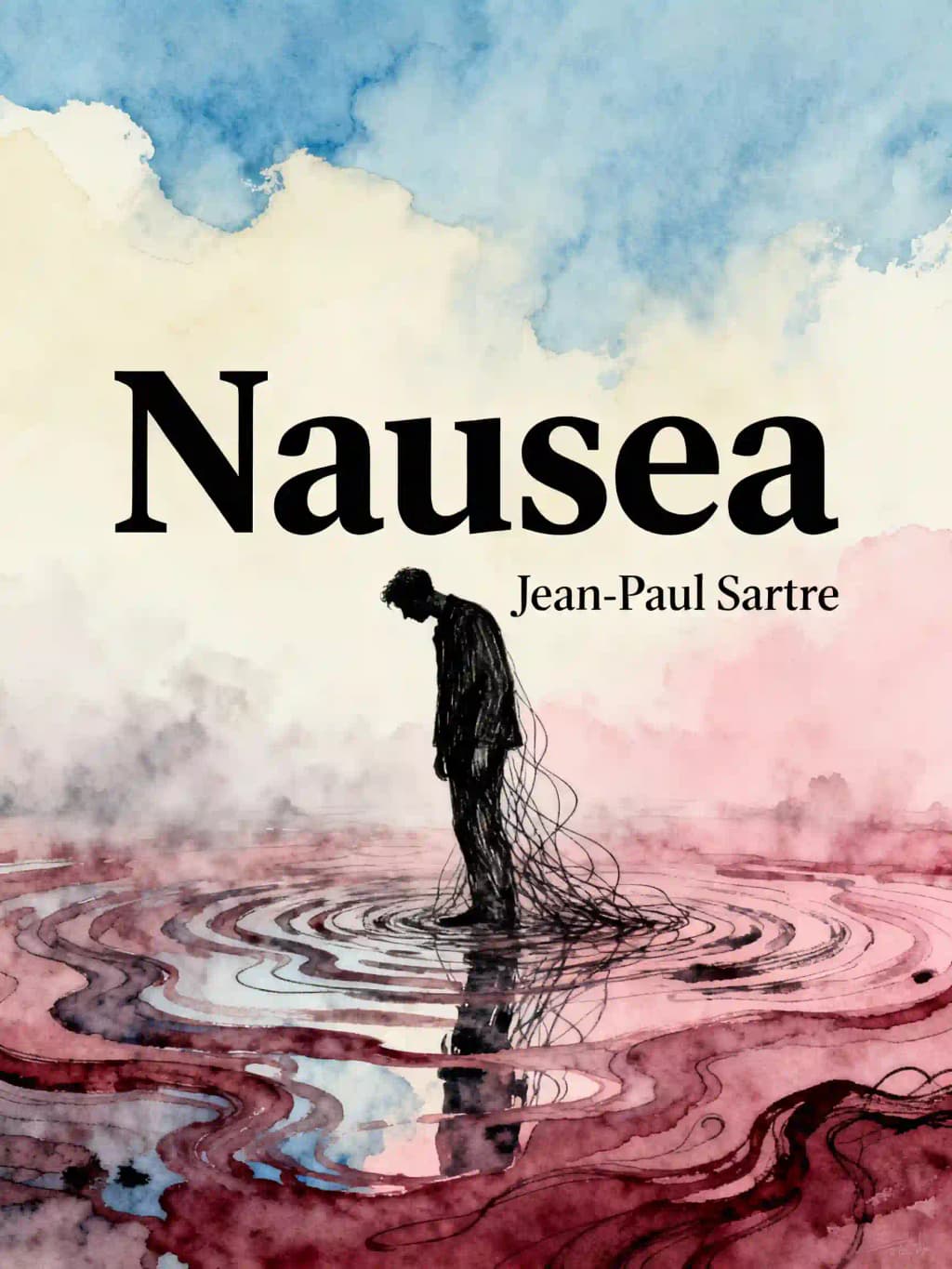
Nausea (Penguin Modern Classics) book cover

Nausea (Penguin Modern Classics)

Jean-Paul Sartre
3.93 (135299 Reviews)

Resumen de Nausea (Penguin Modern Classics)

Sartre's "Nausea" - the 1938 existentialist masterpiece that plunges readers into profound alienation through Antoine Roquentin's crisis. What if meaninglessness itself became physical? This cornerstone of philosophy influenced generations, with Simone de Beauvoir calling it Sartre's first robust expression of contingency and existence.

Temas clave en Nausea (Penguin Modern Classics)

  • existential dread
  • radical freedom
  • ontological contingency
  • absurdity of existence
  • subjective consciousness

Citas de Nausea (Penguin Modern Classics)

  • I am, I exist, I think, therefore I am; I am because I think, why do I think? I don't want to think any more, I am because I think that I don't want to think.

  • I wanted to leave, to go somewhere where I should be really in my place, where I should fit in… but my place was nowhere; I was unwanted.

  • I exist. It is sweet, so sweet, so slow. And heavy: it never stops.

  • Every existing thing is born without reason, prolongs itself out of weakness, and dies by chance.

Personajes en Nausea (Penguin Modern Classics)

  • Antoine RoquentinA historian and the protagonist facing nausea
  • Marquis de RollebonAn obscure aristocrat and Roquentin's research subject
  • AnnyRoquentin's former lover living in Paris
  • The Self-Taught ManA lonely acquaintance of Roquentin in Bouville

Sobre el Autor

Sobre el autor de Nausea (Penguin Modern Classics)

Jean-Paul Charles Aymard Sartre (1905–1980), the groundbreaking existentialist philosopher and Nobel Prize-winning author, wrote Nausea as a seminal exploration of human consciousness and the absurdity of existence. A leading figure in 20th-century philosophy, Sartre studied at Paris’s École Normale Supérieure and taught phenomenology before becoming a full-time writer.

His existentialist themes—radical freedom, personal responsibility, and the void of inherent meaning—permeate Nausea, a philosophical novel following protagonist Antoine Roquentin’s confrontation with existential dread.

Sartre’s authority stems from his iconic works like Being and Nothingness and the play No Exit, which systematized existentialist thought. His ideas on “bad faith” and “existence precedes essence” revolutionized ethics and psychology.

Despite declining the 1964 Nobel Prize in Literature to avoid institutionalization, Sartre remains a cultural touchstone, with Nausea consistently ranked among history’s most influential philosophical novels. Translated into over 50 languages, his works remain required reading in philosophy curricula worldwide.

Descargar resumen de Nausea (Penguin Modern Classics)

Obtén el resumen de Nausea (Penguin Modern Classics) como PDF o EPUB gratis. Imprímelo o léelo sin conexión en cualquier momento.

Preguntas Frecuentes Sobre Este Libro

Nausea follows Antoine Roquentin, a historian grappling with existential angst as he confronts the absurdity of existence. Through his diary entries, Sartre explores themes of isolation, freedom, and the meaningless of life, symbolized by Roquentin’s overwhelming “nausea” when realizing reality’s lack of inherent purpose. The novel is a cornerstone of existentialist literature, blending philosophical inquiry with introspective narrative.

This book suits readers interested in existential philosophy, modernist literature, or psychological introspection. Philosophy students, admirers of Sartre’s works, and those exploring themes of human freedom and authenticity will find it compelling. Its dense, reflective style appeals to fans of Camus or Dostoevsky, though it may challenge those seeking plot-driven stories.

Yes, Nausea is a seminal existentialist work that profoundly examines the human condition. While its abstract style and lack of conventional plot may deter some, its exploration of freedom, identity, and existential dread offers enduring relevance. It’s ideal for readers seeking philosophical depth and literary innovation.

Sartre argues that existence precedes essence: humans define themselves through actions, not predetermined purpose. Roquentin’s “nausea” symbolizes the anguish of recognizing life’s arbitrariness, urging individuals to embrace freedom and create meaning despite inherent absurdity.

The titular nausea represents Roquentin’s visceral awareness of existence’s meaninglessness. It manifests as a physical revulsion toward objects and routines, reflecting his realization that reality lacks inherent structure or purpose. This metaphor encapsulates existentialism’s focus on confronting life’s absurdity.

The novel popularized existentialist ideas like radical freedom and the absurd. Sartre’s portrayal of Roquentin’s crisis illustrated existentialism’s core tenets, influencing thinkers like Simone de Beauvoir and Albert Camus. It also introduced literary techniques to convey philosophical concepts, bridging fiction and theory.

  • “Existence is a fullness which man can never abandon.”
    Highlights the inescapable burden of conscious existence.
  • “Everything is gratuitous, this garden, this city, and myself.”
    Emphasizes life’s lack of inherent meaning.
  • “I am free: there is absolutely no more reason for living.”
    Reflects the terror and liberation of absolute freedom.

Critics note its dense prose, minimal plot, and overly abstract themes, which can alienate casual readers. Some argue it prioritizes philosophical ideas over character development. However, its intellectual rigor and innovative style are widely praised.

Roquentin’s realization that life lacks predefined meaning forces him to confront his freedom to create purpose. Sartre suggests that embracing this freedom—despite its accompanying dread—is essential to authentic existence, a central thesis in his later work Being and Nothingness.

The novel introduces themes expanded in Sartre’s philosophical treatise Being and Nothingness, such as bad faith and consciousness. It also shares existential motifs with plays like No Exit and aligns with Simone de Beauvoir’s ethical explorations in The Ethics of Ambiguity.

Roquentin finds mundane objects—a chestnut tree, a tram seat—triggering existential dread. These moments reveal Sartre’s view that routine obscures life’s inherent absurdity, urging readers to question familiar realities.

Its themes resonate in modern contexts like anxiety, alienation, and searches for meaning in a chaotic world. The novel’s critique of complacency and emphasis on self-determination remain pertinent to discussions about mental health and societal conformity.

Unlike Camus’ The Stranger, which focuses on detached absurdity, Nausea delves into the emotional turmoil of existential awakening. It shares introspective depth with Dostoevsky’s Notes from Underground but uses modernist techniques to fragment narrative structure.

  • Existence precedes essence: Humans define themselves through choices.
  • Bad faith: Self-deception to avoid freedom’s burden.
  • The absurd: Life’s lack of inherent meaning.
    These ideas are explored through Roquentin’s psychological journey.

Explora Tu Forma de Aprender

Nausea (Penguin Modern Classics) no es solo un libro — es una clase magistral en Philosophy. Para ayudarte a absorber sus lecciones de la manera que mejor te funcione, ofrecemos cinco modos de aprendizaje únicos. Ya seas un pensador profundo, un aprendiz rápido o un amante de las historias, hay un modo diseñado para tu estilo.

Modo Personalizar

Experimenta Nausea (Penguin Modern Classics) con tu propio estilo de aprendizaje

Pregunta cualquier cosa, elige tu estilo de aprendizaje y co-crea ideas que realmente resuenen contigo.

Personalize Mode

Creado por exalumnos de la Universidad de Columbia en San Francisco

BeFreed Reúne a una Comunidad Global de Mentes Curiosas

"Instead of endless scrolling, I just hit play on BeFreed. It saves me so much time."

@Moemenn
platform
star
star
star
star
star

"I never knew where to start with nonfiction—BeFreed’s book lists turned into podcasts gave me a clear path."

@Chloe, Solo founder, LA
platform
comments
12
likes
117

"Perfect balance between learning and entertainment. Finished ‘Thinking, Fast and Slow’ on my commute this week."

@Raaaaaachelw
platform
star
star
star
star
star

"Crazy how much I learned while walking the dog. BeFreed = small habits → big gains."

@Matt, YC alum
platform
comments
12
likes
108

"Reading used to feel like a chore. Now it’s just part of my lifestyle."

@Erin, Investment Banking Associate , NYC
platform
comments
254
likes
17

"Feels effortless compared to reading. I’ve finished 6 books this month already."

@djmikemoore
platform
star
star
star
star
star

"BeFreed turned my guilty doomscrolling into something that feels productive and inspiring."

@Pitiful
platform
comments
96
likes
4.5K

"BeFreed turned my commute into learning time. 20-min podcasts are perfect for finishing books I never had time for."

@SofiaP
platform
star
star
star
star
star

"BeFreed replaced my podcast queue. Imagine Spotify for books — that’s it. 🙌"

@Jaded_Falcon
platform
comments
201
thumbsUp
16

"It is great for me to learn something from the book without reading it."

@OojasSalunke
platform
star
star
star
star
star

"The themed book list podcasts help me connect ideas across authors—like a guided audio journey."

@Leo, Law Student, UPenn
platform
comments
37
likes
483

"Makes me feel smarter every time before going to work"

@Cashflowbubu
platform
star
star
star
star
star

"Instead of endless scrolling, I just hit play on BeFreed. It saves me so much time."

@Moemenn
platform
star
star
star
star
star

"I never knew where to start with nonfiction—BeFreed’s book lists turned into podcasts gave me a clear path."

@Chloe, Solo founder, LA
platform
comments
12
likes
117

"Perfect balance between learning and entertainment. Finished ‘Thinking, Fast and Slow’ on my commute this week."

@Raaaaaachelw
platform
star
star
star
star
star

"Crazy how much I learned while walking the dog. BeFreed = small habits → big gains."

@Matt, YC alum
platform
comments
12
likes
108

"Reading used to feel like a chore. Now it’s just part of my lifestyle."

@Erin, Investment Banking Associate , NYC
platform
comments
254
likes
17

"Feels effortless compared to reading. I’ve finished 6 books this month already."

@djmikemoore
platform
star
star
star
star
star

"BeFreed turned my guilty doomscrolling into something that feels productive and inspiring."

@Pitiful
platform
comments
96
likes
4.5K

"BeFreed turned my commute into learning time. 20-min podcasts are perfect for finishing books I never had time for."

@SofiaP
platform
star
star
star
star
star

"BeFreed replaced my podcast queue. Imagine Spotify for books — that’s it. 🙌"

@Jaded_Falcon
platform
comments
201
thumbsUp
16

"It is great for me to learn something from the book without reading it."

@OojasSalunke
platform
star
star
star
star
star

"The themed book list podcasts help me connect ideas across authors—like a guided audio journey."

@Leo, Law Student, UPenn
platform
comments
37
likes
483

"Makes me feel smarter every time before going to work"

@Cashflowbubu
platform
star
star
star
star
star

"Instead of endless scrolling, I just hit play on BeFreed. It saves me so much time."

@Moemenn
platform
star
star
star
star
star

"I never knew where to start with nonfiction—BeFreed’s book lists turned into podcasts gave me a clear path."

@Chloe, Solo founder, LA
platform
comments
12
likes
117

"Perfect balance between learning and entertainment. Finished ‘Thinking, Fast and Slow’ on my commute this week."

@Raaaaaachelw
platform
star
star
star
star
star

"Crazy how much I learned while walking the dog. BeFreed = small habits → big gains."

@Matt, YC alum
platform
comments
12
likes
108

"Reading used to feel like a chore. Now it’s just part of my lifestyle."

@Erin, Investment Banking Associate , NYC
platform
comments
254
likes
17

"Feels effortless compared to reading. I’ve finished 6 books this month already."

@djmikemoore
platform
star
star
star
star
star

"BeFreed turned my guilty doomscrolling into something that feels productive and inspiring."

@Pitiful
platform
comments
96
likes
4.5K

"BeFreed turned my commute into learning time. 20-min podcasts are perfect for finishing books I never had time for."

@SofiaP
platform
star
star
star
star
star

"BeFreed replaced my podcast queue. Imagine Spotify for books — that’s it. 🙌"

@Jaded_Falcon
platform
comments
201
thumbsUp
16

"It is great for me to learn something from the book without reading it."

@OojasSalunke
platform
star
star
star
star
star

"The themed book list podcasts help me connect ideas across authors—like a guided audio journey."

@Leo, Law Student, UPenn
platform
comments
37
likes
483

"Makes me feel smarter every time before going to work"

@Cashflowbubu
platform
star
star
star
star
star

¿Ver Más Historias?

Cómo la gente habla de BeFreed en la web
1.5K Ratings4.7
Comienza tu viaje de aprendizaje, ahora