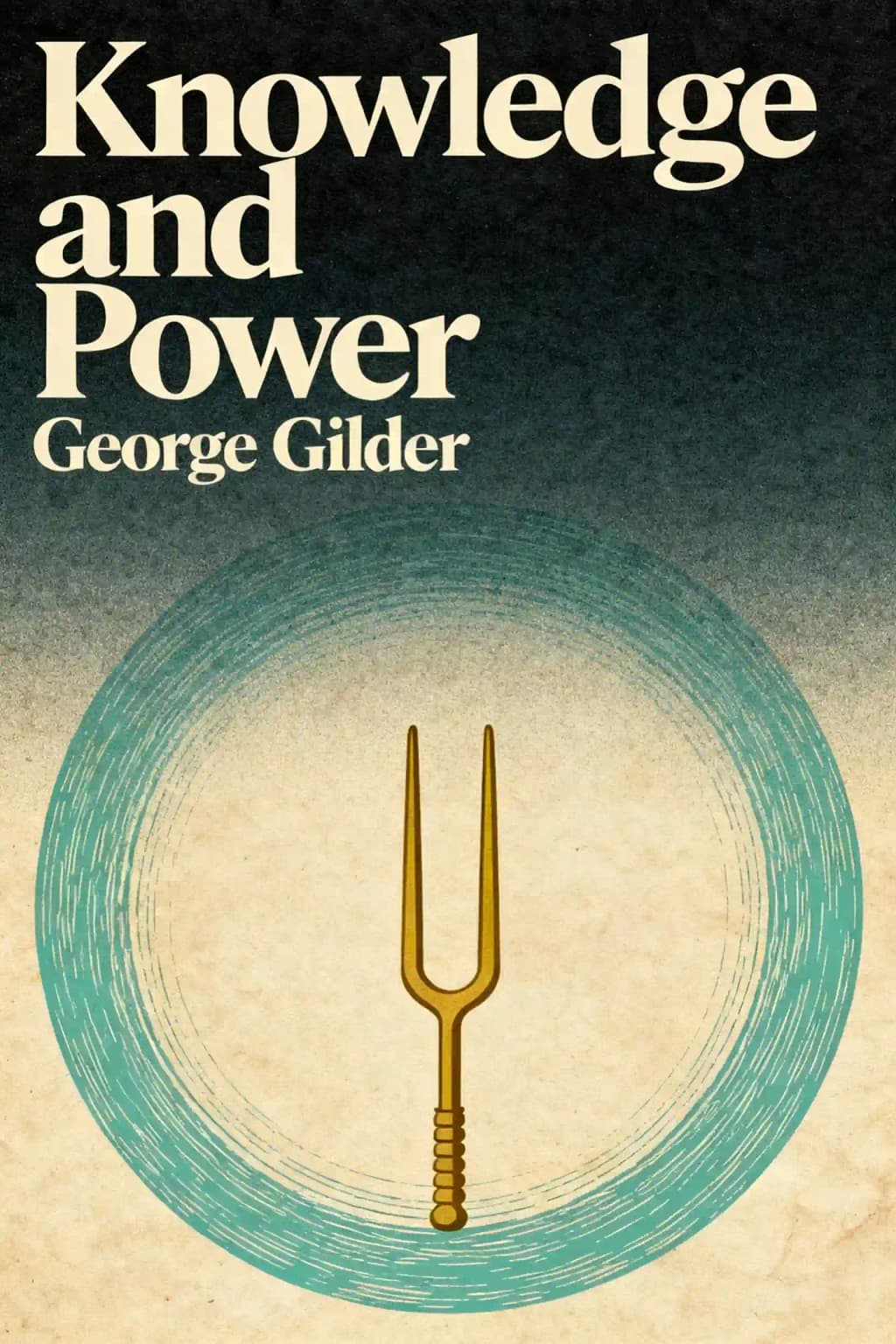
George Gilder's revolutionary economic masterpiece applies information theory to capitalism, earning Steve Forbes' declaration that it "will reshape economics." Reagan's most-quoted author challenges conventional wisdom, positioning entrepreneurs as innovation drivers while government regulation distorts the vital signals powering true prosperity.
George Franklin Gilder is the author of Knowledge and Power: The Information Theory of Capitalism and How it is Revolutionizing our World and a pioneering economist and technology visionary. Born in 1939, Gilder studied under Henry Kissinger at Harvard and became a leading architect of supply-side economics.
His exploration of how information theory shapes capitalism draws on decades of research into wealth creation and technological innovation, alongside his role as Chairman of George Gilder Fund Management and co-founder of the Discovery Institute.
Gilder's influential works include the million-copy bestseller Wealth and Poverty (1981), which became required reading in the Reagan White House, as well as Telecosm, Microcosm, and Life After Google. He was President Reagan's most frequently quoted living author and received the White House Award for Entrepreneurial Excellence in 1986. Across 19 books, Gilder has established himself as one of America's most prescient analysts of technology, capitalism, and the information age.
Knowledge and Power by George Gilder applies information theory to capitalism, arguing that economic growth stems from entrepreneurial knowledge rather than government planning. Gilder presents capitalism as an information system where entrepreneurs generate high-entropy, surprising innovations that create wealth. The book contrasts the creative knowledge of business owners with government regulation, which Gilder views as "noise" that disrupts economic information flow and causes crises like the 2008 financial collapse.
George Gilder is an American economist, investor, and author born in 1939 who co-founded the Discovery Institute. His 1981 bestseller Wealth and Poverty became President Reagan's most-quoted living author and established him as a pioneer of supply-side economics. Gilder wrote Knowledge and Power to present a new economic paradigm moving beyond traditional supply-side models, focusing instead on information theory as the foundation for understanding how capitalism creates wealth.
Knowledge and Power is worth reading for those seeking an unconventional perspective on capitalism and economic policy. The book offers fresh insights into financial crises, entrepreneurship, and government intervention through the lens of information theory. However, reviewers note it's a challenging read that requires patience. It's particularly valuable for fiscal conservatives, business owners, CEOs, and investors interested in understanding how knowledge and innovation drive economic growth.
Knowledge and Power is ideal for entrepreneurs, investors, policymakers, and business leaders seeking to understand modern capitalism through information theory. The book benefits readers interested in supply-side economics, venture capital, and technological innovation's role in economic growth. Fiscal conservatives and those critical of government intervention will find Gilder's arguments compelling, while economists and financial professionals gain unique explanations for market volatility and financial crises through an information-driven framework.
The information theory of capitalism in Knowledge and Power defines economic progress through information entropy and surprise rather than equilibrium. Drawing from Claude Shannon's work, Gilder argues that information equals unexpected, high-entropy innovations created by entrepreneurs. These surprises drive growth when transmitted through low-entropy carriers like stable property rights, sound money, and rule of law. Markets function as information systems coordinating dispersed knowledge, with entrepreneurial disruption generating the profitable surprises that fuel capitalism.
George Gilder argues in Knowledge and Power that entrepreneurs are creators who invest resources without guaranteed returns, generating surprising innovations that meet unexpressed consumer needs. Their wealth reflects superior knowledge and continuous reinvestment rather than greed or privilege. Gilder presents profits as an "altruism index" measuring value created for others, with successful entrepreneurs bound to their enterprises through constant customer service. This contrasts sharply with government bureaucrats who lack skin in the game and accountability.
Knowledge and Power portrays government as a source of "noise" that distorts economic information flows and suppresses entrepreneurial knowledge. George Gilder argues that excessive regulation, taxation, subsidies, and bureaucratic mandates obscure the information entrepreneurs need to allocate resources efficiently. When government intervenes through spending programs or protectionism, it creates rational decisions based on massive ignorance rather than irrational behavior. This information disruption, not market failures, causes economic crises and inefficiency according to Gilder's framework.
In Knowledge and Power, George Gilder argues that capitalism begins with entrepreneurial "giving"—investments made without guaranteed returns that create value before any exchange occurs. This challenges traditional economic models that view markets purely as transactional exchanges. Entrepreneurs commit capital and resources upfront as gifts to potential customers, taking risks based on knowledge and vision rather than certainty. Only after this initial giving succeeds do profitable exchanges emerge, making altruistic risk-taking the foundation of wealth creation rather than self-interested bargaining.
Knowledge and Power explains the 2008 financial crisis through information mismatches and regulatory noise rather than market greed or deregulation. George Gilder argues that government intervention through housing subsidies, monetary manipulation, and regulatory mandates distorted information flows in financial markets. This created rational decisions based on corrupted signals—like inflated housing prices and mispriced risk—leading to systemic failure. The crisis exemplifies how government "noise" disrupts the knowledge-power linkage essential for efficient capital allocation and entrepreneurial decision-making.
High-entropy information in Knowledge and Power refers to surprising, unpredictable innovations that carry genuine economic knowledge and value. Drawing from Claude Shannon's information theory, George Gilder argues that true information is measured by its surprise factor—predictable patterns contain no new knowledge. Entrepreneurs generate high-entropy information through disruptive products, business models, and technologies that couldn't be anticipated by planning or equilibrium models. This entrepreneurial entropy drives economic growth by creating value through genuine novelty and creative destruction.
While Wealth and Poverty established George Gilder as a supply-side economics pioneer during the Reagan administration, Knowledge and Power moves beyond supply-side models to present information theory as capitalism's foundation. Wealth and Poverty focused on traditional supply-side arguments about tax policy and incentives. Knowledge and Power deepens this analysis by framing capitalism as an epistemic system where entrepreneurial knowledge battles government power. Both books champion free markets and criticize government intervention, but Knowledge and Power provides a more sophisticated theoretical framework.
Critics note that Knowledge and Power is a challenging, dense read that requires significant effort and patience from readers. Some reviewers find Gilder's application of information theory to economics unconventional and potentially overstated. The book's strong anti-government stance and portrayal of regulation as purely negative "noise" may oversimplify complex policy tradeoffs. Additionally, Gilder's almost Randian perspective on wealth creators versus government redistributors can come across as ideological rather than balanced. Despite these critiques, reviewers acknowledge the book's creative and penetrating examination of wealth creation.
Siente el libro a través de la voz del autor
Convierte el conocimiento en ideas atractivas y llenas de ejemplos
Captura ideas clave en un instante para un aprendizaje rápido
Disfruta el libro de una manera divertida y atractiva
Economics has strangely attempted to eliminate surprise.
Information represents the difference between what we knew before and after transmission.
The fundamental flaw in economics is treating it as a system of markets without acknowledging the entrepreneurs who drive change.
The central failure of economics has been its inability to grasp the centrality of entrepreneurial creation.
Desglosa las ideas clave de Knowledge and power en puntos fáciles de entender para comprender cómo los equipos innovadores crean, colaboran y crecen.
Destila Knowledge and power en pistas de memoria rápidas que resaltan los principios clave de franqueza, trabajo en equipo y resiliencia creativa.

Experimenta Knowledge and power a través de narraciones vívidas que convierten las lecciones de innovación en momentos que recordarás y aplicarás.
Pregunta lo que quieras, elige la voz y co-crea ideas que realmente resuenen contigo.

Creado por exalumnos de la Universidad de Columbia en San Francisco
"Instead of endless scrolling, I just hit play on BeFreed. It saves me so much time."
"I never knew where to start with nonfiction—BeFreed’s book lists turned into podcasts gave me a clear path."
"Perfect balance between learning and entertainment. Finished ‘Thinking, Fast and Slow’ on my commute this week."
"Crazy how much I learned while walking the dog. BeFreed = small habits → big gains."
"Reading used to feel like a chore. Now it’s just part of my lifestyle."
"Feels effortless compared to reading. I’ve finished 6 books this month already."
"BeFreed turned my guilty doomscrolling into something that feels productive and inspiring."
"BeFreed turned my commute into learning time. 20-min podcasts are perfect for finishing books I never had time for."
"BeFreed replaced my podcast queue. Imagine Spotify for books — that’s it. 🙌"
"It is great for me to learn something from the book without reading it."
"The themed book list podcasts help me connect ideas across authors—like a guided audio journey."
"Makes me feel smarter every time before going to work"
Creado por exalumnos de la Universidad de Columbia en San Francisco

Obtén el resumen de Knowledge and power como PDF o EPUB gratis. Imprímelo o léelo sin conexión en cualquier momento.
In 1948, while unicycling through Bell Labs hallways, Claude Shannon quietly published what Bill Gates would later call "the Magna Carta of the Information Age." This unassuming paper, "Mathematical Theory of Communication," laid the groundwork for our entire digital world-yet most people have never heard Shannon's name. His revolutionary insight was deceptively simple: information isn't about order or predictability-it's fundamentally about surprise. This revelation doesn't just explain how your smartphone works; it offers the missing piece in our understanding of economics, innovation, and human creativity itself. What makes this insight so powerful? Consider how we typically think about information. We imagine it as organized data, neatly structured knowledge. Shannon turned this on its head. The more predictable something is, the less information it contains. A message stating "the sun will rise tomorrow" carries almost no information because everyone expects it. But "a meteor will strike Earth tomorrow" is information-rich because it's unexpected. This principle-that information equals surprise-isn't just a technical curiosity. It's the key to understanding why economies grow, why innovation happens, and why traditional economics has failed to explain the extraordinary explosion of human prosperity.