Capítulo 1
The Sacralization of History: Islam's Unique Quest for God
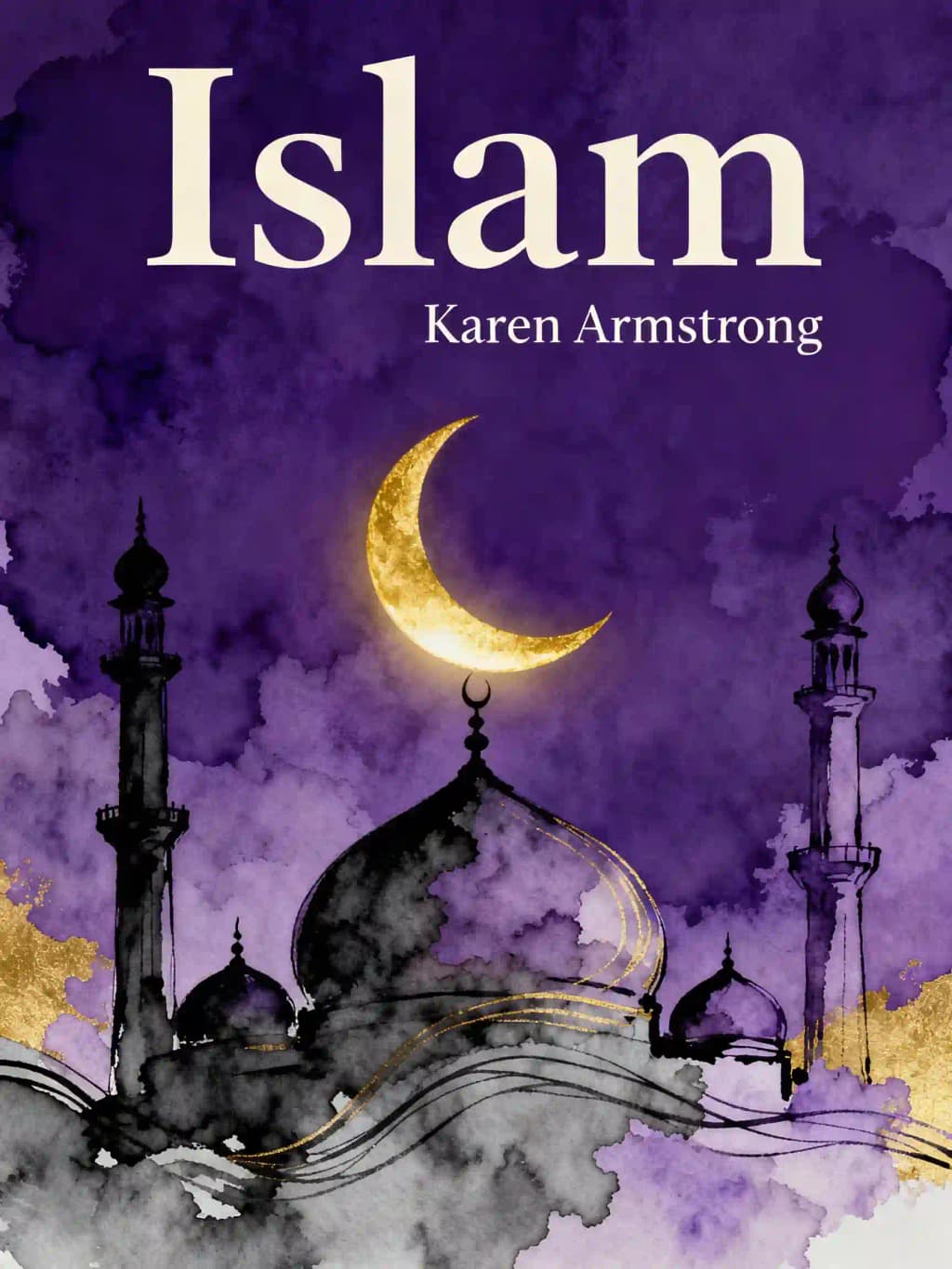
In a world where spirituality is often viewed as an interior journey separate from worldly affairs, Islam stands apart. While many faiths seek God in contemplation or mystical experience, Muslims uniquely look for divine presence within history itself. Since its inception, Islam has maintained that creating a just society is not merely a political goal but a sacred mission-the very essence of spiritual practice. This "sacralization of history" distinguishes Islam from other major religions and explains why, for Muslims, politics has never been separate from faith but rather its practical manifestation. Karen Armstrong's masterful exploration of this tradition has become required reading in universities worldwide and earned praise from religious scholars across faiths. Even celebrities like Malala Yousafzai and Kareem Abdul-Jabbar have cited it as essential for understanding Islam beyond headlines. As religious literacy becomes increasingly crucial in our interconnected world, Armstrong's work provides the historical context needed to appreciate how Muslims have continuously sought the divine within the unfolding of human events.
Capítulo 2
The Prophet's Revolution: Social Justice and Compassion
In 610 CE, Muhammad ibn Abdallah received his first revelation while meditating in a cave on Mount Hira near Mecca. This transformative experience launched a movement that would fundamentally reshape Arabian society and eventually much of the world. Muhammad's message was deceptively simple: the Quraysh tribe must return to belief in Allah and create a just community where wealth is shared equitably. This wasn't merely a spiritual calling but a social revolution.
What's often overlooked is that Muhammad never claimed to be founding a new religion. He insisted he was continuing the same message brought by earlier prophets like Abraham, Moses, and Jesus. The Quran emphasized that "there shall be no coercion in matters of faith" and commanded Muslims to respect Jews and Christians as "people of an earlier revelation." This inclusivity stands in stark contrast to modern stereotypes about Islam's origins.
Muhammad's approach to reform was remarkably pragmatic. Rather than abolishing traditional practices outright, he maintained familiar rituals at the Kabah while infusing them with monotheistic meaning. When persecution intensified in Mecca, Muhammad and his followers made the hijrah (migration) to Yathrib in 622, marking year one of the Islamic calendar. There, he established the first true Muslim community (ummah), revolutionizing social organization by uniting diverse tribes not through blood ties but through shared ideology.
In Medina, Muhammad built a simple mosque that served as both religious center and community headquarters-a physical embodiment of the Islamic principle of tawhid (unity) where no aspect of life stands separate from faith. This integration of spiritual and worldly concerns remains fundamental to Islamic thought.
Perhaps most progressive for his time was Muhammad's commitment to women's emancipation. The Quran granted women inheritance rights, property ownership, and divorce options centuries before Western women would gain similar protections. Imagine living in 7th century Arabia where female infanticide was practiced, and suddenly encountering a spiritual leader who insisted women had inherent dignity and legal rights!
Muhammad's community building wasn't without challenges. Though initially hopeful about working with Medina's Jewish tribes, their rejection of his prophethood disappointed him deeply. However, his discovery of Abraham's connection to Arabs through Ishmael provided a monotheistic heritage that helped establish a distinct Islamic identity while maintaining connection to earlier revelations.
Capítulo 3
The First Civil War: Testing the Community's Foundations
The period of triumph under the early caliphs ended abruptly with Umar's assassination in 644. His successor Uthman initially governed well but growing discontent emerged among soldiers over campaign conditions, while accusations of nepotism for appointing Umayyad family members to key positions created a political crisis. When mutinous soldiers from Fustat assassinated Uthman in 656, they acclaimed Ali ibn Abi Talib-Muhammad's cousin and son-in-law-as caliph.
Despite Ali's close relationship to the Prophet, his rule was immediately contested. Muhammad's widow Aisha, along with prominent companions Talhah and Zubayr, attacked Ali for not punishing Uthman's murderers. Meanwhile, Muawiyyah, governor of Syria and head of the Umayyad family, refused to accept Ali's authority altogether. This conflict plunged the young Muslim community into its first civil war (fitnah).
What's fascinating about this early crisis is how it established patterns of division that would shape Islamic history for centuries. Failed negotiations at Siffin in 657 led to deeper fractures when Ali agreed to arbitration, prompting extremist Kharajites to secede from his supporters. These Kharajites held that leadership should be based solely on piety rather than tribal connections or family ties to the Prophet-a radically egalitarian position that nonetheless led them to violent extremism.
Ali's harsh suppression of the Kharajite revolt cost him crucial support, and he was eventually assassinated by a Kharajite in 661. His son Hasan briefly succeeded him before reaching an agreement with Muawiyyah and retiring to Medina. This first civil war reveals how quickly the ideal of a unified ummah faced practical challenges, forcing Muslims to develop theological positions about legitimate leadership that would eventually crystallize into the Sunni-Shia divide.
The fitnah raises profound questions that Muslims still wrestle with today: Should rulers be chosen for their piety or political skill? Does bloodline connection to the Prophet matter? How should Muslims respond to unjust leadership? These weren't merely theoretical debates but urgent practical matters that shaped how Islam would develop as both a spiritual tradition and a framework for governance.
Capítulo 4
The Evolution of Islamic Piety: From Politics to Spirituality
The civil wars prompted fundamental questions about Islamic leadership and society. From these political discussions emerged the distinctive piety and religious practices that would define Islam. As the community struggled with questions of legitimate authority, various movements developed different approaches to Islamic life.
Hasan al-Basri (d. 728) became the prototype of a new Muslim piety, developing a spirituality based on worldly detachment that echoed the Prophet's ascetic lifestyle. Living frugally in an era of growing court luxury, his simple existence served as implicit criticism of the ruling elite. He supported the Qadariyyah theology, which held that humans had free will and therefore rulers must be accountable for their actions-a position with obvious political implications.
The Mutazilites, founded by Hasan's pupil Wasan ibn Ata, took a moderate position between extremes. They emphasized God's justice and human free will while criticizing exploitation of the poor. Their rational approach to theology would later influence Islamic philosophy. Meanwhile, the Murjites "postponed" judgment between Ali and Muawiyyah, focusing on interior disposition rather than outward actions. This allowed them to maintain community unity while avoiding divisive political positions.
Abu Hanifah (699-767), a Murjite, pioneered systematic jurisprudence (fiqh), establishing legal norms to implement Quranic principles in everyday society. His work began the process of translating Islam's ethical vision into practical guidelines for community life. Early jurists collected hadith (reports about the Prophet) and analyzed sunnah (customary practices) to develop comprehensive legal systems that would allow Muslims to live according to divine guidance in changing circumstances.
Islamic historiography also emerged from these discussions as scholars like Muhammad ibn Ishaq collected accounts of the Prophet's life to understand proper governance. By studying how Muhammad had resolved conflicts and organized society, Muslims hoped to recapture the spirit of the original community.
What's remarkable about this period is how theological, legal, and historical scholarship all developed from essentially political questions. Unlike some religious traditions that separate spiritual concerns from worldly matters, Islamic intellectual traditions emerged precisely from wrestling with how to embody divine principles in human society. This integration of spiritual and social concerns remains characteristic of Islamic thought today.
Capítulo 5
The Abbasid Golden Age: Flourishing Under Decentralization
The Abbasids overthrew the Umayyads in 750 after gaining support by presenting themselves as Shii sympathizers, but quickly shed this religious camouflage to establish an absolute monarchy. The first Abbasid caliph, Abu al-Abbas al-Saffah, massacred the Umayyad family, while his successor Abu Jafar al-Mansur eliminated threatening Shii leaders. The caliphs adopted titles suggesting divine right, with al-Mansur's son styling himself al-Mahdi (the Guided One).
Under Harun al-Rashid (786-809), the transformation to Persian-style autocracy was complete. The caliph ruled in isolation with elaborate court rituals, styled as the "Shadow of God on earth," with governance delegated to viziers. Despite being politically un-Islamic in many ways, the regime brought unprecedented peace and cultural flourishing. This period saw remarkable advances in literature, philosophy, science, medicine, and mathematics that would later help spark Europe's Renaissance.
Muhammad ibn Idris al-Shafii's groundbreaking work systematized Islamic jurisprudence, leading to authoritative hadith collections by scholars like al-Bukhari and Muslim. These collections created a homogeneous religious life based on the Shariah throughout the empire. By imitating the Prophet's external life in minute detail, Muslims sought to acquire his interior attitude of perfect surrender to God. The Shariah made Muhammad a living presence in believers' lives while also serving as political protest against perceived corruption.
After Harun al-Rashid's death, civil war erupted between his sons (809-13), revealing the empire's fragility. Al-Mamun's reign (813-33) saw him unsuccessfully attempt to reconcile religious tensions by supporting the rationalist Mutazilites, which only alienated the masses. Later caliphs oscillated between religious factions while the Turkish slave army grew increasingly powerful.
By the tenth century, Islamdom could no longer function as a single political unit. The Abbasid caliph remained the nominal head with symbolic religious function, but regions were governed independently by various dynasties. What appeared to be political disintegration actually proved more congenial to the Muslim spirit. Islamic culture flourished during this political turbulence as multiple regional capitals replaced Baghdad as cultural centers. Cairo became vital under the Fatimids, establishing al-Azhar college which would become the world's most important Islamic university. Samarkand saw a Persian literary renaissance, while Cordova experienced cultural florescence with poetry resembling French troubadour traditions.
This decentralized system made the empire more genuinely Islamic in many ways. Muslims identified with an international society represented by the ulama rather than with ephemeral states. As Sufism gained popularity, ordinary people's faith deepened with an interior dimension. Sufi orders (tariqahs) formed international networks, creating another source of unity across the decentralized empire.
Capítulo 6
Esoteric Movements: The Inner Dimensions of Islam
During the Abbasid period, four complex forms of Islamic philosophy emerged that appealed to spiritual and intellectual elites. These esoteric movements kept their teachings relatively secret through taqiyyah (dissimulation)-partly for self-protection in times of persecution and partly because they believed their insights required contemplative context to be properly understood.
The Ismailis developed a fascinating cyclical view of history marked by six great prophets (Adam, Noah, Abraham, Moses, Jesus, Muhammad), each with an "executor" who taught the secret meaning of their message. Ali was Muhammad's executor, and they believed the seventh prophet, the Mahdi, would inaugurate the final reign of justice. Their spiritual exegesis (tawil) directed worshippers beyond literal scripture to hidden divine reality. They insisted no single revelation could be definitive since "He Whom the boldness of thought cannot contain" was always greater than human understanding.
The Faylasufs embraced Greek rationalism, believing it the highest form of religion. They sought to reconcile Aristotelian and Plotinian concepts with the Quran, though their philosophical deity often differed significantly from the personal Allah of popular devotion. They viewed human reason as a reflection of God's Absolute Reason, and believed that by purifying their intellects, humans could ascend from worldly multiplicity to divine unity. Al-Kindi, the first major Faylasuf, applied Aristotle's proof of the First Cause to the Quranic God. Al-Farabi went further, seeing philosophy as higher than revealed religion, though he believed Shii Islam could prepare Muslims for a society ruled by a philosopher-king.
Sufism emerged as a reaction against worldliness and legalism, seeking to reproduce Muhammad's interior state of islam (surrender). Unlike the establishment's growing exclusivity, Sufis appreciated other religious traditions, even venerating Jesus as the ideal Sufi. They developed mystical techniques including rhythmic breathing, fasting, and chanting divine names. Some "drunken Sufis" like al-Bistami experienced ecstatic union with Allah, while "sober Sufis" like Junayd of Baghdad emphasized self-possession and the return to humanity's natural state.
What makes these movements so fascinating is their creative adaptation of Islam to new intellectual and spiritual needs. Though Muhammad and Ali would hardly have recognized these evolved forms of Islam, this adaptability proved Islam's capacity to speak meaningfully to Muslims living in vastly different conditions. Despite their differences, all these movements remained deeply political, acutely aware that the empire fell short of Quranic ideals of justice and equality.
These esoteric movements remind us that Islam has never been a monolithic tradition but has always contained diverse interpretations and approaches to spiritual life. The philosophical sophistication of these movements challenges stereotypes about Islamic intellectual history and demonstrates how Muslims have continuously engaged with the deepest questions of human existence.
Capítulo 7
External Threats and Internal Transformation: The Mongol Impact
The decentralized system of politically autonomous amirs that developed under the Seljuks revealed its weakness when Christian Crusaders attacked Jerusalem in July 1099. The amirs, fighting among themselves as the Seljuk Empire declined, could mount no united response as the Crusaders massacred Jerusalem's inhabitants and established states in Palestine, Lebanon and Anatolia.
It took fifty years before Imad ad-Din Zangi drove Crusaders from Armenia in 1144, and nearly another half-century before Saladin recaptured Jerusalem in 1187. Though devastating for Muslims in the Near East, for the vast majority of Muslims in Iraq, Iran, Central Asia, and India, the Crusades were merely remote border incidents. Only in the twentieth century, when Western power became more threatening, would Muslim historians become preoccupied with the Crusades as a historical parallel to modern imperialism.
Far more devastating was the Mongol invasion. Unlike previous nomadic conquerors, Genghis Khan controlled his hordes with iron discipline, transforming them into a devastating fighting force that systematically destroyed cities and massacred populations. From 1219 to 1229, Mongol armies pursued Muhammad Khwarazm-Shah and his son across multiple territories, leaving unprecedented devastation. A new series of raids began in 1231, demolishing great Muslim cities like Bukhara and Baghdad, ending the caliphate and massacring the Ismailis of Alamut.
The first Muslim ruler to halt the Mongols was Baibars, sultan of Egypt's new Mamluk state, who defeated them at Ain Jalut in 1260. After their Indian campaign was deflected by the Delhi sultanate, the Mongols established four large states in Islamdom's heartlands. Though initially bringing no spirituality, the religiously tolerant Mongols eventually converted to Islam by the late thirteenth/early fourteenth centuries.
What's fascinating is how Islam absorbed and transformed the Mongol conquerors. Though their states remained fundamentally organized around "Mongolism"-a military ideology glorifying imperial might-Islamic civilization gradually reasserted itself. By the fifteenth century, the Mongol states began to decline, creating openings for new Muslim powers to emerge.
Abd al-Rahman ibn Khaldun, watching dynasties fail amid plague and nomadic devastation, developed a cyclical theory of history where group solidarity (asibiyyah) enabled conquest and empire-building, but eventual complacency led to decline. This pattern was exemplified by Timur (Tamburlaine), who seized power in the declining Chaghaytay Empire and reconquered Mongol territory with savage brutality before dying en route to China in 1405.
Though Timur's empire fragmented after his death, the fifteenth century discovery of gunpowder weapons enabled new Muslim rulers to establish substantial empires. By century's end, Islam had become the greatest power bloc in the world, advancing into Eastern Europe, the Eurasian steppes, sub-Saharan Africa, and throughout maritime trading networks. This remarkable recovery from the Mongol catastrophe demonstrates Islam's resilience and adaptability in the face of existential threats.
Capítulo 8
Imperial Islam: Three Great Empires and Their Challenges
The gunpowder revolution transformed Islamic politics, enabling rulers to exercise unprecedented control over larger territories. As European monarchs built centralized states, three major Islamic empires emerged: the Safavid Empire in Iran, the Moghul Empire in India, and the Ottoman Empire spanning Anatolia, Syria, North Africa, and Arabia. Additional Muslim states formed in Uzbekistan and Morocco, while Muslims dominated the Malayan archipelago.
These empires marked a period of triumph but departed from Islam's egalitarian traditions by establishing absolute monarchies with sophisticated bureaucracies influenced by the Mongol concept of the army state. Unlike the secular Abbasid caliphate, these new empires maintained strongly Islamic orientations: Shiism became the state religion in Safavid Iran, Falsafah and Sufism influenced Moghul policy, and the Ottoman Empire operated on Shariah principles.
The Safavid Empire emerged when sixteen-year-old Ismail, leader of a Sufi order that had converted to Twelver Shiism, conquered Tabriz in 1501 and subsequently subjugated all of Iran. His revolutionary declaration of Shiism as the official state religion marked a startling transformation, as most Iranians had previously been Sunnis. Ismail implemented this change with unprecedented force, eliminating Sunnism through suppression of Sufi orders and execution or deportation of Sunni ulama.
The Moghul Empire took a dramatically different approach. Its greatest ruler, Akbar (1542-1605), practiced remarkable religious tolerance, recognizing that Muslims were a small ruling minority in a country with diverse religious traditions. He abolished the jizyah tax for non-Muslims, became vegetarian to respect Hindu sensibilities, built temples for Hindus, and established a "house of worship" for interfaith dialogue. Akbar founded his own Sufi order dedicated to "divine monotheism," embracing the Quranic belief that God could reveal himself in any rightly guided religion.
After conquering Constantinople (renamed Istanbul) in 1453, the Ottomans established the most successful and enduring of the Islamic empires. The state was primarily based on the Mongol concept of central power as a huge army at the sultan's personal disposal, but the Ottomans gave the Shariah unprecedented official status, making it the law for all Muslims and creating the first regularized Shariah courts. Religious experts became government officials, creating a moral link between sultan and subjects.
Yet fundamental challenges remained for all three empires. Autocratic rule contradicted Quranic principles, poverty and injustice persisted, and both Moghuls and Ottomans had to govern majority non-Muslim populations. The Safavid establishment of a Shii Empire created unprecedented sectarian conflict between Sunnis and Shiis, paralleling Europe's Catholic-Protestant divisions. By the eighteenth century, decline was evident in all three empires, just as Europe was developing a new civilization that would eventually overtake and subjugate the Islamic world.
Capítulo 9
The Colonial Catastrophe: Islam Confronts Western Modernity
The rise of the West represented an unparalleled historical phenomenon. Once-backward Western Europe had transformed itself into a dominant global power through a revolutionary shift from agrarian to technological society. This transformation created a civilization fundamentally different from anything that had preceded it.
Modernization demanded social and intellectual change with efficiency as its watchword. Mass production required educated workers and consumers living above subsistence level. As workers became literate, they demanded greater participation in government. The ideals of democracy, pluralism, toleration, human rights and secularism weren't merely beautiful concepts but practical necessities for the modern state's productivity and efficiency.
The Islamic world was particularly devastated by Western colonization. Once leaders of world civilization, Muslims were reduced to dependency by European powers who viewed them with contempt. The colonization was systematic and thorough: British traders established themselves in Bengal, permanently damaging local industry; Napoleon occupied Egypt in 1798; European powers gradually colonized Algeria, Aden, Tunisia, Egypt, Sudan, Libya, Morocco, and after WWI, Syria, Lebanon, Palestine, Iraq and Transjordan. Even after independence, Western powers often continued controlling key resources.
Some Muslims initially embraced Western ideas. Iranian intellectuals urged Western education and secular legal codes. Egyptian writer Rifah al-Tahtawi was enthralled by European Enlightenment. Sayyid Ahmad Khan in India tried adapting Islam to modern Western liberalism. Some rulers like Ottoman Sultan Mahmud II and Egypt's Muhammad Ali attempted modernization, though often with brutal methods and superficial understanding of the underlying principles.
The colonial experience left Muslims struggling to define a modern Islamic state. Western powers proclaimed democracy while supporting dictatorships that denied Muslims basic rights-in Egypt, the popular Wafd party won seventeen elections between 1923-1952 but was permitted to rule only five times. Saudi Arabia's Wahhabi model claimed the Quran as constitution but enforced archaic punishments condemned by most Muslims. Pakistan attempted various approaches: Jinnah envisioned a secular state where Muslims weren't limited by religious identity, while later leaders oscillated between aggressive secularism and Islamic symbolism.
What makes this history particularly painful is that Muslims had cultivated virtues crucial to modernity-passion for social justice, egalitarian polity, and freedom of speech-but found themselves subjugated by powers that claimed these very values while denying them to colonial subjects. This contradiction between Western ideals and colonial practices created deep cynicism about Western claims to moral authority that persists today.
Capítulo 10
Fundamentalism and the Future: Finding Islam's Middle Way
Fundamentalism is not uniquely Islamic but a global phenomenon appearing in every major faith as a response to modernity. It emerges not immediately but after modernization is well advanced and moderate religious reforms have failed. All fundamentalist movements share key characteristics: disenchantment with modernity, fear of secular establishments trying to eliminate religion, looking to a "golden age" for inspiration while paradoxically creating innovative reinterpretations of tradition.
Muslim fundamentalism follows this pattern. Early ideologue Mawdudi of Pakistan's Jamaat-i Islami saw Western secularism as an existential threat to Islam and called for universal jihad against this "modern jahiliyyah," innovatively elevating jihad to the status of Islam's central tenet. Sayyid Qutb became radicalized after imprisonment and torture under al-Nasser's regime, going beyond Mawdudi by labeling even nominally Muslim societies as jahili (barbaric) if their rulers were secularists. His selective reading of Islamic history distorted the Prophet's example-emphasizing separation and jihad while ignoring Muhammad's non-violent victory and the Quran's opposition to religious coercion.
The 1992 Algerian crisis exemplifies how suppression transforms moderate religious opposition into violent extremism. When the Islamic Salvation Front won local elections and seemed poised to win national ones, the military staged a coup with Western approval. Pushed outside legal processes, radical members formed the Armed Islamic Group and began a terror campaign. This suppression contradicted Western democratic principles and revealed Western double standards.
Despite these challenges, many influential Muslim thinkers are reaching out to the West. Iran's President Khatami and intellectual Abdolkarim Sorush advocate reconciling Islamic, pre-Islamic, and Western identities while maintaining spirituality. Sunni thinkers like Rashid al-Ghannouchi and Yusuf Abdallah al-Qaradawi similarly seek moderation, rejecting both extremism and Western-imposed secularism.
These thinkers argue Muslims want modernity but with their own spiritual traditions intact, seeing Islam's "Middle Way" as rejecting extremes. They suggest the West should support healthy Islamic development rather than fearing it, as religion at its best cultivates values like social justice, equality, tolerance and compassion-values essential to any truly humane future.
Armstrong's history reveals Islam as a tradition that has continuously adapted to changing circumstances while maintaining its core commitment to creating a just society that reflects divine principles. From Muhammad's initial community in Medina to today's diverse expressions of Muslim identity, Islam has demonstrated remarkable resilience and creativity in the face of challenges. As Muslims navigate the complexities of the modern world, they draw on this rich heritage to find new ways of expressing Islam's perennial values in contemporary contexts.