Capítulo 1
The Curious Mind Behind the Wagging Tail
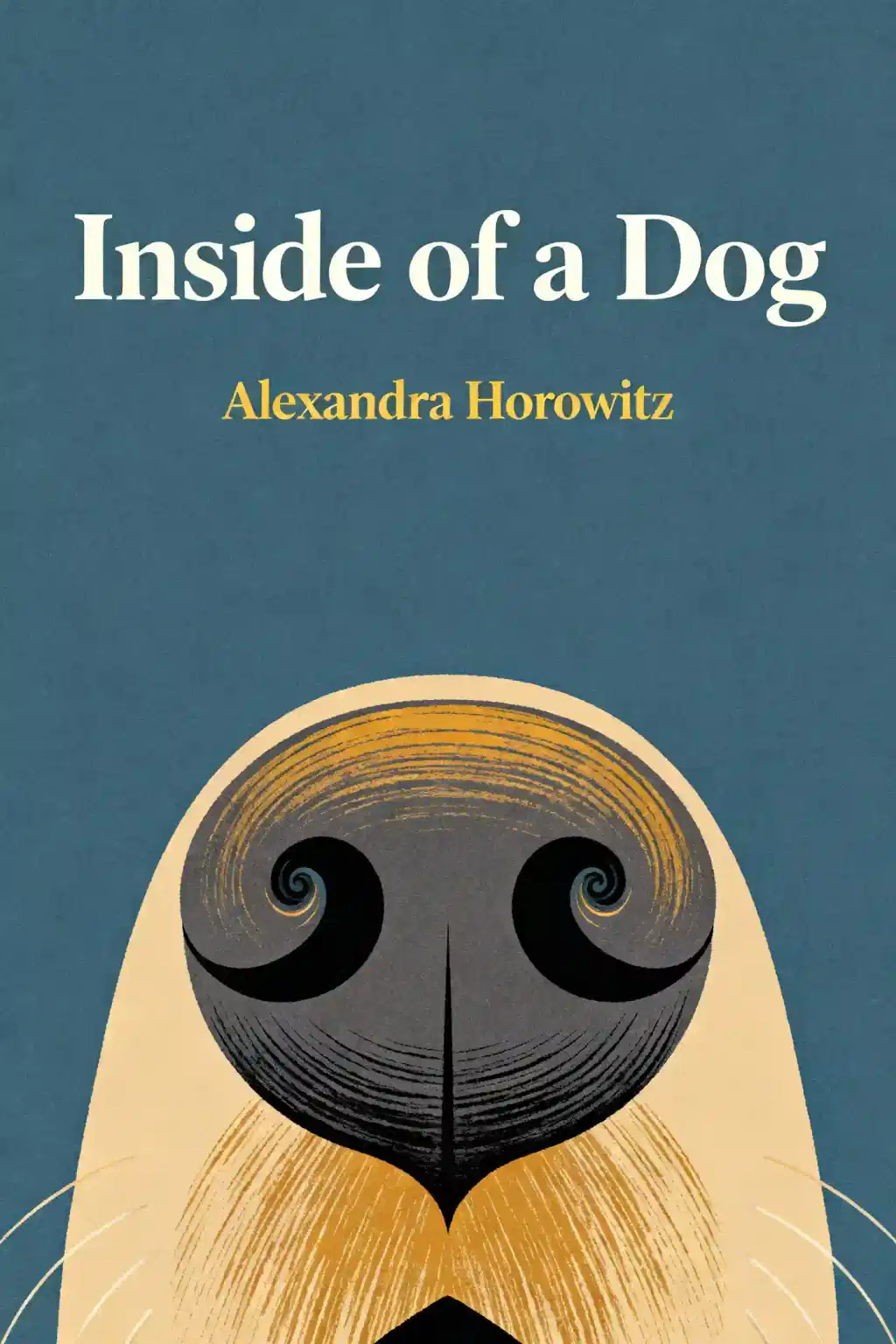
When was the last time you watched a dog and wondered what was happening inside their head? Alexandra Horowitz's "Inside of a Dog" has become a cultural phenomenon since its publication, spending over a year on the New York Times bestseller list and fundamentally changing how millions view their canine companions. The book bridges scientific rigor with accessible storytelling, earning praise from both academic circles and celebrity dog lovers like Oprah Winfrey, who featured it in her book club. What makes this exploration so compelling is Horowitz's unique background-combining cognitive science expertise with genuine dog love-creating an investigation that feels both scholarly and deeply personal. As we explore what dogs perceive, think, and feel, we're invited to step outside our human-centered perspective and enter a world where smell dominates vision, where time flows differently, and where understanding comes not through language but through a complex dance of subtle signals.
Capítulo 2
Seeing Through a Dog's Eyes (And Nose)
We humans live in a visual world. Our reality is constructed primarily from what we see, with other senses playing supporting roles. But to understand dogs, we must abandon this visual bias and recognize that they inhabit a fundamentally different sensory universe-what biologist Jakob von Uexkull called an umwelt, or "self-world."
Each species perceives only what's meaningful for its survival and reproduction. The deer tick, for instance, perceives just three things in its environment: butyric acid (which signals a mammal's presence), warmth (indicating blood), and hair (for navigation). Its world consists solely of these relevant stimuli-it's blind to sights, deaf to sounds, and responsive only to what matters for its existence.
Dogs, like all animals including humans, live in their own perceptual "soap bubble," attending to what's relevant for their existence. What's meaningful in our world may be irrelevant in theirs, and vice versa. A rose, beautiful to us for its visual appearance, holds no aesthetic value for a dog unless marked by another animal's scent.
To truly understand dogs requires going beyond simple anthropomorphism-attributing human characteristics to animals-and trying to embody their umwelt. This means recognizing profound sensory differences. Exercises like spending time at a dog's height or deeply smelling everything we encounter can give us glimpses of their world. Even attending to sounds we normally tune out-fans, heartbeats, pages turning-hints at how different sensory abilities create different realities.
Objects have different meanings for dogs than for humans-they have what von Uexkull calls "functional tones." Dogs see dog things, not human things. A chair might have a "sitting tone" if the dog learns to sit on it, but tables and stools might just be obstacles on the way to the "eating tone" of the kitchen. Many objects meaningful to humans (hammers, clocks, forks) have no significance to dogs unless they connect to something relevant: they're wielded by a loved person, urinated on by another dog, or chewable like a stick.
Those affectionate "kisses" dogs give us illustrate how differently we interpret the same behavior. While we see them as expressions of affection, they evolved from wolf puppies licking their mother's face to stimulate regurgitation after a hunt. Our mouths also taste good to dogs. Beyond these practical origins, licking has become a ritualized greeting. Dogs lick to welcome others home, to get an olfactory report of where they've been, and to confirm identity through smell.
Understanding dogs requires being like an anthropologist in a foreign land populated entirely by dogs. While perfect translation of every wag and woof may elude us, careful observation reveals much about their unique way of experiencing the world.
Capítulo 3
From Wolf to Companion: The Making of Dogs
The transformation from wild predator to household companion is the result of both natural forces and human selection. Creating a dog requires just wolves, humans, interaction, and mutual tolerance-plus thousands of years. Russian geneticist Dmitry Belyaev demonstrated this process by breeding silver foxes for tameness. After forty years, 75% became "domesticated elite" foxes that actively sought human contact. Remarkably, selecting for tameness also produced physical changes: floppy ears, curled tails, wider heads, shorter snouts, and piebald coats-all classic dog traits.
Dogs' history begins with wolves, though domestication has transformed them dramatically. Archaeological evidence dates domesticated dogs to 10,000-14,000 years ago, though genetic evidence suggests the split began up to 145,000 years ago. These early proto-dogs were likely smaller, less dominant scavengers rather than hunters-essentially "less wolfy." Dogs were our first domesticated animals, remarkably predators, chosen before we domesticated any other species.
Modern wolves aren't dog ancestors but share common ancestry. Dogs develop more slowly than wolves-their eyes open later, and physical milestones come later. This creates a longer socialization window for dogs to form attachments to humans and other species. Unlike wolves' pack structure, dogs hunt individually or scavenge, making them naturally suited to human social groups. Dogs form specific attachments to caregivers, showing anxiety at separation and special greetings upon return-adaptations perfect for living with humans but unnecessary for pack-living wolves.
The most consequential difference between wolves and dogs is simple yet profound: dogs look at our eyes. While wolves avoid eye contact, dogs actively seek it, looking to us for information about food, emotions, and situational context. This ability to find and hold our gaze was likely one of the first steps in domestication-we selected animals that would look at us.
Despite extensive breeding that has created dramatic variations in size, shape, temperament, and skills, dogs remain products of both genetics and environment-each one uniquely shaped by experiences and interactions. What distinguishes breeds is their different threshold levels to notice and react to stimuli. Hunting dogs have lower thresholds for detecting bird movement, while sheepdogs are sensitive to individual movement within groups.
There exists a tension between viewing dogs as wild animals at their core versus seeing them as human creations. Neither extreme is correct. Dogs are indeed animals with atavistic tendencies, but they've been fundamentally "retooled" through domestication-they are "animals with an asterisk." The popular notion that dogs view humans as their "pack" with humans as "alphas" misrepresents both dog and wolf behavior. Wild wolf packs are primarily family units with parents and offspring, not competitive hierarchies fighting for dominance.
Despite dogs' domestication, we must acknowledge their atavistic side. Though bred for millennia, they evolved as predators for millions of years before humans. They possess strong jaws, flesh-tearing teeth, and instincts to act before contemplating. This explains why dogs sometimes exhibit unpredictable behaviors like running off trails or even aggressive incidents.
When you bring a new dog home, you essentially recapitulate the history of domestication. Through daily interactions, you define the dog's world-both limiting and expanding it. The dog must learn your expectations, as these aren't innately known. The more time spent together, the more the dog develops its unique personality and the more deeply intertwined your relationship becomes.
Capítulo 4
The Sensory Symphony: How Dogs Perceive Their World
Humans rarely think about smelling, as our world is dominated by visual information. Dogs, however, experience the world primarily through smell. Their universe consists of complex odors at least as rich as our visual world.
Dogs investigate their world nose-first, their prominent snouts leading the way. The sniff isn't a simple inhalation but a sophisticated process: muscles strain to draw air in while simultaneously displacing existing air through side slits. Unlike humans' inefficient "in and out through the same hole" method, dogs create tiny wind currents during exhalation that enhance inhalation of new scents.
While humans have about six million olfactory receptor sites, sheepdogs have over two hundred million, and beagles over three hundred million. Dogs possess more genes for coding olfactory cells, more actual cells, and more varieties of cells capable of detecting different smells. Their sensitivity may be millions of times greater than ours-they can detect a teaspoon of sugar diluted in two Olympic-sized pools of water.
Dogs possess a specialized scent organ called the vomeronasal organ, located above the roof of the mouth along the floor of the nose. Unlike other animals, dogs' vomeronasal receptors are covered in tiny hairs (cilia) that help capture molecules, particularly pheromones often carried in fluids like urine. A dog's wet nose helps capture airborne odors that can dissolve and travel to the vomeronasal organ through interior ducts.
To dogs, humans are walking odor factories. Our armpits, breath, genitals, and skin constantly produce distinctive scents. When we touch objects, we leave behind skin cells and bacteria that create our signature odor. Dogs can easily distinguish individuals by scent alone, even telling identical twins apart.
Dogs can indeed smell fear and other emotions, not through mystical abilities but through detection of physical changes. Fear triggers sweating, adrenaline release, and increased blood flow that brings chemicals to the skin's surface. Many social animals detect alarm pheromones produced involuntarily during stress.
Dogs' extraordinary olfactory abilities extend to detecting disease. Research shows dogs can identify cancer patients through urine samples or breath with remarkable accuracy-in one study missing only 14 out of 1,272 attempts. They've successfully detected skin, breast, bladder, and lung cancers.
Dogs use scent deliberately for social communication. Unlike humans who leave scents inadvertently, dogs intentionally mark their environment with urine. Research has debunked the myth that marking is primarily about territory-studies of free-ranging dogs in India showed only 20% of markings were territorial. Instead, marking provides information about the dog's identity, frequency of visits, social status, and mating interest.
Our human obsession with bathing dogs and keeping homes clinically clean deprives dogs of important sensory experiences. The mildest cleaning fragrances are still olfactory insults to dogs, and a completely "clean" space is sensorially impoverished for them.
A seemingly idle dog is often actively processing scent information through churning nostrils-detecting approaching dogs, distant barbecues, or even oncoming storms through invisible scent tracks. Understanding the importance of smell in a dog's world should change how we interpret their behavior, like greeting visitors by sniffing their groin or other dogs by examining their rumps. These aren't rude behaviors but essential information gathering.
Capítulo 5
The Language of Dogs: Communication Beyond Words
Despite being called our "dumb friends," dogs are far from mute or expressionless. They communicate extensively through vocalizations, body language, and scent. Their "unmuteness" includes a rich vocabulary of sounds-squeals, growls, grunts, yelps, moans, whines, whimpers, barks, yawns, and howls.
Dogs' ears serve as both communication tools and sensory organs. Most dogs can rotate their pinnae (outer ear) to better capture sounds. Dogs hear most human-audible sounds plus much more-their range extends to 45 kilohertz compared to our 20 kilohertz limit. This allows them to detect "ultrasonic" sounds like dog whistles, digital alarm clock pulses, rat navigation chirps, termite vibrations, and humming fluorescent lights that remain inaudible to humans.
Dog vocalizations vary along four dimensions: pitch (whines are high, growls are low), duration (quick or protracted), shape (pure tones versus fractured sounds), and loudness. High-frequency sounds (cries, squeals, whines, whimpers, yelps) typically occur when dogs experience sudden pain or need attention. Low moans or grunts function like purring in cats, occurring when dogs are in close contact with familiar companions. Growls and snarls, with their intimidating low pitch, are aggressive social sounds that dogs don't typically direct at inanimate objects.
Barking, despite its annoying volume (reaching up to 130 decibels), contains rich information that researchers believe dogs developed specifically to communicate with humans. Unlike wolves who rarely bark, dogs have evolved numerous variations that serve distinct purposes. Spectrograms reveal three distinguishable types: low-pitched, harsh "stranger barks" that sound aggressive; higher-frequency, variable "isolation barks" that humans perceive as fearful; and high-frequency "play barks" directed at playmates.
For dogs with limited vocal abilities, body language forms a sophisticated communication system. Dogs express everything from playfulness to aggression through posture, following Darwin's principle of "antithesis"-opposing postures communicate opposing emotions. Standing erect with head and ears up signals engagement or dominance, while crouching with head down, ears flattened, and tail tucked indicates submission.
The tail, particularly expressive, conveys at least thirteen distinguishable messages-high tails indicate confidence or excitement, low-hanging tails suggest depression or anxiety, and a tail curled between the legs signals fear and submission. Dogs read posture more than physical size when assessing other dogs, explaining why small dogs confidently engage with larger ones.
Communication for dogs extends beyond vocalizations and body language to include scent marking-a sophisticated form of intentional messaging. Unlike the automatic morning bladder emptying, urine marking is strategic communication: dogs reserve urine for targeted deposits, often raising a leg to aim precisely at conspicuous locations.
Dogs also recognize intention in human gestures, distinguishing between purposeful pointing and incidental movements. Unlike the contrived "dog autobiographies" that simply project human thoughts onto canines, dogs' natural, non-linguistic communication creates genuine connection-their silence becoming one of their most endearing qualities.
Capítulo 6
The Cognitive Canine: Inside the Dog's Mind
When a dog looks directly at you, there's a powerful sense of connection-they're not just seeing you, but attending to you. This gaze implies a frame of mind and attention that goes beyond simple looking. Dogs distinguish themselves from other mammals by how their attention overlaps with humans', particularly their focus on our faces, movements, and moods.
Human infants develop attention through predictable stages, beginning with simple reflexes toward warmth and food and eventually engaging in joint attention-understanding that they and another person are attending to the same object together. Dogs follow a similar path, though unlike many animals that avoid direct eye contact as it signals aggression, dogs have evolved to make eye contact with humans, strengthening our bond.
Dogs quickly learn to follow human gaze and pointing to locate objects. In experimental settings, they successfully follow various forms of pointing-even across the body, with elbows or knees, or from brief glances-to find hidden treats. They outperform chimpanzees in these tasks, though they still make errors 15-30% of the time (compared to perfect performance by three-year-old children).
Dogs employ various strategies to redirect human attention-jumping, barking, bumping, pawing, or simply positioning themselves directly in front of someone. Guide dogs use "sonorous mouth licking" to alert visually impaired owners. Many dogs escalate their tactics when initial attempts fail, from approaching with a forbidden item to whining, woofing, nose-nudging, or dramatically sighing at their human's feet.
Dogs not only follow our gaze but can actively show us things they want. When experimenters hide treats that dogs witness but can't reach, dogs use attention-getters like barking followed by looking back and forth between their owners and the treat location-effectively pointing with their gaze.
Dogs strategically use their understanding of human attention both to get what they want and to determine when they can break rules. They distinguish between potential helpers and those who can't help them-preferring to beg from people who can see them rather than those who are blindfolded or facing away. Dogs also adjust their obedience based on their owners' attentional states: they stay obediently lying down when directly watched, get up sooner when the owner watches TV, and disobey fastest when the owner leaves the room entirely.
Dogs observe us with an intensity and persistence that no other animal matches. While we share our homes with countless creatures, only dogs actively study our every move, habit, and relationship. They function as anthropologists among us, noticing both what is typical and what is different in human behavior. Unlike humans who are socialized to stop staring and who lose the habit of close observation as we age, dogs never stop looking.
The apparent mind-reading abilities of dogs recall the famous case of Clever Hans, a horse who seemed able to solve arithmetic problems by tapping his hoof. When investigated by psychologist Oskar Pfungst, it was discovered Hans wasn't calculating but reading subtle, unconscious cues from his questioners-tensing and relaxing of muscles, slight leans forward or back. Like Hans, dogs excel at noticing the signals we unconsciously give, often detecting what even other humans miss.
Dogs observe us, think about us, and know us in non-verbal ways. They recognize us not just by our appearance and smell, but by how we move. Our most ordinary behaviors-walking across a room in our characteristic style-provide information dogs can interpret. They quickly learn to recognize the rituals preceding a walk, noticing subtle changes in our posture, gaze direction, and movements.
Capítulo 7
The Extraordinary Bond: Why We Connect With Dogs
The dog-human bond feels so natural we rarely question its extraordinary nature. Our relationship with dogs isn't just with any animal but a particular domesticated one with whom we've created a symbiotic dance. Dogs possess ideal characteristics for human bonding. They're diurnal, appropriately sized, physically familiar with mappable body parts, move similarly to us, and are manageable and trainable. Their lifespans align well with significant arcs of human life. Crucially, they're compellingly cute with neotenized features-large heads, oversized ears, saucer eyes-that trigger our evolutionary instinct to care for infant-like creatures.
Touch creates profound connections between humans and dogs. Unlike our relationships with other social animals, dog-human bonding thrives on physical touch. Dogs instinctively seek contact from birth, using their heads as "thermotactile sensory probes" to find warmth and connection. While wolves touch each other roughly six times hourly, dogs transfer this instinct to humans-burrowing heads under us, resting on us, or gently nibbling.
Dog greetings are elaborate rituals that strengthen bonds. Konrad Lorenz viewed animal greetings as "redirected appeasement ceremonies"-channeling potential territorial aggression into welcoming behaviors. Dogs' greetings mirror wolf behavior: face-licking (attempting to prompt regurgitation), submissive postures, wagging tails, and vocalizations. The dog's entire body communicates recognition-ears flattening, lips pulling back, eyelids dropping in a dog's version of a smile.
The human-dog bond is uniquely strengthened by synchronized movement and timing. Despite not hunting cooperatively like wolves, dogs remain inherently cooperative creatures, moving in remarkable synchrony with their humans. Dogs function at a pace similar to humans, allowing us to interpret their movements and intentions. Young puppies quickly learn to match their owners' walking pace, even anticipating routes and boundaries.
Play between humans and dogs follows conversational rules of timing and turn-taking. In a study of human-dog play, successful interactions depend on actions being contingent on each other's movements, creating a rhythmic dance with responses occurring within fractions of a second. Unlike cats, dogs participate in games like fetch with conversational timing that feels like communion.
The human-dog bond, strengthened by physical contact, synchrony, and greeting ceremonies, provides measurable health benefits for both species. When we interact with dogs, our endorphins, oxytocin, and prolactin levels increase while stress hormones decrease. This physiological response explains why dogs correlate with reduced risk for various diseases and better recovery rates. The connection runs so deep that dogs even catch human yawns-a reflex previously observed only in humans and chimpanzees.
Beyond scientific measurement lies the ineffable quality of the relationship-daily affirmations, shared activities, and silent companionship that science can only partially deconstruct. Part of our attachment comes from being seen by them-they have impressions of us, know us intimately, and reflect our image back to us.
Capítulo 8
Living With Dogs: Practical Wisdom from Dog Science
Understanding dog science helps us appreciate dogs' behavior from their perspective. Though humans often take dogs for walks with human priorities-maintaining pace, completing errands, making good time-we should reconsider walks from the dog's perspective. Dogs don't care about efficiency. Instead of yanking dogs away from interesting scents or pulling them past other dogs, try "smell walks" where progress is minimal but olfactory exploration maximal, "dog's-choice walks" where the dog decides the route, or "serpentine walks" accommodating natural weaving behaviors.
Effective dog training requires clarity about desired behaviors, consistency in requests, and immediate rewards. Beyond "come here," few commands are truly necessary-what matters most is the dog recognizing your importance, which comes naturally to them.
Embrace your dog's natural behaviors occasionally-letting them roll in interesting smells, splash through puddles, and walk off-leash when possible. Not every dog behavior has deep meaning-sometimes a dog lying down is just lying down. When behaviors do have significance, consider the dog's natural history as an animal, a canid, and a particular breed. Herding dogs may stare or nip at heels; pointers freeze at movement. Understanding these breed tendencies helps provide appropriate outlets for their innate drives rather than punishing natural behaviors.
Dogs thrive with engaging activities-strings to chase, treats to find, toys to manipulate. Dogs enjoy both familiarity and novelty: new experiences in safe environments stimulate their minds and prevent boredom. Hiding food for them to find combines mental and physical engagement, using nose, paw and mouth together in natural exploration.
Dogs, like children, learn through play throughout their lives. Games like peekaboo, creating associations between signals and activities, and playing imitation games can stretch their abilities. Most importantly, play as dogs do-using play signals, physical engagement, and mutual enjoyment.
Notice the often-overlooked aspects of your dog-the creative ways they seek attention, their ear movements, and the complexity of their gaits. Recording your dog when alone reveals their independent life without human scrutiny.
Avoid frequent bathing, allowing dogs to maintain their natural smell. Excessive bathing can cause painful skin conditions, and most dogs don't appreciate smelling like bath products.
Dogs reveal their intentions through body language if owners learn to read these signals. Dogs can communicate multiple messages simultaneously-a barking dog with high-wagging tail shows curiosity rather than aggression.
Not all dogs enjoy petting, and their preferences vary based on health, mood and past experiences. Light touches excite or irritate, firm touches calm, and excessive pressure oppresses. Find each dog's preferred touch zones and allow reciprocal contact.
Mixed-breed dogs are often healthier, less anxious, and longer-lived than purebreds, who often have "overriding fixations" bred for tasks they'll never perform in domestic settings. Mixed breeds offer diverse abilities without the single-minded intensity of purpose-bred dogs.
Rather than avoiding anthropomorphizing altogether, consider the dog's umwelt while naming and relating to them. Naming a dog begins making them personal, starting them on the personality they will grow into. The invitation remains open: "Go look at your dog. Go to him! Imagine his umwelt-and let him change your own."
Capítulo 9
What It's Like to Be a Dog: A Journey into Canine Consciousness
To understand what it's like to be a dog, we must make an informed imaginative leap using our knowledge of their sensory capacities, evolutionary history, and behavior. While philosopher Thomas Nagel argued we can never truly know what it's like to be another species (like a bat using echolocation), we regularly imagine other humans' experiences by extrapolating from our own. Similarly, we can sketch a dog's umwelt-their subjective experience-using scientific facts about their perception and cognition.
One fundamental aspect of a dog's experience is their height-typically at human knee level. This perspective profoundly shapes their world. The ground-level world is more odoriferous as smells linger there rather than dispersing in the air. Sounds travel differently along the ground too, with vibrations affecting dogs more directly.
Dogs experience their world through their tongues almost as much as through their noses. Nearly everything becomes a candidate for licking-floors, people, objects, themselves. This licking-bringing molecules directly into oneself-represents an intimate connection with the environment that humans rarely experience. It reveals a fundamentally different relationship to the physical world, with less of a barrier between self and surroundings.
Dogs categorize their world not by appearance but by how they can interact with objects. Their classification system is remarkably simple: things either fit in the mouth or they don't. A ball, pen, teddy bear, and shoe are equivalent in this taxonomy. Similarly, objects are defined by how they act on the dog. Motion, rather than shape, becomes a critical identifying feature. A running squirrel and stationary squirrel might as well be different creatures; a skateboarding child is more interesting than a child holding a skateboard.
Humans develop by learning to ignore sensory information; dogs experience the world at a different granularity, attending to details we overlook. While lacking our color vision, they detect subtle brightness contrasts and movements we miss. Without speech, they're attuned to our vocal prosody, tension, and silences. Dogs' sensory systems, like ours, focus on novelty, but they're less habituated to human cultural sounds. A city street bombards them with details we filter out-each car door slam might register as new and significant.
The dog's attention to sensory details may preclude abstract thinking. While they clearly have beliefs about immediate circumstances (like recognizing you're behind the door), philosopher Wittgenstein questioned whether they ruminate on future events. Dogs experience the world without the burden of reflection-they think, but perhaps don't think about thinking. Their experience of time differs from ours too. With faster visual processing (higher flicker-fusion rates), a dog's "moment" may be briefer than ours. What constitutes "right now" for a dog happens before we register it.
For dogs, olfaction provides perspective, scale and distance, but exists in a different timeframe than our visual world. Scents don't arrive with the regularity of light. Smell itself tells time-weakened odors indicate age while fresh ones signal recency. Their "present" includes traces of the past (lingering scents) and hints of the future (smells arriving on the breeze). This creates a temporal experience broader than our visually-dominated present.
Dogs are ingenuous-their bodies map directly to their internal states without deception. Their joy translates through wagging tails, concern shows in lifted eyebrows, and their "smiles" (though not actual grins) communicate in ritualized ways. A dog's head carriage reveals mood, interest, and attention in capital letters through altitude, ear position, and eye radiance.
Though we can never know with certainty what it's like inside a dog's mind, we can approach understanding by replacing anthropomorphism with umwelt-seeing through their perspective rather than imposing our own.