Capítulo 1
Redefining Our Nature: The Surprising Truth About Human Goodness
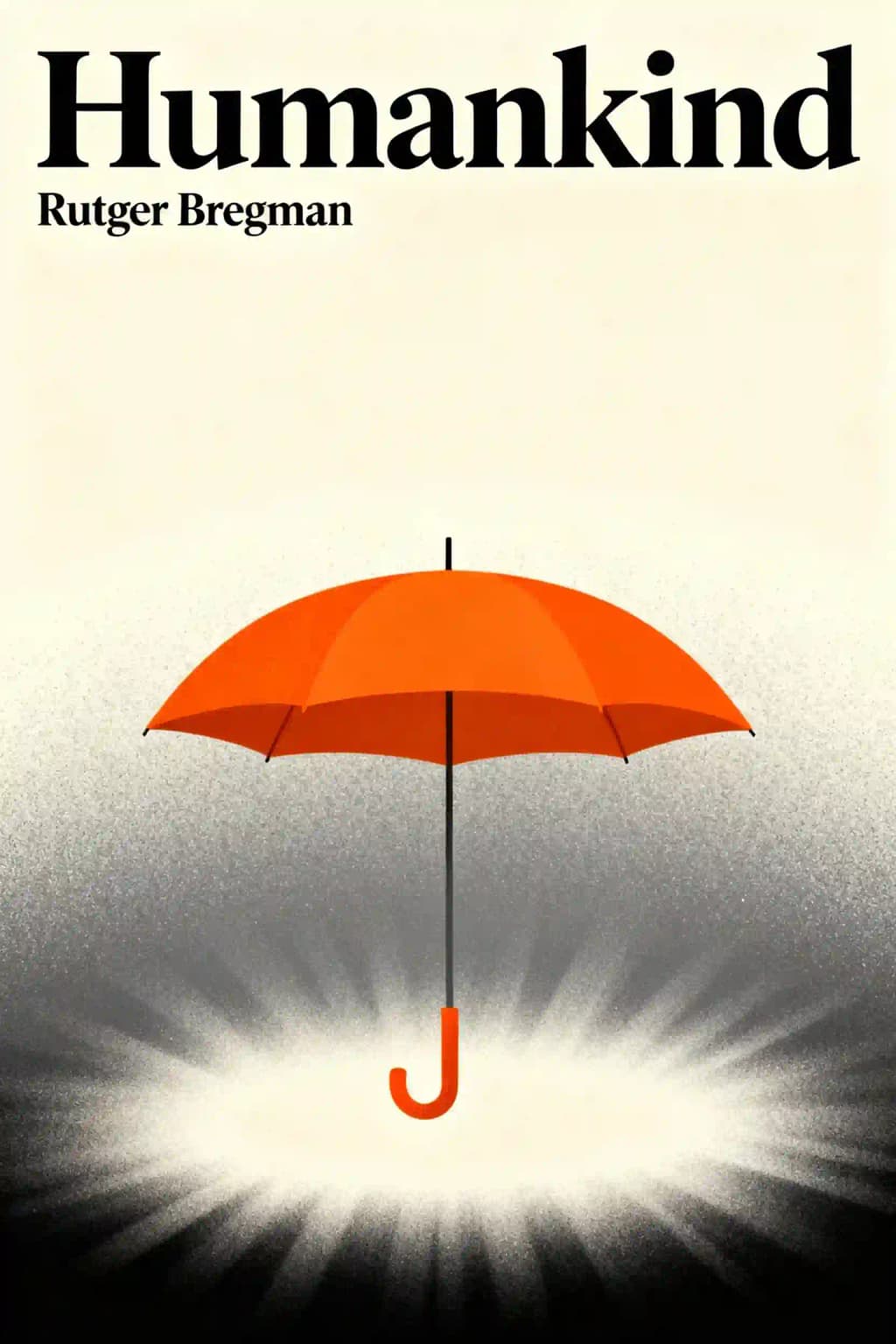
What if everything you thought you knew about human nature was wrong? Imagine a world where people, when faced with crisis, become their best selves rather than descending into chaos. Rutger Bregman's "Humankind" challenges our deepest assumptions about who we are as a species, arguing that humans are fundamentally decent rather than naturally selfish and violent. This revolutionary perspective has captivated readers worldwide, including Barack Obama who named it one of his favorite books, and Bill Gates who praised its "hopeful view of human nature." The book's cultural impact has been profound, sparking conversations about how we design everything from schools to prisons to workplaces. At a time when cynicism seems the only rational response to world events, Bregman offers a radical alternative: what if optimism about human nature is actually the most realistic position?
Capítulo 2
The Blitz Spirit: When Crisis Reveals Our Better Nature
On the eve of World War II, British authorities feared London would collapse under German bombing. Experts predicted mass panic, looting, and psychological breakdown when the bombs began falling. Hitler, Mussolini, Stalin, Churchill and Roosevelt all believed this theory, having read influential crowd psychologist Gustave Le Bon's work suggesting civilization was merely a thin veneer that would crack under pressure.
When the Blitz began on September 7, 1940, reality proved shockingly different. Despite 80,000 bombs falling on London over nine months, destroying a million buildings and killing 40,000 people across Britain, civilians remained remarkably calm. Canadian psychiatrist John MacCurdy found children playing and shoppers haggling moments after air raid alarms. The British responded with stoicism and humor, posting signs like "MORE OPEN THAN USUAL" outside damaged shops.
Most surprisingly, British mental health actually improved during the bombing. Alcoholism decreased, suicide rates fell, and psychiatric wards remained empty. The crisis brought out people's best qualities - courage, humor and kindness.
Yet despite this evidence, Churchill's advisor Frederick Lindemann falsely reported that bombing would "break the spirit of the German people," leading to devastating Allied bombing campaigns against German civilians. The German bombings proved equally ineffective at breaking morale. Psychiatrist Friedrich Panse found Germans responding with resilience and even euphoria after raids.
This pattern repeats across disasters worldwide. When Hurricane Katrina struck New Orleans in 2005, media reported anarchy, rape and murder. In reality, researchers found "overwhelming prosocial activity" - civilians forming rescue squads, sharing resources, and displaying courage and charity. The Disaster Research Center has conducted nearly 700 field studies since 1963, consistently finding that during disasters, crime drops and altruism rises.
Our cynical view of humanity functions like a nocebo effect on society. While we trust those close to us, the World Values Survey reveals most people believe strangers can't be trusted. This cynicism spans political divides - religious conservatives see humans as sinful, capitalists assume we're self-interested, and environmentalists view humanity as destructive.
A major culprit is the news media, which functions as an addictive drug causing "mean world syndrome" - symptoms include cynicism, misanthropy and pessimism. Despite objective measures showing we live in the safest, healthiest era ever, news focuses on exceptional negative events, exploiting our negativity bias.
Capítulo 3
The Real Lord of the Flies: How Children Actually Behave
William Golding's "Lord of the Flies" has shaped our understanding of human nature for generations. The novel tells the story of British schoolboys stranded on a deserted island who quickly descend into savagery. Jack, a redheaded boy obsessed with hunting, leads a rebellion against rules and reason. By the time a naval officer rescues them, the island is a wasteland and three boys are dead.
This story never actually happened - Golding invented it in 1951. The novel sold tens of millions of copies and became a 20th-century classic, perfectly timed for the 1960s generation questioning human nature after World War II. Golding, who later confessed "I have always understood the Nazis because I am of that sort by nature," won the Nobel Prize for work that supposedly illuminated the human condition.
But what happens when children are actually stranded on a deserted island? In 1966, six Tongan boys were shipwrecked on 'Ata, a tiny, uninhabited island. After falling asleep on their boat, they awoke to a storm that destroyed their sail and rudder. They drifted eight days before spotting the island.
Unlike Golding's fictional boys, the real castaways created a functional society. They established a garden, collected rainwater in hollowed trees, built a gymnasium and badminton court, and maintained a permanent fire. They worked in teams with strict duty rosters and resolved conflicts through time-outs and apologies. They began and ended each day with song and prayer.
Despite hardships - drought, a failed escape attempt, a storm destroying their shelter, and Stephen breaking his leg (which they set using sticks) - they survived over fifteen months until Captain Peter Warner rescued them in September 1966. A doctor later marveled at their muscled physiques and Stephen's perfectly healed leg.
The boys were initially arrested for stealing the boat, but Peter paid the owner and arranged a documentary. Their story demonstrates friendship and cooperation - the antithesis of Lord of the Flies - yet remains largely unknown while Golding's cynical tale continues influencing reality television and our perception of human nature.
Capítulo 4
Homo Puppy: How Humans Evolved Through Friendliness
Evolutionarily speaking, humans are newcomers, appearing in the last hour if Earth's history were compressed into a year. Despite sharing 99% of our DNA with chimpanzees, we've uniquely dominated the planet. Why us?
It's not our physical strength - chimps easily overpower us. It's not even our natural intelligence. When tested against other primates on spatial awareness, calculation, and causality, human toddlers score similarly to zoo animals. Even our working memory and processing speed aren't exceptional compared to chimpanzees.
The mystery deepens when we consider Neanderthals - powerfully built with brains 15% larger than modern humans. They were tough, created art, made tools, and survived two ice ages across 200,000 years. If Neanderthals were stronger and possibly smarter than us, why did they disappear shortly after Homo sapiens arrived?
The answer lies in a revolutionary experiment conducted in Soviet Russia. In 1958, biologist Lyudmila Trut joined geneticist Dmitri Belyaev to "make a dog out of a fox." Using aggressive silver foxes, they selected only the least hostile animals for breeding.
Results came surprisingly fast. By the fourth generation, foxes began wagging their tails. Soon they craved human attention, remained playful into adulthood, developed curled tails, floppy ears, spotted coats, and even started barking like dogs. All these changes emerged solely from selecting for tameness.
Belyaev proposed a revolutionary idea: humans themselves are domesticated apes who evolved through "survival of the friendliest." Modern science confirms this - human skulls have grown softer, more youthful and feminine over 200,000 years, with smaller brains and more childlike features. We are to Neanderthals what dogs are to wolves - Homo puppy.
Brian Hare, studying dog intelligence, discovered that while chimps failed the "object choice test" (following human pointing to find hidden treats), dogs easily passed it. When Hare tested Belyaev's domesticated foxes, he found they significantly outperformed their aggressive counterparts on intelligence tests. This contradicted the assumption that domestication diminishes brainpower. Hare concluded: "If you want a clever fox, you don't select for cleverness. You select for friendliness."
What truly distinguishes humans from other primates isn't raw intelligence but our unparalleled social learning abilities. We're "ultrasocial learning machines" built to bond, learn and play. Even our physical features evolved for sociability - whites in our eyes reveal our gaze direction, smoother brow ridges enable expressive eyebrows, and our unique ability to blush shows we care what others think.
Capítulo 5
The Paradox of Human Violence: Why We Don't Want to Kill
Despite our cooperative nature as "Homo puppy," humans possess a uniquely dark capacity for cruelty. We're the only species that builds gas chambers or commits genocide. Brian Hare explains this paradox: "The mechanism that makes us the kindest species also makes us the cruelest." Our social bonding has a fatal flaw - we feel stronger affinity for those most like us.
This tribal instinct appears biologically encoded. The hormone oxytocin, often called the "hug hormone" for promoting bonding and kindness, has a darker side. Research revealed that oxytocin enhances affection for one's own group while potentially intensifying aversion to strangers.
Yet evidence suggests humans aren't naturally violent. In November 1943, Colonel Samuel Marshall made a stunning discovery while interviewing American soldiers after the Battle of Makin. Most soldiers never fired their guns. Only 15-25% actually shot their weapons, even in life-or-death situations. It wasn't cowardice - non-firing soldiers remained at their posts, risking their lives. Marshall concluded that the average healthy person has "such an inner resistance toward killing a fellow man that he will not of his own volition take life."
Archaeological evidence further undermines the "natural violence" theory. Among thousands of prehistoric cave paintings, none depict warfare, and examinations of ancient human remains show virtually no evidence of prehistoric warfare. As anthropologist Brian Ferguson concluded: "War does not go forever backwards in time. It had a beginning."
Modern hunter-gatherer studies reveal nomadic foragers typically avoid violence, preferring to resolve conflicts through discussion or separation. Their social networks are vast - the average tribe member meets up to a thousand people in their lifetime.
When Christopher Columbus first encountered the peaceful inhabitants of the Bahamas in 1492, he noted they didn't bear arms and would "make fine servants." Within fifty years, European colonization had decimated 99% of the native population.
Such violence can be incomprehensible to people from peaceful societies. On the Pacific atoll of Ifalik, residents became physically ill after watching Hollywood films, unable to believe Americans really killed each other.
Capítulo 6
The Curse of Civilization: How We Lost Our Freedom
If our ancestors lived in egalitarian societies, why did we abandon them? And why can't we remove domineering leaders now as easily as our forebears did?
The turning point came 15,000 years ago with the end of the last ice age. As climate warmed, the fertile region between the Nile and Tigris became abundant with resources. People settled permanently, built structures, and crucially, began accumulating possessions.
Just as Rousseau observed, the concept of ownership - "this is mine" - transformed society. Inheritance allowed wealth disparities to grow across generations. Archaeological evidence shows this period coincides with the first military fortifications and cave paintings depicting warfare.
Two factors drove this change: we now had property worth fighting over, and settled life made us more distrustful of outsiders. Clans formed alliances against other clans, with charismatic battlefield leaders emerging who eventually refused to relinquish power during peacetime.
Infectious diseases like measles, smallpox and plague emerged after we abandoned nomadic life for farming, originating from our domesticated animals' microbes. As disasters like famines and epidemics struck settled populations, religious beliefs transformed dramatically. While nomadic peoples had relatively simple cosmologies without moral judgments, settled societies developed concepts of vengeful gods, sin, and elaborate rituals of penance.
Why did we abandon our nomadic freedom? We fell into a trap, first settling in fertile floodplains where farming was initially effortless. As populations grew and wild animals declined, we had to expand farming to less fertile areas, requiring exhausting labor. By then, it was too late to return to foraging - we'd lost the skills, population density was too high, and neighboring settlements blocked migration.
Thomas Hobbes completely mischaracterized our ancestors' lives as "nasty, brutish and short" when they were actually friendly, peaceful and healthy. The first states were universally slave states. What we consider "milestones of civilization" began as instruments of oppression: coins were invented for taxation, early writing documented debts, and the first legal codes punished those who helped slaves escape.
Despite civilization's dark history, genuine progress has emerged recently. Until 1800, three-quarters of humanity lived in bondage, with over 90% working the land and 80% in dire poverty. Only in the last two centuries - the final fifteen minutes in civilization's twenty-four-hour history - has civil society become beneficial.
Capítulo 7
The Easter Island Myth: Rewriting a Cautionary Tale
The story of Easter Island has long been presented as the ultimate cautionary tale of environmental collapse. According to the popular narrative, the islanders became obsessed with carving ever-larger moai statues, competing until they depleted all their trees, causing soil erosion and declining crops. Without wood for canoes, fishing became impossible. This ecological collapse supposedly triggered warfare, widespread destruction of the moai, and even cannibalism.
Jared Diamond popularized this cautionary tale in his bestseller "Collapse," presenting Easter Island as a metaphor for our planet's environmental future - a society that destroyed itself through overconsumption and resource depletion.
In 2002, environmental biologist Jan Boersema made a simple yet profound discovery that contradicted everything we thought we knew about Easter Island. Reading Jacob Roggeveen's original logbook from 1722, Boersema was shocked to find no evidence of a society in decline. Instead, Roggeveen described the Easter Islanders as friendly, healthy people with muscular physiques and gleaming white teeth who offered food to the Dutch crew. He called the island an "earthly paradise" with "exceptionally fertile" soil, never mentioning toppled statues, weapons, or cannibalism.
Recent analysis of hundreds of islander skeletons showed they were healthy and fit, not starving. Among 469 skulls examined by Smithsonian anthropologists, only two showed injuries potentially caused by violence. The Easter Islanders knew how to make deadly weapons but, as researchers noted, "they chose not to."
Population estimates were also exaggerated. Rather than 15,000 inhabitants as claimed by Diamond, calculations based on a 1100 CE settlement date and realistic growth rates suggest only about 2,200 people by Roggeveen's time. The deforestation wasn't caused by statue-moving either, as moving all 493 relocated statues would have required only 15,000 trees, while the island had millions. More likely, the Polynesian rat, which could produce millions of offspring within years, devastated the forest by consuming tree seeds.
The true devastation of Easter Island came from without, not within. The first native to board Roggeveen's ship marveled at the European technology, dancing and repeatedly shouting "O dorroga!"-likely meaning "Welcome." This welcome was met with gunfire when nervous Dutch sailors opened fire, killing about ten islanders.
The final devastating blow came in 1862 when Peruvian slave ships arrived. Slavers captured 1,407 people-a third of the population. When international pressure forced Peru to return the survivors in 1863, the fifteen islanders who made it back home brought smallpox with them. The epidemic decimated the remaining population. By 1877, only 110 inhabitants remained.
Capítulo 8
The Power of Intrinsic Motivation: Trusting Human Nature
Jos de Blok, founder of the Dutch healthcare organization Buurtzorg, has a simple philosophy: "Managing is bullshit. Just let people do their job." This isn't some crackpot talking but the leader of a hugely successful organization with fourteen thousand employees that's been voted Employer of the Year in the Netherlands five times.
De Blok created Buurtzorg after growing frustrated as a healthcare executive with the disconnect between management and frontline workers. Rejecting conventional wisdom, he built an organization without managers, call centers, planners, targets or bonuses. Starting with just four nurses in Enschede, Buurtzorg has grown to over eight hundred self-directed teams nationwide. Each twelve-person team enjoys complete autonomy-planning schedules, hiring colleagues, and providing holistic care rather than fragmented services defined by bureaucratic codes.
This approach contradicts traditional business administration, which emerged in the early 20th century based on the Hobbesian view that humans are inherently greedy. Both capitalism and communism shared this cynical perspective, relying on either carrots (money) or sticks (punishment) to motivate people. This view manifested in Frederick Taylor's "scientific management," which treated workers as brainless robots motivated solely by wages.
In 1969, psychologist Edward Deci challenged the prevailing behaviorist view by discovering that financial incentives could actually reduce intrinsic motivation. When he paid students to solve puzzles, they lost interest in the task. Research consistently shows that extrinsic rewards can undermine intrinsic motivation and creativity. Bonuses work only for simple, routine tasks-precisely the kind robots now handle.
Companies like Buurtzorg and FAVI demonstrate how everything transforms when you replace suspicion with a positive view of human nature. FAVI, under Jean-Francois Zobrist, dismantled hierarchical controls-removing time clocks, unlocking storage rooms, eliminating bonuses, and organizing workers into autonomous "mini-factories." Despite what might sound like a recipe for chaos, productivity increased dramatically, with the workforce expanding fivefold and production times shrinking from eleven days to one.
The core philosophy is simple: when you treat people as responsible and trustworthy, they become exactly that. Edward Deci's research confirms this approach-the question isn't how to motivate others but how to create conditions where people motivate themselves. This represents a new realism that transcends traditional political divides, recognizing that nothing is more powerful than intrinsically motivated people doing something because they genuinely want to.
Capítulo 9
This Is What Democracy Looks Like: Citizens Taking Power
In 2004, an unlikely revolution began in Torres, Venezuela when marginal candidate Julio Chavez won the mayoral election with just 35.6% of the vote. His radical platform? Handing power directly to citizens. Despite opposition from elites and the state governor, Chavez implemented a participatory budget system where residents - not politicians - decided how to allocate the municipality's entire $7 million investment budget.
Within ten years, Torres had achieved remarkable progress: reduced corruption, increased civic participation, and tangible improvements in infrastructure, housing, education and community development. Today, some 15,000 citizens participate in 560 assemblies across Torres, determining budget priorities based on local knowledge rather than decisions made by disconnected officials.
Torres is just one example of a global democratic movement that began in Porto Alegre, Brazil in 1989 when the city entrusted a quarter of its budget to citizens. By 2016, over 1,500 cities worldwide had adopted participatory budgeting. Unlike flashy politicians with spin doctors and campaign ads, citizen politicians engage in calm, deliberative dialogue.
The results are transformative. In Porto Alegre, access to running water increased from 75% to 95% between 1989 and 1996, while sewage service access jumped from 48% to 95%. School attendance tripled, road construction increased fivefold, and tax evasion plummeted. The World Bank found that participatory budgeting redirected funds from prestige projects to infrastructure, education and healthcare in poorer communities.
Perhaps most surprisingly, participatory budgeting makes people more willing to pay taxes. In Porto Alegre, citizens even requested higher taxes - something political scientists had considered impossible. The process transforms taxes from a burden into a contribution to society, with participants reporting they learned to "look at the city as a whole" rather than just their own community.
Political economist Elinor Ostrom challenged Garrett Hardin's influential "tragedy of the commons" theory by studying how real communities manage shared resources. She discovered what Hardin overlooked: humans can talk. People readily make agreements to protect shared resources from overuse. Ostrom documented over 5,000 examples of successfully managed commons worldwide-from Swiss pastures to Japanese croplands to Philippine irrigation systems-many dating back centuries.
One of the most promising alternatives to capitalism comes from an unexpected source: Alaska. Republican governor Jay Hammond established the Alaska Permanent Fund in 1976 when oil reserves were discovered, believing this resource belonged to all Alaskans. Since 1982, every Alaskan citizen receives an annual dividend (up to $3,000 in good years) - unconditionally and as a right. Studies show most Alaskans invest their dividends in education and children, with no adverse effects on employment while substantially reducing poverty.
Capítulo 10
When Enemies Become Friends: The Christmas Truce of 1914
The First World War began with optimistic soldiers marching off to battle, expecting to be home by Christmas 1914. Instead, it became the "seminal catastrophe of the twentieth century" - the precursor to the Russian Revolution, the rise of Stalin and Hitler, and eventually World War II. By Christmas 1914, over a million soldiers were dead along a 500-mile front that barely moved despite endless slaughter.
On Christmas Eve 1914, despite warnings from High Command about possible enemy attacks, something extraordinary happened along the front near La Chapelle-d'Armentieres. British soldiers watched in disbelief as Germans lit lanterns and Christmas trees, then began singing "Stille Nacht." The British responded with "The First Noel," and soon both sides were singing "O Come, All Ye Faithful" together in Latin.
Soldiers ventured into no-man's land to exchange tobacco and conversation, amazed to be laughing with men they'd been trying to kill hours earlier. By Christmas morning, they were exchanging gifts of chocolate, tea, cigars and schnapps, taking photographs together, and even playing football matches. Near Fleurbaix, they held joint burial services, singing hymns together as they laid to rest comrades killed by enemy fire. Soldiers exchanged addresses, promising to meet after the war, creating a moment so extraordinary that participants could scarcely believe it themselves.
Many soldiers tried to sustain the unofficial peace, secretly passing letters warning of upcoming artillery or inspections. Some maintained ceasefires for weeks, and similar truces continued to break out despite suppression from military leaders who bombarded strategic positions to prevent any repeat of the Christmas spirit. As one British major said, "If we had been left to ourselves, there would never have been another shot fired."
The truth is that humans aren't wired for war - peace is always ready to surface, requiring constant propaganda and force to suppress it. Like all good things in life, the more peace you give, the more you have.




![[1dd96caa-7de2-4534-9d5c-48623d25e592:c0000] The Laws of Human Nature.pdf p1-1](/_next/image?url=https%3A%2F%2Fd1y2du6z1jfm9e.cloudfront.net%2Fassets%2Fpodcast%2Fblue.png&w=1024&q=50)


