Capítulo 1
The Path to Your First Million: Wisdom from the Trenches
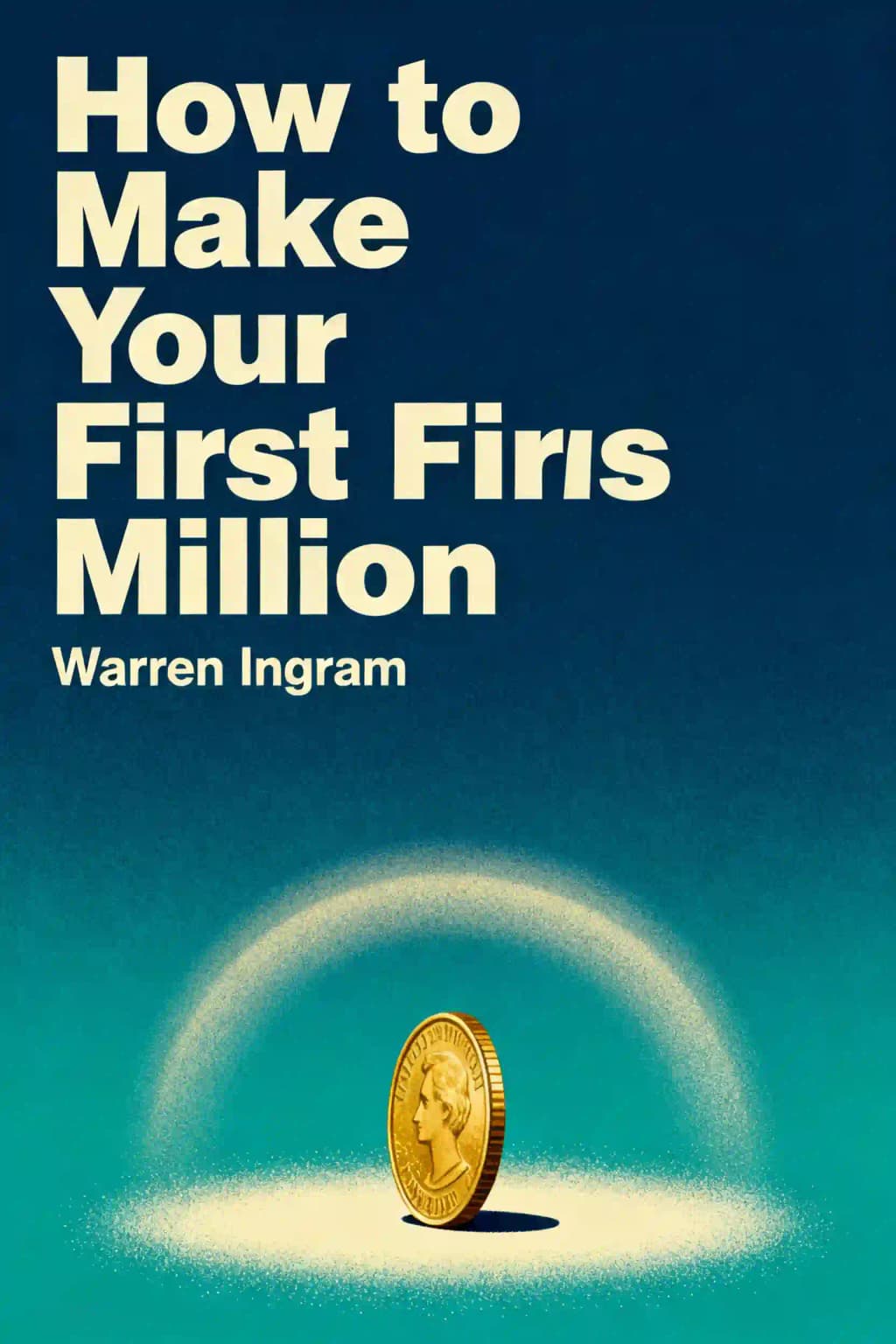
Picture this: You're financially free, making decisions based on what you want rather than what you need. Your investments generate enough income to cover your expenses, and you wake up each morning with the freedom to pursue your passions. This isn't a fantasy reserved for the lucky few. Warren Ingram's approach to wealth creation has helped countless ordinary people achieve financial independence through patience, discipline, and consistent action. Unlike get-rich-quick schemes that promise overnight success, Ingram's methodology focuses on sustainable wealth-building that anyone with determination can achieve. The book has become a favorite among financial advisors and self-made millionaires alike, with all royalties supporting the Serendipity Trust to fund education for deserving young people. As Bruce Whitfield notes in the foreword, this isn't just a well-considered text-it's a complete toolkit for financial freedom that works whether you earn R10,000 monthly or ten times that amount.
Capítulo 2
Crafting Your Personal Vision: The Foundation of Wealth
Financial freedom begins with a clear, compelling vision that motivates you through the inevitable challenges of wealth-building. While Bill Gates and Steve Jobs didn't set out primarily to become wealthy-Gates envisioned a computer on every desk when they were still enormous, expensive machines, and Jobs wanted to make powerful technology accessible to everyone-their fortunes emerged as byproducts of pursuing their visions. Your vision doesn't need to change the world, but it must be meaningful enough to sustain your motivation when obstacles arise.
Without a personal vision, you're like a boat with no steering, engine, GPS, or map-drifting aimlessly with no clear destination. Research from Stanford University and Fidelity Investments reveals that people approaching retirement experience a values shift, with most viewing freedom as more important than money itself. Simply trying to move away from something negative (like a job you hate) isn't sustainable motivation; you need positive goals to work toward.
To create an effective vision, make it as detailed and realistic as possible. Start by determining when you want to achieve financial freedom-the point where your investment income covers all expenses. Be realistic: if you're 25, aiming for freedom by 35 requires enormous luck plus hard work, while freedom by 45 gives you half your life to live on your own terms. As a rule of thumb, you need about R2.4 million in capital for every R10,000 of monthly expenses.
Consider where you want to live, as location dramatically impacts your financial requirements. Someone planning to live in New York needs a very different financial plan than someone choosing a small town in the Karoo. Think about your lifestyle preferences-do you enjoy frequent restaurant dining or expensive hobbies? Consider travel plans, as people have vastly different aspirations and willingness to compromise. Some live simply at home to spend more on travel, while others prefer staying in their own beds.
Finally, create a stepladder to your vision with smaller, attainable goals as milestones. We tend to view our older selves as different people, making it difficult to sacrifice immediate benefits for future gain. Breaking down your ultimate vision into concrete steps makes the journey manageable and provides regular feedback on your progress.
Capítulo 3
Finding Your Passion: The Fuel for Financial Success
How you earn income is just as important as your vision. Many people work in careers they hate, for bosses they despise, making it difficult to excel. Ideally, you should earn income doing something you're passionate about-this leads to working harder, becoming better at what you do, increasing your income more rapidly, and building savings faster.
Charlie Munger, Warren Buffett's business partner, suggests starting by excluding jobs for which you have no talent or natural ability. Through elimination, narrow down career options to those that suit your strengths and interests. You'll never enjoy something or be properly rewarded financially if you're not good at it.
Successful people typically develop specialized skills and expertise honed over a lifetime. As Malcolm Gladwell explains in Outliers, top performers spend roughly 10,000 hours becoming experts before achieving global success. Always do your current job brilliantly-it's how others judge your abilities and potential. Too many people find their first jobs demeaning and perform poorly, limiting their careers.
Consider becoming a revenue generator-companies rarely eliminate people who bring in money. As a revenue generator, you have greater control over your destiny, with income determined largely by what you produce for your employer. Also, try to leverage your time rather than selling it directly. Many wealthy people made fortunes selling their time-lawyers, accountants-but at high personal cost. If you can leverage your time successfully through writing, asset management, software development, or similar fields, you can earn income even when not working, achieving better life balance.
The combination of a clear vision and work you're passionate about creates a powerful foundation for wealth-building. Without this road map and fuel, you're more likely to drift around letting life and everything around you determine your future.
Capítulo 4
Investment Fundamentals: Building Your Financial Arsenal
A sound game plan is the key to successful investing. UBS Wealth Management studies show that even a small amount of planning makes a massive difference to your wealth over your lifetime. Budgeting is essential-save at the start of the month before spending the rest, and make your budget realistic based on what you actually spend rather than what you should spend.
Your investment choices should align with your timeframes. For short-term goals (one month to three years), avoid investment risks and use money-market or fixed-deposit accounts at banks. Shop around for the best interest rates-banks typically pay higher interest on larger amounts and longer fixed periods.
For longer-term goals (five years or more), you'll need to take some investment risk. Shares will give you three to four times more growth than cash but require longer investment periods. Options include buying directly through stockbrokers, via exchange-traded funds (ETFs), unit trusts, endowments, or retirement annuities. ETFs are the cheapest and easiest way to invest smaller amounts in shares, requiring just R300 monthly or R1,000 lump sum.
Retirement annuities (RAs) can be good investments if you work for a company without a retirement fund or earn commission or large bonuses. Choose unit-trust-based RAs with pay-as-you-go fees rather than upfront commissions. Endowments can benefit high-income taxpayers investing for five-plus years, as proceeds are tax-free after five years.
While conventional wisdom suggests owning property rather than renting, shares have grown three times faster than home prices since the 1960s. Consider buying when monthly rent exceeds mortgage repayments-an unusual situation indicating high demand. Remember that owning means additional costs: property taxes, maintenance, insurance, transfer fees, and agent commissions when selling.
You don't need to own a business to become wealthy. With a monthly salary and disciplined investing, you can build significant wealth. For someone earning R19,000 monthly with R14,000 in expenses, investing the remaining R5,000 monthly can lead to remarkable results. Start by creating a six-month emergency fund in a money-market account, then invest in shares via ETFs, projecting 15% average annual growth. The first million takes about eight years and four months, the second million only three years and seven months, and the third million just two years and four months.
Once you have your first million, wealth accumulation accelerates dramatically. By age 41, you could have R3 million invested. The initial capital is the hardest part-eventually it takes just 15 months for R5 million to grow to R6 million. Becoming a millionaire within 10 years is possible but requires delaying gratification and maintaining investment discipline.
Capítulo 5
Property Investment: Myths and Realities
Many South Africans believe residential property is a good investment, but this assumption deserves scrutiny. When comparing residential property to other investments over the long term (1900-2014), property ranks fourth, beating inflation by only 1.9% annually, while the share market outperformed inflation by 7.6%.
Property ownership comes with significant costs beyond mortgage interest, including transfer duties, legal fees, agent commissions (2.5-5%), and maintenance (approximately 1% of home value annually). Property also carries concentration risk (too many eggs in one basket) and liquidity risk (difficulty selling quickly), as demonstrated by Sea Point's price depression in the mid-1990s.
The Herengracht Index study tracking Amsterdam property values over nearly 400 years (1628-1973) confirms residential property's mediocre performance globally, showing real house-price growth averaging only 0.5% annually. The study, focusing on a historically prime residential area unaffected by urban decay, demonstrates that residential property essentially tracks inflation over the long term rather than significantly outperforming it.
A home only becomes an investment when using its mortgage as leverage to buy income-generating assets. A paid-off home that costs money to maintain is merely a lifestyle asset with value but no income generation potential. While many derive security from homeownership, if you never plan to sell and live off the capital, it's not truly an investment.
Successful property investors treat it as a business, becoming professional investors who dedicate significant time and expertise. Unlike passive investments like ETFs, rental properties demand constant management of tenants, maintenance, and monitoring neighborhood changes.
Given the high transaction costs and investment risks of buy-to-let residential property, listed property companies offer a compelling alternative. These companies own diversified portfolios of shopping malls, office blocks, and industrial buildings across various locations, professionally manage properties and tenants, and provide liquidity through easy buying and selling on the stock market. Listed property funds typically yield 6-9% annually, outperforming residential property's 5-8%, making them more attractive long-term investments.
Property investments are heavily influenced by interest rates-prices typically rise when rates fall and decline when rates increase. Economic growth also affects property values, though often with significant lag times. Additional factors impacting prices include population growth, electricity costs, political environment, legislation changes, crime rates, and market sentiment.
Capítulo 6
Building a Resilient Investment Portfolio
Financial markets may be turbulent, but successful investing requires patience and discipline. Building financial independence follows a specific sequence, much like constructing a house. First, define your investment objective-every investment decision should align with specific goals. Second, establish how much you can invest monthly-prioritize investing 20-33% of earnings if you're serious about financial freedom. Third, decide what assets to buy based on your time horizon. Finally, keep going-set up automatic debit orders to maintain discipline and don't panic-sell during market declines.
Before investing, understand these fundamental principles:
Diversification extends beyond just owning various shares-it means spreading investments across countries, asset classes, and time periods. Different assets move for different reasons; when shares fall during economic crises, bonds might rise due to interest rate cuts. Time diversification is equally important-phasing investments over months rather than lump-sum investing can dramatically improve returns.
While most investors fear market volatility, long-term investors should view it as an opportunity to buy quality assets at discount prices. Inflation poses a far greater risk-silently eroding purchasing power daily without dramatic events to signal danger. The only reliable inflation hedge is growth assets like shares and property companies, which are inherently volatile. Avoiding volatility at the expense of inflation protection often leads to retirement struggles.
Asset allocation-the distribution of capital across shares, property, cash, and bonds-varies for each individual. Most people should have between 35% and 75% of their investments in shares. Less than 35% in shares means your capital likely won't outpace inflation long-term. More than 75% in shares is considered high-risk, especially if you need income from your capital.
The debate between long-term investing and short-term trading features billionaires on both sides-Warren Buffett champions long-term investing while George Soros represents short-term trading. Trading appeals to our desire for quick money but requires numerous investment decisions-each an opportunity for error. Long-term investors buy and hold investments for at least 3-5 years, providing fewer opportunities for irrational decisions and better perspective on short-term events. Real wealth accumulates after 10-15 years, with dividends comprising over 50% of total returns.
Managing investments doesn't require a finance degree-just common sense and research. Asset allocation determines 93.6% of portfolio movement according to a landmark 1986 study. This means you can ignore market noise and focus on the right asset mix for your goals: more shares for growth, more bonds and listed property for income.
Capítulo 7
Strategic Asset Allocation: Making Decisions That Matter
Asset allocation-dividing your money between shares, property, cash, and bonds-is the most crucial factor in your long-term investment success. This decision should be based on three factors: investment term, required growth, and risk tolerance.
Historically, shares have been the best-performing asset class, beating inflation by 7.6% annually from 1900-2015, though they're also the most volatile. Everyone should have at least 35% in shares for inflation protection, with allocation increasing to 75% for those with long time horizons and high risk tolerance.
For goals beyond seven years without income needs, invest 75% in shares and 25% in cash. For three years or less, keep everything in cash. For five to seven years, consider 50% shares, 25% bonds/property, and 25% cash-also suitable for income-generating portfolios.
Young investors needing maximum growth should have most money in shares and listed property. Elderly investors in financial difficulty might need growth but can't risk losses, so should limit shares and favor government bonds and cash. Most people need maximum growth, suggesting a 75% share allocation long-term.
Most investors should have between 35-75% in shares. Moderately risk-tolerant investors needing growth and some income should consider 55% shares, 25% bonds/property, and 20% cash. Less risk-tolerant investors might prefer 35% shares, 35% bonds/property, and 30% cash.
For long-term growth, combine shares (75%) with listed property (25%). For growth plus income, reduce shares to 50%, with 25% in bonds and 25% in property. Exchange-traded funds (ETFs) offer a cost-effective way to create diversified exposure.
While many experts recommend offshore investments for diversification, the JSE has historically been one of the world's best-performing markets. Since 1900, South African shares have grown by 12.5% annually, beating inflation by 7.2%-outperforming US, European, and global markets. Only Australia has delivered marginally better returns.
Global investing makes sense for portfolio diversification, as international assets grow at different times relative to South African ones. Allocating 25-50% of your portfolio overseas can improve overall growth. Those planning to emigrate or concerned about South Africa's future might consider larger offshore allocations.
South Africans have multiple offshore investment options, including foreign-market ETFs on the JSE, JSE-listed companies with global operations, rand-denominated offshore unit trusts, or direct foreign investments using their R10 million annual offshore allowance. Before investing overseas, understand how your assets will be treated upon death and ensure your investment won't face double taxation.
Capítulo 8
Real-Life Success Stories: Ordinary People, Extraordinary Results
Jane, a self-employed widow in her 50s, built wealth through property investment and ETFs. Starting with R30,000 down on a townhouse in 2000 (now worth R700,000) and later investing R100,000 in a second property (now worth R550,000), she created a net investment of about R1 million from an initial R130,000 outlay. She also converted a R300,000 retrenchment package into R1.5 million through ETFs. Jane's success came from focusing on just two investment types-residential property and ETFs-allowing her to develop expertise in these areas.
Julia, a thirty-something married professional, transformed her finances through disciplined ETF investing. Starting with a clear goal of financial independence by age 40, she consistently invested one-third of her salary and most bonuses, even through market downturns like the 2008 crash. Her simple strategy focused on South African stock market ETFs with some foreign-currency exposure. Julia's remarkable discipline sets her apart-she consistently saved 33% of her salary and most bonuses without excuses, even during market downturns.
Kevin, a forty-something insurance broker and business owner, built wealth primarily through property renovation rather than traditional saving. His approach involved buying undervalued homes in good areas that needed extensive work, living in them during renovation, and then selling at a significant profit. This strategy required significant time, capital, and personal sacrifice but proved highly effective.
Shaun and Susan, a married couple in their forties, share their journey to financial freedom through property investment. They never sold properties when moving, instead converting them to rental investments. Starting with disciplined debt management and aggressive mortgage repayments, they've built a portfolio worth R6.5 million with only R2.5 million in debt. Their strategy focused on creating a "third income" from rentals to provide security if either lost their job.
Jenny, a self-employed woman in her sixties, escaped an abusive marriage by secretly saving money from her grocery allowance. Starting over in a new city, she worked odd jobs, studied part-time, and eventually entered the technology sector. After launching a successful business with a friend, Jenny accumulated her first million in savings within 10 years. Though risk-averse with personal investments, she embraces commercial risk in her business and has built significant wealth while remaining debt-free.
Tatiana, now in her 70s and widowed, grew up in post-WWII Europe without a father. When her husband died, she was left with two young children, a paid-off home, and minimal capital. With no support network, she purchased a financial services agency despite having no experience. Working from her dining table around her children's schedule, she strictly controlled spending, cutting her own hair and avoiding luxuries even after becoming successful. It took her 22 years to save her first million rand, but just 10 more years to add another R10 million.
Doc, a medical specialist in his 40s, grew up in poverty with an early obsession to break that cycle. Without financial mentors, he educated himself through books and newspapers. By 2012, he achieved his first R1 million through disciplined saving and avoiding "nice to have" items. Deeply afraid of debt, Doc builds wealth for future generations with a goal of R50 million by age 60.
Paulo, now retired in his 60s, worked his entire career in the mining industry despite starting as an immigrant who needed to learn English. He saved 15% of his salary annually beyond retirement contributions and remarkably never used debt. He initially walked to work, buying a car only after saving the full amount, then followed the same approach for his first apartment. By age 45, he was a debt-free homeowner with a substantial investment portfolio.
Capítulo 9
Investment Wisdom from the Wealthy
My wealthy clients who achieved early financial freedom share several key characteristics. Most fear retiring at 65 only to die shortly after-often because they witnessed this happen to parents or close family members. This fear becomes a powerful motivator driving their financial decisions.
Successful retirees typically enjoy stable, long-term marriages where financial goals are shared. They attend planning meetings together, agree on objectives, and rarely fight about money. This partnership provides a constant "training partner" to maintain motivation toward financial goals.
Finding contentment with your current lifestyle is crucial-whether living on R30,000 or R200,000 monthly. Those who constantly want more never achieve financial freedom. Being satisfied makes saving easier because you're not constantly paying off credit cards for unnecessary luxuries.
While not necessarily wealthy, the parents of successful retirees were typically prudent with money and instilled strong saving ethics. Many required their children to work for pocket money or take holiday jobs rather than simply giving them everything they wanted-a valuable lesson for today's parents.
Financially successful people maintain stable, predictable financial lives. They plan major expenses, rarely use debt, purchase vehicles with cash, clear credit cards monthly, and maintain emergency funds. They budget consistently and save monthly. Interestingly, they experience fewer financial emergencies-not from luck, but because they plan meticulously for unexpected setbacks.
Couples who approach investments as equal partners perform better than individuals. Despite stereotypes suggesting men handle money better, research shows women save more (8.3% vs. 7.9% of salary) and outperform men in investments by 0.94% annually. Women check portfolios 45% less frequently and make 20% fewer changes, demonstrating greater patience. The ideal approach combines a woman's patience and saving discipline with a man's initiative, creating a balanced team where neither partner dominates.
Capítulo 10
Timeless Principles for Building Lasting Wealth
Successful people rarely tell you how hard they actually work, but consistent hard work over long periods is the common denominator among top performers in every field. Achievement typically requires sacrificing leisure time when others are relaxing.
Jim Rohn's insight that "you're the average of the five people you spend most time with" highlights the profound impact of our social circle. When feeling stuck, examine your social circle-as LinkedIn founder Reid Hoffman says, "The fastest way to change yourself is to hang out with people who are already the way you want to be."
Patience is often the difference between a great investment and a disaster. Media focuses on spectacular successes or failures, overlooking the common pattern of investors who made good decisions but sold too early from impatience. As Nobel Prize-winning economist Paul Samuelson noted, "Investing should be more like watching paint dry or watching grass grow."
Know what you're buying. As investment expert Peter Lynch advised: "Know what you own, and know why you own it." This principle explains why many successful investors avoid complex financial products like hedge funds and structured products with sophisticated algorithms and legal structures beyond their understanding.
In the investment world, index-tracking investments offer a simple, low-cost approach to building wealth. As John Bogle said: "Don't look for the needle in the haystack. Just buy the haystack!" History shows only 2 out of 10 mutual funds beat the index over longer periods. Even Warren Buffett has instructed his trustees to put 90% in a low-cost S&P 500 index fund after his death.
Good investing is boring, not entertaining. When markets crash, the urge to take action is nearly irresistible, but often the best course is to do nothing. As Martin Whitman says, "We ignore outlooks and forecasts... we're lousy at it and we admit it... everyone else is lousy too, but most people won't admit it."
Borrowing to invest demands great respect and education. Treat investment debt like explosives-powerful but dangerous without proper knowledge. Ensure monthly repayments are easily affordable-if your payment is R10,000, make sure you can afford R20,000. Always plan for unexpected events by maintaining liquid capital reserves.
Long-term financial success is linked to sound moral and ethical foundations. Having a powerful personal vision combined with secure values helps guide decisions when things get tough. While financial setbacks made in good faith can be recovered from, ethical mistakes often cause devastating, permanent damage.
The key to financial freedom is consistently maintaining financial discipline-spending less than you earn every month and saving consistently. This accounts for about 80% of success, while smart investment decisions make up the remaining 20%. The best investors cannot succeed without money to invest, which is why having a clear vision and motivation to save is so crucial.