Capítulo 1
The Entrepreneur's Guide to Failure: Lessons from the Trenches
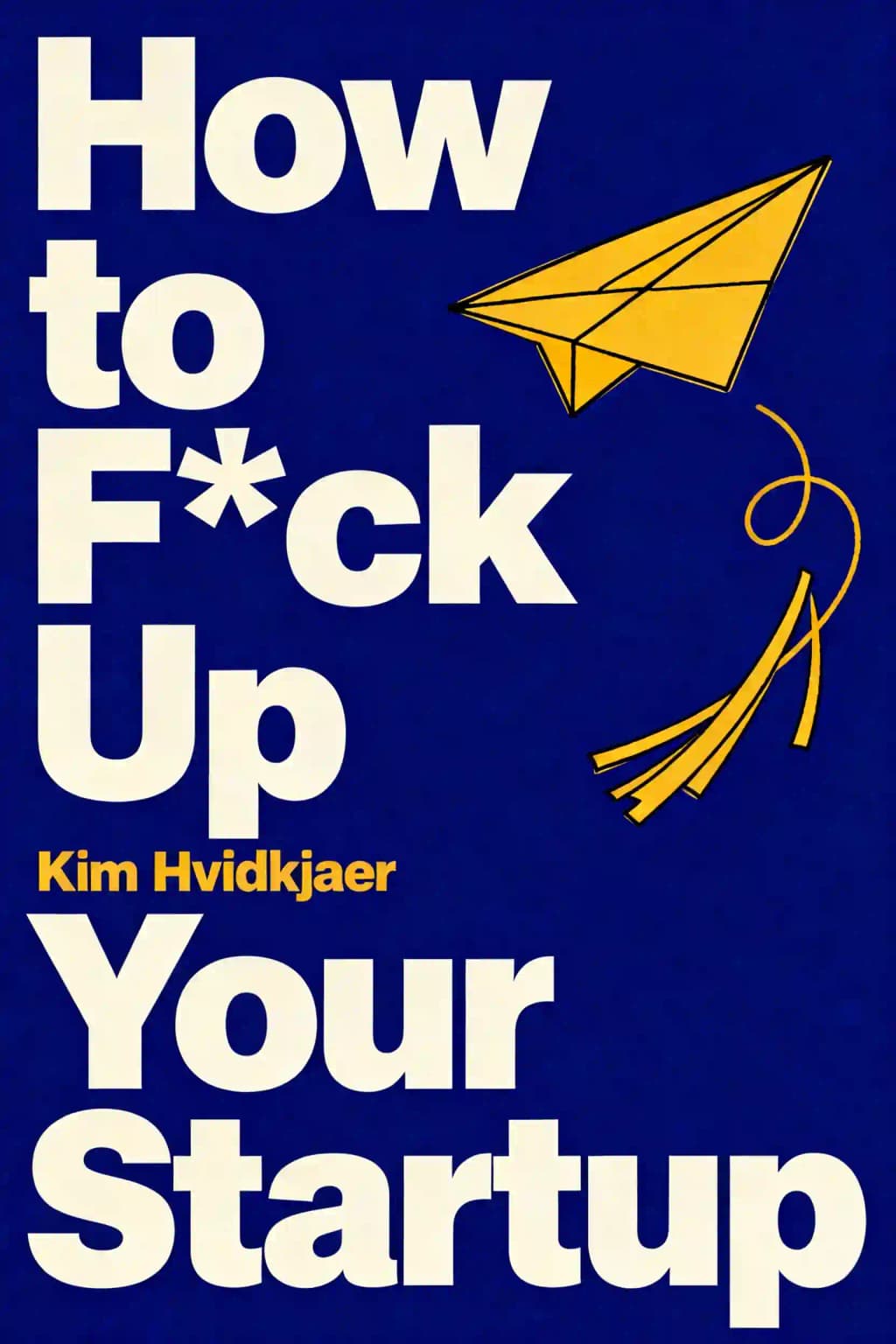
Picture this: New Year's Day 2007. A spacious brick manor house in one of Denmark's most expensive neighborhoods. A spreadsheet confirming assets exceeding $2 million. A feature in Denmark's leading business magazine as one of "Denmark's Six Rising Stars." This was Kim Hvidkjaer's reality-until it wasn't. Just two years later, he had lost more money than the average American earns in a lifetime.
Hvidkjaer's book "How to F*ck Up Your Startup" has become required reading in entrepreneurial circles, praised by business leaders for its unflinching honesty about failure. Unlike most business literature that celebrates success stories while ignoring the 90% of startups that fail, this book dives deep into the patterns that destroy promising ventures. Through analyzing over 160,000 failed companies across fifteen years, Hvidkjaer provides a roadmap of the most lethal mistakes entrepreneurs make-and how to avoid them.
What makes this book particularly compelling is that it's not written by an academic or consultant theorizing from the sidelines. It's written by someone who has experienced spectacular success and devastating failure firsthand, making his insights both practical and authentic. As Mark Cuban notes, "Understanding failure is the first step to success"-and this book offers that understanding in spades.
Capítulo 2
The Mindset That Makes or Breaks Entrepreneurs
Attitude forms the foundation of startup success. Like marathon runners who must push through physical and mental barriers, entrepreneurs need the right mindset to navigate the inevitable challenges from competitors, partners, customers, and even family members.
The most basic failure is simply not starting at all. People create endless excuses-loving a stable job, enjoying steady income, family responsibilities, feeling too young or too old. But age truly is just a number in entrepreneurship. While we celebrate young founders like Musk and Zuckerberg, many successful entrepreneurs launched later in life: Mark Pincus started Zynga at 41, Arianna Huffington founded HuffPost at 54, and Colonel Sanders was 62 before KFC succeeded.
If you're contemplating starting a company, now is the perfect time. Let go of the notion that failure is shameful-failure demonstrates courage. Add social pressure by telling others about your plans. Use the "Toilet Test" to determine if your idea is worth pursuing: if you think about it as often as you use the bathroom, if it makes your pulse quicken and everything else fade away, you're exactly where you need to be.
Impostor syndrome represents another critical attitude failure. The Dunning-Kruger effect reveals that unskilled people overestimate their abilities while skilled people undervalue theirs. The journey of wisdom moves from "Mount Stupid" (high confidence, low wisdom) through the "Valley of Despair" (lower confidence from increased wisdom) to the "Slope of Enlightenment" (high wisdom with recovered confidence).
The solution? Fake it till you make it. Start identifying as an entrepreneur rather than someone who "just started a company." Celebrate all victories, strike power poses with verbal mantras, share doubts with trusted friends, keep an accomplishment journal, dress confidently, and set positive affirmation alarms.
Passion is essential though not sufficient for success. NewsTilt illustrates this perfectly-despite Y Combinator backing, the news platform collapsed after just two months because its founders admitted they "didn't really care about journalism." They treated their startup like a 9-to-5 job, didn't read their own publication, and lacked the passion to overcome setbacks.
Ensure you're building in a field you genuinely care about. Passion doesn't have to be a burning flame-a steady, warm glow of interest is sufficient. Make sure it's your own passion, not something to impress others, and be wary of fleeting interests that shouldn't necessarily become businesses.
Trying to pursue too many projects simultaneously-"plate-spinning"-is another common failure. The solution is simple but challenging: accomplish more by doing less. Create a "not-to-do list" to capture ideas without acting on them immediately, helping you acknowledge creative thoughts while maintaining focus on current priorities.
Finally, avoid "lone-wolf syndrome." Working briefly for competitors provides invaluable insider knowledge that might otherwise take years to learn. Seek mentors through LinkedIn connections or phone calls, potentially offering board positions or equity rather than hourly compensation.
Capítulo 3
Business Models: The Foundation of Sustainable Success
A surprising number of businesses fail simply because they don't create a meaningful business plan. Even companies with major clients like Nike, LEGO, and Disney collapse without strategic revenue planning. Without considering ongoing client relationships, entrepreneurs pitch services a la carte and start from scratch with each new opportunity.
Vine, the once-popular six-second video platform, failed to establish a sustainable business model despite its viral success. Even after being acquired by Twitter, Vine couldn't compete with Instagram's video features and eventually shut down.
Start with Alexander Osterwalder's Business Model Canvas-a visual one-page tool with nine components that can be sketched in 15-30 minutes. Then follow a five-step planning process: develop the canvas (15-30 minutes), expand it to a one-page plan (15-30 minutes), make a budget (2-4 hours), create a project plan (2-4 hours), and compile everything into a business plan (1 day).
Your choice of industry dramatically affects your startup's outcome. Michael Porter's Five Forces Framework helps analyze industry attractiveness: threat of new entrants, threat of substitutes, bargaining power of suppliers, bargaining power of buyers, and competitive rivalry. Select attractive industries with sustainable competitive advantages or disrupt existing industries through innovation.
Avoid creating solutions for non-existent problems, especially those attempting to digitize processes that work perfectly well traditionally. Teaforia's $1,000 Wi-Fi-enabled tea infuser and Juicero's $700 juice press exemplify unnecessary products that failed spectacularly. These companies wasted resources trying to "educate the market" rather than solving genuine problems.
Focus intensely on the problem, not the solution. Write down the problem (not the solution), determine if it's a "Tier 1 problem" (painful enough for people to care), identify existing solutions and their pain points, verify there's a budget for a solution, and use prospects to define your roadmap.
Beware of co-dependency collapse-becoming dependent on a single relationship or platform. Diversification is key: recognize that size doesn't matter when selecting customers; avoid excessive customization; never serve just one customer; save capital for product improvements rather than fancy offices; and avoid micromanagement.
Timing can make or break a startup, as evidenced by numerous failures during the dot-com bubble burst (2000-2003) and Great Recession (2007-2009). Build flexibility into your business plan through "If-Then" scenarios that prepare you for market shifts. Companies that plan for multiple contingencies can pivot when timing works against them, rather than stubbornly sticking to their original vision.
While entrepreneurs often think too big initially, many startups fail because founders think too small. The "cozy little flower shop" mentality that aims merely to pay bills is inadequate-businesses need substantial buffers to weather inevitable challenges. Apply the "10x Rule" or "Antifragile Rule"-multiply your goals by ten to create businesses that thrive on chaos rather than collapse under it.
Capítulo 4
Market Research: Know Before You Go
Market research is crucial for preventing startup failure. Examine competitors' annual reports for key metrics like employee numbers, profit margins, and capitalization. Even basic analysis can reveal vital information-like discovering none of the major TV production companies were profitable, which helps avoid bad investments.
Many entrepreneurs pitch ideas without even checking if identical businesses already exist-a mistake called "doppelganger danger." These copycat businesses typically position themselves as "Pinterest for [niche]" or "Airbnb for [market segment]." Over 20 failed Pinterest clones (from Pinspire to PinCat) illustrate how frequently copycats fail. Even Facebook's Hobbi app, a Pinterest-like photo-sharing platform, shut down months after launch despite Facebook's resources.
The solution isn't necessarily abandoning your idea if similar businesses exist, but differentiating your offering through cost leadership, differentiation, or focus strategies to avoid being "stuck in the middle" when competing with established players.
While uniqueness is valuable, being unnecessarily original can lead to failure. If your market research reveals an empty market niche, there's likely a reason no one else is operating there-it's probably not profitable. Washboard charged $27 to deliver $20 worth of quarters for laundromats, solving a problem that didn't exist. Similarly, Agister let people upload photos and have others guess their age-addressing a non-existent need while potentially creating new problems around body image issues.
It's nearly impossible to compete with established network effects. As more users join platforms like Facebook, they become increasingly valuable, making it extraordinarily difficult for competitors to break in. Google's multiple failed attempts to compete with Facebook illustrate this challenge-Google Wave (2009), Google Buzz (2010), and Google Plus (2011) all failed despite Google's resources.
Customers are the true bosses of any company, with the power to "fire everybody" if ignored. Webvan launched online grocery delivery without consulting customers, missing critical insights like Americans' desire for coupons and resistance to 24-hour advance ordering. Conduct thorough customer research through one-on-one feedback from industry experts and direct customer surveys.
Skipping or botching your Minimal Viable Product (MVP) dramatically increases failure risk. Google Glass serves as a cautionary tale-launched with fanfare but no MVP testing, it quickly faced backlash over privacy concerns, safety issues, and vulnerability to hacking. While creating an MVP requires investment, it provides invaluable market feedback before full launch.
For prioritizing MVP functionality, use the MoSCoW method (Must have, Should have, Could have, Won't have)-a system developed by Dai Clegg at Oracle in 1994 that works well with timeboxing development.
Analysis paralysis occurs when founders get trapped in endless testing and analyzing, never making decisions. While data analysis is valuable, it can prevent launches entirely or strip ideas of their original spark. Compare Waymo's approach with Tesla's: Google's self-driving car project Waymo, launched in 2009, still hasn't fully delivered while attempting to perfect every detail before release. Meanwhile, Tesla has been incrementally releasing autopilot features since 2014-starting with highway lane steering, then expanding to other roads, self-parking, and garage exit capabilities-improving each feature through real driver feedback.
The solution is simple: "Test it Like Tesla." Any decision is better than no decision, as it allows for forward movement, learning, and correction. Only test what enhances your value proposition, do just enough research to understand your product, and bring your MVP to market as soon as it's viable (sellable, not perfect).
Capítulo 5
Funding: The Lifeblood of Startups
While funding is essential for most startups without independently wealthy founders, an excessive early focus on funding can be detrimental. Securing investments is challenging and time-consuming, requiring significant effort for pitching and deal-making.
During the chaotic early days of a startup, founders often lose sight of their primary objectives-developing the best possible product and securing initial sales-as funding anxieties take over. Pearl Automation, founded by former Apple engineers, secured $50 million in venture capital based on their reputations. Despite the substantial funding, their $500 rearview camera failed in the market because it was overpriced and targeted consumers who likely already had this feature.
Founders should "prove your case to get funded" rather than "get funded to prove your case." Early funding can mask fundamental product problems by removing financial pressure that would otherwise force immediate improvements. Contrast Pearl Automation with Glossier, which began as a beauty blog where Emily Weiss spent years gathering customer feedback before seeking funding, putting customers at the center of her business rather than investors.
Bootstrapping is often best, as overcomplicating capital acquisition can kill promising ideas. Many alternative funding sources exist including angel investors, private placements, and crowdfunding. Approach investors confidently with comprehensive knowledge of your business model and numbers, a clear pitch deck showing value proposition and market validation, and "pitch like a king, not a beggar."
Bad budgeting sends the majority of companies "down the drain." Miscalculating operational costs and burn rates, particularly staffing expenses, can be fatal. Wise Acre Frozen Treats rapidly expanded from one employee to fourteen and moved to a large facility, only to go bankrupt by year's end due to overstaffing and excessive overhead.
Mismanaging your cap table (capitalization table) is one of the few unfixable startup mistakes. Once you've sold too much equity and lost control, you can rarely buy it back without paying exorbitant prices. Even Steve Jobs lost control of Apple, seeing his 26% ownership diluted to 11% before being forced out in 1985.
Thoroughly vet potential co-founders and investors, seeking "smart money" that brings networks and knowledge beyond just capital. Protect yourself by hiring a contract attorney before signing agreements, reading contracts meticulously, maintaining paper copies of all documents, and consulting legal counsel before making deals with major investors.
Amateur accounting can be disastrous. Founders often attempt to handle accounting without professional training or outsource it to cheap, distant accounting firms. Call in professionals rather than trying to reinvent accounting systems or relying on unproven technology. A good accountant provides not just technical services but valuable business advice.
Startups don't have unlimited time to reach profitability-typically they need to get there within two to four years. Fieldbook, a spreadsheet-database hybrid, never achieved significant revenue despite years of development. By 2018, with Annual Recurring Revenue under $60,000, they shut down. Be flexible about your product vision to achieve early profitability rather than waiting years for a revolutionary breakthrough.
Massive early funding can pressure young companies into unhealthy rapid growth. Bootstrap through the early stages by getting a side hustle, selling stock, depleting savings, reducing expenses, or considering alternatives like grants, loans, crowdfunding, accelerators, or angel investors. The ideal time to seek investment is when your equity post-infusion will be greater than before.
Capítulo 6
Product Development: Creating Value That Lasts
Every year, about thirty thousand new products launch, with over 95% failing. Founders often get stuck in their vision rather than seeing products as evolving entities. View your products as general sketches guiding a path to evolution rather than fixed destinations.
FNAC (Feature, Not A Company) is venture capital shorthand for a service component that doesn't constitute a viable standalone business. WeWork exemplifies this failure-a real estate company masquerading as a tech company that fell from a $47 billion valuation to $2.7 billion. Their identity crisis led them to purchase unrelated companies while losing billions and laying off thousands of employees.
The solution is clarity and simplicity. Instagram began as feature-heavy "Burbn" until CEO Kevin Systrom focused solely on mobile photo sharing. Define your product in its simplest form, understand its unique value proposition, and anticipate questions from investors about competitors and target audiences.
Releasing products with a big bang might sound sexy, but it's dangerous and costly. Rand Fishkin of Moz learned this when he pushed for a massive release of Moz Analytics in 2013 despite team concerns. The rushed product disappointed customers and hurt the company financially. Instead, break offerings into smaller, more frequent releases. This "growth hacking" approach allows for continuous testing, optimization and learning from mistakes.
Combining two successful products doesn't guarantee a winning innovation. The "X meets Y" approach often fails because it doesn't solve actual problems. Maxwell House's Ready-to-Drink Coffee attempted to merge coffee with convenience, but the product couldn't be microwaved in its container, defeating its purpose. Similarly, adding technology like Wi-Fi or AI to existing products without solving genuine problems creates expensive failures.
Founders often waste precious time obsessing over company names and logos. Apply the "80 percent = 100 percent rule"-if you're 80 percent satisfied with your brand identity, consider it done. Any decision is better than endless deliberation. Your product should be your priority, not perfecting your logo or website.
Founders who succeed with their first startup often believe their next venture will be equally successful, but research shows the opposite. A Copenhagen Business School study of over 65,000 startups revealed that second ventures typically underperform first ones, and third attempts fare no better. It's usually the fourth startup that finally outperforms the debut success.
Outsourcing can be a fatal mistake for early startups. Rivet & Sway secured $2 million in funding but folded sixteen months later after outsourcing production increased customer acquisition costs. PatientDox made the same error by outsourcing software development without a technical founder, making changes expensive and slow. Only outsource non-core functions when your business is established, maintain control over your core product, and ensure you understand what you're outsourcing.
Like Newton standing on the shoulders of giants, successful founders should build upon existing knowledge rather than reinventing everything. Too many startups fail by ignoring successful models or refusing partnerships that could accelerate their growth. Finding mentors in your market (or similar markets outside your geographical radius) can provide invaluable guidance.
Capítulo 7
Building an Organization That Thrives
Surrounding yourself with the right team is crucial for startup success. Two types of teams typically exist: young, hungry workers willing to live on minimal resources while dedicating long hours, or experienced professionals who bring expertise but require higher compensation. Assemble complementary team members who fill your deficits, clearly define responsibilities, communicate a shared vision, and celebrate milestones together.
Having a co-founder creates essential accountability and brings complementary skills to the venture. Without a co-founder, there's no one to challenge decisions or maintain momentum when motivation falters. Write a job description for your ideal partner, network actively to find co-founders, and look for someone who complements your weaknesses.
Starting a business with friends, family members or significant others can create dangerous complications. The Kellogg brothers founded their cereal company but existed in a constant state of feuding. Combining the high failure rate of startups with personal relationships creates tenfold stress. Instead, ask friends for recommendations rather than asking them to join you.
Choosing a co-founder is like marriage-it shouldn't be rushed. You need to "date" potential business partners by learning about their conflict management style, work ethic, skills, and ensuring you have compatible communication styles. Take time to thoroughly vet potential partners, understand their business history, and trust your gut.
While hiring too quickly can be financially fatal, not hiring at all creates different problems. Bringing on employees forces founders to create structure and provides fresh perspectives. Having staff creates accountability and adds energy, though you should still be thorough in the interview process.
Every hire shapes your startup's culture, so attitude matters more than aptitude. A single toxic employee can destroy company morale in a small team. Use a compressed interview format (15-20 minutes per candidate) combined with personality assessments like Myers-Briggs to efficiently evaluate fit.
Hiring only people like yourself is a business failure, not just a social one. Pinky Gloves-a product designed by men for women's menstrual needs-solved a non-existent problem and faced massive backlash. Research from the IMF conclusively shows diverse teams outperform homogeneous ones, with companies having more women in senior positions delivering significantly higher returns.
Founders often delay necessary firings due to discomfort and self-blame for making a bad hire. The two legitimate reasons to fire someone: they're not the right fit or you can't afford them. Never fire someone who hasn't seen it coming, always providing warnings and improvement opportunities first. For cost-cutting, do all layoffs at once so remaining team members feel secure rather than creating a constant atmosphere of fear.
Building accountability is crucial in startups, especially with remote teams where conveying nuances becomes challenging. Weekly video meetings can focus on key questions: where resources are being spent, what challenges exist, and what each team member hopes to accomplish. Calculate the cost of meetings by multiplying attendees' hourly rates by time spent, ensuring meetings deliver value worth their expense.
Most founders imagine themselves as lifelong CEOs, but this isn't always realistic or beneficial. Rahul Yadav of Housing.com was fired after three years with no succession plan, leading to the company selling for far less than its value. In contrast, David Helgason of Unity "self-fired" when he recognized the company needed a leader with stronger marketing skills. Successful CEOs need leadership (vision articulation, right ambition, ability to achieve), desire (burning urge to build something great), and emotional and physical resilience.
Capítulo 8
Sales: Show Me the Money
Without proper sales infrastructure, startups are doomed to fail. Many founders make the mistake of having non-sales people (like project managers, customer support staff, or even the CEO) handle sales functions. This approach leads to inefficient customer acquisition costs and often results in over-customized, unprofitable products. Hire trained salespeople who understand the sales cycle. Without someone dedicated to bringing in revenue, you don't have a business-you have a hobby.
Without proper measurement of your sales funnel, improvement is impossible. Track all conversion points-from cold calls to website visits to signups-not just the areas where you focus most energy. MobileIgniter failed partly because they set sales goals too far in the future without tracking progress toward those targets.
Without a structured sales process, results become unpredictable and random. MobileIgniter underestimated their sales cycle length (3-6 months estimated vs. 9-12 months actual) when targeting manufacturing clients. The Hershey Company's disastrous CRM implementation during Halloween season cost them $100 million in lost candy sales. Use CRM systems to maintain consistent sales flow, avoiding "stop-go sales" that create feast-or-famine cycles.
Finding the right audience for your product is critical for startup success. Boardmeter, a board evaluation tool, targeted the wrong market segment. Danish dating app Swipes failed despite beautiful design and $1 million in funding because they couldn't find proper product-market fit. The fix requires either reinventing the product for a new audience or enhancing it to better satisfy current customers.
Young startups often make the mistake of customizing their product for individual customers who offer substantial money. Gary Swart of Intellibank attributed their failure to lack of product-market fit: "Every customer was asking for something different and we gave it to them... we should have developed just one product." Recognize there are right and wrong customers for your business. Rather than completely customizing your offering, redirect customers toward existing products.
Pushing sales before your product is ready is a recipe for failure. EventVue, a social network for conference attendees, tried to solve what the author calls a "mosquito-bite problem"-annoying but not painful enough to build a company around. Samsung's Galaxy Note 7 disaster stemmed from rushing to market with defective batteries, costing them $14.7 billion and immeasurable brand damage. Don't jump the gun. Test thoroughly, ensure market-readiness, and prioritize quality over quantity.
Pricing strategy can make or break your startup. JCPenney's 2012 experiment with "everyday low pricing"-eliminating sales, coupons and deals-failed spectacularly because it ignored decades of customer conditioning. Understand what motivates your customers, know whether your industry uses cost-plus or value-based pricing, calculate your actual costs to determine breakeven points, consider payment options that might affect profit, and stay alert to market fluctuations.
Founders often over-promise to generate excitement, but failing to deliver creates angry customers and investors. The Grid raised $5 million in 2015 by promising AI-powered custom website creation but delivered buggy, barely-stylized sites. The Fyre Festival disaster exemplifies this failure at its most extreme-selling $500-12,000 tickets for a luxury Bahamas experience but delivering a tent city with cold cheese sandwiches. Under-promise and over-deliver. Research thoroughly to set realistic expectations that you can exceed.
Some founders delude themselves that their businesses can survive without revenue, imagining profits will magically appear later. AltSchool exemplifies this mistake-despite requiring $30 million annually to operate, they charged just $150 per year for their online learning platform. Every startup needs a revenue model that outlines profit streams, is regularly evaluated, and serves as a touchstone for marketing and sales strategy.
Capítulo 9
Growing Without Breaking
Growing a startup is a marathon requiring mental stamina more than a sprint. Like completing an Ironman Triathlon, founders need determination and the ability to keep going when exhausted. Growth requires regular recalibration, overcoming obstacles, and sticking to fundamentals.
Pivoting-drastically shifting company direction-is both overused and underutilized in startups. Young companies often pivot unnecessarily while mature ones fail to pivot when needed. Wanful, an online gift service, failed after abandoning its personalized approach to become a general e-commerce shop. Toys "R" Us partnered with Amazon but couldn't adapt when Amazon allowed competitors on their platform. Blockbuster infamously dismissed Netflix and refused to pivot from brick-and-mortar. Successful pivots require solid market research, sticking to core competencies, and targeting the same audience.
Founders often fail by focusing on the wrong priorities. Delicious, once a beloved social bookmarking platform, collapsed after being acquired by YouTube's founders because they didn't understand how users actually valued the platform. Focus only on what truly matters. Watch for common distractions: clingy low-value clients who consume time without adequate return; getting lost in endless learning without action; obsessing over perfect logos and websites instead of building your product; and holding meaningless meetings that waste everyone's time and money.
Poor decision-making ranks high among startup failure causes. Salorix illustrates this perfectly-despite having $3.5 million in funding and acquisition offers from Google, the founder's quibbling over price killed the deal, causing investors to abandon ship. To make better decisions, understand the mental models that influence your thinking: Loss Aversion, Availability Heuristics, Anchoring, Confirmation Bias, and Survivorship Bias.
Complexity often strangles growth. Keep operations simple, as demonstrated by Supercell's CEO Ilkka Paananen, who transformed his company by organizing into independent cells rather than micromanaging. By giving teams freedom with a simple mandate to create cool games, morale improved and productivity soared.
Explosive growth can lead to spectacular crashes. Crumbs Bake Shop expanded from one NYC store to seventy locations across ten states in less than a decade, riding the cupcake craze until it collapsed into bankruptcy. Make haste slowly-focus on natural growth, keep customer experience as your north star, maintain financial discipline even with VC funding, and pay attention to office energy.
Perseverance separates successful founders from the rest. Chris Hill-Scott co-founded SwiftKey but quit after just two months, selling his shares to buy a bicycle. Years later, Microsoft acquired the company for around $100 million, with his former partners each walking away with $50 million. Contrast this with Pekka Rantala of Rovio, who released 51 unsuccessful games before creating Angry Birds, game number 52.
A fate worse than failing is not knowing when to quit. For companies stuck in limbo between meager profits and bankruptcy-"stale startups"-continuing may be worse than closing. Set clear goals and deadlines. If you repeatedly miss them, quitting isn't mental fatigue but wisdom. Ask yourself: "Am I still passionate about this product, and is it gaining ground?" Remember, failure is merely a stepping stone to success if you learn from it.
Capítulo 10
Predicting and Preparing for the Future
Failing to believe you can predict the future causes countless failures. Kodak, once commanding 85-90% of US camera and film sales, ironically invented the first handheld digital camera in 1975 but neglected it until competition made recovery impossible. Similarly, Xerox invented revolutionary technologies-personal computers, graphical user interfaces, the mouse, laser printers-at their Palo Alto Research Center but abandoned these innovations to focus on their "core business."
The Johari window offers a framework for understanding uncertainty with four quadrants: Known/Knowns (things we understand and are aware of), Known/Unknowns (things we're aware of but don't understand), Unknown/Knowns (things we understand but aren't aware of), and Unknown/Unknowns (things we neither understand nor are aware of).
For predicting the future, use three categories: Provable (certain events, like technology improvements), Probable (likely events, like self-driving cars), and Possible (things that might happen, like flying cars). Always start with certainty and build outward, not the reverse.
Future-looking should be a routine business procedure. Use frameworks like VUCA (Volatility, Uncertainty, Complexity, Ambiguity) or PESTLE (Political, Economic, Social, Technological, Legal, Environmental). The goal is maximizing future freedom of action-which Dr. Alex Wissner-Gross defines as intelligence itself.
Remember that predictions involve psychological factors: we fear losses more than we value gains, and we're more likely to believe optimistic predictions than negative ones. Combining forecasts from independent sources provides a more accurate picture. As long as you consider provable outcomes and build from there, you'll likely make decisions you won't regret.
Capítulo 11
The Most Important Rule: Don't Die
The most important principle in entrepreneurship is Rule Zero: Don't die. This applies both literally (avoid suicide despite business failures) and figuratively (don't risk everything on one venture). Bill Gates and Paul Allen's first startup Traf-O-Data failed before they founded Microsoft, illustrating that failure is merely a stepping stone to future success.
Startup failure isn't truly failing-it's leveling up in the entrepreneurial journey. When you create a business model, develop a product, secure funding, sell to customers, and build a team, these are all successes regardless of the ultimate outcome.
Take time to reset, do a postmortem on your business, and prepare for your next venture with the valuable knowledge you've gained. As Thomas Edison famously said after thousands of failed attempts to create the light bulb: "I have not failed. I've just found 10,000 ways that won't work." Each failure brings you one step closer to success.