Capítulo 1
From Cricket Fields to Cloud Computing: Satya Nadella's Journey of Transformation
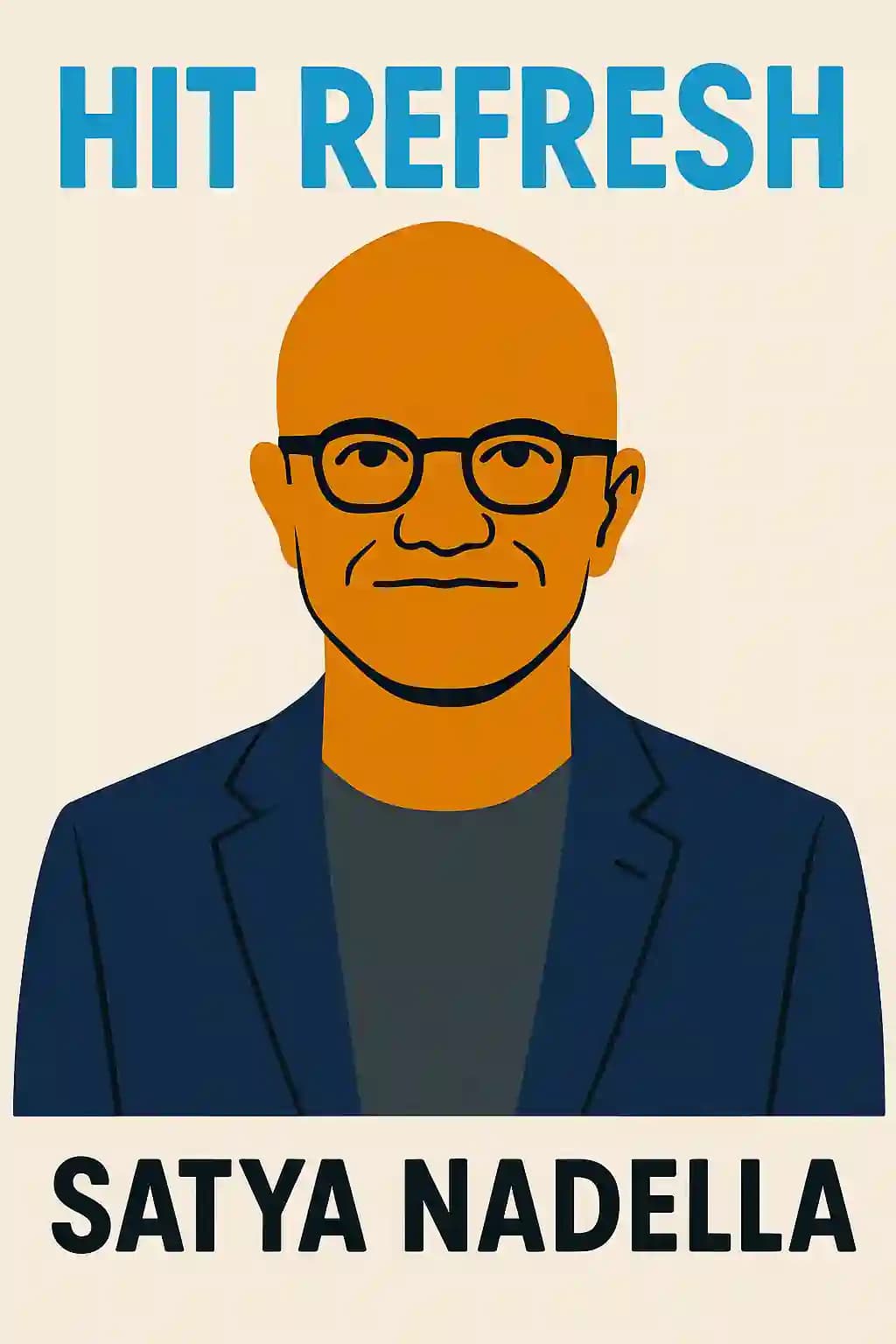
In a world where technology shapes nearly every aspect of our lives, few stories are as compelling as Satya Nadella's transformation of Microsoft. "Hit Refresh" has become a modern business classic, landing on the reading lists of tech innovators and Fortune 500 CEOs alike. The book has sold over a million copies worldwide and has been translated into more than 20 languages. When Bill Gates publicly praised it as "an essential read for anyone interested in technology or leadership," the book catapulted to bestseller lists. What makes this narrative particularly fascinating is how Nadella, an Indian immigrant with a passion for cricket, managed to revitalize one of the world's most influential technology companies at a critical juncture in its history. Through his deeply personal story of transformation, Nadella offers a blueprint not just for corporate renewal, but for navigating our rapidly evolving digital future with empathy and purpose.
Capítulo 2
The Empathy Revolution: Personal Tragedy Shapes Leadership Philosophy
When Satya Nadella's son Zain was born with severe cerebral palsy, it forever altered his perspective on life and leadership. This wasn't just a personal challenge-it became the foundation of his leadership philosophy. Imagine receiving the news that your newborn son would never walk, talk, or experience life as most children do. For Nadella and his wife Anu, this moment became a profound catalyst for personal growth.
The experience of raising Zain transformed Nadella's understanding of empathy. "Nothing prepared me for the journey we would find ourselves on," he reflects. Through countless hospital visits and therapies, he developed a deeper capacity to understand the struggles of others-not just to sympathize, but to truly comprehend their experiences and needs.
This newfound empathy didn't remain confined to his personal life. It seeped into his professional identity, reshaping how he approached leadership at Microsoft. Nadella began to see that technological innovation without human understanding was hollow. What good was creating powerful tools if they didn't address real human needs?
Buddhist teachings about suffering and impermanence provided additional perspective. Nadella discovered that accepting life's impermanence could lead to equanimity-a balanced mind that could weather any storm. This philosophical foundation helped him navigate both personal challenges and corporate turbulence.
The impact of this personal journey manifested in tangible ways at Microsoft. Under Nadella's leadership, the company invested in technologies like eye-gaze tracking, which allows people with mobility challenges to control computers with their eyes. What began as a personal connection to accessibility became a corporate commitment to inclusive design.
This transformation illustrates a profound truth: our greatest personal challenges often become our greatest sources of strength and wisdom. For Nadella, the journey with his son wasn't just about coping with difficulty-it was about discovering a new lens through which to view both technology and humanity. By bringing empathy to the center of Microsoft's mission, he didn't just change a company culture; he began reshaping how one of the world's most influential technology companies approaches innovation itself.
Capítulo 3
From Hyderabad to Redmond: The Unlikely Path to Microsoft's Top Job
The journey from a cricket-obsessed schoolboy in Hyderabad to the CEO of Microsoft seems improbable at first glance. Yet Nadella's formative years at Hyderabad Public School laid the groundwork for his future success in ways that weren't immediately obvious. The school's diverse student body-children from various cultural and economic backgrounds learning side by side-instilled in him an appreciation for different perspectives that would later become central to his leadership philosophy.
Cricket wasn't just a pastime for young Satya; it was a classroom for learning teamwork, strategy, and resilience. "Cricket taught me more about working in teams and leadership than any management book ever could," he reflects. The sport's emphasis on individual contribution within a team framework mirrored the balance he would later strike at Microsoft between personal excellence and collective achievement.
What's particularly striking about Nadella's early ambitions is how modest they were. Unlike many future tech leaders who dreamed of changing the world from childhood, his aspirations centered around playing cricket professionally or working at a local bank. The pivotal moment came when his father gave him a Sinclair ZX Spectrum computer-a simple machine by today's standards but a portal to possibility for the teenage Nadella.
This unexpected gift sparked a curiosity about technology that would eventually lead him halfway around the world. The transformation from cricket enthusiast to technology evangelist wasn't immediate or dramatic-it was a gradual awakening to the potential of software to solve problems and create opportunities.
When Nadella arrived at Microsoft in 1992 as a young engineer, the company was riding high on the success of Windows. Yet his path through the company wasn't a straight line to the top. He worked across various divisions, from Windows NT to cloud services, gaining a comprehensive understanding of Microsoft's business that few others possessed.
What distinguishes Nadella's story is how he maintained connections to his roots while embracing new challenges. The values instilled at HPS-curiosity, respect for diversity, and teamwork-remained central to his approach even as he climbed the corporate ladder. His journey reminds us that leadership isn't always born from grand ambitions, but often emerges from a genuine passion for solving problems and helping others succeed.
Capítulo 4
The Cloud Revolution: Seeing Beyond Windows
When most people were still getting comfortable with personal computers, Satya Nadella was already envisioning a world where computing would extend far beyond the desktop. His early recognition of cloud computing's transformative potential wasn't just technological foresight-it was a fundamental understanding of how technology could democratize access to computing power.
"I saw the cloud as the ultimate democratizer," Nadella explains. "It could bring the power of computing to anyone, anywhere, regardless of their resources." This vision stood in stark contrast to Microsoft's traditional business model, which relied heavily on selling software licenses for Windows and Office.
The shift wasn't merely theoretical. Nadella witnessed firsthand how cloud technology could transform education in developing regions. In places where traditional infrastructure was lacking, cloud computing offered a way to leapfrog generations of technology. Students who might never have access to a fully equipped computer lab could now tap into world-class computing resources through simple, internet-connected devices.
But the true power of the cloud became evident through its real-world applications. In Andhra Pradesh, India, and Tacoma, Washington-places separated by thousands of miles but united by similar challenges-cloud computing helped predict which students were at risk of dropping out, allowing educators to intervene before it was too late. In Kenya, a startup used mobile and cloud technology to bring solar energy to rural families, simultaneously building credit histories for people who had never participated in the formal banking system.
Perhaps most poignantly, when Nepal was devastated by an earthquake in 2015, cloud technology enabled aid workers to coordinate relief efforts with unprecedented speed and efficiency. What might have taken weeks in the pre-cloud era could now be accomplished in hours, saving countless lives in the process.
These examples illustrate why Nadella pushed Microsoft toward cloud computing despite internal resistance. It wasn't just about business strategy-it was about unleashing the full potential of technology to solve humanity's most pressing problems. The cloud wasn't simply a new product category; it represented a fundamental shift in how computing power could be distributed and applied for the greater good.
Capítulo 5
Transforming Microsoft: Cultural Renaissance and Strategic Pivots
When Satya Nadella stepped into the role of CEO in February 2014, Microsoft was at a crossroads. The company that had once dominated the technology landscape was struggling to find its footing in a world increasingly defined by mobile devices and cloud services. Windows 8 had received a lukewarm reception, PC sales were declining, and internal divisions were hampering innovation. The challenge wasn't just technological-it was cultural.
"Culture eats strategy for breakfast," Nadella often says, quoting management guru Peter Drucker. He understood that without addressing Microsoft's culture, no strategic pivot would succeed. The company had developed what he called a "know-it-all" culture, where being the smartest person in the room was valued above learning and growth.
Nadella's first order of business was to shift this mindset. "We needed to become learn-it-alls, not know-it-alls," he explains. This seemingly simple shift represented a profound change in how Microsoft approached both its internal dynamics and its relationships with customers and partners.
The transformation wasn't just philosophical-it was structural. Nadella dismantled the rigid organizational boundaries that had created silos within the company. Teams that had once competed against each other for resources and recognition were now encouraged to collaborate toward common goals. The emphasis shifted from individual product success to customer outcomes.
This cultural shift enabled a strategic pivot that would have been impossible in the old Microsoft. Nadella articulated a new mission focused on "empowering every person and every organization on the planet to achieve more." This wasn't just corporate jargon-it was a fundamental reorientation of the company's purpose.
With this new mission as a guide, Microsoft embraced a "mobile-first, cloud-first" strategy that acknowledged the changing technological landscape. Rather than clinging to Windows as the center of its universe, Microsoft began developing services that worked across all platforms-even those of competitors like Apple and Google.
The results of this transformation were remarkable. Microsoft's cloud platform, Azure, grew from an also-ran to a major competitor to Amazon Web Services. Office 365 successfully transitioned from a packaged software product to a subscription service. And perhaps most symbolically, when Nadella appeared on stage at a Salesforce event holding an iPhone running Microsoft apps, it signaled to the world that this was indeed a new Microsoft.
What makes Nadella's transformation of Microsoft particularly instructive is how he balanced respect for the company's legacy with a clear-eyed view of the future. He didn't reject Microsoft's past-he built upon its strengths while addressing its weaknesses. The result was a company renewed not just in its business strategy, but in its very soul.
Capítulo 6
From Competition to Collaboration: Redefining Industry Relationships
Picture this: the CEO of Microsoft standing on stage at a Salesforce event, holding up an iPhone running Microsoft applications. Just a few years earlier, this scene would have been unimaginable. Microsoft had long been known for its competitive-sometimes combative-stance toward other technology companies. The message was clear: Microsoft was changing its approach to industry relationships.
"The world is too complex to go it alone," Nadella explains. This simple insight drove a fundamental shift in how Microsoft engaged with other companies, even those traditionally seen as competitors. The old zero-sum mentality-where Microsoft's gain had to come at another company's expense-gave way to a more nuanced understanding of the technology ecosystem.
Take Microsoft's relationship with Apple, historically one of tech's most famous rivalries. Rather than continuing to position Windows as the only legitimate operating system, Microsoft began developing versions of its Office applications that worked seamlessly on Apple devices. The result? Microsoft expanded its reach to millions of Apple users while Apple could offer its customers access to productivity tools they valued.
This collaborative approach extended to other former adversaries as well. Microsoft partnered with Google on certain open-source projects, worked with Facebook on AI initiatives, and even embraced Linux-an operating system that former CEO Steve Ballmer had once called "a cancer." These weren't just publicity stunts; they were strategic moves that recognized the interconnected nature of the modern technology landscape.
Building these partnerships required more than just business logic-it demanded a new level of trust. Nadella approached these relationships with empathy and transparency, understanding that past tensions couldn't be erased overnight. "Trust is built in drops and lost in buckets," he notes, acknowledging the patience required to transform long-standing rivalries into productive partnerships.
Perhaps most importantly, these collaborations were guided by a customer-centric philosophy. The question wasn't "How does this partnership benefit Microsoft?" but rather "How does this partnership create value for our shared customers?" This shift in perspective allowed Microsoft to identify opportunities for collaboration that might otherwise have been overlooked.
The lesson here extends beyond the technology industry. In an increasingly interconnected world, the ability to collaborate with competitors-what some call "coopetition"-has become a crucial skill for organizations of all kinds. Nadella's approach demonstrates that with the right mindset, even the most entrenched competitive relationships can be transformed into sources of mutual value.
Capítulo 7
Beyond the Cloud: The Three Technological Shifts Shaping Our Future
As cloud computing transforms from revolutionary to mainstream, Satya Nadella is already looking toward the next horizon of technological innovation. He identifies three interconnected shifts that will define the future: mixed reality, artificial intelligence, and quantum computing. These aren't isolated technologies but converging forces that will fundamentally reshape how we interact with the digital world.
Mixed reality-the blending of physical and digital environments-represents a profound shift in computing interfaces. "For the past 30 years, we've been trapped in a two-dimensional relationship with technology," Nadella observes. "Mixed reality breaks us out of that flat world." Microsoft's HoloLens exemplifies this vision, allowing users to interact with digital content as if it existed in the physical world.
The applications are far-reaching. Imagine architecture students walking through their designs before construction begins, surgeons practicing complex procedures on virtual patients, or remote experts guiding field workers through repairs using holographic overlays. These aren't science fiction scenarios-they're already emerging in various industries.
Artificial intelligence represents another fundamental shift. While AI has been the subject of research for decades, the combination of vast data sets, powerful cloud computing, and advanced algorithms has accelerated progress dramatically. Microsoft's approach to AI emphasizes augmentation rather than replacement-technology that enhances human capabilities rather than substituting for them.
This philosophy manifests in tools like Cortana and Xiaoice, AI assistants designed to complement human interaction rather than simulate it perfectly. It also appears in Microsoft's investments in AI for accessibility, such as Seeing AI, which helps visually impaired people understand their surroundings through computer vision.
Perhaps most speculative but potentially most transformative is quantum computing. Traditional computers, no matter how powerful, struggle with certain types of problems that quantum computers could potentially solve in minutes or seconds. These include modeling complex molecular interactions for drug discovery or optimizing logistical challenges across global supply chains.
Microsoft's approach to quantum computing combines theoretical research with practical engineering challenges. Station Q, the company's quantum computing research lab, brings together physicists, mathematicians, and computer scientists to tackle fundamental questions about quantum information processing.
What unites these three technological shifts is their potential to transform not just how we use computers, but how we understand and interact with the world itself. They represent not incremental improvements but paradigm shifts in computing-from the graphical user interface to natural interaction, from programmed responses to learning systems, from binary processing to quantum states.
Nadella's vision isn't just about developing these technologies in isolation but understanding how they converge and complement each other. A mixed reality interface powered by AI and backed by quantum computing capabilities could solve problems we can barely articulate today. By investing across all three areas, Microsoft is positioning itself not just for the next product cycle but for the next computing era.
Capítulo 8
The Trust Equation: Balancing Privacy, Security, and Free Speech
In December 2014, Sony Pictures Entertainment faced a devastating cyberattack from a group calling themselves the Guardians of Peace. Beyond the immediate damage to Sony's systems and data, the attackers threatened violence against theaters showing "The Interview," a comedy about North Korea. Major theater chains pulled the film, effectively censoring it through intimidation.
This crisis presented Microsoft with a difficult decision. Should they help distribute the film digitally, potentially making themselves a target? Or should they step back, prioritizing security over free expression? For Satya Nadella, this moment crystallized a fundamental challenge of the digital age: how to balance privacy, security, and free speech.
"These aren't just technical problems-they're human rights issues," Nadella reflects. Microsoft chose to support Sony by making the film available on Xbox Video, standing up for free expression despite the risks. This decision exemplified Nadella's approach to what he calls "the trust equation"-the delicate balance of values that technology companies must maintain to deserve public confidence.
Privacy presents particular challenges in an era of big data and cloud computing. Users want personalized services that require data collection, yet they also want control over their information. Microsoft has advocated for a balanced approach, supporting privacy as a fundamental right while acknowledging legitimate security needs.
The company took a stand in 2013 by challenging a U.S. government warrant seeking customer data stored in Ireland, arguing that digital information should receive the same territorial protections as physical documents. This case, which eventually reached the U.S. Supreme Court, highlighted the need for updated legal frameworks that reflect the realities of cloud computing.
Security concerns further complicate the picture. Encryption protects privacy but can also shield criminal activity. Government agencies push for backdoors into encrypted systems, while technology companies warn that such vulnerabilities would undermine security for everyone. Nadella advocates for a middle path that protects individual privacy while enabling appropriate law enforcement access through clear legal processes.
Perhaps most challenging is the question of free speech in digital spaces. Online platforms must balance open expression against the harms of harassment, hate speech, and misinformation. Microsoft has developed AI systems that can detect harmful content while striving to avoid overreach that would stifle legitimate discourse.
Nadella proposes that addressing these challenges requires not just technical solutions but new governance models. He advocates for a "Digital Geneva Convention" that would establish international norms for behavior in cyberspace, protecting civilians from nation-state attacks and establishing clear accountability for digital weapons.
The trust equation isn't just about abstract principles-it has real business implications. Companies that fail to protect privacy, ensure security, or respect free expression will ultimately lose customer trust and face regulatory backlash. By contrast, those that thoughtfully navigate these tensions can build enduring relationships with users and societies.
Capítulo 9
The Human-AI Partnership: Designing Ethical Artificial Intelligence
When Microsoft launched Tay, an AI chatbot designed to learn from Twitter interactions, in 2016, it took less than 24 hours for users to manipulate it into posting offensive and hateful content. The company quickly took Tay offline, but the incident highlighted a crucial challenge: artificial intelligence systems reflect both the best and worst of humanity.
This experience reinforced Satya Nadella's conviction that AI development must be guided by strong ethical principles. "We're creating tools of unprecedented power," he notes. "The question isn't just what they can do, but what they should do." This perspective has shaped Microsoft's approach to AI, emphasizing human-AI partnership rather than replacement.
Nadella outlines several principles for ethical AI design. First, AI should complement human capabilities rather than replace them. This means focusing on augmentation-enhancing human creativity, judgment, and empathy-rather than automation alone. Microsoft's Seeing AI app exemplifies this approach, helping visually impaired people "see" the world through their smartphones without attempting to replace human perception entirely.
Second, AI must be transparent and explainable. As algorithms make increasingly consequential decisions-from medical diagnoses to loan approvals-people need to understand how these systems reach their conclusions. Microsoft has invested in research on "explainable AI" that can articulate its reasoning in human-understandable terms.
Third, AI should be designed with privacy and security built in from the ground up. This means not only protecting data used to train AI systems but also ensuring that the systems themselves respect user privacy and resist manipulation. After the Tay incident, Microsoft developed more robust safeguards for its conversational AI, including Zo, which was designed to withstand attempts at manipulation.
Fourth, AI must be inclusive, reflecting the diversity of human experience. This means both ensuring that AI systems work well for people of all backgrounds and involving diverse perspectives in the design process itself. Microsoft has established an AI ethics review board that includes experts from various disciplines and backgrounds to evaluate potential applications.
Perhaps most importantly, Nadella emphasizes that AI should be designed to earn trust. This means creating systems that are reliable, fair, and aligned with human values. It also means being transparent about limitations and potential risks rather than overselling AI capabilities.
The stakes of getting this right are enormous. AI technologies will increasingly shape fundamental aspects of our lives-from healthcare and education to transportation and employment. If designed ethically, these systems could help address some of humanity's most pressing challenges. If designed carelessly, they could exacerbate existing inequalities or create new forms of harm.
Nadella's vision for the human-AI partnership isn't just about avoiding negative outcomes; it's about actively pursuing positive ones. He sees AI as a tool for empowerment-technology that can help more people participate fully in economic and social life regardless of physical ability, geographic location, or socioeconomic status. This optimistic but clear-eyed perspective guides Microsoft's AI research and development, aiming for technology that enhances rather than diminishes our humanity.
Capítulo 10
Economic Growth for Everyone: Technology's Role in Creating Shared Prosperity
The rise of artificial intelligence and automation has sparked widespread anxiety about the future of work. Will machines replace human workers? Will economic benefits flow primarily to those who own the technology? These questions take on particular urgency as income inequality continues to grow in many countries.
Satya Nadella approaches these challenges with a perspective shaped by both his personal journey and his role leading a global technology company. "Technology has always disrupted labor markets," he acknowledges, "but it has ultimately created more opportunity than it has destroyed." The key, he believes, is ensuring that these opportunities are broadly shared.
This begins with rethinking how we measure economic success. GDP growth alone doesn't capture whether prosperity is widely distributed or concentrated among a few. Nadella advocates for metrics that reflect not just aggregate growth but improvements in living standards across society.
Microsoft's acquisition of LinkedIn exemplifies this approach. Beyond the business rationale, Nadella saw an opportunity to create what he calls an "economic graph"-a digital representation of the global economy that could help connect people with opportunities. By making job markets more transparent and efficient, such tools can help address the mismatch between available skills and open positions.
Education plays a crucial role in this vision. As technology transforms the economy, workers need ways to acquire new skills throughout their careers. Microsoft has invested in educational initiatives ranging from coding programs in schools to partnerships with community colleges and online learning platforms. These efforts aim to democratize access to the skills needed for technology-related careers.
Nadella also emphasizes the importance of inclusive design-creating technology that works for people of all abilities. This isn't just about accessibility as a moral imperative; it's about tapping the full potential of human talent. When technology accommodates diverse needs and abilities, more people can contribute to economic growth.
The story of Kent International, a bicycle manufacturer, illustrates how automation can transform rather than eliminate jobs. When the company brought production back to the United States from overseas, it used automation to remain competitive. Rather than reducing employment, this created new, higher-skilled jobs operating and maintaining the automated equipment.
This example points to a broader pattern: technology tends to eliminate specific tasks rather than entire jobs. The most successful approach combines human and machine capabilities, with people focusing on aspects that require creativity, empathy, and judgment while machines handle routine, repetitive tasks.
Nadella calls for a new social contract for the AI age-one that balances the interests of capital, labor, and society as a whole. This includes rethinking education, social safety nets, and corporate responsibility. It also means ensuring that the benefits of technological progress are widely shared rather than concentrated among a few.
The stakes are high. If managed poorly, technological change could exacerbate inequality and social division. If managed thoughtfully, it could create unprecedented opportunities for human flourishing. Nadella's vision is firmly in the latter camp-technology as a force for inclusive economic growth that empowers everyone to achieve more.
Capítulo 11
A Global Vision: Technology's Role in Addressing Humanity's Challenges
As Satya Nadella concludes his narrative, he broadens his perspective from Microsoft's transformation to technology's role in addressing global challenges. This isn't just corporate social responsibility-it's a recognition that technology companies have both the capability and the responsibility to help solve humanity's most pressing problems.
"The next industrial revolution, powered by artificial intelligence, mixed reality, and quantum computing, will be shaped by the choices we make today," Nadella asserts. These choices extend beyond technical specifications to fundamental questions about values, ethics, and human flourishing.
Climate change exemplifies the kind of complex global challenge that requires technological innovation. Microsoft has committed to becoming carbon negative by 2030, removing more carbon from the atmosphere than it emits. Beyond its own operations, the company is developing AI tools to help other organizations reduce their environmental impact, from optimizing energy usage in buildings to improving agricultural efficiency.
Economic inequality presents another critical challenge. Nadella points to the uneven distribution of gains from globalization and technological change as a source of political instability and social division. Technology companies must recognize their role in this dynamic and work to ensure that digital transformation creates opportunities across society, not just for those already advantaged.
This means rethinking how multinational corporations operate in a global economy. Rather than centralizing all high-value activities in a few technology hubs, Nadella advocates for distributing opportunity more widely. Microsoft's investment in data centers and development offices around the world exemplifies this approach, creating skilled jobs and building digital capacity in diverse regions.
Education emerges as a crucial lever for addressing both inequality and technological adaptation. As automation transforms labor markets, workers need ways to develop new skills throughout their careers. Microsoft has invested in educational initiatives ranging from basic digital literacy to advanced technical training, often partnering with local organizations to ensure relevance to specific contexts.
Perhaps most fundamentally, Nadella calls for a human-centered approach to technology development. This means designing systems that enhance rather than replace human capabilities, that respect privacy and autonomy, and that reflect diverse perspectives and needs. It also means acknowledging that technological solutions alone cannot address complex social challenges-they must be part of broader efforts involving policy, education, and community engagement.
The COVID-19 pandemic (which occurred after the book's publication) has only underscored these themes. Technology enabled remote work, education, and healthcare during lockdowns, but also highlighted digital divides and the importance of human connection. The crisis accelerated digital transformation while revealing both the potential and limitations of technological solutions to human problems.
Nadella's global vision is ultimately one of cautious optimism-recognition of technology's power to address humanity's challenges coupled with humility about the complexity of these challenges and the need for multifaceted approaches. It's a vision that extends beyond quarterly earnings or product cycles to fundamental questions about the kind of future we want to create and technology's role in that future.