Capítulo 1
Napkin Math: How Simple Estimates Solve Impossible Problems
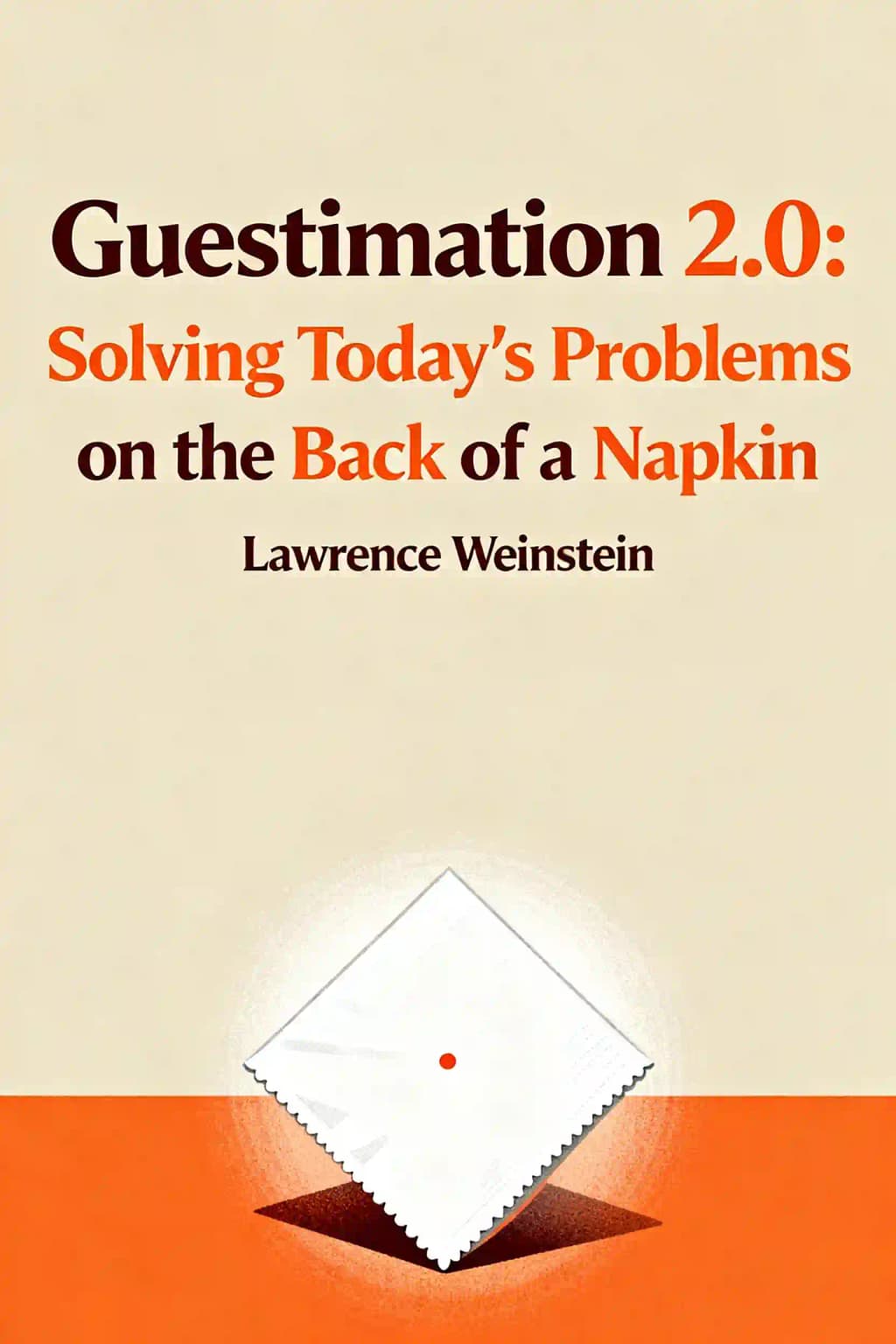
Ever wondered how many piano tuners are in Chicago? Lawrence Weinstein has - and he can calculate it on a napkin while waiting for his coffee. In "Guesstimation 2.0," this renowned physicist and educator delivers the sequel to his cult-classic that's transformed how engineers, scientists, and business leaders approach seemingly unsolvable problems. When Google interviewers ask candidates how many golf balls fit in a school bus, they're testing the very skills this book masterfully teaches.
Through delightfully quirky problems - from calculating the carbon footprint of cheeseburgers to estimating the volume of human blood in the world - Weinstein equips you with mental tools that transform intimidating questions into approachable puzzles. Beyond mere calculations, you'll develop a framework for breaking down complex challenges that transfers directly to business strategy, environmental policy, and everyday decisions.
Weinstein's approach has influenced curriculum at top universities worldwide and sparked a movement of "Fermi estimation" enthusiasts. Master these techniques, and you'll never be paralyzed by analytical uncertainty again - just reach for a napkin.
Capítulo 2
Breaking Down the Impossible: The Power of Estimation
Have you ever wondered how many pizza boxes Americans use each year? Or whether it's worth walking an extra block to recycle that aluminum can? These questions might seem trivial or impossibly complex, but they represent exactly the kind of everyday puzzles that estimation can solve.
Weinstein introduces us to a revolutionary way of thinking: dare to be imprecise! The goal isn't to calculate the exact answer to six decimal places, but rather to determine if something is "too big," "too small," or "just right." Most real-world decisions don't require perfect precision-they require reasonable approximations that guide our actions.
The beauty of estimation lies in its accessibility. You don't need advanced mathematics or specialized knowledge. Instead, you need a willingness to break complex problems into manageable pieces, make reasonable assumptions, and embrace imprecision. A factor of ten-being within 10 times the actual answer-is often sufficient for practical purposes.
Consider a real-world example: should you drive across town to save $5 on groceries? By estimating the cost of gas, wear on your vehicle, and your time, you can quickly determine if the trip makes economic sense. Or perhaps you're wondering if installing solar panels will save you money in the long run. Rather than getting lost in complex calculations, estimation helps you determine if the investment falls into the "worth it" category.
The method is simple but powerful: divide and conquer. Break down the problem into components you can estimate, recombine those estimates, and then compare your answer to known quantities to check if it makes sense. This approach transforms seemingly impossible questions into manageable puzzles.
Capítulo 3
From Pizza Boxes to Video Games: Everyday Applications
Let's explore how estimation works through some everyday examples. How much area would all the pizza boxes used in America in one year cover? Rather than researching precise statistics, we can build our estimate from reasonable assumptions.
Start by considering how many pizzas an average American might eat in a year-perhaps 20? With approximately 300 million Americans, that's about 6 billion pizzas annually. If a typical pizza box is about 1 square foot, we're looking at 6 billion square feet of pizza boxes. To put that in perspective, that's roughly 200 square miles-enough to cover a major city like Chicago! This striking visualization helps us grasp the environmental impact of something as mundane as pizza packaging.
Or consider video games: how much collective time do Americans spend playing them? If roughly half of Americans between ages 10 and 40 (about 50 million people) play video games for an average of one hour daily, that's 50 million hours per day or about 20 billion hours annually. That's equivalent to over 2 million human lifetimes spent gaming each year! Yet when distributed across the population, it's only about 0.2 hours per person per day-a reminder that large numbers need context to be meaningful.
These examples demonstrate the power of estimation to transform abstract numbers into concrete insights. By breaking down complex questions into manageable pieces and making reasonable assumptions, we can arrive at answers that, while not exact, are close enough to be useful. This approach doesn't just solve puzzles-it builds a deeper understanding of the world around us.
Capítulo 4
Toilet Paper, Popcorn, and Money: Visualizing the Unimaginable
Have you ever tried to conceptualize truly large numbers? Our minds struggle with magnitudes beyond our everyday experience, but estimation offers a path to understanding through vivid comparisons.
Consider toilet paper: Americans use approximately 20 sheets per person daily. With 300 million people, that's 6 billion sheets daily or about 2 trillion sheets annually. If unrolled, this would stretch from Earth to the Sun-a distance of 93 million miles. This comparison transforms an abstract number into a visceral understanding of our paper consumption.
Or imagine filling spaces with popcorn-a bedroom might require 10 million kernels, while a movie theater would need over 1 billion. These mental exercises help us grasp scales that would otherwise remain abstract.
Money presents another challenge to our imagination. What does $1 trillion look like? In $100 bills, it would weigh about 10,000 tons-equivalent to 50 fully loaded Boeing 747s. In gold, it would occupy much less space but weigh 30,000 tons. These comparisons help us comprehend the true magnitude of national debts or economic stimulus packages.
Even improbable events can be estimated. What are the odds of a baseball landing in a cup of beer at a stadium? With about 40 foul balls per game and perhaps 10,000 beer cups in the stands, the probability is roughly 1 in 250-rare but not impossible. Indeed, such an event once splashed beer onto a former governor!
These visualizations do more than entertain-they build our capacity to reason about quantities and probabilities in a world increasingly defined by big data and complex systems. By translating abstract numbers into concrete comparisons, we develop a more intuitive grasp of reality.
Capítulo 5
Recycling Reality: What Actually Matters?
Environmental decisions often hinge on estimations, yet many of our "green" choices may be more symbolic than substantive. Weinstein challenges us to calculate the actual impact of common recycling practices.
Consider plastic water bottles: recycling one saves energy equivalent to about a penny's worth of electricity. The real value lies in conserving raw materials rather than energy. Similarly, recycling a glass beer bottle saves less than a penny in energy costs. While convenient recycling makes sense, going far out of your way for minimal impact doesn't.
Aluminum presents a different story. Because extracting aluminum from ore requires enormous energy-about 50 MJ per kilogram-recycling even a single can is worthwhile. The energy saved by recycling one aluminum can equals about a penny's worth of electricity, making it one of the most impactful recycling choices.
Plastic bags, often vilified, represent a tiny fraction of our hydrocarbon consumption. The entire annual U.S. plastic bag usage equals less than one day's worth of gasoline. Studies suggest traditional plastic bags may actually have a smaller environmental footprint than paper or reusable alternatives when all factors are considered.
These calculations reveal a crucial insight: not all environmental actions are created equal. Some choices make a significant difference, while others are largely symbolic. By estimating actual impacts, we can focus our efforts where they matter most rather than pursuing environmental virtue signaling.
This approach exemplifies moral licensing-the tendency to perform token environmentally friendly actions while ignoring more impactful changes. Understanding the real numbers helps us move beyond symbolic gestures to meaningful environmental choices.
Capítulo 6
The Remarkable Range of Human Perception
Our senses operate across astonishing ranges, allowing us to perceive and interact with the world in ways we rarely appreciate. Through estimation, we can quantify these remarkable capabilities.
Vision demonstrates perhaps the most impressive dynamic range. The human eye can tolerate light intensities from the dimmest visible star to direct sunlight-a range of 10^14, or 100 trillion times. This extraordinary span exceeds the capabilities of any camera.
Our visual acuity-the smallest detail we can distinguish-is limited by the density of receptor cells in our retina and the physics of light diffraction. At arm's length, we can resolve details about 0.1 mm across, corresponding to an angular resolution of about 10^-4 radians. This precision explains why we can read text but can't identify distant license plates without magnification.
Hearing offers less precision in localization but still impressive capabilities. We can distinguish sound sources separated by about 10 horizontally, using the time difference between sounds reaching our ears (about 0.6 milliseconds) to determine direction.
Touch demonstrates a more modest dynamic range of about 10^5-from the weight of a small insect (0.1 N) to the maximum force we can comfortably withstand (10,000 N). While less expansive than vision, this range still allows us to interact with objects across a wide spectrum of forces.
Understanding these sensory limits helps explain why certain tasks remain challenging despite technological advances. For instance, reading license plates from satellites requires overcoming fundamental physical limitations-a camera with a 20-meter aperture would be needed, far exceeding current technology.
These estimations reveal not just the capabilities of our senses but also their limitations, helping us understand both the remarkable nature of human perception and the boundaries that constrain it.
Capítulo 7
Energy in Everyday Life: From Human Power to Niagara Falls
Energy surrounds us in forms both obvious and subtle. By estimating energy quantities, we gain insight into everything from personal exercise to massive natural phenomena.
Human physical exertion generates surprisingly little electrical energy. A person exercising on a power-generating machine might produce about 100 watts-enough to power a light bulb but worth only pennies in electricity. This explains why human-powered generation remains impractical despite our significant physical capabilities.
Natural energy sources dwarf human efforts. Niagara Falls, with its massive water flow dropping 50 meters, theoretically generates about 10 gigawatts of power-equivalent to several nuclear power plants. In practice, constraints like tourist seasons and environmental considerations limit actual generation to about 2.4 gigawatts, still an impressive figure.
Even simple actions involve quantifiable energy. Cracking a walnut requires about 0.3 joules of work-a small amount of energy but requiring significant force due to the short distance involved. This explains why nutcrackers use leverage to amplify our strength rather than increasing energy.
Everyday tasks reveal surprising energy requirements. Pushing a car involves overcoming static friction initially (requiring about 500 N of force) and then kinetic friction to maintain motion (about 100 N). The total work-around 3,000 joules-helps us understand why pushing a car feels so demanding despite covering a short distance.
Inflating tires provides another example. Pumping a car tire requires about 1,000-2,000 joules of work-equivalent to lifting a medium weight several feet. This explains the effort required and helps us appreciate the energy stored in compressed air.
These estimations connect abstract energy concepts to tangible experiences, helping us understand both the physics of everyday actions and the scale of natural energy phenomena. By quantifying these experiences, we develop a more intuitive grasp of energy in its various forms.
Capítulo 8
Transportation Efficiency: Surprising Comparisons
How do different transportation methods compare in energy efficiency? Through estimation, we can evaluate options from bicycles to airplanes, often with surprising results.
If humans could metabolize gasoline directly (which we thankfully cannot), we would achieve about 300 miles per gallon-far more efficient than most vehicles. This startling comparison highlights how energy-efficient the human body is compared to mechanical transportation.
For cross-country travel, cars use about 300 liters of gasoline to travel from New York to Los Angeles, achieving roughly 40 mpg. Trucks, despite their size, prove remarkably efficient for cargo transport-moving a ton of goods across the country requires about 100 liters of diesel, making them six times more efficient per ton than cars.
Bicycles demonstrate even greater efficiency. Transporting a ton of cargo by bicycle would require energy equivalent to 300 liters of gasoline-seemingly high until you consider this represents the metabolic energy of many cyclists. Per person, bicycles remain the most efficient transportation method.
Trains excel at large-scale movement, using just 4 liters of fuel per ton of cargo across the country-25 times more efficient than trucks and 150 times more efficient than cars. This explains why rail remains crucial for freight transportation despite its infrastructure limitations.
Airplanes, despite technological advances, remain the least efficient option, requiring about 500 liters of fuel per ton of cargo for a cross-country trip. This high energy cost explains why air freight commands premium prices.
Even minor factors affect efficiency. A 747 passenger urinating before boarding saves about 0.2 liters of fuel on a cross-country flight-trivial individually but adding up across all passengers. Similarly, solar panels on cars generate only about 1 MJ/day, just 2% of a car's daily energy needs, explaining their limited automotive application.
These comparisons provide crucial perspective on transportation choices, revealing the true energy costs of moving people and goods across distances. By understanding these relationships, we can make more informed decisions about both personal travel and policy priorities.
Capítulo 9
Cosmic Calculations: From Jumping Off Asteroids to Splitting Moons
Space presents some of the most fascinating estimation challenges, involving scales far beyond everyday experience. By applying basic physics principles, we can explore questions that seem like science fiction.
Could you jump off a small celestial body? By calculating escape velocity and comparing it to human jumping capability (about 1,000 joules of energy), we discover that bodies with radii less than 3 kilometers-small asteroids or moons-could indeed be escaped with a strong jump. This explains why astronauts must be tethered when exploring small bodies.
What about splitting the Moon? This cinematic scenario would require an enormous energy input-about 3 x 10^28 joules, equivalent to 10 trillion large nuclear bombs. Only the impact of an extremely large asteroid could provide such energy, explaining why such events are cosmically rare.
Earth's rotation presents another fascinating subject. A meteorite impact like the one that killed the dinosaurs would change Earth's day length by only milliseconds. Even massive events like Yellowstone supervolcano eruptions would have negligible effects on our planet's rotation, demonstrating Earth's remarkable rotational stability.
Looking back in time, when the Moon was much closer to Earth (at Roche's Limit, where tidal forces would have torn it apart), days would have been only 6-8 hours long due to conservation of angular momentum. The extreme tidal forces would have created dramatic ocean movements, shaping Earth's early development.
These cosmic calculations reveal both the stability of our current planetary configuration and the dramatic forces that shaped our solar system's evolution. By applying estimation techniques to astronomical questions, we gain insight into processes that unfold over billions of years and energies beyond human scale.
Capítulo 10
Material Limits and Molecular Marvels
Materials science offers fascinating estimation opportunities, revealing both the theoretical limits of materials and the practical constraints we face in engineering.
What's the strongest possible material? By considering atomic binding energies and cross-sectional areas, we can calculate that a perfect rope without defects could withstand up to 6 x 10^10 N/m^2-far stronger than even the most advanced current materials like carbon nanotubes. This theoretical limit represents what might be possible with perfect engineering at the atomic level.
These calculations have practical implications for ambitious projects like space elevators. A "beanstalk" cable extending into orbit would need to withstand enormous tensile stresses-beyond what even carbon nanotubes could support. This explains why space elevators remain theoretical despite their conceptual simplicity.
Even natural structures have calculable limits. Mountains can only grow so tall before gravity causes their bases to flow. By balancing gravitational energy against the energy needed for rock flow, we can estimate that Earth's tallest possible mountain would be about twice the height of Everest. On the Moon, with its weaker gravity, mountains could theoretically grow six times taller.
Everyday activities also involve material limits. Cutting a tree with bullets-as attempted on the TV show Mythbusters-requires breaking enough chemical bonds to sever the trunk. Calculations suggest it would take about 10,000 bullets to accomplish this task, explaining why such stunts rarely succeed in practice.
These material calculations bridge the gap between theoretical physics and practical engineering, helping us understand both the ultimate limits of what's possible and the practical constraints we face with current technology. By estimating these boundaries, we gain insight into both natural structures and human engineering capabilities.
Capítulo 11
Radiation Realities: From Solar Neutrinos to Cosmic Rays
Radiation surrounds us in forms both harmful and harmless. Estimation helps us understand these invisible phenomena and their impacts on our lives.
The Sun produces an astonishing number of neutrinos-ghostly particles that rarely interact with matter. About 10^14 solar neutrinos pass through each of us every second, yet we never notice them because they interact so weakly with ordinary matter. This flux dwarfs all other radiation sources we encounter.
Supernovas present a different story. If our Sun were to explode as a supernova (fortunately impossible given its mass), the resulting neutrino burst would deliver a lethal radiation dose to Earth despite the particles' weak interaction. This calculation explains why life couldn't exist too close to stars prone to such explosions.
Cosmic rays-high-energy charged particles from space-strike our bodies at a rate of about one per second per square centimeter. While this sounds alarming, the probability of a cosmic ray hitting bacterial DNA and breaking chemical bonds remains extremely low. Over millions of years, however, these rare events accumulate, contributing to natural mutation rates.
Even theoretical phenomena can be estimated. If protons decay, as some theories suggest, their incredibly long lifetime (exceeding 10^33 years) means this process contributes negligible radiation compared to natural background sources. This calculation reassures us that even exotic physics poses no practical danger.
Space travel presents unique radiation challenges. A starship traveling near light speed would encounter interstellar hydrogen atoms with enormous relative energy, creating a radiation environment that would vaporize travelers in microseconds. This sobering calculation reveals one of many challenges facing interstellar travel.
These radiation estimates help us distinguish between theoretical concerns and practical dangers, providing perspective on both natural phenomena and human activities. By quantifying radiation effects, we can make informed decisions about everything from medical procedures to space exploration.
Capítulo 12
The Power of Approximation: Thinking in Orders of Magnitude
Throughout "Guesstimation 2.0," Weinstein emphasizes a fundamental principle: precision often confuses rather than clarifies. For most real-world problems, thinking in orders of magnitude-powers of ten-provides sufficient accuracy while avoiding the false certainty of excessive digits.
Scientific notation simplifies this approach, allowing us to focus on the scale of numbers rather than their exact values. When estimating, one-digit precision is usually sufficient-the difference between 2 x 10^6 and 2.5 x 10^6 rarely changes our conclusions, while the difference between 2 x 10^6 and 2 x 10^7 often does.
This approach isn't about laziness or imprecision-it's about honesty. Using too many digits implies a certainty we rarely have when estimating. By embracing approximate values, we acknowledge the inherent uncertainty in our calculations while still extracting useful insights.
The metric system facilitates this thinking, with its clean powers-of-ten relationships between units. Even for those more comfortable with customary units, learning key conversions (like 1 inch ~ 2.5 cm or 1 gallon ~ 4 liters) enables quick mental calculations.
Perhaps most importantly, estimation builds a habit of critical thinking. Rather than accepting numbers at face value, we learn to ask: "Does this make sense? How does it compare to things I know? What assumptions might be wrong?" This questioning mindset serves us well not just in calculation but in evaluating claims across all domains.
In a world increasingly driven by data yet plagued by innumeracy, the ability to make reasonable estimates represents a form of intellectual self-defense. By mastering these techniques, we gain not just practical problem-solving skills but a deeper, more intuitive understanding of the quantitative world around us.