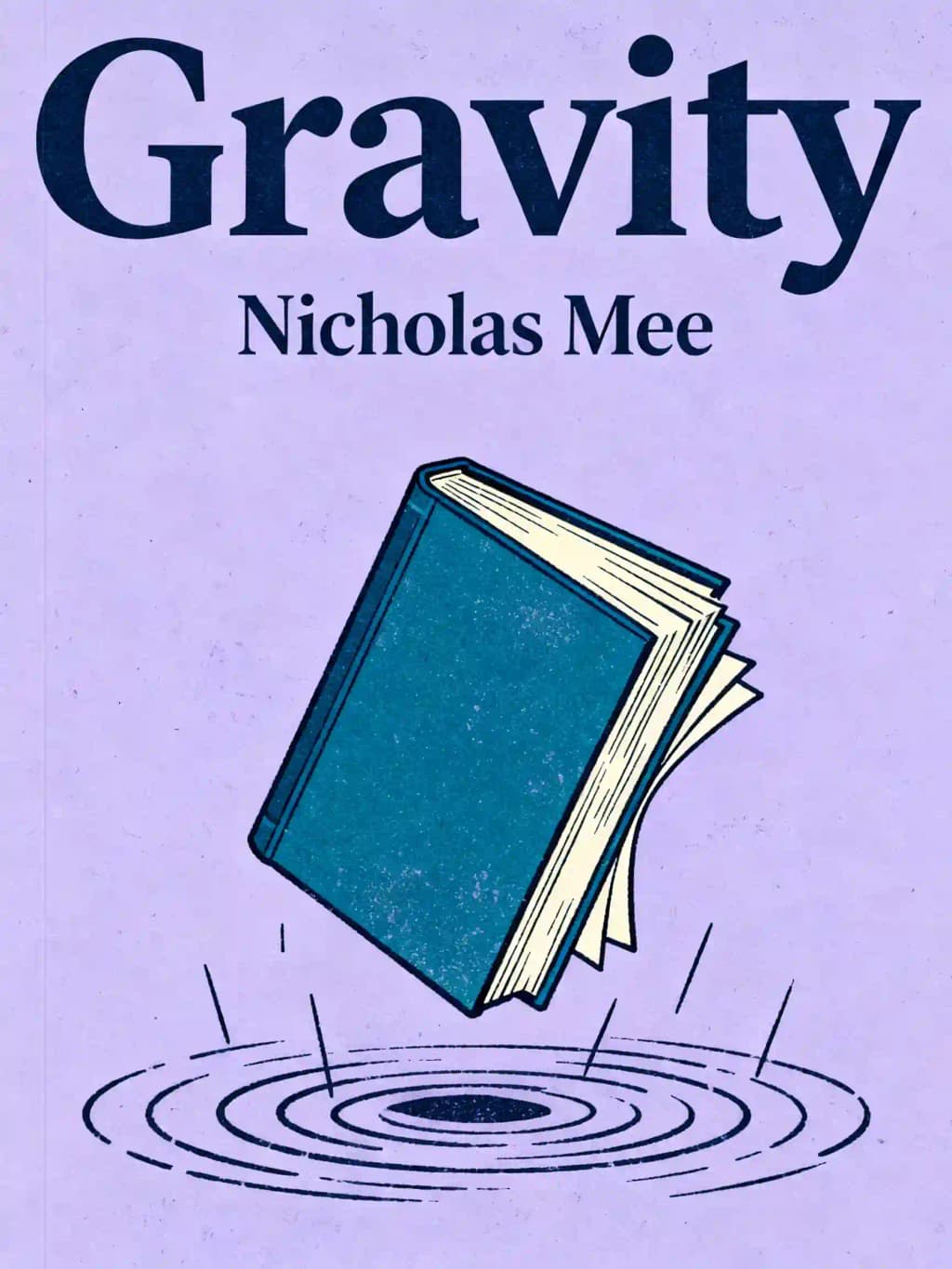
Dive into the universe's most mysterious force with "Gravity" by Nicholas Mee, where centuries of scientific pursuit culminate in recent breakthroughs like gravitational waves and black hole imaging. Endorsed by Astronomer Royal Lord Martin Rees, this 320-page journey makes spacetime curvature surprisingly accessible.
Nicholas Mee, theoretical physicist and award-winning science communicator, explores the universe's fundamental forces in Gravity, merging cosmology with art and mathematics.
A University of Cambridge graduate in theoretical physics and mathematics, Mee bridges scientific rigor with interdisciplinary creativity—evident in his prior works like Higgs Force: Cosmic Symmetry Shattered (Royal Society Science Book Prize finalist) and Celestial Tapestry, which examines geometric patterns in art and nature.
As Director of Virtual Image, he has produced over 50 multimedia science titles and curated exhibitions like the Royal Society’s Henry Moore and Stringed Surfaces.
Mee’s writing, featured on the Quantum Wave blog and in Oxford Literary Festival keynotes, distills complex concepts into accessible narratives. His books are recommended reading in STEM programs worldwide, with Higgs Force translated into six languages.
Gravity: From Falling Apples to Supermassive Black Holes explores humanity’s evolving understanding of gravity, blending historical accounts with modern breakthroughs. It traces discoveries from Newton’s laws to Einstein’s relativity, while highlighting recent advances like gravitational wave detection and black hole imaging. The book emphasizes mathematics' role in physics and contextualizes cosmic phenomena through engaging narratives and puzzles.
This book suits physics enthusiasts, astronomy history buffs, and general readers curious about cosmic forces. Nicholas Mee’s accessible explanations and storytelling make complex concepts like spacetime curvature and black hole dynamics approachable for non-experts. Students and educators will also appreciate its blend of historical context and scientific rigor.
Yes, reviewers praise Mee’s clarity and ability to demystify advanced topics without oversimplifying. The updated second edition adds breakthroughs like LIGO’s gravitational wave detection and the first black hole image, ensuring relevance for modern readers. Its mix of history, science, and interactive puzzles offers a compelling read for diverse audiences.
The book highlights two landmark findings: the 2015 detection of gravitational waves by LIGO, confirming Einstein’s predictions, and the 2017 imaging of a supermassive black hole by the Event Horizon Telescope. These breakthroughs revolutionized our understanding of spacetime and cosmic cataclysms like black hole mergers.
Mee structures the narrative chronologically, starting with ancient cosmologies and progressing through Galileo, Newton, and Einstein. He emphasizes paradigm shifts, such as Newton’s universal gravitation superseding Aristotle’s celestial spheres and Einstein’s relativity redefining gravity as spacetime curvature.
While the book incorporates equations and mathematical reasoning, Mee guides readers through concepts with puzzles and step-by-step explanations. It balances technical depth with readability, making it suitable for those without advanced math training.
The second edition adds chapters on gravitational waves and black hole imaging, reflecting post-2015 advancements. It also expands discussions on supermassive black holes and their role in galaxy formation, ensuring alignment with cutting-edge research.
Black holes exemplify gravity’s extreme effects, from warping spacetime to generating gravitational waves. Mee details their discovery, properties (e.g., event horizons, Hawking radiation), and significance as galactic anchors, using recent imagery and data to illustrate their cosmic importance.
Mee contrasts Newton’s force-based model with Einstein’s geometric spacetime curvature, showing how Einstein’s theory resolved anomalies like Mercury’s orbit. He emphasizes how both frameworks remain essential: Newtonian physics for everyday scales and relativity for cosmic phenomena.
Yes, Mee integrates puzzles to deepen understanding, such as calculating orbital dynamics or visualizing spacetime curvature. These interactive elements bridge historical experiments with modern principles, encouraging active learning.
Gravitational waves confirm that massive objects like colliding black holes ripple spacetime—a prediction of Einstein’s relativity. Their detection provides a new observational tool for studying cosmic events invisible to traditional telescopes.
The book explores unresolved questions, including how gravity interacts with quantum mechanics. Mee discusses theories like string theory and loop quantum gravity while acknowledging ongoing research challenges, offering readers a glimpse into physics’ frontiers.
Siente el libro a través de la voz del autor
Convierte el conocimiento en ideas atractivas y llenas de ejemplos
Captura ideas clave en un instante para un aprendizaje rápido
Disfruta el libro de una manera divertida y atractiva
Bodies maintain constant motion unless acted upon.
The universe must be possibly infinite.
Know the mind of God.
Gravity's grip on our universe.
Desglosa las ideas clave de Gravity en puntos fáciles de entender para comprender cómo los equipos innovadores crean, colaboran y crecen.
Experimenta Gravity a través de narraciones vívidas que convierten las lecciones de innovación en momentos que recordarás y aplicarás.
Pregunta cualquier cosa, elige tu estilo de aprendizaje y co-crea ideas que realmente resuenen contigo.

Creado por exalumnos de la Universidad de Columbia en San Francisco
"Instead of endless scrolling, I just hit play on BeFreed. It saves me so much time."
"I never knew where to start with nonfiction—BeFreed’s book lists turned into podcasts gave me a clear path."
"Perfect balance between learning and entertainment. Finished ‘Thinking, Fast and Slow’ on my commute this week."
"Crazy how much I learned while walking the dog. BeFreed = small habits → big gains."
"Reading used to feel like a chore. Now it’s just part of my lifestyle."
"Feels effortless compared to reading. I’ve finished 6 books this month already."
"BeFreed turned my guilty doomscrolling into something that feels productive and inspiring."
"BeFreed turned my commute into learning time. 20-min podcasts are perfect for finishing books I never had time for."
"BeFreed replaced my podcast queue. Imagine Spotify for books — that’s it. 🙌"
"It is great for me to learn something from the book without reading it."
"The themed book list podcasts help me connect ideas across authors—like a guided audio journey."
"Makes me feel smarter every time before going to work"
Creado por exalumnos de la Universidad de Columbia en San Francisco

Obtén el resumen de Gravity como PDF o EPUB gratis. Imprímelo o léelo sin conexión en cualquier momento.
Drop a hammer and a feather on Earth, and the hammer hits first. Drop them on the Moon-as Neil Armstrong did in 1969-and they land simultaneously. This simple demonstration revealed something profound: what we experience as "weight" isn't gravity at all. It's the ground pushing back against us, electromagnetic forces between atoms resisting compression. Gravity itself? We've never felt it. This counterintuitive truth sits at the heart of our cosmic story, one that begins with medieval monks arranging stones and ends with detectors capturing ripples in spacetime itself. The journey from Earth-centered cosmology to our modern understanding required overturning everything humanity believed about the universe-and it started with a beautiful mosaic on a church floor. The Cosmati Pavement in Westminster Abbey isn't just decorative stonework. This 13th-century mosaic encodes an entire worldview, declaring itself "the perfectly rounded sphere which reveals the eternal pattern of the universe." One inscription calculates the cosmos's lifespan as 19,683 years-derived from 3^9, the number three representing the Holy Trinity. This wasn't whimsy. Medieval thinkers built upon Aristotle's model: Earth motionless at the center, surrounded by crystal spheres carrying celestial bodies, all turned by angelic hierarchies, with nine corresponding levels of Hell below. Dante's Divine Comedy gave this vision its ultimate expression, structuring every realm around threes and nines. But while European philosophers debated cosmic architecture, Babylonian astronomers were doing something more practical: recording planetary positions with meticulous precision. They discovered the eight-year Venus cycle and eighteen-year eclipse patterns through patient observation. When Greek thinkers like Thales began predicting eclipses using this data, humanity took its first steps toward modern science.
Hipparchus of Nicaea explained why planets sometimes moved backward through epicycles-planets moving in circles upon circles-inventing trigonometry to make it work. His sophistication lives on in the Antikythera mechanism, a 2,000-year-old device recovered from a Mediterranean shipwreck. This astronomical calculator contained twenty-seven bronze gears predicting planetary positions and eclipses. One wheel had exactly 223 teeth, matching the saros cycle for eclipse prediction. Claudius Ptolemy refined this system with the equant-a point from which each planet's motion appeared constant. Mathematically elegant, observationally accurate, and completely wrong about reality. Yet astronomers used it for fourteen centuries. Nicolaus Copernicus placed the Sun at the center, but faced a devastating objection: if Earth truly orbited the Sun, nearby stars should shift position throughout the year. They didn't-or rather, the shifts remained undetectable until 1838, when Friedrich Bessel measured 61 Cygni's parallax at two-thirds of an arcsecond. The star lay 10.4 light years away. Johannes Kepler wanted to read God's blueprint. When Tycho Brahe's unprecedented observations came into his possession, Kepler began mapping Mars. His circular model matched observations within two minutes of arc, but eight minutes remained unexplained. Rather than accept "close enough," Kepler concluded his model was wrong. Those eight minutes "showed the way to a renovation of the whole of astronomy." After years of struggle, he found his answer: Mars follows an ellipse with the Sun at one focus.
Kepler placed planets on ellipses with the Sun at one focus (First Law), discovered planets sweep equal areas in equal times (Second Law), and found orbital period squared equals orbital radius cubed (Third Law). He died in 1630, having given us planetary motion's mathematics without connecting it to Earth's gravity. While Kepler decoded Mars, Galileo shattered Aristotelian certainty: the Moon had mountains, Jupiter had moons-not everything orbited Earth. Rolling balls down ramps, he discovered falling objects follow the "law of odd numbers"-distances increase as 1, 3, 5, 7-deriving that distance increases as time squared. He showed horizontal and vertical motions operate independently, explaining projectile paths. Young Jeremiah Horrocks calculated Venus would transit the Sun in 1639. Despite urgent business and battling clouds, he witnessed "a most agreeable spectacle," revealing Venus was smaller and more distant than believed-the solar system was vastly larger than suspected. He died at twenty-two, having linked Kepler to the man who would explain it all. In January 1684, when Halley asked Newton what curve planets would follow under inverse-square attraction, Newton immediately replied: "An ellipse." He'd developed an entire system of mechanics and told nobody.
Halley persuaded Newton to publish his 1687 Principia Mathematica, revealing gravity as universal-acting between any two pieces of matter anywhere. His equation F = Gm1m2/r2 showed the Moon pulls on you exactly as you pull on it, though Earth's greater mass dominates. By proving spherical masses act gravitationally as though concentrated at their centers, he simplified calculations enormously. This single law explained planetary orbits, tides, and falling apples. William Herschel found Uranus in 1781. When Uranus's orbit showed unexplained wobbles, mathematicians calculated where another planet must be-Johann Galle found Neptune in 1846 within half an hour. Yet Mercury's orbit precessed forty-three arc seconds per century faster than Newton predicted, a tiny discrepancy requiring revolutionary physics. Einstein wasn't the slow student of myth but a philosophical teenager who taught himself calculus while reading Kant and Hume. At sixteen, he imagined riding a beam of light-a thought experiment technique he'd refine into his most powerful tool. His 1905 special relativity established that light always travels at the same speed regardless of its source's motion, making it the cosmic speed limit. Time itself slows for moving objects. Muons created by cosmic rays should decay before reaching Earth's surface, yet arrive in precisely the numbers his equations predict because time passes more slowly for them. As objects approach light speed, their mass increases-reaching it would require infinite energy. This led to E=mc2 and demanded a complete overhaul of gravity theory since Newton's instantaneous gravitational transmission violated relativity's speed limit.
Einstein's "happiest thought" came in 1907: a person falling in an elevator feels weightless. This Equivalence Principle revealed that gravity isn't a force - massive objects warp spacetime itself, with bodies following the straightest paths through this curved geometry. Mathematicians like Bolyai, Lobachevsky, and Gauss discovered that on curved surfaces, parallel lines can meet and triangles' angles don't sum to 180 degrees. Bernhard Riemann developed methods for describing arbitrarily curved spaces - perfect for Einstein's needs. In November 1915, Einstein announced general relativity. When he calculated Mercury's orbit, spacetime curvature produced exactly forty-three arc seconds of precession per century - the unexplained discrepancy that had haunted astronomers for decades. No mysterious Vulcan planet needed. Karl Schwarzschild solved Einstein's equations within weeks while serving in World War I. His solution predicted something bizarre: compress any mass within a critical radius and nothing prevents further collapse - a region where not even light escapes. NASA's Uhuru telescope identified Cygnus X-1 in 1970 - a twenty-solar-mass black hole emitting X-rays from million-degree material. Roy Kerr's 1963 solution revealed rotating black holes are defined by just mass, spin, and electric charge. John Wheeler called this remarkable simplicity "black holes have no hair." Stephen Hawking discovered that if black holes possess entropy, they must emit radiation - now called Hawking radiation.
Einstein predicted in 1916 that accelerating massive objects create ripples in spacetime - gravitational waves that squeeze and stretch space as they pass. The first evidence came in 1974 when Joseph Taylor and Russell Hulse discovered a binary neutron star system losing energy through gravitational waves exactly as Einstein predicted, earning them the 1993 Nobel Prize. The Laser Interferometer Gravitational-wave Observatory (LIGO) consists of two L-shaped detectors 3,000 kilometers apart. On September 14, 2015, both facilities detected two black holes merging 1.3 billion light years away, converting three solar masses into pure energy - releasing power exceeding all stars in the visible universe combined. On August 17, 2017, LIGO and VIRGO captured colliding neutron stars, followed 1.7 seconds later by a gamma-ray burst - the dawn of multi-messenger astronomy, observing cosmic events through both gravitational waves and electromagnetic radiation. In 2019, the Event Horizon Telescope synchronized eight radio telescopes globally to image M87's supermassive black hole - a blazing orange ring surrounding dark shadow, 6.5 billion solar masses with a diameter exceeding our solar system. Arthur Eddington's 1919 eclipse expedition confirmed Einstein's prediction that starlight bends around the Sun, making Einstein world-famous. Experiments later proved time passes more slowly near massive objects - clocks at sea level literally run slower than those at mountain peaks.
Einstein initially believed the universe was static, introducing a cosmological term he later called his "biggest blunder." Theorists like Alexander Friedmann and Georges Lemaitre followed general relativity's equations to their logical conclusion: an expanding universe originating from an incredibly dense state. Henrietta Swan Leavitt discovered that brighter Cepheid variables have longer periods, creating "standard candles" for measuring cosmic distances. Edwin Hubble used her work to prove Andromeda was a separate galaxy, then discovered distant galaxies racing away with velocities proportional to their distances-evidence of cosmic expansion. Ordinary matter comprises just sixteen percent of the universe's mass. Dark matter-eighty-four percent of all mass-remains mysterious, possibly consisting of unknown particles called WIMPs. Even more baffling: in 1998, astronomers studying distant supernovae discovered the universe's expansion is accelerating, driven by unknown "dark energy" pushing space apart. From Newton's elegant mathematics to Einstein's revolutionary spacetime geometry, our understanding of gravity has transformed our view of the universe. Gravitational wave detectors now listen to spacetime's symphony while space-based observatories peer deeper into cosmic history, revealing a universe far stranger and more beautiful than our ancestors imagined.