Capítulo 1
The Creative Maverick's Manifesto
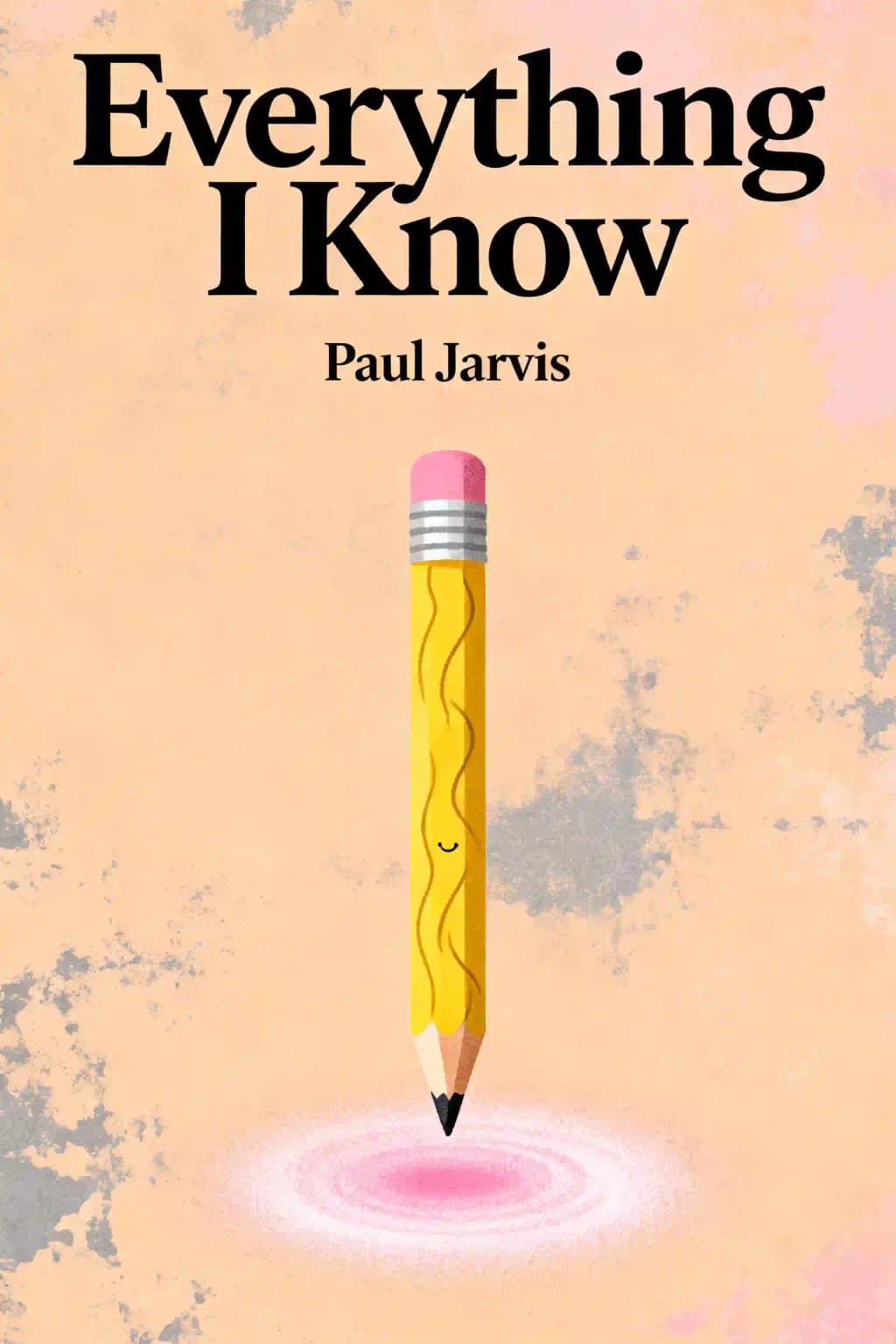
Have you ever felt that nagging fear that someone might discover you're a fraud? That one day, the "Creative Police" will come knocking at your door, ready to expose your inadequacies to the world? Paul Jarvis opens his manifesto with this exact anxiety-the persistent fear of being sentenced to a beige office job, never to see his wife or pet rats again. Yet despite this fear, he wakes each morning and continues creating, sharing his work with the world. His book "Everything I Know" has become a cult favorite among creative entrepreneurs seeking authenticity in their work. Praised by industry leaders like Danielle LaPorte and embraced by those tired of cookie-cutter business advice, Jarvis offers something refreshingly different: permission to forge your own path and create work that matters on your own terms.
Capítulo 2
Choose Your Own Adventure: The Path Less Traveled
Remember those "Choose Your Own Adventure" books where readers determined the plot through their choices? Jarvis approaches his career with the same philosophy-choosing his own path, staying true to his values, experimenting with choices, pushing past fears, and continually moving forward. After a brief stint at a Toronto advertising agency (his only "real job"), he realized he could work directly for clients and be his own boss. The traditional agency model, with its layers of management and rigid processes, felt constraining to his entrepreneurial spirit. For nearly two decades, he's built a business his way, preferring firsthand experimentation over following established rules or formulas, learning through direct experience rather than conventional wisdom.
While most of us come from environments where following rules helped us advance - schools, corporations, institutions - working for yourself means you don't have to follow the leader. You can carve your own path, establish your own rules, express your unique voice, and align work with your values. This freedom is precisely why most people start their own businesses. The ability to make decisions based on personal conviction rather than corporate policy allows entrepreneurs to create authentic businesses that reflect their principles and priorities.
"I must create a system or be enslaved by another man's; I will not reason and compare: my business is to create," Jarvis quotes William Blake, setting the tone for his philosophy of creative independence. This powerful statement encapsulates the entrepreneurial spirit - the drive to build something unique rather than merely copying existing models.
The world rewards innovators most generously. Consider breakthrough companies like Airbnb, which reimagined hospitality, or Square, which transformed payment processing. If there were a single guaranteed business model, everyone would be wealthy. Since emulating others guarantees nothing, why not do things your way-aligned with your values? This might mean unusual working hours, unconventional pricing models, or innovative service delivery methods. If it doesn't work, you can pivot - the beauty of entrepreneurship lies in this flexibility to experiment and adapt.
The path less traveled often leads to unexpected opportunities. By breaking free from conventional wisdom, entrepreneurs can discover underserved markets, create new categories, and solve problems in ways others haven't considered. This approach requires courage, resilience, and a willingness to trust your instincts, but it also offers the greatest potential for both personal fulfillment and market success.
Capítulo 3
Authentic Weirdness: The Power of Being Yourself
"If I had a nickel for every client asking for a website 'just like so-and-so's,' I'd nearly have yacht money," Jarvis writes. He sees countless websites mimicking industry leaders-using similar layouts, tones, calls to action, and products. They aren't direct copies but are similar enough to be utterly forgettable.
We've been conditioned in school and corporate jobs that being unique isn't good-to be productive members of society, we must fit in. Always be professional. Don't stand out. But everyone is weird, even if they pretend otherwise. In work, we mask our weirdness with professionalism. We wear suits, use marketing jargon like "Synergy!" and "Conversion!" We're careful not to swear, get too excited, or let our personalities shine. But if we don't let our weirdness surface, our work can't stand out.
Take Caren, a yoga teacher who distinguishes herself in a saturated market by doing every pose with her dog, Willow, and talking openly about her depression-ignoring the expectation that yoga teachers must be perfectly enlightened. Her openness could put people off, but it doesn't-it shows her humanity. She stands out by being her real, flawed self.
Jarvis himself swears in business situations and in his writing because that's who he is. He uses profanity to make passionate points or call attention to something important, not to put others down. Some might think this threatens his business credibility, but he's been booked solid for years and can choose his clients. His authenticity reflects his personality, not his work abilities.
It's interesting how we want to emulate others' successes but not the fact that they succeeded by being themselves. Their uniqueness is seen as visionary charisma-as if what makes them them was just a brilliant marketing strategy. But when we're starting out, we feel being our honest self might put others off. People are drawn to leaders because they're true to who they are.
Capítulo 4
Values Over Money: Finding Your True North
When Jarvis was young, he wanted to make a million dollars a year with his company. That goal guided his decisions-he said yes to almost everything, worked 80+ hours weekly, and designed websites for professional athletes despite having no interest in sports. Eventually, he realized money was a horrible goal because it had nothing to do with his values. Making lots of money didn't make him feel accomplished; he felt worse working too many hours on projects he didn't care about.
He learned that it's critical to care about what you do. When you focus on work you love, more soon appears. That intersection between enjoying what you do and getting paid for it is the sweetest place of all.
Despite distancing himself from money as a primary goal, Jarvis doesn't believe money is intrinsically bad. Money is an enabler and amplifier-if you're focused on others, it can help you do more good. Money also makes a point by measuring how much people value what you do. This has nothing to do with your intrinsic worth, but until money changes hands, other people aren't valuing your business as much as when they're paying you for it.
Jarvis approaches money by asking: when do I have enough? He learned this from a contract accountant friend who accepts projects until he's made enough to cover necessities and retirement savings. Then he stops working and travels for months at a time. Once Jarvis hits his upper target, he doesn't need to work for a while and can focus on writing, music, or whatever interests him. Living frugally with minimal business expenses helps. Knowing what's "enough" enables him to travel with his wife 2-3 months yearly and take time to explore new ideas.
Once he abandoned his million-dollar goal, Jarvis realized he didn't have a replacement strategy. He still doesn't know what an actual business plan entails. Instead, he lets his values guide his work-they're vague enough not to impose limits, but clear enough to guide him in the right direction.
Capítulo 5
Confronting Fear: The Only Way Forward
Our fear of failure often prevents us from trying things, but not trying guarantees failure. With trivial challenges like puzzles, few of us hesitate, but with our art and work, fear intensifies. Yet if our worst fears came true, would we die? Would we be unable to try again? Most fears boil down to being judged by others-a valid concern since people can be judgmental. But letting judgment stop you only hurts yourself.
A reader who'd written her own list of fears realized something profound: everything she feared losing was something she was grateful to have. She feared losing her husband because he was vital to her life, feared illness because she'd always been healthy. Fear often means losing what you're already grateful for having. Taking chances leads to gratitude-she wouldn't have her husband without risking dating and marriage. If you weren't afraid of anything, you'd have nothing valuable to lose.
Jarvis handles his fears by acknowledging them, then acting anyway. This approach sometimes leads to stupid decisions, and he always has people who unsubscribe or unfollow, but pushing past his fear of sharing has also created huge opportunities. He's comfortable sharing either the stupidest or smartest ideas-because they're his, and he knows more ideas are always coming.
Despite being deeply introverted-awkward in groups, uncomfortable in public, struggling with verbal communication-Jarvis has been a touring musician as long as he's been a web designer. He started small, playing in parks with bandmates-not performing for people but playing around them. When that didn't kill him, he moved to open mics where everyone was equally scared. Then small club shows for handfuls of people. Eventually, he played bigger venues and toured Canada and the US. He's never become less afraid of performing, but he's learned to acknowledge the fear and walk onstage anyway.
Fear only has the power you give it-its strength lies in preventing you from trying. Jarvis faces his fears constantly, starting with small pushes, then medium ones, then harder ones. Fear can't fight back if you don't empower it.
Capítulo 6
The Myth of Perfection: Embracing Failure as Progress
Traditional education systems have conditioned us to view failure as something shameful and terminal. In schools, a failing grade often means repeating a course or facing academic probation, with little room for experimentation or creative risk-taking. This rigid system of evaluation creates a mindset that can be deeply limiting, especially in creative and innovative fields where breakthrough ideas often emerge from multiple attempts and iterations.
The pursuit of perfection becomes a paralyzing force that prevents genuine growth and discovery. When we're too focused on getting everything right the first time, we miss valuable learning opportunities that come from making mistakes. Thomas Edison's journey to creating the light bulb involved over 1,000 unsuccessful attempts, each one providing crucial insights that led to the final breakthrough. Einstein's path to revolutionary theories was paved with countless research papers that were initially dismissed or criticized by his peers. James Dyson created 5,126 failed prototypes before finally developing his revolutionary vacuum cleaner. These examples illustrate that failure isn't just an acceptable part of the creative process-it's an essential component.
The concept of perfection itself is fundamentally flawed because it's subjective and constantly shifting. What's considered perfect today might be outdated tomorrow. This is particularly evident in creative fields where tastes and standards evolve continuously. Instead of chasing an impossible ideal, successful creators focus on achieving a level of quality that's "good enough" to share with their audience while leaving room for future improvements. Authors like Stephen King emphasize that if writers waited for perfect prose, no books would ever be published. Artists like Pablo Picasso produced thousands of works, not all masterpieces, but each contributing to his artistic development.
Reframing creative endeavors as experiments transforms the entire approach to work. Scientists don't "fail" when their hypotheses are disproven-they gather valuable data that guides their next attempt. This mindset can be applied to any creative pursuit. J.K. Rowling's Harry Potter manuscript was rejected by 12 publishers before finding success. Walt Disney was fired from a newspaper for "lacking imagination." These setbacks weren't failures but rather steps in an iterative process leading to eventual success.
The key lies in developing resilience and persistence. Successful individuals aren't those who never fail, but those who keep going despite setbacks. They understand that each attempt, successful or not, provides valuable feedback and learning opportunities. This approach turns failure from a dreaded outcome into a valuable tool for growth and innovation. By embracing imperfection and viewing each attempt as part of a larger learning journey, creators can free themselves from the paralysis of perfectionism and focus on making meaningful progress in their work.
Capítulo 7
Showing Up: The Real Secret to Creative Success
You have to show up every day-especially when you don't want to or aren't feeling inspired. Showing up when uninspired sounds uninspiring, and that's okay, because inspiration is bullshit. Everyone who's good at what they do isn't good because of magic fairy dust-they're good because they do what they do as often as possible. The most successful creators, from authors to artists to entrepreneurs, share this common trait: they commit to their craft regardless of their emotional state or external circumstances.
To become a better writer, Jarvis writes around 500 words daily, treating it like brushing his teeth - a non-negotiable daily habit. To become a better designer, he designs every time he's hired, whether it's for major clients or small projects. Sometimes it's awful stuff he wouldn't share with anyone, rough drafts that make him cringe, but sometimes it's worth sharing and becomes part of his portfolio. He increases his odds of doing better work by tackling it daily, understanding that volume often leads to quality. And paradoxically, sometimes when he doesn't feel like creating and does it anyway, fighting through the resistance, he produces his best stuff - work that surprises even himself.
His job as a web designer requires being "creative on demand," a skill that can only be developed through consistent practice. With deadlines and deliverables, he needs to develop original assets for every project, even when not feeling inspired. On those days, he starts small-maybe picking a typeface, then choosing colors, then seeing how they interact together, playing with different sizes and styles. Breaking his work into tiny pieces makes it feel less like a huge creative job and more like small, accomplishable tasks-even without the muse on his shoulder. This systematic approach turns intimidating creative projects into manageable chunks that can be tackled one at a time.
Most days when he's writing, Jarvis wakes with a knot in his stomach, facing the same fears that plague many creators. What if his next work isn't as popular? What if people realize he doesn't know anything? What if no one buys his books or everyone wants refunds? These thoughts are scary but won't kill him or make it impossible to try again. At worst, failure would bruise his ego. He's learned that these fears are actually signals that he's pushing himself beyond his comfort zone, which is exactly where growth happens. He wakes thinking about all these things, acknowledges them, then gets down to writing anyway, understanding that action is the antidote to anxiety.
The key is establishing systems and routines that don't rely on motivation or inspiration. By showing up consistently, you build a professional practice that transcends mood and creates momentum. Some days will be better than others, but the cumulative effect of regular practice leads to mastery, regardless of how you feel on any given day.
Capítulo 8
Finding Your People: The Heart of Any Business
Your business is about your people-those who find value in your work, get what you're saying, and show up for what you create. Srinivas Rao calls them your "small army." These people are your royalty because they listen to you, stand on your side, and become your most authentic advocates. They're not just customers; they're the foundation of your business ecosystem.
Finding your people requires deep introspection and strategic observation. Start by asking: Who do you naturally gravitate toward? Who energizes you in conversations? How can your work meaningfully impact their lives? Who consistently engages with your content or services? Your true audience might begin small-perhaps just five dedicated customers who bought your first product or ten passionate followers who share your message. The key is quality over quantity in these early relationships.
Building these connections demands intentional effort. Engage with them personally through direct messages, thoughtful responses to their comments, or even personal calls. Help them solve problems before they ask. When their needs change, be willing to pivot your approach. Authenticity is crucial-your audience can sense when you're genuine versus when you're just selling.
Your business needs a clear rallying point-something deeper than mere branding or mission statements. Think of it as planting your flag in the ground and declaring "This is what we stand for." For example, Patagonia's environmental activism isn't just marketing-it's their battle cry. REI's decision to close on Black Friday sends a clear message about their values. Your rallying point might be controversial, like Buffer's radical transparency about salaries, or fundamental, like Basecamp's stance against unnecessary meetings.
The most effective marketing doesn't just sell products-it advocates for a worldview. When Apple says "Think Different," they're not just selling computers; they're attracting people who see themselves as creative innovators. Your marketing should clearly articulate why your approach matters and how it aligns with your audience's values. Consider: What's the hill you're willing to die on? What industry conventions are you challenging?
Jarvis takes a contrarian stance on the common advice to "follow your passion." Instead, he advocates for a more nuanced approach: find the sweet spot where your skills, interests, and market demand intersect. Passion alone doesn't pay bills-you need to regularly evaluate whether your drive comes from genuine internal motivation or the allure of external validation. The goal is to identify where your expertise and enthusiasm align with real market needs. For instance, a passionate photographer might find success not in fine art photography, but in solving specific business problems through commercial photography.
Success comes from building a sustainable business at this intersection: where your skills create genuine value for people willing to pay for solutions. This might mean adapting your initial vision-perhaps teaching photography rather than selling prints, or consulting rather than creating. The key is maintaining flexibility while staying true to your core values and the needs of your people.
Capítulo 9
The Creative Process: Ugly, Messy, and Beautiful
Creativity is part magic, but mostly showing up and iterating toward something beautiful. The journey from first draft to final product is ugly-requiring horrible drafts, bad ideas, and dead-end paths. We idolize creativity because as consumers, we only see polished final products that may have taken months or years of curation, editing, and refinement.
Good design makes the process seem easy when it's actually hard work. A book that reads effortlessly likely went through double-digit revisions. Quality finished products aren't fleeting like social media updates-they can remain relevant for lifetimes.
First drafts are tough because they're often a chaotic mish-mash of every idea and brainstorm applied to a project. The key is to get ideas down without editing-put your editing hat away and just create. Brainstorm until there's nothing left to brainstorm. Jarvis purposefully writes hideous first drafts that he wouldn't show his editor, but they give him something concrete to mold and shape later.
When Jarvis started designing websites, he would study their graphics and source code, replicating them repeatedly until he mastered the techniques. Then he'd try to improve them-making them better, faster, and more aligned with his style. He'd blend elements from multiple sites, smooth out inconsistencies, and iterate until the result looked nothing like his original sources. This process of theft and iteration is how he taught himself design and programming.
Comparing our work to others' creations is futile because we never see their full process. Finished products can look effortless, but we don't witness the sleepless nights or 108 iterations that led to the "obvious" conclusion. We're comparing our whole, flawed selves against a perceived "perfect" other-matching our personal reality to a fantasy version of someone else.
Capítulo 10
The Magic Beyond Fear: When Inspiration Strikes
Jarvis tends to write about negative emotions-criticism, fear, failure-framing them as obstacles to overcome, with just a glimmer of hope at the end. But what happens in the absence of negativity? What happens when you find your "groove" and inspiration strikes?
Those magical moments when genius, revelation, or inspiration flows give us goosebumps. We constantly struggle to create something inspired and awesome. Negative thoughts can make brilliant creation seem impossible, but sometimes light shines through the cracks in our defenses.
In those rare inspired moments, Jarvis feels utterly present-so present that thinking about the feeling would break it. There's only space to channel whatever the genius is delivering; any distraction breaks the spell. Interestingly, the second before inspiration hits is when negative thoughts reach their peak-that make-or-break moment when you either push through or retreat to comfort.
It's a numbers game-your odds of doing great work increase only when you do more work. Repeatedly summoning the courage to work wears down resistance. Fears don't vanish but grow tired of being ignored. Attention is a gift you give your work-the more you devote to it, the less space fear can occupy.
Creating meaningful work is never truly finished. No great artist ever stops after one epic piece. Making your own path is terrifying because you're ultimately responsible for the outcome-success or failure is completely on you. Fitting in is safe, but there's already too much of that. Walking your unique path means stepping into darkness without a flashlight, but it's the only way to live meaningfully according to your values.
Your work isn't just about you-it's about finding the intersection where your values align with what your audience values enough to pay for. You might be scared, but progress comes one small step at a time. What you create reflects yourself, gaining meaning as it aligns with your internal compass. Stay true to your values and you'll never get lost. Fears never disappear, but you can manage them while doing great work. You're responsible for what you put into the world-why not make it great?