Capítulo 1
The Moral Maze of Our Plates: Exploring Our Relationship with Animals We Eat
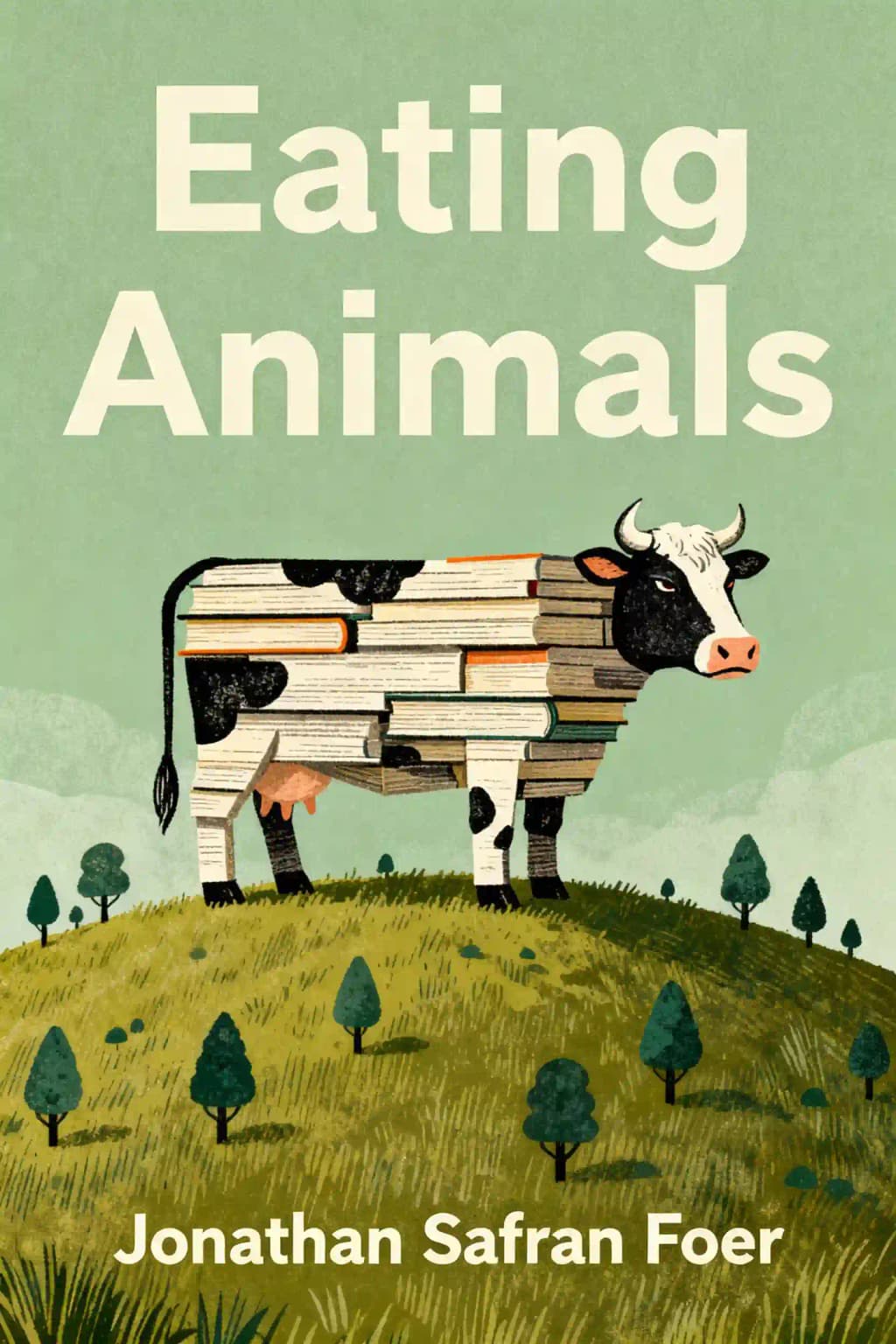
When Jonathan Safran Foer's grandmother embraced him as a child, her hugs were more than affection-they were survival checks, secretly weighing him to ensure he wasn't starving. A Holocaust survivor who once scavenged inedible objects to stay alive, she transformed her traumatic relationship with food into expressions of love through simple dishes like chicken with carrots. Though her family proclaimed her "the Greatest Chef Who Ever Lived," her cooking transcended taste-embodying terror, dignity, gratitude, and love. This culinary identity became their family story, perhaps easier to share than her survival narrative. Today, Eating Animals has become a cultural touchstone, praised by celebrities from Natalie Portman to Ellen DeGeneres, and credited with inspiring thousands to reconsider their dietary choices. The book's unflinching examination of factory farming practices has influenced public discourse about food ethics more than perhaps any other contemporary work, forcing us to confront uncomfortable truths about what reaches our plates.
Capítulo 2
The Journey from Inconsistency to Conviction
Foer's relationship with vegetarianism had always been inconsistent-enlightenment at age nine when a babysitter explained "chicken is chicken," followed by years of philosophical commitments punctuated by convenient lapses. His wife shared similar moral ambivalence toward meat. When they married, vegetarianism seemed like a meaningful change they could make together-though they immediately compromised at their wedding, on their honeymoon, and whenever they "felt like it."
Everything changed with impending fatherhood. As Foer prepared for his son's arrival-fixing lightbulbs, buying socks-he also confronted the question of eating animals with new urgency. His son's first wordless desire was to eat, breastfeeding seconds after birth with an awe that had no precedent in Foer's life. This instinctual knowledge connected him across generations to his ancestors. As his son grew, feeding him became more than nutrition-it became storytelling.
Within Foer's Jewish tradition, food serves dual purposes: nourishment and remembrance. We eat selectively from thousands of available foods, requiring explanations that establish narratives and rules. His grandmother's refusal to eat pork even when starving during the Holocaust-"If nothing matters, there's nothing to save"-exemplifies how food choices define our moral boundaries.
The book began as a personal quest to understand what meat is-where it comes from, how it's produced, how animals are treated, and the economic, social and environmental impacts. Though 99% of animals eaten in America come from factory farms, Foer dedicates significant space to the remaining 1% of family-run farms because they prove the rule rather than the exception. What started as a straightforward case for vegetarianism evolved into something more complex, as Foer discovered that facts alone don't provide meaning without being placed in stories of compassion or domination that speak to who we are and who we want to be.
Capítulo 3
When Pets and Food Animals Collide
For twenty-six years, Foer disliked animals, particularly dogs. Then unexpectedly, he and his wife adopted a tiny black puppy from the street-George-and he became a dog person almost instantly. Their relationship forced him to encounter someone entirely "other," with thoughts and emotions he sometimes understood but often didn't-an embodied secret, as he must be to her. Despite their closeness, he occasionally felt thrilled, and even a bit scared, by her foreignness.
This relationship raises uncomfortable questions about how we categorize animals. Despite being legal in forty-four states, eating dogs remains deeply taboo in America. Dogs are wonderful companions, but their intellectual and experiential capacities aren't unique-pigs are equally intelligent and feeling. Our taboo against dog eating reveals cultural contradictions: the French sometimes eat horses, the Spanish eat cows, Indians eat dogs.
The justifications for excluding dogs from our diet fall apart under scrutiny. The "companion animal" argument fails because dogs aren't companions everywhere they're eaten. The "significant mental capacity" argument would also protect pigs, cows, and chickens. The "evolutionary taboo" argument fails because dog eating has been practiced throughout human history-from fourth-century tombs showing slaughtered dogs to Hippocrates praising dog meat for strength.
Dogs and fish occupy opposite ends of our moral consideration. Dogs share our homes and beds; fish remain distant behind aquarium glass or on dinner plates. Dogs are singular companions with names; "fish" encompasses 31,000 different species. We talk to our dogs, believing they understand, but can't imagine a fish's internal experience.
This contrast reveals our inconsistent ethics: no one would tolerate someone swinging a pickax at a dog's face, yet we accept similar violence toward fish without question. If more intelligent beings regarded us as we regard fish, what would be our argument against being eaten?
Capítulo 4
The Hidden War Against Animals and Oceans
For every ten large predatory fish that existed in our oceans fifty to a hundred years ago, only one remains today. Scientists predict the total collapse of all fished species in less than fifty years, yet intense efforts continue to catch and eat more sea animals. University of British Columbia researchers describe our relationship with fish as resembling "wars of extermination."
"War" aptly describes our relationship with fish-capturing both the dominating technologies we employ against them and our spirit of conquest. This war extends to all animals we eat through factory farming-a system of industrialized agriculture housing tens or hundreds of thousands of genetically engineered animals with restricted mobility and unnatural diets.
Factory farming represents a mindset of minimizing production costs while externalizing environmental degradation, human disease, and animal suffering. Industrial fishing shares this spirit, with captains using electronics-filled control rooms, GPS monitors, fish-attracting devices, and military technology to systematically harvest sea animals. The industry deploys 1.4 billion hooks annually and uses nets thirty miles in length, with single vessels hauling fifty tons of sea animals in minutes.
Standing before sea horses in Berlin's aquarium-strange creatures that change color, eat constantly, mate monogamously under full moons, and where males become pregnant-Foer felt layers of shame: as a writer inadequate compared to Kafka, as a human responsible for the threatened extinction of twenty sea horse species through seafood production, as a citizen of a prosperous nation that treats animals with extreme cruelty. But nothing inspires as much shame as parenthood, when children confront us with our paradoxes and hypocrisies, demanding answers we don't have.
Capítulo 5
The Language of Denial: How We Obscure Animal Suffering
Language about eating animals often misdirects rather than communicates. Words like "veal" help us forget what we're talking about, "free-range" can mislead conscientious consumers, "happy" often means its opposite, and "natural" means almost nothing.
The typical egg-laying hen's cage allows just sixty-seven square inches of floor space-smaller than a sheet of paper. These cages stack three to nine tiers high in windowless sheds. Imagine being trapped in an overcrowded elevator with a wire floor cutting into your feet, where you're often held aloft by neighbors. Eventually, those confined will lose their group cohesion-some becoming violent, others going mad, a few turning cannibalistic.
Modern agriculture has created two distinct chicken types: layers for eggs and broilers for meat. Broilers have been engineered to grow twice as large in half the time as chickens from the 1930s. Once living 15-20 years, modern broilers are typically killed at six weeks, with growth rates increased 400%. This division creates a disturbing problem: what happens to male layers? They serve no function, so all 250 million born annually in the US are destroyed-sucked through pipes onto electrified plates, suffocated in plastic containers, or sent conscious through macerators like wood chippers.
The "free-range" label is essentially meaningless. For meat chickens, it requires only "access to outdoors"-which could mean 30,000 birds with a small, rarely-opened door to a tiny dirt patch. For laying hens, the USDA doesn't even define the term, relying on producer claims. Most "free-range" eggs come from factory-farmed chickens packed in barren barns. These birds are typically still debeaked, drugged, and slaughtered when "spent."
Environmental concern typically focuses on preserving natural resources and ecological systems that sustain human life. Yet despite overwhelming evidence of animal agriculture's environmental impact, environmentalists rarely address farmed animals. Studies from the UN and University of Chicago show livestock contribute more to climate change than all transportation combined-18% of greenhouse gas emissions versus transport's lower percentage.
Capítulo 6
The Hidden Intelligence of Our Food
Farmers have long known that clever pigs learn to undo latches, but the depth of porcine intelligence extends far beyond simple problem-solving. In 1789, naturalist Gilbert White documented a remarkable case of a female pig who would methodically unlock her pen, navigate through multiple gates, visit a male pig at a distant farm, and return home using the same complex route. Modern research has revealed that pigs possess a sophisticated language system with distinct vocalizations for different emotional states and situations. They respond reliably to given names, demonstrating not just recognition but social awareness. Pigs show clear preferences in play, selecting favorite toys and engaging in complex social games with both objects and companions. Their empathetic abilities are particularly noteworthy - they actively help other pigs in distress, showing emotional intelligence comparable to dogs and primates. Dr. Stanley Curtis's groundbreaking research demonstrated that pigs could master video games with joystick controls as quickly as chimpanzees, revealing sophisticated abstract thinking abilities and spatial awareness previously unexpected in livestock animals.
Our understanding of fish intelligence has undergone a revolutionary transformation, challenging long-held assumptions about their cognitive capabilities. The explosive growth in research is telling: in 1992, only 70 peer-reviewed papers covered fish learning; by 2002 there were 500, and today over 640 studies document their remarkable abilities. Fish demonstrate architectural skill in building complex nests, with some species creating elaborate structures using multiple materials. They form lasting monogamous relationships, with pairs coordinating parental care and territory defense. Tool use has been observed in multiple species, from archer fish using water jets to catch prey to wrasses using rocks to crack open shellfish. Their social intelligence is particularly sophisticated - they can recognize dozens of individual fish, track the trustworthiness of potential partners through multiple interactions, and make independent decisions based on past experiences. Fish employ "Machiavellian strategies" in social hierarchies, forming alliances and manipulating competitors. Their long-term memory enables them to remember migration routes and feeding grounds for years, while social learning allows them to pass knowledge through networks and generations, maintaining cultural traditions for specific feeding spots and mating grounds that persist for decades.
The disconnect between public opinion and practice regarding animal welfare is striking. An overwhelming 96 percent of Americans believe animals deserve legal protection, with 76 percent specifically stating they would prioritize animal welfare over lower meat prices. Nearly two-thirds support implementing strict laws for farmed animal treatment. This consensus extends to environmental concerns, with most Americans expressing worry about ecological impact. The scale of our interaction with farmed animals is massive - they represent over 99 percent of all animals humans directly interact with in the United States, far exceeding our contact with pets, wildlife, and laboratory animals combined. Nothing in our daily choices has greater potential to cause animal suffering or environmental impact than meat consumption - industrial animal agriculture being a leading cause of greenhouse gas emissions, deforestation, and water pollution. Yet paradoxically, those who act on these widely shared values by choosing plant-based diets are often viewed as extremist or radical, despite their choices aligning with majority-held beliefs about animal welfare and environmental protection.
Capítulo 7
Behind Closed Doors: Witnessing Factory Farm Realities
Foer finds himself in an unlikely situation-wearing black in the middle of the night, equipped with surgical booties, latex gloves, and a bag of supplies: flashlight, camera, water bottle, cell phone, and legal documents. He's with an animal activist named "C"-short, wispy, wearing glasses and a retainer-who lives with her parents. As they drive down "Blood Run" highway, she explains how these farm visits work. Sometimes entry is simple; other times fences must be climbed, with risks of alarms, dogs, or even bulls.
They park hundreds of yards from the farm, approaching through an apricot grove. Through the trees, they reach barbed wire fencing that separates them from seven massive sheds, each about 50 by 500 feet, housing approximately 25,000 birds each. With a massive granary and metal pipes spiderwebbing the buildings, the industrial complex looks nothing like the mental image most people have of a farm. Yet this is the type of operation that produces 99% of animals consumed in America.
Inside, Foer is immediately struck by the row of gas masks hanging on the wall. The shed contains tens of thousands of turkey chicks, fist-sized with sawdust-colored feathers, huddled in groups beneath heat lamps that replace the warmth their absent mothers would provide. The space is perfectly calibrated-lights, feeders, fans, and heat lamps spaced with mathematical precision. Nothing natural exists here-no earth, no windows, just artificial day. Looking closer, he sees blackened beaks and toes, red spots on heads, and dead chicks scattered throughout-some blood-matted, some covered in sores, some pecked at, others desiccated like piles of leaves.
C explains her background: she once worked as a backup killer at a poultry plant, slitting the throats of chickens that survived the automated throat slitter-killing thousands, maybe hundreds of thousands of birds. Her awakening began as a teenager when a friend showed her slaughterhouse videos as shock entertainment. That night, holding a chicken drumstick, she couldn't eat it-suddenly seeing not just chicken but a chicken. She began investigating farms herself, writing to corporations for tours and being denied, then eventually entering facilities at night. Each time she hoped to find that the cruelty was exceptional, but farm after farm revealed the same conditions.
Capítulo 8
The Industrialization of Animals: From Wild to Factory
Before domestication, the wild rooster surveyed landscapes, warned of intruders with complex calls, and defended mates with beak and sharp toes. The wild hen communicated with her chicks even before hatching, responding to distress peeps by shifting her weight. This protective maternal image would later be invoked in Genesis to describe God's first breath hovering over water, and by Jesus as a metaphor for protective love: "I have longed to gather your children together as a hen gathers her chicks under her wings."
By 8000 BCE, chickens and other animals had been domesticated, creating new forms of intimacy, care, and violence between humans and animals. For thousands of years, humans followed an "eat with care" ethic toward domestic animals-neither complete abstention nor indifference, but care coupled with exploitation. This ethic evolved differently across cultures (cow prohibitions in India, quick slaughter mandates in Islam and Judaism) but didn't fade gradually-it "died suddenly. It was killed."
Industrial slaughterhouses emerged in Cincinnati and Chicago in the 1820s-30s, replacing skilled butchers with assembly lines of specialized workers performing repetitive tasks. Henry Ford acknowledged these slaughterhouse efficiencies inspired his auto manufacturing revolution-"putting together a car is just taking apart a cow in reverse." The industrialization accelerated with refrigerated rail cars in 1879, allowing concentrated cattle operations and long-distance meat transport.
In 1923, Celia Steele of Delaware's Delmarva Peninsula accidentally received 500 chicks instead of 50. Her decision to keep them indoors through winter, aided by newly discovered vitamin supplements, launched modern poultry farming. By 1926, she had 10,000 birds; by 1935, 250,000 (when the average American flock was just 23). This convergence of technologies-artificial incubation, vitamin supplements, hybrid corn, automated feeders, debeaking, and light manipulation-engineered every aspect of chickens' lives for maximum profit at minimum cost.
The factory farm wasn't merely an innovation but a transformative event. Pastures became security buffers, barns were replaced by multi-tiered confinement systems, and genetically engineered animals-flightless birds, pigs that couldn't survive outdoors, turkeys incapable of natural reproduction-replaced familiar barnyard animals. American businessmen, allied with government and science, turned Descartes' philosophical proposition that animals are machines into reality for billions of creatures. Industry journals openly described hens as "converting machines" and pigs as "factory machines."
Capítulo 9
The Hidden Cost: Pandemic Risk and Public Health
In 1997, scientist Johan Hultin traveled to Brevig Mission, a tiny Inuit village, to excavate bodies preserved in permafrost from the 1918 flu pandemic. His expedition coincided with the first human deaths from H5N1 bird flu in Hong Kong. Three-year-old Lam Hoi-ka was the first of six victims of this virus, potentially marking the beginning of a new pandemic. The 1918 pandemic killed more people faster than any other disease in history-as many as 50-100 million worldwide in just 24 weeks, compared to AIDS killing 24 million over 24 years.
Scientists now understand that all human influenza strains ultimately derive from migrating aquatic birds like ducks and geese, making flu fundamentally about our relationship with birds. Virologist Robert Webster proved the "barnyard theory"-that human pandemic viruses recruit genes from flu viruses in domestic birds. The danger emerges when viruses cross species barriers, particularly through pigs, which are susceptible to both bird and human viruses.
Industrial chicken farms house birds in massive windowless sheds-typically 45x490 feet containing 33,000 birds each, with only 0.8 square feet per bird. Modern broilers grow unnaturally fast, developing deformities and diseases: 1-4% die from sudden death syndrome, 5% from ascites, 75% develop walking impairments, and 25% experience significant pain. These conditions create disease factories-95% become infected with E. coli, 8% with salmonella, and 70-90% with campylobacter.
Beyond food-borne illnesses and communicable diseases, factory farming influences public health through connections to heart disease, cancer, and stroke. The American Dietetic Association confirms that well-planned vegetarian diets are appropriate for all life stages and often associated with lower cholesterol, reduced heart disease risk, lower blood pressure, reduced diabetes risk, lower BMI, and lower cancer rates.
The global implications of factory farming growth are terrifying-if India and China followed America's poultry consumption patterns, they alone would consume as many chickens as the entire world does today, raising serious questions about antibiotic resistance and future pandemics.
Capítulo 10
Alternatives and Ethical Choices
Frank Reese, a lifelong poultry farmer, raises heritage turkeys with natural behaviors intact-they fly, mate naturally, and thrive outdoors in all weather. He recognizes their complex vocalizations and personalities, describing them as "curious, playful, friendly and full of life." Reese contrasts his healthy, robust birds with modern industrial turkeys that cannot walk normally, fly, or reproduce naturally-every supermarket turkey comes from artificial insemination.
Paul Willis's approach to pig farming embodies what Wendell Berry referred to as "our old sympathetic attempts to imitate natural processes." For Paul, this means letting pigs be pigs-allowing them to engage in natural behaviors while still raising them for slaughter. His Niman Ranch pigs have access to earth rather than concrete slats, and many farmers provide outdoor access or deep bedding systems that allow for species-specific behaviors like rooting and communal sleeping.
The contrast with industrial agriculture is stark. While Paul considers the pigs' natural biorhythms, factory farms focus solely on profitability. Niman Ranch prohibits antibiotics and hormones unless medically necessary, has no waste lagoons (manure returns to the soil as fertilizer), and subjects farmers to independent auditing and transparent practices.
Yet even these alternatives face challenges. Despite high demand from chefs and food enthusiasts, Frank struggles financially without the infrastructure that once supported small-scale farming. When the last acceptable slaughterhouse in his region was bought and closed by an industry company, Frank faced potential ruin. And a factory farm purchased land near Paul's "Dream Farm" retirement property, threatening to bring thousands of suffering hogs and noxious odors that would destroy his land's value and health.
Capítulo 11
The Path Forward: Reimagining Our Food System
After three years investigating animal agriculture, Foer became firmly committed to vegetarianism. He simply cannot participate in factory farming. Yet simultaneously, he grew to deeply respect sustainable farmers like Paul, Bill, Nicolette and especially Frank, who give animals good lives before a humane death. These extraordinary people should be advising our agricultural policies.
Despite industry attempts to paint this position as radical, Foer maintains that ranchers can be vegetarians and vegans can support ethical animal agriculture. The fundamental question remains: in our industrial era, is raising animals for meat inherently a denial of compassion?
We shouldn't delude ourselves about the availability of ethical eating options. There isn't enough nonfactory chicken produced in America to feed Staten Island, nor enough nonfactory pork for New York City. Ethical meat remains more promise than reality, meaning any serious ethical-meat advocate will necessarily eat mostly vegetarian fare.
Throughout his childhood, Thanksgiving celebrations took place at Foer's uncle and aunt's house. The mismatched dining setup-different tables pushed together under matching cloths-was imperfect yet perfect. Thanksgiving encompasses all holidays in its expression of gratitude. It transcends American specificity while embodying American ideals. It represents the meal we aspire for others to resemble-deliberate, good, thoughtful.
For Thanksgiving, Foer now gives thanks not for his own health, happiness, and loved ones, but through and on behalf of his son. Producing our own food made early Americans self-sufficient and free from European dependence. With Native American help, colonists became self-sustaining, making Thanksgiving America's founding act of conscientious consumption.
Yet the 45 million turkeys on our Thanksgiving tables are unhealthy, unhappy, and unloved. It shouldn't be the consumer's responsibility to determine what's cruel or kind, what's environmentally destructive or sustainable. Just as we don't need toys with lead paint or medicines with unlabeled side effects, we don't need factory-farmed animals. Our response to factory farming tests how we treat the powerless and voiceless. To accept factory farming would make us less ourselves, proving Foer's grandmother's wisdom that "if nothing matters, there's nothing to save."