Capítulo 1
From Chaos to Clockwork: The Ultimate Business Freedom Blueprint
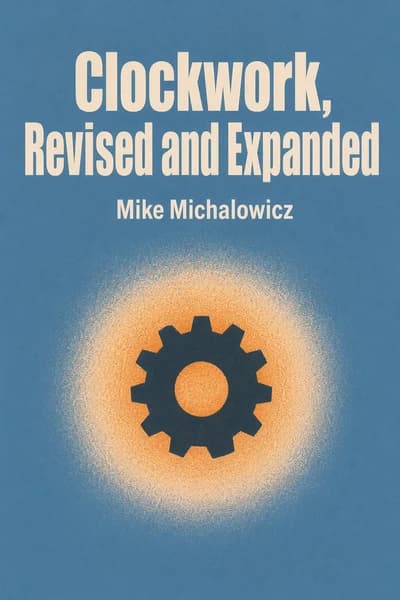
Imagine stepping away from your business for a full month, completely disconnected, while it continues to run smoothly-perhaps even better than when you were there. For most entrepreneurs, this seems like an impossible fantasy. Yet Mike Michalowicz's "Clockwork" has become the go-to manual for thousands of business owners who've transformed this dream into reality. Beloved by celebrities like Simon Sinek (who called Michalowicz "one of the top contenders for the patron saint of entrepreneurs") and embraced across industries from tech startups to construction firms, this book has sparked a quiet revolution in how entrepreneurs view their relationship with their businesses. The cultural impact is profound-challenging the glorified "hustle culture" that has dominated entrepreneurial thinking for decades. What makes this approach so revolutionary isn't just the promise of freedom, but the counterintuitive path to achieving it: working less in your business to help it grow more.
Capítulo 2
Breaking Free from the Entrepreneurial Hamster Wheel
The entrepreneurial journey typically begins with excitement and boundless energy. You launch your business with dreams of freedom and impact, only to find yourself trapped in an endless cycle of working in your business rather than on it. This is the entrepreneurial hamster wheel-running faster and faster without making real progress.
Most business owners believe the solution is greater productivity-doing more in less time. But this approach is fundamentally flawed. As Parkinson's Law demonstrates, work expands to fill the time available. The more productive you become, the more work you take on, creating an endless cycle of busyness without breakthrough.
The real problem isn't productivity but organizational efficiency-getting your business's gears to mesh harmoniously to maximize output with minimal effort. This requires a fundamental shift in thinking from growing your business (doing more to get more) to scaling it (doing less to get more).
The "someday switch"-the belief that if you work hard enough in your business, you'll eventually be able to work on it-never flips by itself. As Michael Gerber (author of "The E-Myth") noted in conversation with Michalowicz, freedom requires deliberate, consistent action starting today. Many entrepreneurs become comfortable with hardship, falling into what Michalowicz calls the "Survival Trap"-the never-ending cycle of reacting to whatever comes up, giving you the adrenaline rush of fixing things while making no real progress.
The breakthrough comes when you stop thinking of yourself as the hardest-working doer and start declaring yourself a shareholder. A shareholder owns part of a company and influences its strategic direction but doesn't work in day-to-day operations. Your job as a business owner is to create jobs, not do them. If you're doing the work, you're stealing jobs.
The ultimate test of whether your business truly runs itself is taking a four-week vacation-the length of most business cycles. Like a fire drill, it ensures your business can function without you. The Clockwork system consists of three phases to transform your business: Align (clarifying who you serve and your core promise), Integrate (protecting what matters most and capturing systems), and Accelerate (balancing your team and fixing bottlenecks).
Remember, the goal isn't to do more with your time but to help your business achieve better results while giving you freedom.
Capítulo 3
Finding Your North Star: Clarifying Who You Serve
Many business owners fall into the common trap of claiming they serve "everyone," but this approach inevitably creates inconsistency and unpredictability in operations. For a business to run like clockwork, you need predictable processes that yield consistent results, which requires systematically reducing variability. This principle applies whether you're running a local service business, an online platform, or a product-based company.
When you attempt to serve multiple client types with multiple products, each requiring their own variations and customizations, you exponentially increase potential problems and complexity. For instance, a web design agency trying to serve both small local businesses and enterprise clients will need different processes, different team members, and different pricing structures for each. Serving fewer customer types with fewer products means fewer variations, allowing you to excel at what you do while requiring fewer resources and maintaining higher quality standards.
The Crush/Cringe Analysis provides a structured framework to identify your ideal customers to clone and which ones to avoid. First, sort customers by revenue to see who values you most through their spending patterns - look for both total revenue and consistency of purchases. Second, evaluate your emotional response to each customer (crush, cringe, or somewhere in between), considering factors like communication style, alignment with your values, and ease of working together. Third, document which community each customer belongs to, including professional associations, social groups, or industry segments. Finally, determine their congregation points-where these communities naturally gather, such as conferences, online forums, social media platforms, or local meetups.
This analysis reveals patterns about which customers you naturally serve well and which drain your resources and energy. As Chris Hudson of Hudson Lighting discovered through painful experience, sometimes "cringe" customers want custom variations that initially seem like easy upsells but actually reduce efficiency and profitability while frustrating your team. One custom lighting fixture request led to months of revisions and ultimately an unprofitable project that delayed other important work.
Having established congregation points is more important than loving your current customers because it provides a sustainable pathway to growth. Even without existing clients in a target community, you can access these gathering places and build relationships. The key is finding where your ideal clients naturally gather, as Brian Smith (UGG founder) demonstrated when he initially focused on California surfers: focus on a small, well-defined community first, then let them carry you to bigger markets through authentic word-of-mouth.
When Mike identified mom entrepreneurs as his niche for his first book, he found their specific congregation points-conferences like Mom 2.0 Summit and online communities like Business Among Moms-which helped his message spread organically to other small business niches with minimal marketing effort. This focused approach allowed him to build deep relationships within one community rather than shallow connections across many.
By understanding exactly who you serve best and where to find them, you create the foundation for a business that can operate predictably and efficiently. This clarity becomes the north star guiding everything from product development to marketing strategies to hiring decisions-the first crucial step toward building a business that runs itself.
Capítulo 4
Your Big Promise and the Queen Bee Role
Every business needs a guiding purpose and a clear promise to its customers. Lise Kuecker, owner of five Anytime Fitness franchises, built her business around serving communities with high obesity rates-places others avoided. Despite never living in the same state as her gyms due to her husband's military career, she transformed failing franchises by focusing on her mission rather than chasing conventional business wisdom.
Your Big BANG (Big Beautiful Audacious Noble Goal) is your company's greater purpose-the ultimate tool for aligning employees and energizing your business. Lise's Big BANG is removing obesity from traditionally obese communities, while Mike's is eradicating entrepreneurial poverty. What matters is that your purpose outweighs your effort and keeps you motivated through challenges.
Your Big Promise is the thing your company is known for-what your clients value most. Unlike your Big BANG (your driving purpose), the Big Promise is what you deliver to customers. For Lise's gym, the Big Promise was strong personal connection, which helped retain members. Mike's Big Promise is to simplify entrepreneurship.
To discover your Big Promise, ask your Top Clients what you're doing right-they'll reveal how they measure your performance. At Mike's IT company Olmec, they learned their Big Promise was lightning-fast response to tech problems, which became their focus. Your clients don't care about everything you do-they care about what they value most.
The Queen Bee Role (QBR) is the activity that most ensures delivery of your Big Promise. For FedEx, it's logistics-not customer service-because package movement fulfills their promise of on-time delivery. When Jessi and Marie of North Star Messaging identified "we get you" as their Big Promise, they determined their QBR was capturing clients' voices.
The QBR is never a person-it's always an activity. While you may currently fulfill this role, you shouldn't always be the one doing it. Jesse Cole's Savannah Bananas baseball team demonstrates this perfectly. Their Big Promise isn't great baseball but "fun family entertainment," making their QBR the continuous creation of fresh entertainment ideas.
Every company has a reputation. You can either deliberately build it or let customers assign one to you. When you determine your Big Promise and the critical activity (QBR) that delivers it, you create a focused organization that excels rather than being mediocre at everything.
Capítulo 5
The Four Ds: Your Path to Freedom
Every company engages in four elements of work-the Four Ds: Doing (the necessary productive work), Deciding (making choices and assigning tasks), Delegating (assigning outcomes and empowering others to make decisions), and Designing (working on the company vision and strategy). The goal is to shift the business owner from Doing to Designing-not an overnight change but a gradual throttle adjustment.
Most entrepreneurs get stuck in Doing or Deciding, flip-flopping between the two as they grow frustrated with employee questions and retreat to doing everything themselves again. Even successful entrepreneurs struggle with the urge to "just do everything myself," attributing success to their tireless work ethic. But as a business leader, time is best spent Designing the work, not Doing it.
When leaders constantly answer employee questions, they create a dependency cycle that blocks learning and increases workload. This "I'll decide, you do" pattern creates the "better than sliced bread" phenomenon: initial excitement about delegation turns into frustration as questions multiply and productivity plummets. The true learning happens in doing, not in being told what to do.
To optimize your business, you need clear targets for how time should be distributed across the Four Ds. The ideal mix for most companies is 80% Doing, 2% Deciding, 8% Delegating, and 10% Designing. This high percentage of Doing is essential because businesses need to deliver value to customers to generate profit.
Even creative entrepreneurs with specialized skills can shift from Doing to Designing. Sir Peter Lely, the 17th-century German artist who became London's most sought-after portrait painter, systematized his art business by focusing solely on painting faces (his zone of genius) while delegating the rest to his team of artists. By concentrating on what clients valued most-his interpretation of their faces-Lely produced thousands of paintings while contemporaries managed only hundreds.
Adrienne Dorison, president of Run Like Clockwork, identified a fifth D missing from the original framework: Downtime. Research shows we can't maintain optimal productivity for eight straight hours-our brains need breaks. Building intentional Downtime into your workday is more efficient than unplanned distractions and eliminates guilt.
Begin by allocating just 1% of your work time to Designing. For a 40-hour workweek, that's only 30 minutes. Schedule this time intentionally-like a 15-minute walk to pick up lunch with your phone away and mind focused on business strategy. As you become comfortable with this practice, you'll naturally want to increase your Design time.
Capítulo 6
Trash, Transfer, Trim, or Treasure: Optimizing Your Work
The longer we do something, the more likely we are to continue it, even when it no longer serves us-the sunk cost effect. After completing your Time Analysis, you can optimize your 4D Mix by applying the Trash, Transfer, Trim, Treasure process to everything you do that doesn't directly serve the QBR or your Primary Job.
Start by analyzing your Time Analysis sheet-highlight work directly serving the QBR or Primary Job, then calculate what percentage of time is spent on these core functions. When Mike did this at his company, they discovered two major inefficiencies: his assistant Erin was spending 68% of her time managing his schedule (which could be partially automated), and Mike himself was spending significant time on a low-listener podcast that was distracting from his QBR of writing books.
Small business owners often say, "I need to find someone like me," but this is impossible-you're irreplaceable. Instead, "fractionalize" yourself by breaking down your work into individual tasks that can be selectively handled by others. Stop viewing your work as one massive role and start seeing it as stackable tasks that can be distributed.
You don't need full-time people or perfect clones-you can use part-timers, contractors, vendors, or virtual help. Start small by transferring one task you dislike, build confidence, then continue the process. The goal isn't to immediately empty your plate but to strategically lighten it.
When you're the only one serving the Queen Bee Role, the objective is simple-get others involved. At Vitality Med Spa, founder Monique Hicks was exhausted from personally developing all their cutting-edge procedures (their QBR). Her solution was hiring a "strong-voiced" individual who wasn't intimidated by her to collect frontline feedback from the team. This strategic hire allowed the company to leap forward with new services and continue growing.
By systematically evaluating everything you do and determining what to eliminate, delegate, streamline, or preserve because it brings joy, you create space to focus on what truly matters-designing a business that can run without you.
Capítulo 7
Capturing Systems Without the Headache
Creating effective systems often feels overwhelming and time-consuming for business owners. The traditional approach of documenting detailed standard operating procedures (SOPs) frequently leads to frustration-they're never perfect, constantly need updating, and employees rarely use them.
Most entrepreneurial companies lack documented systems, relying instead on haphazard on-the-job training. The goal isn't creating systems from scratch-it's capturing the systems already in your head. Rather than painstakingly writing everything down step-by-step, record yourself performing tasks as you do them.
For computer work, use screen recording software while narrating your actions. For physical tasks, use your smartphone to record video or audio. Store these recordings in an organized, accessible location for your team. When someone learns a process, have them create their own recording to reinforce learning and improve the system.
The biggest misconception about systems is thinking you need to create them from scratch. In reality, every process already exists in your head or your employees' heads. You don't need to create anything new-just capture what you're already doing.
That special thing you do-the one you think no one else can replicate-can actually be captured and taught. North Star copywriters Jessi and Marie discovered this when they systematized their process for capturing client voices. By examining their method, they created a repeatable training system that allowed other writers to match client voices accurately.
Employees naturally defer decisions to leaders because it's safer-if you make the decision and it fails, they bear no responsibility. To break this pattern, never make decisions for them. Instead, respond with "What do you think we should do?" and insist they return with their own solutions. Support their decisions even when you disagree, then debrief afterward to discuss outcomes.
The key is rewarding mistakes rather than punishing them-when employees know they won't be criticized for wrong decisions, they'll stop bringing every question to you. Toyota's lean manufacturing exemplifies this by empowering line workers to stop production and direct managers when problems arise.
By capturing systems as you work and empowering your team to make decisions, you create a business that can function without your constant involvement-a critical step toward taking that four-week vacation.
Capítulo 8
Building a Team That Thrives Without You
Building a harmoniously functioning team requires getting "the right people, doing the right things, in the right portions, right." This means identifying your team members' super strengths and zones of genius, aligning them with appropriate tasks, maintaining a balanced 4D Mix, and providing clear education on systems and goals.
Finding the right people means identifying individuals' extraordinary talents and matching them to roles where they can apply those strengths. Rather than asking what someone is good at, discover what they naturally love to do through questions like "What are your three favorite things you've ever done at work?" Observation is perhaps the most effective strength detector-watch what people naturally excel at and want to learn more about.
Hiring can't happen too soon, but it can happen too fast. The Survival Trap keeps entrepreneurs thinking they must "grind it out longer" alone, but this only extends their struggle. While doing the work yourself might earn you $50 an hour, building a team that generates $5 an hour without your involvement creates scalable income that multiplies with each hire.
Ironically, you shouldn't hire based on resume skills. Skills can be taught, but attitude, energy, intelligence, cultural fit, and desire cannot. When you hire for skills alone, people bring baggage from previous jobs and rarely perform tasks the way you need them done. Instead, seek people with the right intangibles and teach them your systems.
The biggest obstacle to scaling your business isn't the system-it's trust. Many entrepreneurs fail to grow despite following excellent systems because they can't trust others to run their business. Rather than demanding you "buck up," build trust gradually. Start by transferring small, low-risk responsibilities to new team members, measuring their output, and slowly increasing their autonomy.
Instead of trying to find perfect candidates who fit every aspect of a position, match people's natural traits to specific tasks that require those traits. For each job/task, determine the primary trait needed for excellence, rate its importance, note who currently performs it, and identify who would be best suited based on their natural traits.
When people do what they love, they excel and gain energy rather than feeling drained. By aligning joy with job responsibilities-matching tasks to talents and work to wants-you create a company people love working for and helping grow.
Whitney Johnson's S-Curve of Learning concept explains how employees start as newbies at the bottom of the curve, experience growth and excitement as they climb, but may become bored once they reach mastery at the top. The ideal team balance includes a majority who are actively learning (your producers), a few masters who can mentor others, and some newbies who challenge established practices with fresh perspectives.
By building a team based on strengths and natural talents rather than traditional job descriptions, you create an organization that can thrive-even when you're not there.
Capítulo 9
The Ultimate Test: Your Four-Week Vacation
The ultimate test of whether your business truly runs itself is taking a four-week vacation. Greg Redington, founder of a $25 million construction management firm, announced he'd be living in Italy for two years-a declaration that shocked his mastermind group. When he returned, his business had doubled in size to $50 million.
This isn't about escaping your business permanently, but gaining the freedom to choose your involvement. The four-week timeframe is critical because most businesses experience their full cycle-Attract, Convert, Deliver, Collect-plus typical internal and external challenges within this period. When you're gone this long, your team can't just postpone problems until your return; they must solve them independently.
When you constantly make yourself available during vacations "in case of emergency," you're signaling to your team they can't handle problems independently. Leslie Liondas discovered her team's true capabilities when Winter Storm Uri hit Texas during her one-week test vacation. With both owners away and unplugged, her five-person CPA firm faced the challenge of running payroll for dozens of clients during widespread power outages. Her clockworked team rose to the occasion-the marketing person drove to the office during a brief power window to process payroll, while another team member handled a major client's payroll from her car.
To successfully plan your four-week vacation, start by selecting dates 18-24 months from now. This timeline gives you adequate preparation and allows you to experience the same calendar period once before your absence. The vacation doesn't need to be extravagant-it just needs to achieve three critical goals: physically disconnecting from the office, virtually disconnecting (even if Wi-Fi is available), and letting the business run entirely without you for the full duration.
The preparation process includes declaring yourself a shareholder, running Time Analyses to track your progress in reducing Doing work, telling your team about your plans, gradually cutting down your Doing time, running test vacations of increasing length, and eventually positioning yourself as an observer before completely disconnecting.
Sometimes life events require extended absences. Alex Beadon, founder of Beadon International, had clockworked her business before her grandmother's cancer diagnosis, allowing her to move to Trinidad for months to provide care. Her company continued functioning with minimal oversight. Whether it's for caregiving, parental leave, sabbatical, or spiritual quests, a properly clockworked business gives you freedom to live life on your terms-likely one of the reasons you started your company.
Lin-Manuel Miranda's experience perfectly illustrates why vacations matter for entrepreneurs. After his first musical's off-Broadway run, his wife insisted they take a real vacation to Mexico. Instead of working, Miranda read Ron Chernow's 818-page Alexander Hamilton biography, which sparked the idea for one of Broadway's most successful musicals. This happened because his "Doing brain" was at rest, allowing his "Designing brain" to activate.
When your work brain shuts down, your wonderment brain turns on-exploring, creating, and designing. What brilliant idea might emerge during your next vacation? What if a break from work makes the impossible suddenly possible? What if your lightbulb moment saves money, creates a new product, or solves a major problem?
Start with one week off, then work up to two, then four. Your business will thank you for it. No matter what challenges you face, you can grow a business that runs itself using this proven system that thousands of entrepreneurs have successfully implemented. Book your four-week vacation now-your business is ready to soar without you.