Capítulo 1
Digital Vertigo: The Price of Constant Connection
In 1979, the Three Mile Island nuclear accident shattered my sense of safety. Something invisible and human-created happening far away could fundamentally alter all our lives. Though everything outside my window appeared unchanged, the surrounding air was no longer the same.
TMI became an acronym for that disaster, but years later acquired a new meaning: "too much information." This coincidence feels apt for our current information culture - a similarly invisible, dispersed system changing us with such subtle uniformity that we hardly notice. Yet we adapt remarkably quickly to technologies that bring ease, from computers to smartphones, while resisting acknowledgment of how these choices transform us.
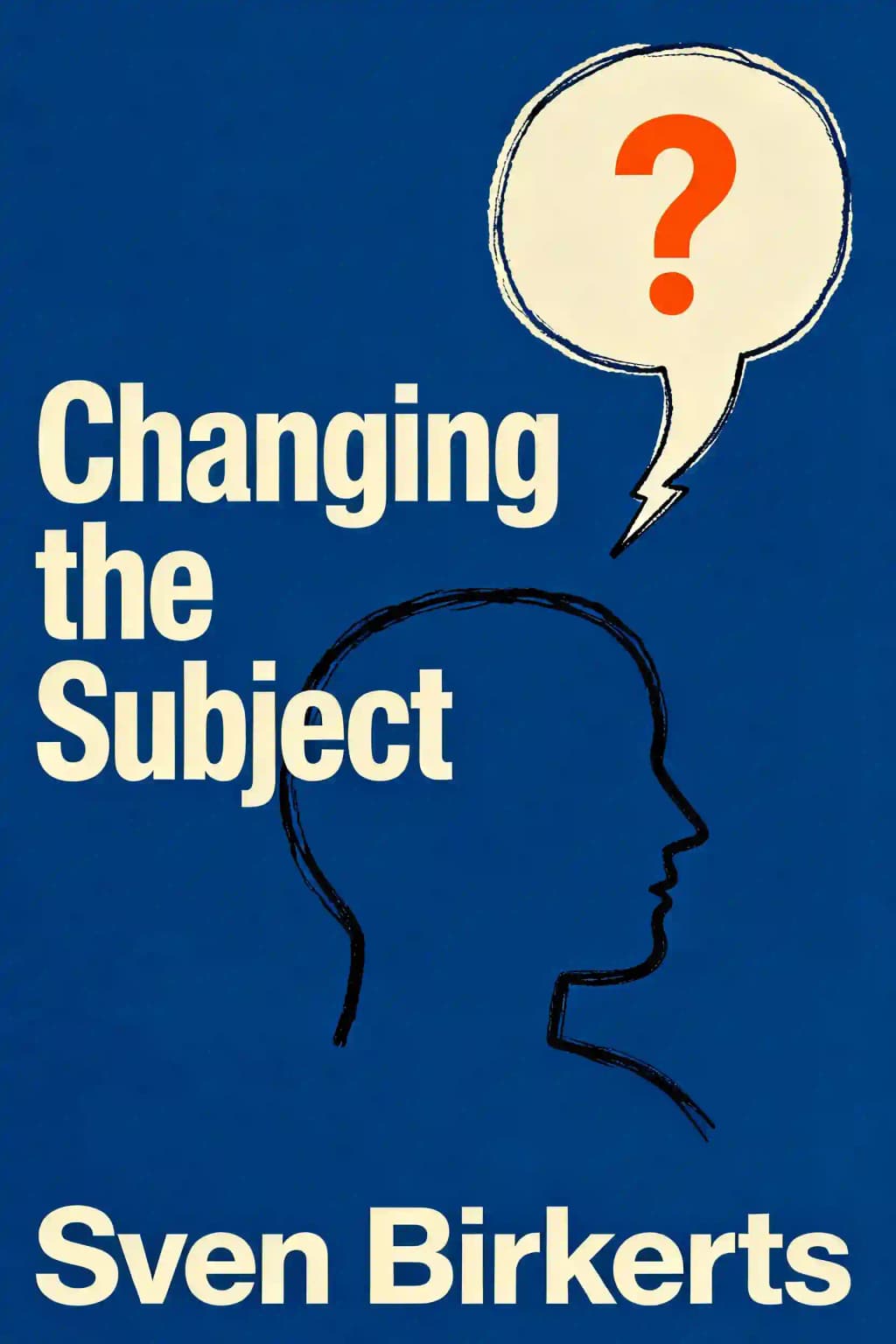
The book has been embraced by literary critics and tech skeptics alike, with publications like The New York Times calling it "a vital counterweight to digital utopianism." Birkerts, known for his earlier landmark work "The Gutenberg Elegies," continues his thoughtful exploration of how technology reshapes not just our habits but our inner lives. In an era when even raising questions about technological progress can earn one the dismissive label of "Luddite," this book offers a nuanced, deeply human perspective on what we gain and lose in our digital metamorphosis.
Capítulo 2
The Invisible Transformation of Consciousness
Two men stand in the same physical location, watching someone approach. Adam lives in 1700s Boston; Zeno is his modern counterpart. Though biologically similar, their experiences differ profoundly because their consciousness has been formed by entirely different circumstances. Zeno's awareness is expanded but diffused, his sense of presence diminished. The specific gravity of objects and events has lessened.
In our information age, we're drowning in data that only becomes usable information when given context. The balance has tipped dramatically from Adam's embodied physical reality to Zeno's disembodied data space. Modern living finds us enmeshed in systems we think we require but that increasingly separate us from physical reality. These digital systems proliferate through codes, interlock, and never simplify our experience. Their machinery advances through constant creation of data, accelerating with wireless networks that surround us with information as an enveloping environment rather than discrete items.
We've unleashed a flood of data like the sorcerer's apprentice, with technology outstripping human capacity to integrate its output. The essential human premise of context is under siege, as George Trow warned in his aptly titled "Within the Context of No Context." Paradoxically, computers have become both the source of proliferation and our primary contextualizing tool, organizing data through search engines and algorithms.
The digitization of all the world's texts creates the possibility of a universal digital library, as Kevin Kelly enthusiastically described in "Scan This Book!" Beyond mere digitization, Kelly envisions a system where "every bit informs another; every page reads all other pages" through cross-linking, clustering, and analysis. This creates algorithmic pathways of preferred usage that prioritize certain ideas and connections - essentially forming a vast extended brain with collective intelligence.
This vision suggests a "brave new world" of universal digital library functioning as a universal brain - one collective mind thinking in determined hierarchies. While we might dismiss Kelly as extreme, his vision merely projects what's already happening: electronic merging and social hiving that levels idiosyncrasy.
Capítulo 3
The Collapse of Distance and Mystery
The concept of distance has been fundamentally altered in our digital age. Once a measure of physical separation with inherent mystery-what Walter Benjamin called "aura"-distance now feels collapsed by our constant connectivity. I resist buying a cell phone precisely because I want to preserve the friction of geography, the meaningful effort of contact. I don't wish to surrender to 24-7 availability.
Technology's simplifications come with psychological costs. GPS may guide us efficiently, but it shifts us from active navigators to passive followers, strengthening our dependence on technological solutions while changing how we perceive our surroundings. We look for indicators rather than experiencing places for themselves.
My first experience using Siri for navigation became unexpectedly transcendental. Though I intellectually understand GPS technology, I found myself wondering, "How does she know?" as the disembodied voice directed me through unfamiliar streets. Most revealing was how easily I anthropomorphized the voice, wanting to please "her" with correct turns and feeling a strange guilt when my daughter entered the car, creating a "three's a crowd" sensation.
The very day after my Siri experience, I discovered I was already behind the curve. A newspaper headline asked, "Does anybody still use Siri?"-introducing Google Now as the superior alternative. This is the relentless pattern of technological advancement: more, faster, better, cheaper. The psychological effect is a perpetual sense of being in arrears.
Google executives speak of "just building the dream" when describing their predictive technologies - a phrase loaded with implications. It suggests they believe they're fulfilling humanity's destined evolution rather than merely creating useful tools. The casual "just" betrays a presumption of inevitability - as if resistance were futile. Most disturbing is the assumption that technology companies will lead us forward and "users will have to get comfortable" with whatever they create.
Capítulo 4
The Death of Serendipity
The word "serendipity" has suffered from overuse - reduced to a boutique name or New Age platitude alongside concepts like synchronicity and satori. Yet the original Persian tale of the princes of Serendip celebrated something profound: finding "valuable or agreeable things not sought for."
The subjective psyche requires possibility and surprise as desperately as plants need water. Serendipity involves attention and recognition - seeing familiar objects anew in changing circumstances. By embracing serendipity, I honor the unknown while affirming imagination's role in processing reality. I navigate life as if events happen for reasons, creating narratives that may objectively be retrofitted patterns but which nonetheless give meaning to my experience.
Two technologies are reshaping our relationship with the unknown. First, preference algorithms like Amazon's recommendations and Pandora's music suggestions create profiles based on our past choices. Second, instant search capabilities through Google and Wikipedia provide immediate answers where none were previously available.
These technologies appear benign - even beneficial. What could be wrong with systems that anticipate our tastes and expand our choices? Yet something vital is being lost. These systems subtly shift us from initiative to obedience while stealing away mystery - that uncertain unknown which I believe is our birthright. When we gaze at the night sky and feel reverence, we're experiencing the power of the immense unknown - not merely as gaps in knowledge but as a philosophical premise of being.
The old ways of discovery required vigilance and patience. Finding connections between artists might take years rather than milliseconds, but that investment of time gave experiences substance and significance. There must be a difference between earned knowledge and that which is simply delivered to our laptops. Through the work of achieving, we establish psychological ownership of our experiences.
Capítulo 5
The Neural Rewiring of Human Experience
These search-and-present technologies represent a breathtaking abridgment of initiative, short-circuiting the trial-and-error approaches that once mapped our progress through the world. They've quickly transformed from miracles to assumptions, feeding the illusion of competence while pampering us with instant gratification.
Neuroscience reveals how quickly our brains adapt - neural pathways rewire far more rapidly than previously thought, consolidating new reflexes while retiring obsolete ones. As Max Frisch presciently observed, technology is "the knack of so arranging the world that we don't have to experience it."
Yet experience isn't merely a means to an end - it is simultaneously the end itself. The journey of discovery, problem-solving, and immersion might actually be the point of living, with our goals serving merely as pretexts for having experiences. When technologies modify our customary patterns, they transform our understanding at fundamental levels.
GPS exemplifies our surrender of agency to technology. Unlike map reading, which demands interpretation and improvisation, GPS solves everything for us, commanding rather than guiding. The psychological control is completely reversed - we obediently follow instructions rather than making informed surmises.
This technology symbolically banishes inefficiency and lostness, concepts bound up with our deepest being. "Lostness" isn't trivial but a metaphysical category, a trope for authentic being-in-the-world. Our navigation technologies rationalize travel, selling us the message of complete knowability while transforming our world from wild oyster to farm-raised creature.
We've transferred reliance from self to system, believing ourselves cradled in a data field as if in God's hand. Yet we understand nothing of how these trusted powers work - only that they do. When they fail, our panic reveals the chasm between their capability and our ignorance, exposing our frightening hubris and fundamental powerlessness.
Capítulo 6
The Assault on Deep Reading
I've developed a stimulus shield when going online - a defensive, exclusionary scanning technique to counter the unremitting neural disquiet the internet creates. This medium activates a persistent sense of deferred expectancy, as if that unnamed thing I'm seeking is always just a finger tap away - the root of a lowercase addiction.
Online reading demands constant mental counter-pressure to resist the keyword-driven, hyperlinked structure that propels lateral movement rather than deep engagement. Articles are engineered for fast-lane drivers with highlighted sense nuggets that vault the eye forward, creating a choppy, accelerated reading experience that lifts off rather than settles in.
An article on Wikipedia's merits invokes Marshall McLuhan as its intellectual godfather, repurposing the media theorist as patron saint of "communal knowledge-making." McLuhan's early distaste for "expertise" and "authority" supposedly dovetails with Wikipedia's collaborative approach.
The writer celebrates McLuhan's intellectual innovations - abandonment of fixed viewpoint, equal consideration of present and past, borrowing wisdom from any source, understanding the mechanisms of understanding - as cornerstones of internet-age thinking. This celebration comes with a dismissive tone toward traditional scholarship, casually diminishing Walter Pater as just some "guy" and mocking Jaron Lanier's defense of individuality and authorship.
The most shocking statement comes from Bob Stein: "The sadness of our age is characterized by the shackles of individualism." This epitomizes the cultural zeitgeist I've been trying to identify - the environment itself is the elephant in the room. The deeper issue is the stark choice between two conceptions of humanity: the individualized self versus the socially and neurally collectivized self, where eventually the very concept of "self" must blur away.
Various thinkers have imagined collective selfhood - from Teilhard de Chardin's spiritual "noosphere" to E.M. Forster's prescient story of isolated beings connected by an Internet-like network, to Kevin Kelly's "hive" theory. Against this, Lanier argues "the hive mind is for the most part stupid and boring" and warns against devaluing individual people. Yet electronic collectivism has rapidly evolved from sci-fi fantasy to plausible scenario endorsed by computer culture insiders. And as McLuhan warned, "We create machines in our own image and they, in turn, recreate us in theirs."
Capítulo 7
The Dematerialization of Culture
The digital cloud is hastening the obsolescence of physical cultural items. Video stores have vanished, bookstores struggle, as more people access culture through screen portals. While instant access offers advantages, we're losing the physical markers of our tastes and desires - no records, CDs, fewer books on shelves. These aren't just commercial spaces but community symbols of cultural value. What's distressing about this transfer from object to cloud is that materiality itself seems to be receding as screens gain power to compel our attention. Marx lamented that "all that is solid melts into air" - a perfect description of our dematerializing world.
The transformation of our living spaces raises vital questions: Are collaborative, collectivized ways of living entirely at odds with individuality? Can we use digital systems while preserving our selfhood? This isn't just about tools but about technology transforming our deepest structures of meaning and identity. I propose two diverging paths - one moving toward collectivized, dematerialized screen living, the other preserving individual being. For guidance on the latter, I turn to Rilke's Duino Elegies, which place the existential self at their core. Where our age pushes toward instrumental mastery and social merging, Rilke urges confronting the world directly, suffering it, transforming it inwardly through language - not collectively into a digital cloud, but subjectively, raising the natural world into consciousness.
Over twenty years after publishing "The Gutenberg Elegies: The Fate of Reading in an Electronic Age," I reflect on my early concerns about digital culture's impact on reading. Some predictions proved accurate - trade publishing's panic, bookstore closures, e-book growth, waning print reviews - but I underestimated literary culture's resilience in finding new paths. Yet challenges remain: uncompensated Internet publication, monetization problems in a culture where "information wants to be free," and overwhelming media saturation competing for our attention. What I missed then was understanding how digital immersion physically rewires our brains.
Capítulo 8
The Neuroscience of Digital Transformation
Neuroscience now offers crucial insights into how digital technologies affect our neural functioning. We literally become "how, with what tools, we think." Our brains physically modify their structure based on use - our growing engagement with the fluid Internet network is radically modifying our cognitive makeup. As Nicholas Carr argues, "If you were to set out to invent a medium that would rewire our mental circuits as quickly and thoroughly as possible, you would probably end up designing something that looks and works a lot like the Internet."
The paradox is that "the Net seizes our attention only to scatter it." Through neurological principles where "neurons that fire together wire together," our intensive Internet immersion bends us away from certain mental orientations toward others. The mental functions losing the "survival of the busiest" brain cell battle are those supporting calm, linear thought - the very faculties needed for traversing lengthy narratives or involved arguments.
The Internet is fundamentally a tool for lateral connection rather than deep contemplation. Its power lies in linking materials instantaneously, creating momentum that works against the narrowing intensity required for sustained development. Yet contemplation isn't just one thinking style among many - it's the point of thinking itself, directing itself at existential questions. It requires solitude and duration, lingering among intimations. Without it, we're banished to the shallows of the trivial. The opposition between breadth and depth isn't new - Archilochus captured it with his fox and hedgehog metaphor, later explored by Isaiah Berlin who contrasted Dostoyevsky and Tolstoy as exemplars of these different approaches to understanding.
This meditation begins with a moment of contemplation - staring at a mundane roof surface at Bennington College and experiencing the epiphany that context determines meaning. The same insignificant roof could become vitally important through different frameworks: artistic rendering or survival necessity. This insight reveals that information only matters within narrative contexts that summon it from "dead-dust inertia" into significance.
Capítulo 9
The Hive Mind and the Individual Soul
Kevin Kelly's vision of digitizing all texts into a universal library represents a fundamental shift in how we conceive information. Beyond mere accessibility, Kelly celebrates the dissolution of boundaries between texts through links and tags, creating a collective intelligence where connections are ranked by popularity. This approach transforms isolated works into an "open-source weave" reflecting patterns of collective use.
Jimmy Wales' Wikipedia exemplifies this trend, already outpacing traditional encyclopedias despite questions about scholarship quality. The concern isn't just technological but philosophical - as digital immersion advances, the primacy of individual books and authors yields to a decentered cultural sampling that undermines reliable context and authority. Without the binding tension of individually generated contexts, we risk destroying what makes books meaningful: the relationship between thinker and thought, knower and known. By relinquishing control to search algorithms, we become nodes in a system rather than independent selves, drifting without coherent origins or destinations - the "hive life" made inevitable.
I felt deeply depressed watching the Jeopardy! showdown between IBM's Watson computer and human champions Ken Jennings and Brad Rutter. This wasn't merely a contest but the unveiling of a program that had absorbed virtually all human-generated data and could now parse speech patterns through concurrent algorithms. Watson's domination was complete, its few errors merely identifying problems for future refinement. The competition revealed something profound: this wasn't knowledge versus knowledge, but human understanding against raw calculating power. Watson's ability to answer questions about Charlemagne with the same inflection as questions about Alka-Seltzer reduced all information to undifferentiated "mind rubble," devoid of hierarchy or significance.
Our tendency to project humanity onto Watson is nearly irresistible. Despite knowing it's merely circuits and processors, I found myself relating to the icon as if it possessed answers through lived experience rather than algorithmic probability calculations. This anthropomorphizing impulse was deliberately encouraged by IBM's developers, who gave Watson a name, a winsome voice, and a distinctive personality. Like Tom Hanks with his volleyball in Cast Away or the protagonist in Spike Jonze's Her, we reflexively attribute consciousness where none exists. What's truly unsettling isn't that I fell for this projection, but recognizing how powerful that unconscious impulse remains even as machines cross the cognitive species barrier.
Capítulo 10
The Fear of Being a "Cranky Luddite"
I was struck by Steve Almond's article about his children's school introducing iPads, particularly his immediate disclaimer: "It's not because I'm a cranky Luddite, I swear." This reflexive distancing from the Luddite label reveals our culture's automatic mockery of technology skeptics. Despite feeling genuine dread about corporate intrusion into education, classroom socialization being replaced by isolated screen interactions, and parents losing control over children's screen exposure, he still fears the toxic "cranky Luddite" tag. His concerns are fundamental, touching on what Heidegger called "the question concerning technology" - ultimately about humanity's place in a digitized world.
The term "Luddite" has evolved far from its origins with Ned Ludd, who broke weaving frames protesting mechanization. Today it's a catchall for anyone questioning technological progress, especially regarding computers. This spectrum is too vast to lump together both determined opposers and those merely harboring doubts. Most of us, even digital natives, have concerns about certain aspects of technology that need monitoring. We're not acquiescent lemmings but individuals trying to find balanced ways to live with these devices and their unsettling changes.
The perceived reality shift has undermined parental authority - "Back in the day, when my folks snapped off the TV... they did so with a certain cultural credibility. Everyone knew you couldn't experience the 'real world' by sitting in front of a screen." Today, screens have become the accepted gateway to reality itself.
The most vexing question is whether screen stimulants erode our interaction with the unmediated world. Do these "magical devices" dim our "sense of wonder at the world beyond the screen"? The win/lose dynamic can't be ignored - what exactly are we sacrificing for these conveniences? Previous generations believed that struggle built character, that attainability and desire were inversely related. When making these calculations for our children, we're forced to imagine various future scenarios. If techno-competence becomes the ultimate key to advancement, shouldn't we encourage total immersion? But what picture of meaning and purpose would that leave them with? We're ultimately asking: what is the point of living?
Capítulo 11
The Endangered Art of Reading
Andre Kertesz's book of photographs called "On Reading" captures people in moments of the most private kind of free fall - through the inner landscape. Photography commits to outer surfaces while reading unfolds in pure inwardness. Reading creates content in the figurative space that thought makes possible - the inner holds the outer. There's a striking polarity between the reader's necessary stillness and their unseen concentrated dynamism. Nothing so vividly depicts the split between bodily and mental as the engaged reader. Another paradox: the engaged reader is never aware of their setting; only the observer is. While solitary eaters or daydreamers remain somewhat attuned to surroundings, the reading mind has vanished from its environment.
Kertesz includes several photos of children reading, evoking what is for many our finest memories - not of specific books but of reading's unmatched potency before adulthood's cares. That lock-on intensity wanes as we age. At some point in my teens, I lost the capacity for absolute transport. Does the world compete more aggressively for our attention, or does the reading psyche itself change? These images of children with books evoke something true and pure no longer available to me.
Kertesz also includes images of readers in public settings. Of and apart - that has always seemed the most desirable balance. Reading in complete solitude creates a kind of existential agitation in me, as if the book was a drug slightly too strong, making the world overwhelmingly strange. Reading in the presence of others affords a delicious oscillation. Peripherally aware of surroundings, my immersions become discontinuous. I find the shift thrilling, especially surfacing from the book to catch first awareness of what's around me - a moment of split attention highlighting my dual citizenship and making all things seem richer.
Despite my deep allegiance to printed books, I can see the historical movement like a time-lapse metamorphosis - from papyrus and vellum to scriptoria and codices, through countless iterations of books, to the Kindle. These might be the outer garb of something struggling for release. Future reading forms will likely explore interactivity, sophisticated linkage, and multimedia rather than reiterating the known. The question remains whether they'll still connect to humanist assumptions of the old canon, and if not, what values will guide them instead?
Capítulo 12
Reading in a Digital Age
We're acclimating to unprecedented change as signals, data, and networks reshape our habits and reflexes. Young people navigate life with minimal recourse to paper, checking online sources constantly, creating a vast gulf between generations. Though newspapers still arrive and bookstores display new titles, information has become an environmental constant that pulls the world close while redefining reality itself.
From hindsight, past technologies always look quaint. Watching Wenders's film "Wings of Desire" with its library scene, I suddenly saw our present moment through future eyes - with bemused pity for a now that doesn't know it's a then. It's easy to imagine a world where screen-to-screen interactions replace paper entirely. My students already navigate this reality, finding any information instantly online while I present book knowledge with defensive irony, fearing their tolerant bemusement toward my earnest passions.
Neuropsychology increasingly suggests there may be no mind apart from brain function - that our consciousness is merely "operations carried out by the brain." This threatens the humanist worldview that allowed for possibilities beyond the strictly material. The digital paradigm advances alongside this research, saturating our language and premises. Yet the mystery remains how "chemicals in combination" create narratives that elicit profound responses. Human narratives aren't mere sequences but events selected for meaning. Did humans invent narrative or inherit it as part of consciousness? If "mere matter" created the capacity to theorize itself, perhaps imagination - the faculty connecting us to deeper possibilities of being - deserves protection as digital prostheses increasingly separate us from the essential givens of existence.
What underlies my agitation is the conviction that imagination-the whole party of the imagination-shrinks faster than Balzac's wild ass's skin with each digital prosthesis that appears. These technologies insert layers between ourselves and the essential givens of existence, making it harder to grasp ourselves as part of an ancient continuum while offering false inklings of agency. Contemplative thought, being intransitive and experiential, opposes analytical thought, which is goal-directed. While the Internet excels at gathering information for analysis, it undermines the contemplative mode where reflection tests and refines our relation to the world. I've come to see that the Internet and the novel are fundamentally opposites.
Capítulo 13
The Novel as Sanctuary
The novel isn't merely something to study in English classes but a field for thinking-a condensed time-world adjacent to ours. Its purpose might be less about communicating themes and more about igniting inwardness, which is an end itself: an enhancement, a deepening, a way of priming conjecture. This makes the novel a vital antidote to the mental reflexes the Internet promotes. My worry isn't artificial intelligence overthrowing human intelligence, but the rapid erosion of reflection, imaginative projection, and contemplation-thinking for its own sake.
Where am I when reading a novel? I'm "in" it to the degree it involves me, yet never without awareness of my surroundings. Rather than hovering between two places-the conjured and empirically real-I occupy a third state amalgamating both awarenesses, like the temporary borderland between sleep and wakefulness. Reading involves a double transposition: the inward plunge into another world, then adapting to the specific givens of that work. The problem in our stimulus-saturated culture is that this connection becomes harder to make or sustain. We've evolved coping strategies for an information space blazing with signals-grazing lightly, applying focus only where needed, orienting with fractured attention. No wonder we struggle with unfragmented text.
Having just finished O'Neill's "Netherland," I can testify about a novel's residue. Plot details fade first and rapidly, but I retain a distinct tonal memory, a conviction of having been inside an author's language world, along with some understanding of their psyche. I believe I've gained something important, though memory access can't be the sole criterion of impact. In a lifetime of reading-which maps to a lifetime of forgetting-we store impressions according to private systems, keeping factual information on one plane, psychological insight on another, ideas on a third. I know a great deal without knowing what I know, as insights from various sources join together. The source may fade as the sensation remains.
This idea of vantage fascinates me-sophisticated visual access to the whole planet correlates uncannily to the novelist's swooping freedom. Yet Hans can only get so close, constrained by technology and visual exteriority. The novelist, however, can complete the action, moving through the dormer window and into minds. This satellite capability represents our transformed information culture that has changed how we live and who we are. It questions fiction's place-how can beauty hold a plea against such potency? Though O'Neill captures this sensation beautifully, the very availability of such power to average users diminishes the novel's overall power. Every new instrument of access reduces imagination's operating power by some factor. Will someone who can make transatlantic swoops digitally be willing to read labored written sequences?