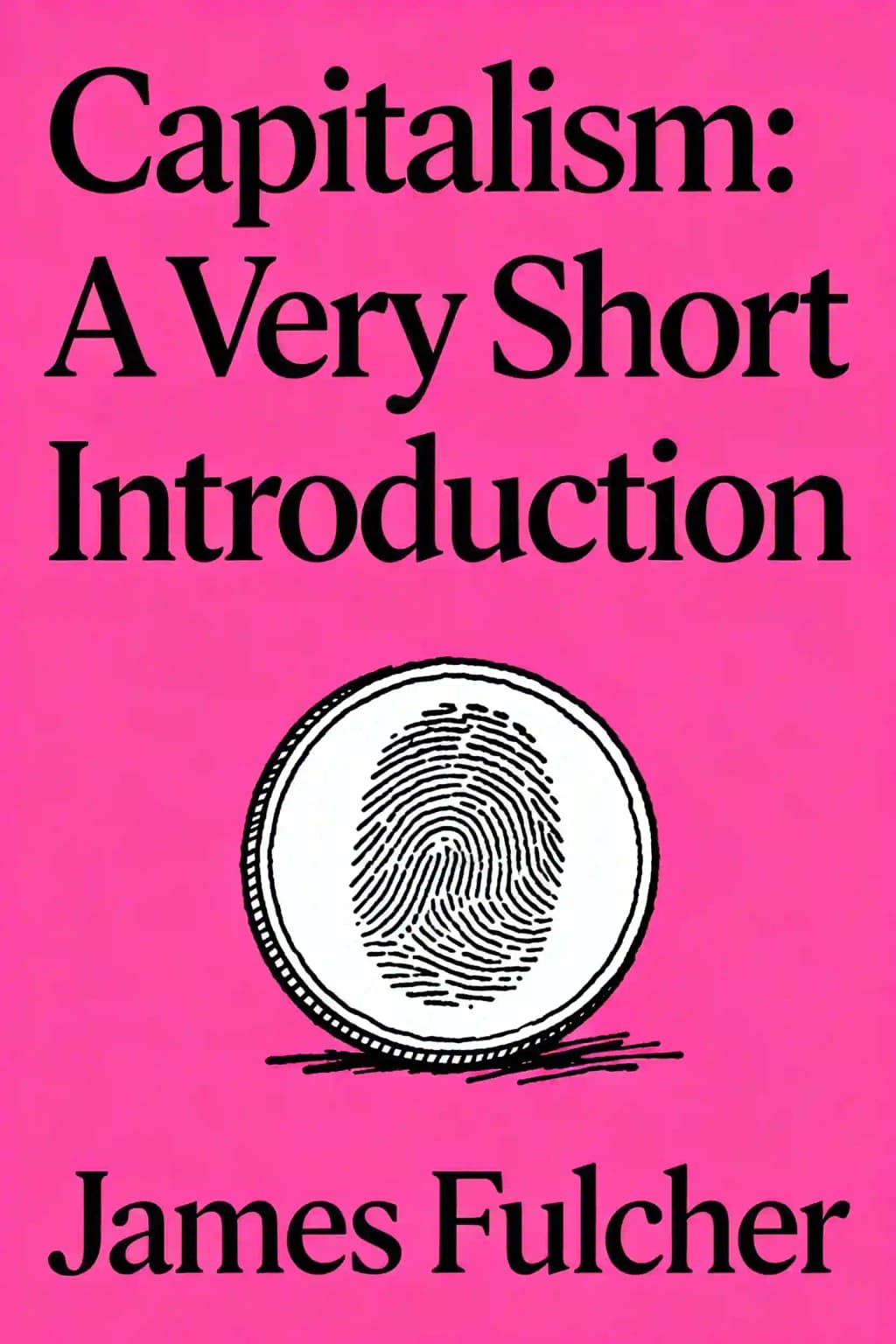
Capitalism
A Very Short Introduction (Very Short Introductions)
Resumen de Capitalism
Capitalism: A Very Short Introduction unravels our global economic system's complex evolution - from merchant origins to modern crises. Oxford's acclaimed guide explores capitalism's ethical dilemmas and transformative power, offering crucial insights for anyone questioning how financial systems shape our world and what alternatives might exist.

Temas clave en Capitalism
- merchant capitalism
- industrial revolution
- capital accumulation
- labor exploitation
- market evolution
Citas de Capitalism
Profit ultimately depended on exploiting workers.
Capitalism simultaneously commercialized leisure.
Work became sharply separated from leisure.
Capitalism has fundamentally transformed the world.
Personajes en Capitalism
- Friedrich EngelsCo-author of the 1848 critique of capitalism
- James M'ConnelScottish entrepreneur and cotton spinning magnate
- John KennedyScottish entrepreneur and cotton spinning magnate
- James FulcherAuthor and expert on the history of capitalism
Sobre el Autor
Sobre el autor de Capitalism
James Fulcher, author of Capitalism: A Very Short Introduction, is a British sociologist and acclaimed academic renowned for his incisive analyses of economic systems and labor relations. With a master’s degree from the London School of Economics and a PhD from the University of Leicester, Fulcher spent his career as a senior lecturer at Leicester, where he co-authored the widely adopted textbook Sociology—praised as a definitive resource in the field. His expertise spans comparative studies of capitalism, labor movements, and industrial relations, exemplified in works like Labour Movements, Employers, and the State, which contrasts British and Swedish models.
Fulcher’s writing distills complex societal structures into accessible insights, blending historical context with contemporary critique. Capitalism: A Very Short Introduction has become a cornerstone in economics and sociology curricula, translated into multiple languages, including Bulgarian and Turkish.
His interdisciplinary approach, informed by decades of teaching and research, continues to influence debates on globalization and economic inequality. The book remains a bestseller in Oxford University Press’s Very Short Introductions series, lauded for its clarity and relevance in understanding modern capitalism.
Descargar resumen de Capitalism
Obtén el resumen de Capitalism como PDF o EPUB gratis. Imprímelo o léelo sin conexión en cualquier momento.
Preguntas Frecuentes Sobre Este Libro
Capitalism: A Very Short Introduction by James Fulcher provides a concise exploration of capitalism’s core principles, historical evolution, and global impact. It defines capitalism as the investment of money to generate profit, tracing its development from merchant trade in the 17th century to modern financial systems. The book examines crises like the 1997 Asian financial collapse and debates capitalism’s sustainability, offering insights into its institutional forms and alternatives like socialism.
This book suits students, economists, and general readers seeking a clear primer on capitalism’s mechanics and societal influence. Fulcher’s accessible style makes complex topics—like wage labor, market dynamics, and globalization—digestible for non-experts. Those interested in historical case studies (e.g., tulipomania, Enron’s collapse) or critiques of capitalist systems will find it particularly valuable.
Yes—it distills capitalism’s complexities into 160 pages, blending academic rigor with readability. Fulcher’s analysis of capitalism’s adaptive resilience through crises and global expansion offers timeless relevance. The book’s structured approach (defining terms, historical case studies, modern applications) makes it a standout in Oxford’s Very Short Introductions series.
Fulcher identifies four key phases:
- Merchant capitalism: Profit through monopolized long-distance trade (e.g., 17th-century Dutch spice ventures).
- Industrial capitalism: Rise of factories and wage labor during the Industrial Revolution.
- Financial capitalism: Dominance of speculative markets and complex instruments.
- Global capitalism: Modern integration of economies worldwide, transcending national borders.
Fulcher defines capitalism as “the investment of money in the expectation of making a profit.” He emphasizes wage labor, market-mediated production/consumption, and risk-taking in financial speculation. Capital extends beyond cash to assets like property, which generate returns through rent, sale, or collateral.
The book analyzes:
- Tulipomania (1630s): A speculative bubble in Dutch tulip markets.
- 1997 Asian financial crisis: Currency collapses and IMF interventions.
- Enron scandal (2001): Corporate fraud exposing systemic risk in deregulated markets.
Fulcher argues globalization isn’t new but has intensified through technology and deregulation. He explores tensions between multinational corporations and nation-states, noting how capital mobility challenges local labor and environmental policies. Case studies include post-Soviet Russia’s economic collapse.
The book highlights capitalism’s instability, inequality, and environmental costs. Fulcher questions whether profit-driven systems can sustainably address climate change or wealth gaps. He also analyzes socialist and communal alternatives, though notes their historical challenges in scaling effectively.
Unlike dense academic texts, Fulcher’s work prioritizes brevity without oversimplification. It balances historical analysis (e.g., Marx’s influence) with modern phenomena like algorithmic trading. For deeper dives, readers might pair it with Thomas Piketty’s Capital in the Twenty-First Century or Naomi Klein’s critiques of neoliberalism.
- “Profit was the result of scarcity and distance”: Highlights merchant capitalism’s reliance on trade imbalances.
- “Capital has not escaped the nation-state”: Challenges assumptions about globalization’s inevitability.
- “Crises are not flaws but features”: Emphasizes capitalism’s cyclical boom-bust nature.
As debates over AI-driven job displacement and climate financing intensify, Fulcher’s framework helps contextualize capitalism’s evolving role. The book’s analysis of financial speculation remains pertinent amid cryptocurrency volatility and ESG (Environmental, Social, Governance) investing trends.
Some reviewers argue Fulcher oversimplifies capitalism’s cultural diversity (e.g., contrasting Japanese vs. Anglo-American models). Others note minimal discussion of digital economies or gig work. Despite this, the book is praised for making foundational concepts accessible to newcomers.