Capítulo 1
The Battlefield of Ideas: How the Left Conquered Campus and How We Fight Back
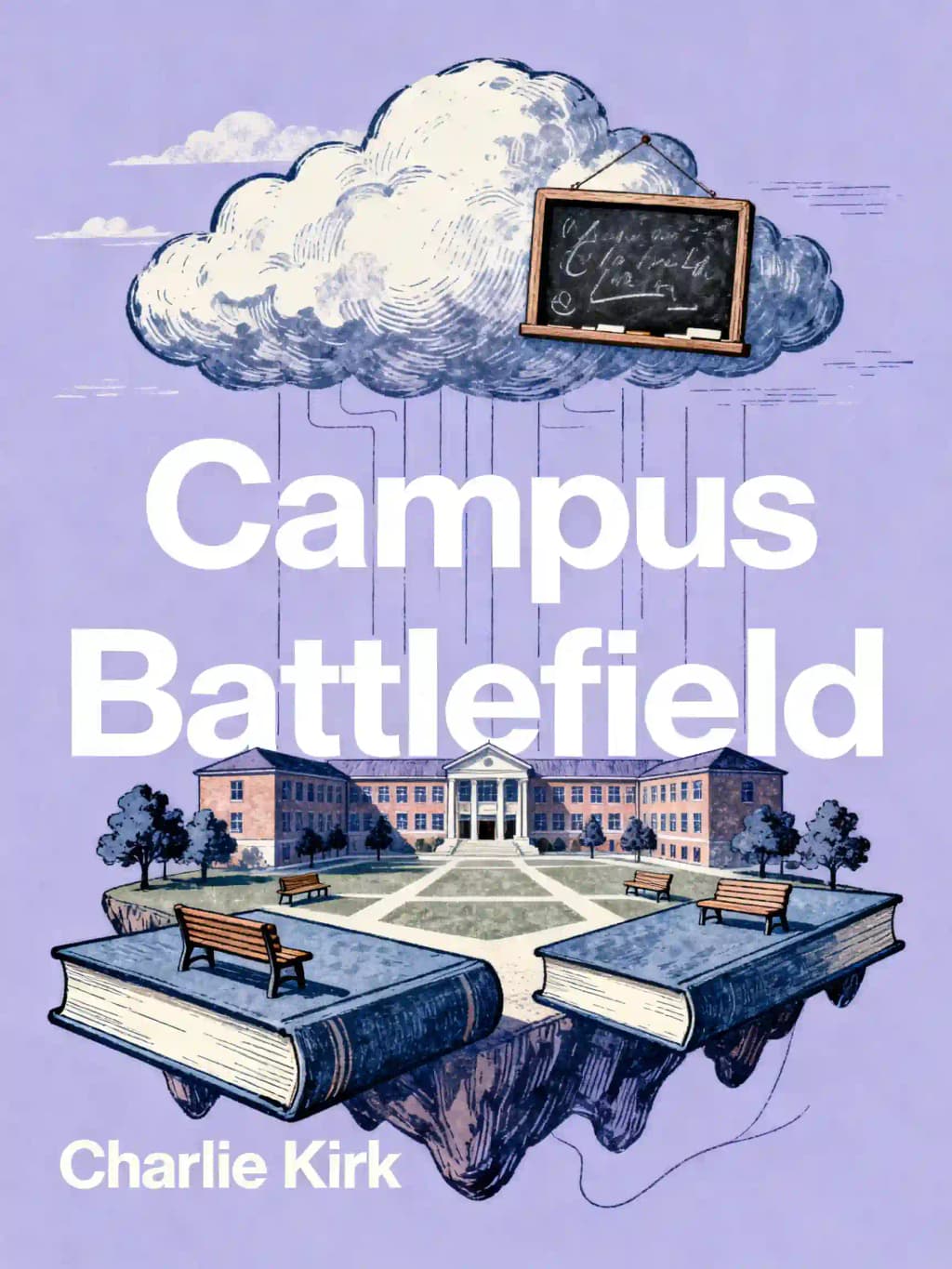
Imagine a world where expressing your opinion could get you surrounded by screaming protesters, where campus police escort you to class, and where professors openly mock your beliefs. For thousands of conservative students across America, this isn't dystopian fiction-it's Monday morning. Charlie Kirk's "Campus Battlefield" has become a cultural touchstone for understanding the ideological war raging across American universities. The book has earned praise from influential conservatives like Ben Shapiro and Donald Trump Jr., who wrote the foreword, while simultaneously drawing fierce criticism from progressive academics. What makes this work particularly relevant is how it predicted the campus free speech battles that have intensified in recent years, becoming a blueprint for conservative student activism nationwide. Kirk, who founded Turning Point USA at just 18 years old, has transformed from a college dropout into one of conservatism's most recognized young voices-proving his own thesis that the real education happens outside the classroom's leftist echo chamber.
Capítulo 2
The Safe Space Paradox: How Protection Became Segregation
The concept of "safe spaces" represents one of the most visible contradictions in modern campus culture. These designated areas, ostensibly created to protect vulnerable students from psychological harm, have evolved into something far more problematic. While liberals can freely express their views across campus, conservatives find themselves marginalized and labeled as oppressors simply for holding different political opinions.
What makes this situation particularly ironic is how safe spaces have morphed into a form of self-imposed segregation. Universities now create separate dormitories, graduation ceremonies, and student centers based on identity categories-effectively reversing decades of integration progress. At Harvard, Columbia, and UCLA, segregated housing options have returned under the guise of creating "affirming spaces" for minority students. The University of Connecticut even created a separate dormitory specifically for African American male students, calling it "positive" segregation-a concept that would have horrified civil rights leaders of the past.
This contradiction becomes even more apparent when examining the justifications offered. Campus administrators frequently claim that "the best hope we have of creating an inclusive community is to first create spaces where members of each group feel safe." This reasoning turns the entire concept of integration on its head. How can students learn to live in a diverse society by first retreating into homogeneous enclaves? The psychological impact is equally troubling-these spaces reinforce the idea that certain students are perpetual victims who require special protection from opposing viewpoints.
The real-world consequences extend far beyond campus. Students who graduate having spent four years in ideological bubbles enter society unprepared for the rough-and-tumble of democratic debate. They expect the workplace and public square to function like their campus safe spaces, demanding protection from ideas they find uncomfortable. This expectation collides violently with reality, creating graduates who struggle to function in environments where their views might be challenged.
While freedom of association remains an important right, safe spaces become fundamentally problematic when they undermine higher education's essential purpose: exposing students to diverse perspectives and teaching them to engage with challenging ideas. Universities should be preparing students for the world as it exists-not sheltering them from it. The safe space movement, despite its compassionate veneer, ultimately produces the opposite of its intended effect: graduates less capable of building bridges across difference and more likely to view those with opposing views as threats rather than fellow citizens.
Capítulo 3
The Microaggression Industry: When Words Become Weapons
Remember when "sticks and stones may break my bones, but words will never hurt me" was a childhood lesson in resilience? On today's college campuses, this wisdom has been completely inverted. Words have been transformed into weapons more dangerous than physical harm-they've become "microaggressions," capable of inflicting invisible but supposedly devastating psychological damage.
This concept, originally coined by Harvard psychiatrist Chester Pierce in 1970 to describe subtle racist remarks toward African Americans, has expanded exponentially. Today's definition encompasses virtually any statement that could conceivably make someone from a "marginalized group" feel uncomfortable. The University of California system defines microaggressions as "brief, everyday exchanges that send denigrating messages" to certain individuals-a definition so broad it can include almost anything.
What's particularly troubling is how this framework creates an unfalsifiable accusation. As the American Psychological Association states, "Some racism is so subtle that neither victim nor perpetrator may entirely understand what is going on." This creates a kafka-trap where denying the offense becomes evidence of guilt. If you didn't realize your innocent question was offensive, that just proves how deeply your unconscious bias runs.
The list of forbidden phrases has grown to absurd proportions. Asking "Where are you from?"-once considered basic friendly conversation-is now labeled xenophobic. Complimenting someone's English skills is racist. Saying "I believe the most qualified person should get the job" supposedly attacks affirmative action. Even statements like "America is a melting pot" or using the word "mankind" have been classified as microaggressions at universities from California to New York.
Consider the real-world examples: At the University of Minnesota, a student was reported for microaggression after making a joke about graduation requirements. At Brandeis University, the administration condemned the phrase "trigger warning" itself as a microaggression because it might evoke thoughts of gun violence. At UCLA, a professor was formally investigated for reading Martin Luther King Jr.'s "Letter from Birmingham Jail" aloud-including its historical racial epithets-in a civil rights class.
The scientific foundation for this approach is remarkably thin. Psychology professor Scott Lilienfeld conducted a comprehensive review of microaggression research and concluded that the concept lacks scientific rigor, with negligible evidence supporting its core premises. He recommended abandoning the term entirely and halting microaggression training pending better research. Yet despite this scholarly skepticism, microaggression theory continues to expand its influence across campus policies.
Perhaps most concerning is how this framework undermines due process. As sociologist Amitai Etzioni observes, in the microaggression paradigm, the accused has no defense-the accuser serves simultaneously as prosecutor, judge, and jury. The mere claim of feeling offended constitutes proof of wrongdoing, creating a system where subjective emotional responses trump objective standards of evidence. This approach doesn't prepare students for professional environments where clear communication and evidence-based reasoning are essential skills.
Capítulo 4
Free Speech Zones: The Quarantine of Ideas
Among the most puzzling contradictions on modern campuses is the concept of "free speech zones"-designated areas where expression is permitted while the remainder of campus becomes effectively a "shut-your-mouth zone." These spaces, often comically small relative to the campus size, represent a fundamental misunderstanding of constitutional principles.
Picture this: At Pierce College in Los Angeles, the free speech zone comprised just 616 square feet-about 0.003% of the campus. Students needed permits to use this tiny area, and distribution of materials (including copies of the Constitution) was prohibited elsewhere. At Modesto Junior College, student Robert Van Tuinen was stopped by campus police for distributing copies of the Constitution on Constitution Day because he wasn't standing in the designated zone.
These restrictions emerged during the turbulent protests of the 1960s and 70s but have evolved into something far more restrictive. By 2013, the Foundation for Individual Rights in Education (FIRE) found that one in six top American colleges maintained these zones, with some schools like the University of Cincinnati restricting free expression to just 0.1% of campus grounds.
The courts have consistently ruled against these speech quarantines. When Modesto Junior College students were directed to their "free speech corral," FIRE helped file a lawsuit resulting in a $50,000 settlement and policy changes. Similarly, when Pierce College barred a student from distributing Spanish-language copies of the Constitution outside their designated area, courts ruled that open campus areas are public forums for student expression.
What makes these zones particularly insidious is their selective enforcement. While seemingly content-neutral, administrators frequently apply these restrictions more stringently against conservative viewpoints. At Kellogg Community College in Michigan, students were arrested for distributing copies of the Constitution without permission, while progressive demonstrations often proceed without interference. At California State University-Los Angeles, conservative speaker Ben Shapiro required police protection when his event was nearly shut down by protesters who pulled fire alarms and blocked entrances-yet progressive speakers rarely face such obstacles.
The practical effect of these policies extends beyond the immediate restriction. They create a chilling effect where students self-censor rather than navigate bureaucratic approval processes. The message becomes clear: expression is a privilege granted by administrators, not a fundamental right. This inverts the proper relationship between students and institutions in a free society, where universities should facilitate the exchange of ideas rather than restrict them.
Encouragingly, these zones are declining due to court challenges and state legislation, with only about one in ten schools still maintaining them. However, their very existence reveals a troubling mindset among administrators who view unfettered expression as a threat rather than education's lifeblood. As the Supreme Court has repeatedly affirmed, "the vigilant protection of constitutional freedoms is nowhere more vital than in the community of American schools."
Capítulo 5
Academic Absurdity: The Decline of Liberal Education
The traditional "liberal arts" education-designed to create well-rounded citizens through exposure to history, philosophy, literature, and science-has been systematically replaced by courses that often serve more as indoctrination than education. This transformation represents perhaps the most fundamental shift in higher education's purpose.
Today's college catalogs feature offerings that would have been unimaginable a generation ago: "The Unbearable Whiteness Of Barbie" at Occidental College, "Politicizing Beyonce" at Rutgers, and "Tree Climbing" at Cornell (which actually fulfills physical education requirements). These aren't merely lighthearted electives but symptoms of a deeper intellectual decay where serious scholarship has been replaced by ideological posturing.
Consider the "research" emerging from these departments. The University of Oregon produced a "feminist glaciology framework" examining how "gender, power, and epistemologies" influence glacier science. The paper, funded by taxpayers through the National Science Foundation, argued that glacier research has been dominated by "masculinist discourses" and requires "alternative ways of understanding." Another study from Rutgers claimed ski slopes are sexist "for performing athletic, risk-seeking masculinity."
The problem extends beyond bizarre course offerings to the classroom experience itself. Professors like Sara Goldrick-Rab at Temple University (who compared Wisconsin Governor Scott Walker to Hitler for cutting education spending) bring naked political activism into their teaching. At the University of Michigan, a professor refused to write a recommendation letter for a qualified student solely because she wanted to study in Israel. At Evergreen State College, biology professor Bret Weinstein was surrounded by an angry mob and effectively driven from campus after questioning a day of racial segregation.
The language used in these academic settings has become increasingly impenetrable-not because the concepts are sophisticated but because clarity would expose their intellectual emptiness. Academic papers filled with phrases like "heteronormative capitalist patriarchy" and "intersectional epistemological frameworks" serve not to illuminate but to obscure, creating a priesthood of academic insiders who can decode this specialized vocabulary.
This decline in academic standards coincides with skyrocketing costs. Since 1985, college tuition has increased at nearly four times the rate of inflation, while the actual educational value has arguably decreased. Students graduate with massive debt and often minimal marketable skills or genuine intellectual development. The average college graduate now carries over $30,000 in student loan debt-a figure that would be justified if they received a rigorous education, but becomes scandalous when that education consists largely of ideological training.
Despite this current fad of progressive nonsense, there is hope. The classics and untainted scholarship have survived for centuries precisely because they contain enduring wisdom and truth. As these intellectual fads pass, the fundamental questions explored by Plato, Shakespeare, and Adam Smith will remain relevant, continuing to provide guidance to those seeking genuine education rather than fashionable indoctrination.
Capítulo 6
Trigger Warning Culture: The Infantilization of Students
Trigger warnings began with legitimate intentions-to spare trauma victims from unexpectedly confronting content that might trigger post-traumatic stress. A combat veteran with PTSD might reasonably appreciate advance notice before watching graphic war footage; a rape survivor might benefit from knowing a discussion will include sexual assault. These applications represent trauma-informed care at its best.
However, this concept has been hijacked by victimhood culture and stretched beyond recognition. What started as compassionate accommodation has morphed into mandatory warnings for virtually any content that might cause discomfort. The list of potential triggers has expanded to include discussions of racism, sexism, classism, ableism, eating disorders, drug use, medical procedures, pregnancy, and even "slimy things" or "trypophobia" (fear of irregular patterns of small holes).
This expansion creates practical impossibilities for educators. How can professors possibly identify every potential trigger for every student? Must warnings be issued daily as course material changes? What happens when a student complains about a missing warning for something the professor couldn't reasonably anticipate? The system creates an administrative nightmare while infantilizing students.
The University of Chicago took a bold stand against this trend in 2016, sending incoming freshmen a letter stating that "our commitment to academic freedom means that we do not support so-called trigger warnings" and that the university would not cancel controversial speakers or create "intellectual safe spaces." President Robert Zimmer eloquently defended this position: "Universities cannot be viewed as a sanctuary for comfort but rather as a crucible for confronting ideas."
This stance drew criticism from other institutions and students who incorrectly insisted that certain speech isn't constitutionally protected. Meanwhile, schools like DePaul University took the opposite approach, erasing pro-Trump chalk messages under the false pretense that tax-exempt institutions can't allow political expression-a clear misapplication of IRS rules that was selectively enforced against conservative viewpoints.
Though defenders claim trigger warnings are voluntary pedagogical tools, policies at many institutions make them effectively mandatory. Drexel University's policy uses vague language about "creating safe learning environments," leaving teachers vulnerable to punishment if students complain about missing warnings. Title IX has been broadly applied to enforce such requirements, with accusations of creating a "hostile environment" used to silence controversial discussions.
The deeper problem with trigger warnings is their fundamental assumption that students are fragile beings who must be protected from intellectual challenge rather than resilient individuals capable of engaging with difficult ideas. This approach directly contradicts research on treating anxiety and trauma, which shows that avoidance reinforces fears while controlled exposure helps overcome them. Psychologists like Jonathan Haidt and Greg Lukianoff have argued that trigger warnings may actually worsen mental health by teaching students to catastrophize normal emotional responses to challenging material.
While accommodations may be appropriate for students with documented trauma histories, the general application of trigger warnings represents a fundamental misunderstanding of education's purpose. Universities should prepare students to engage with the world as it exists-not shield them from it. As philosopher John Stuart Mill noted, "He who knows only his own side of the case knows little of that."
Capítulo 7
The White Privilege Paradigm: Race as Destiny
Few concepts have spread more rapidly from academic theory to mainstream discourse than "white privilege"-the notion that white Americans automatically benefit from unearned advantages based solely on skin color. This framework has moved from obscure critical race theory seminars to corporate training programs, K-12 curricula, and media commentary with remarkable speed.
The academic origins are evident in courses like "The Problem of Whiteness" at the University of Wisconsin-Madison and "The Abolition of Whiteness" at Hunter College. These courses claim to teach "tolerance" while asserting that white privilege pervades society regardless of individual circumstances. The circular logic becomes impossible to escape-if you acknowledge your privilege, you confirm the theory; if you deny it, that denial is itself presented as evidence of your privilege.
This ideology has thoroughly penetrated mainstream media. Chicago Tribune columnist Dahleen Glanton declared white privilege "just a fact" that whites should "acknowledge." MSNBC host Joy Reid insisted that even poor whites benefit from "the politics of white racial grievance." This messaging directly contradicts Martin Luther King Jr.'s dream that people "not be judged by the color of their skin but by the content of their character"-words that conservatives now guard while progressives increasingly reject.
The white privilege framework creates several significant problems. First, it reduces complex social phenomena to a single variable-race-while ignoring other crucial factors like family structure, cultural values, and individual choices. Second, it treats whites as a monolithic group, ignoring vast differences in circumstances between, for example, an Appalachian coal miner and a Manhattan executive. Third, it creates a hierarchy of moral authority where lived experience trumps evidence, making rational debate nearly impossible.
Most troublingly, this approach betrays King's legacy by compartmentalizing people based solely on immutable characteristics. It suggests that skin color should determine not just how people are treated but how they should think and what political positions they should hold. Black conservatives like Candace Owens face particular hostility precisely because they challenge this deterministic view.
Meanwhile, other forms of privilege receive little attention: hard work privilege, good choice privilege, and perhaps most importantly, marriage privilege. Children raised in two-parent households show better outcomes across virtually every metric regardless of race or income. Yet government policies often incentivize family breakdown through welfare systems that penalize marriage and reward single parenthood.
Candace Owens, Turning Point USA's communications director, has emerged as a powerful voice challenging the victim mentality embraced by many activists. When confronted by Black Lives Matter protesters invoking historical oppression, she responded bluntly: "I don't know why people like being oppressed... You are not living through anything right now. You are overly privileged Americans." This message resonates with many who recognize that perpetual victimhood serves neither individuals nor communities.
The white privilege paradigm ultimately offers a dead-end: if advantages are permanent, structural, and based on immutable characteristics, what solution exists beyond perpetual resentment? A more productive approach would acknowledge historical injustices while focusing on specific, addressable problems and promoting individual agency rather than collective guilt or victimhood.
Capítulo 8
The Left's Long March Through the Institutions
The current campus climate didn't emerge overnight but represents the culmination of a decades-long strategy to capture cultural institutions. This approach, inspired by Italian Marxist Antonio Gramsci's concept of cultural hegemony, recognized that controlling education would be more effective than traditional revolutionary tactics.
The seeds were planted during the 1960s counterculture movement-still glorified in media despite the problems it spawned. As protesters from that era completed PhDs and gained tenure, they transformed departments from within, gradually shifting hiring practices to favor like-minded scholars. Today's tenured liberal arts professors are often direct intellectual descendants of that counterculture upheaval, carrying forward its rejection of traditional American values.
This ideological capture has been reinforced through government funding that channels millions into social sciences whose studies frequently "prove" progressive talking points. The National Science Foundation and National Endowment for the Humanities direct grants predominantly toward research that aligns with left-leaning perspectives. Meanwhile, liberal foundations like George Soros' Open Society Foundations contribute hundreds of millions to colleges, dwarfing conservative philanthropic involvement in higher education.
The result is a self-reinforcing ecosystem where hiring committees select ideologically compatible candidates, peer review processes favor politically congenial research, and students receive an education increasingly detached from viewpoint diversity. A comprehensive study by social psychologist Jonathan Haidt found that the ratio of liberal to conservative faculty members has skyrocketed from roughly 2-to-1 in the 1990s to nearly 12-to-1 today, with some humanities departments showing ratios exceeding 30-to-1.
This imbalance creates what psychologists call "groupthink"-where homogeneous groups become increasingly extreme in their views while growing less aware of their own biases. Without meaningful exposure to alternative perspectives, both faculty and students mistake their political assumptions for objective reality. Ideas that would face rigorous challenge in a truly diverse intellectual environment instead receive automatic acceptance.
The consequences extend far beyond campus. Graduates carry these unchallenged assumptions into journalism, entertainment, corporate human resources departments, and government bureaucracies-explaining the leftward drift in these institutions. The education system thus functions as the headwaters from which progressive ideology flows downstream through all major cultural channels.
Despite this overwhelming influence, there's hope in the growing resistance movement. Organizations like Turning Point USA, the Heterodox Academy, and the Foundation for Individual Rights in Education are challenging this monopoly. Individual professors like Jonathan Haidt, Jordan Peterson, and Bret Weinstein have risked their careers to defend viewpoint diversity. Most importantly, students themselves are increasingly recognizing the value of genuine intellectual challenge over ideological conformity.
Capítulo 9
The Battle Plan: How Turning Point USA Fights Back
Turning Point USA has become so effective at igniting campus conservatism that the left has resorted to desperate name-calling, labeling the organization with every "-ist" and "-phobic" in their playbook. Rather than claiming victimhood, TPUSA wears these baseless attacks as badges of honor while continuing its mission to identify, educate, train, and organize students around principles of freedom, free markets, and limited government.
Since its founding in 2012, TPUSA has grown into America's largest and fastest-growing youth organization with a presence on over 1,000 campuses nationwide. This growth reflects both the hunger for alternative perspectives and the effectiveness of TPUSA's multi-faceted approach to campus engagement.
The organization's strategy begins with direct student outreach-setting up tables on campuses to engage peers in conversation about economic freedom and constitutional principles. These face-to-face interactions, numbering over 500,000 since the organization's founding, create opportunities for students to discover conservative ideas often absent from their classroom experiences. Rather than lecturing, TPUSA representatives ask thought-provoking questions that encourage students to reconsider assumptions: "Do you own yourself?" "Should people keep what they earn?" "Is healthcare a right?"
Beyond campus activism, TPUSA hosts major conferences featuring prominent conservative voices like Donald Trump Jr., Candace Owens, and Ben Shapiro. These events provide networking opportunities and intellectual ammunition for students returning to hostile campus environments. The organization has trained over 5,000 conservative Millennials in effective activism techniques, creating a nationwide network of chapter leaders equipped to challenge progressive dominance.
TPUSA's Professor Watchlist documents faculty who discriminate against conservative students, creating accountability for classroom bias. Meanwhile, Turning Point News keeps young conservatives informed about campus liberal overreach, providing a counternarrative to mainstream media coverage. Through comprehensive online resources, the organization helps students start chapters, connect with like-minded peers, and access conservative viewpoints often excluded from course materials.
What distinguishes TPUSA from earlier conservative campus efforts is its sophisticated understanding of modern communication. The organization maintains a powerful social media presence reaching millions weekly, produces compelling video content, and frames messages in ways that resonate with Generation Z. Rather than simply recycling traditional conservative talking points, TPUSA connects free-market principles to issues young people care about: student debt, job opportunities, and personal freedom.
Most importantly, TPUSA rejects the left's victimhood framework. Instead of complaining about bias, the organization empowers students to confidently articulate alternative perspectives. When faced with administrative resistance or progressive protests, TPUSA chapters respond not by demanding protection but by becoming more visible and vocal. This approach models the resilience and self-reliance central to conservative philosophy.
The organization's rapid growth-from a single campus to over 1,000 in just seven years-demonstrates the hunger for viewpoint diversity among today's students. Despite media narratives portraying all young people as progressive, TPUSA's experience reveals a significant cohort eager for alternatives to the dominant campus ideology. By building the largest database of pro-capitalism students nationwide, TPUSA is cultivating America's next generation of leaders who reject victimhood narratives and embrace the principles of freedom that have made America exceptional.
Capítulo 10
The Freedom Alternative: Reclaiming Higher Education's Purpose
The battle for America's campuses represents more than partisan politics-it's a struggle for the very soul of higher education and, by extension, the country's future. The university's historical purpose-pursuing truth through reasoned debate and exposing students to diverse perspectives-has been systematically undermined by an ideology that values emotional comfort over intellectual challenge.
This transformation threatens democracy itself, which depends on citizens capable of engaging with opposing viewpoints and resolving differences through discourse rather than force. When students learn that silencing opposition is preferable to debating it, they develop habits fundamentally incompatible with self-government. As Thomas Jefferson recognized, "If a nation expects to be ignorant and free... it expects what never was and never will be."
The solution isn't censorship but better ideas. Rather than silencing progressive voices, conservatives should challenge them with questions and expose flawed thinking through reasoned argument. Trying to censor offensive speech makes one the very thing they claim to oppose-an authoritarian who believes some ideas are too dangerous for public consideration.
At Turning Point USA, this principle guides all activities. The organization defends free speech for everyone-not just conservatives-as a bedrock principle. While accepting socialists' right to speak and welcoming debate, conservatives don't try to silence liberals through the tactics routinely deployed against conservative voices: speaker disinvitations, administrative obstacles, and even violence.
The path forward requires reclaiming higher education's original purpose: the pursuit of truth through reasoned inquiry. This means rejecting both the left's speech restrictions and the temptation for conservatives to respond in kind. It means creating spaces where genuine intellectual diversity flourishes and students encounter challenging ideas that force them to sharpen their own thinking.
Most importantly, it means remembering that education isn't primarily about credentialing or career preparation but about forming citizens capable of maintaining a free society. When universities abandon this mission to become indoctrination centers, they betray not only their students but the civilization that created them.
The stakes couldn't be higher. Today's college students will become tomorrow's leaders in business, media, government, and education. If they graduate believing that silencing opposition is morally justified, that emotional comfort trumps intellectual challenge, and that group identity matters more than individual character, America's experiment in self-government faces an uncertain future.
But if enough students embrace the freedom alternative-valuing open inquiry, individual rights, and reasoned debate-there's hope for a renaissance in higher education and American civic life. This is the vision that animates Turning Point USA and the growing movement of students who refuse to surrender their intellectual autonomy to campus orthodoxy. The campus battlefield may determine whether America remains a nation where freedom flourishes or becomes another failed experiment in ideological conformity.