Capítulo 1
Banking's Digital Revolution: From Branches to Bytes
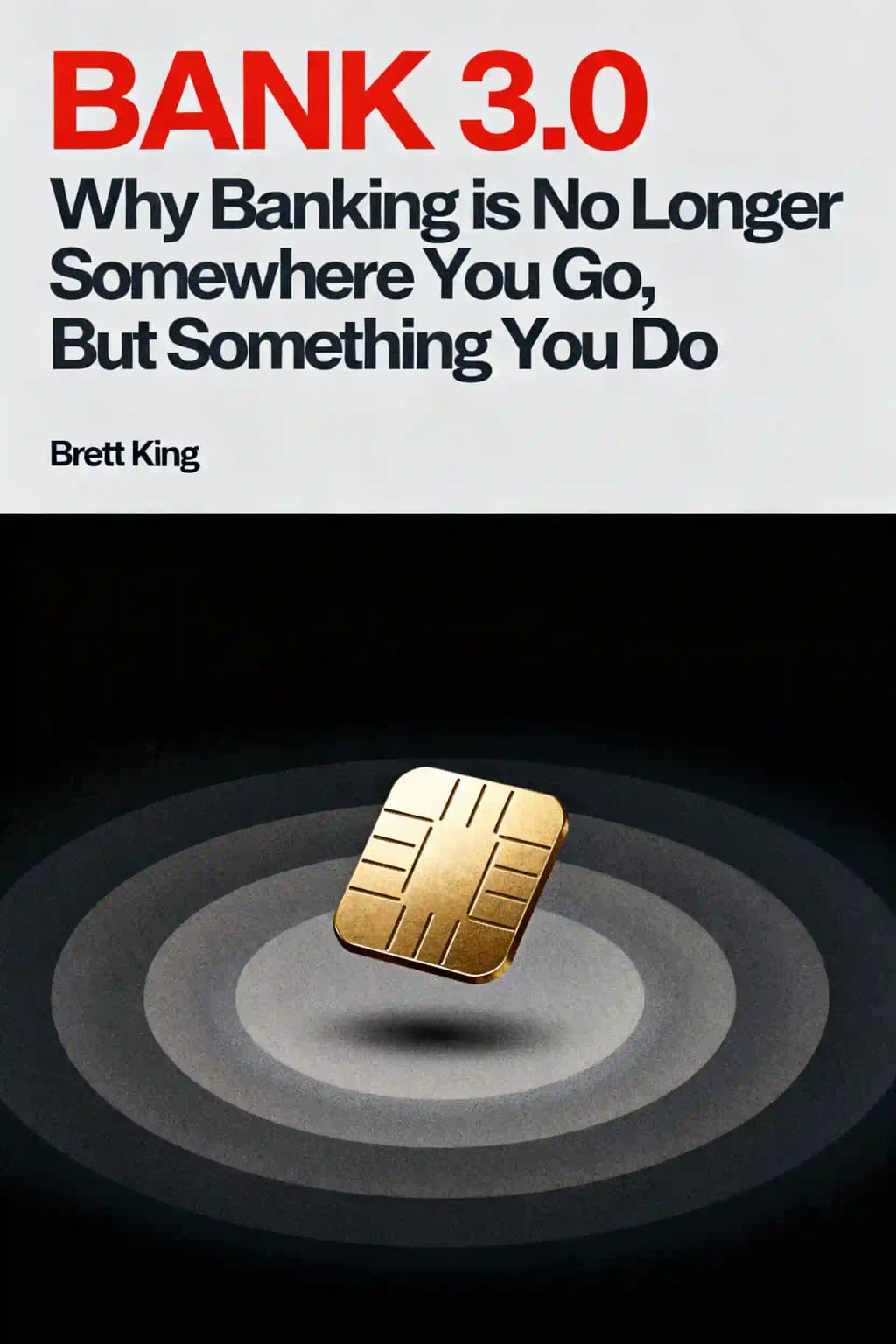
In an era where we can order dinner, hail a ride, and video chat with friends across the globe all from our smartphones, why do banks still expect us to sign physical papers and visit branches during limited business hours? Brett King's groundbreaking book "Bank 3.0" challenges this disconnect, declaring that "banking is no longer somewhere you go, but something you do." Since its publication, King has been proven remarkably prescient-his insights have influenced financial institutions worldwide, with even JPMorgan Chase CEO Jamie Dimon citing the book when announcing their digital transformation strategy. The work has become required reading at financial innovation labs from Singapore to Silicon Valley, as banking executives scramble to adapt to a world where customers expect banking to be as seamless as ordering from Amazon. King's vision of banking as an embedded, contextual utility rather than a physical destination has fundamentally reshaped how an entire industry thinks about its future.
Capítulo 2
The Hyperconnected Consumer Changes Everything
We now live in a hyperconnected world where internet access is considered a basic human right, fundamentally transforming how people interact with financial services. By 2016, more than half the planet will own smartphones with internet access, representing an unprecedented level of global connectivity. Today's consumers are digital multitaskers, simultaneously using an average of three connected devices, spending 94 minutes daily using apps, checking emails and texting up to 100 times per day. They engage with mobile banking 20-30 times monthly but visit physical branches only 3-4 times yearly - a dramatic shift from traditional banking patterns.
For Generation Z - anyone born after 2000 - these technologies aren't special or revolutionary - they're simply the backdrop of everyday life. This hyperconnectivity creates both unprecedented opportunities and complex challenges for financial institutions. Banks must not only adapt their services but fundamentally understand the psychological impact of the Information Age on consumer behavior and the accelerating process of innovation diffusion across society.
To understand modern hyperconnected consumers, we must revisit Maslow's hierarchy of needs through a digital lens. Technology and efficient service paths have fundamentally shifted how we value time and perceive control. The evolution is stark: in the 1970s, mortgage applicants had to grovel before bank managers who held absolute power over approval, rates and fees. Today's customers wield significant control through sophisticated online research and comparison tools. Research shows 88% of internet users start mortgage searches online, spending 6-11 hours researching before selecting a provider, with 72% comparing at least three different lenders before making a decision.
The rate at which new technologies spread through society has accelerated dramatically over the past century, creating an innovation adoption curve that's nearly vertical. While the telephone took 50 years to reach critical mass, television took 25, mobile phones and PCs about 12-14 years, and the internet just 7 years. Today, new technologies like the iPad achieve mass adoption in months rather than years - the iPad reached 50 million users in under 2 years. This accelerating adoption creates a significant challenge for banks: if you aren't introducing innovations at the same pace customers adopt new technologies, you risk losing to more agile competitors who can match consumer expectations.
Four distinct phases of disruption are fundamentally changing retail banking's landscape. Phase one began with internet and social media giving customers unprecedented control over information and choice. Phase two is happening now with smart devices enabling portable banking - effectively putting cashless ATMs in customers' pockets and enabling 24/7 financial management. Phase three involves mobile payments replacing physical cash and cards, with NFC wallets and the convergence of phones with payment cards transforming transaction experiences. Phase four represents the most dramatic shift: banking becomes embedded into everyday processes, with traditional banks becoming product manufacturers while technology companies and fintech startups own the customer relationship.
As these phases unfold, traditional bank differentiators are rapidly evaporating. Product features, interest rates, and physical location/network - once the cornerstones of banking competition - have become commoditized in today's transparent, digital world. What truly drives customer decisions now is mobile capability, internet banking support, and frictionless experiences across onboarding and problem resolution. Research shows that 82% of consumers consider the quality of digital services when choosing a bank, while only 31% prioritize branch proximity.
Capítulo 3
The Branch Dilemma: Reimagining Physical Banking
The branch has become increasingly irrelevant for day-to-day banking in our hyperconnected world. Despite the historical significance of physical locations-the word "bank" itself derives from the Italian "banco" for the benches money traders sat on-branch usage is rapidly declining while mobile and internet banking soar.
Bank branch networks are shrinking globally: Bank of America announced closures of up to 600 branches, HSBC USA sold off 195 locations, and the UK has seen one branch closing daily since 1990. Traditional bankers' claims that customers choose banks based on branch proximity no longer hold true. Seventy-five percent of Standard Chartered's customers across 40 countries identified the internet as their primary channel and decision factor, with only 12% choosing branches.
Banking is fundamentally about utility-the facilitation of our financial lives rather than the physical experience. We don't buy mortgages; we buy homes. We don't purchase credit cards; we go shopping. The bank's value lies in enabling these life activities. Historically, branches emerged as distribution points for cash, then evolved to provide other financial services. Today, this utility is available 24/7 digitally, meeting modern lifestyle demands that can't wait for branch opening hours.
Branch visitation is rapidly declining across all markets, with only three primary drivers still bringing customers to physical locations: cash deposits (mainly for small businesses), advice for complex products, and resolution of major problems unresolvable through other channels. The psychology of branch banking presents a paradox: while customers increasingly abandon branches for daily transactions, many still demand their existence for psychological comfort.
Today's successful branch adaptations aren't futuristic concepts but working models that banks can incorporate elements from immediately. These innovations focus on creating engaging spaces that reinforce brand psychology while acknowledging changing customer behaviors:
1. Flagship brand stores - Showcasing the bank's capabilities through impressive physical spaces rather than transaction-focused centers. Umpqua Bank pioneered this approach in 1994, transforming branches into "stores" with attractive retail spaces, staff with strong people skills, and a culture rewarding service over sales.
2. Bank-shops - Placing branches in high-traffic locations like shopping malls with extended hours to reach customers during evenings and weekends.
3. Pop-up branches - Providing temporary or specialized banking presence without permanent structures, such as branch stalls at trade shows or auto-branches at car dealerships.
4. The "third place" - Stripping the branch to its advisory essence with comfortable seating, an advisor with an iPad, and perhaps a coffee machine.
5. Automated and self-service branches - Featuring greeters who direct customers to automated devices for routine transactions, with video-conference teller access for more complex needs.
Despite these innovations, behavioral shifts are working against branches. Wealthy, time-poor customers increasingly see branches as friction points in their banking experience. By decade's end, most customers won't need tellers, advisors, or complex products-they'll simply want the utility of banking with minimal friction.
Capítulo 4
The Digital Banking Revolution: Web, Mobile, and Self-Service
Despite the internet being the primary day-to-day banking channel for over five years in developed economies, branches still dominate revenue intake for most retail banks. The friction in banking's online sales stems not from product complexity but from unnecessary compliance processes that could be streamlined.
Financial products are inherently virtual-more like books or digital media than physical goods-making them naturally suited for online distribution. The complexity lies not in the products themselves but in the application processes and compliance requirements banks have constructed around them. While banks perceive these processes as necessary risk management, they create friction that leaves the industry vulnerable to disruption.
Mobile's true power lies in its deeply personal nature. The average US smartphone user spends 94 minutes daily using apps-surpassing time spent on web browsing and approaching television consumption. Our relationship with these devices has become intimate: 75% of Americans use phones in the bathroom, 66% sleep with them nearby (rising to 90% among 16-29 year-olds), and they're often the first and last thing we interact with daily.
What makes mobile transformative for banking is the combination of personal space, contextual awareness, and constant availability. Mobile enables time and location-specific experiences impossible on other channels. With Facebook seeing half its traffic from mobile and Twitter at 55%, consumer behavior has already shifted decisively to the small screen.
In the financial space, several distinct categories have emerged: Mobile Payments (using phones instead of cash/cards), Mobile Commerce (purchasing via mobile), Mobile Money (complete financial ecosystems built around mobile in developing markets), and Mobile Banking (adding mobile as a channel for existing bank customers). Evidence of mobile's financial impact is everywhere-Barclays' PingIt gained 120,000 downloads in five days, Square has over two million merchants (about 25% of all US card merchants), and Starbucks processes 25% of North American payments via their app.
With mobile phone ownership 5-10 times higher than bank account penetration in developing economies, the mobile phone is positioned to become the basic bank account of the world by 2020. Mobile payments, particularly peer-to-peer transfers, are already established in developing countries where traditional financial infrastructure is lacking.
Self-service in banking began with ATMs in the 1970s, solving banks' cash distribution challenges. ATMs revolutionized banking by reducing branch costs through automation while increasing customer convenience with 24/7 cash access. By 2011, UK consumers made 2.87 billion ATM withdrawals totaling 191 billion pounds.
As ATMs became embedded in customer behavior, banks sought to expand their functionality beyond cash dispensing. Rising costs-real estate, servicing, replenishment-drove the need for ATMs to generate revenue through fees or product sales. Recent innovations include check deposits, bill payments, and mobile integration.
The next evolution in ATMs will integrate smartphones and apps, beginning with ATM locators in mobile banking apps and progressing to using phones as the primary ATM interface. NCR has developed prototypes where the ATM becomes essentially a cash dispenser, with all interface functionality handled by the customer's smartphone.
Capítulo 5
Social Media and the Power of Customer Advocacy
Social media's evolution spans decades, from the 1978 Computerized Bulletin Board System to today's billion-user platforms. Social media demonstrated its real-time news power when Twitter broke the US Airways Hudson River crash in 2009 just two minutes after impact. It proved its financial impact when Barack Obama raised $55 million in 29 days through online networks versus John McCain's $11 million from traditional fundraisers.
Research shows customers who engage with companies via social media spend 20-40% more and demonstrate deeper emotional commitment. Facebook's growth trajectory is unprecedented-projected to reach one billion users by 2012 and potentially half the US population by 2014. Despite this influence, few Fortune 500 financial institutions have recognizable social media leadership.
Banks' initial reactions to social media were counterproductive: attempting to force traditional advertising through these channels while simultaneously blocking employee access internally. This approach prevented organizations from learning social media's true capabilities and drove employees to use personal mobile devices instead, pushing potential risks outside the controlled environment.
Financial institutions struggle with social media integration because it requires organization-wide commitment that challenges traditional command-and-control structures. When banks attempt to censor or control social conversations, the backlash can be severe. Westpac learned this lesson when they deleted negative Facebook comments about mortgage rate increases, generating widespread criticism and negative press coverage.
Banks typically progress through five stages when confronting social media:
1. Total ignorance-dismissing it because "banking doesn't fundamentally change"
2. It's just a fad-avoiding commitment while hoping it blows over
3. Where's the money?-failing to see value despite multibillion-dollar social businesses
4. The sonic boom-finally recognizing significance after competitors gain substantial leads
5. The mad scramble-desperately playing catch-up
To break this cycle, organizations must restructure around the customer. Social media isn't just another channel-it's as vital as branches or phone support, with potential to transform internal business processes. Success requires leadership with both common sense and organizational authority-not a junior role.
Nearly 57% of internet-connected Americans engage on social media daily, creating more demanding customers who expect real-time service and broadcast opinions widely. Social media empowers consumers by creating tribes, networks and influential voices that traditional companies struggle to match.
Crowdsourcing transforms customers into an army of brainstormers and beta-testers, creating products that gain immediate advocacy because they're designed by customers for customers. Commonwealth Bank's IdeaBank and First Direct's Lab exemplify this approach, inviting customers to submit, discuss and vote on banking innovations.
Capítulo 6
The Future of Payments: Mobile Wallets and Digital Currency
Mobile payments encompass alternative payment methods beyond cash, checks or credit cards, particularly effective for micropayments. Seven primary models exist: SMS-based transactions, direct mobile billing, in-app payments, mobile commerce/web payments, peer-to-peer payments, virtual currency payments, and contactless payments.
Despite pundits claiming mobile payments remain years from mainstream adoption, research shows widespread adoption globally. In Asia, mobile payments have been mainstream for nearly a decade, with Japan setting the benchmark (47 million using tap-and-go phones). China will have 169 million tap-and-go users by 2013, while globally 500 million to 1 billion people will access financial services by mobile by 2015.
Visa and MasterCard recognize that mobile payment behaviors are already widespread and consumers prefer the ease of mobile payments over plastic, cash, and checks. While debit card usage grows, check usage is rapidly declining. In 2011, prepaid debit cards were America's fastest growing electronic payment form with over $200 billion in utilization.
The mobile wallet market will inevitably fragment rather than produce a single winner. Unlike the credit card industry of the 70s-80s that required massive infrastructure investment (POS terminals, networks, secure cards), mobile wallets need only smartphones and IP access-creating extremely low barriers to entry.
Virtual currencies represent a growing challenge to traditional banking and monetary systems, operating largely outside regulatory control. China's QQ coins, created by Tencent for its massively popular QQ Messenger platform, emerged as a significant threat to the yuan. With 900 million subscribers using this virtual currency for everything from avatars to mobile ringtones and online gaming, the People's Bank of China expressed serious concern about its impact on the national currency.
Bitcoin, a peer-to-peer digital currency operating without central authority, has gained surprising market traction with transaction fees of just 0.99% compared to Square and PayPal's 2.7%. In inflation-ravaged African markets, merchants sometimes prefer holding Bitcoins over local currency.
Point-of-sale terminals are dramatically underutilized from a customer experience perspective, failing to provide personalized interactions even for regular customers. Future POS systems will need to integrate NFC technology, communicate with apps, and connect to bank systems in real-time.
The future of retail payments may eliminate the need for physical interaction entirely. Current innovations could allow customers to select items and walk out without engaging a cashier-charges would automatically process through mobile wallets with receipts delivered instantly to phones. The ultimate evolution will integrate biometrics with mobile devices to eliminate checkout entirely, creating a frictionless retail experience where the payment process itself disappears.
Capítulo 7
Banking in the Cloud: Data, Analytics, and Contextual Services
As our computing becomes more mobile, our data and applications must follow us rather than being tethered to specific devices or locations. With mobile devices already outselling traditional PCs and tablets soon to follow suit, we're entering a distributed computing paradigm at the personal level where our data must move seamlessly with us across multiple devices.
Major technology companies are heavily investing in cloud computing infrastructure. Apple built a $1-billion data center in North Carolina to support iCloud services designed to synchronize information across all user devices. For corporations, the business case is simple: shifting to the cloud reduces infrastructure costs and moves platform and application expenses from capital to operating expenses.
Despite compliance concerns about sensitive information, banks can't afford to reject cloud computing outright. Legacy IT infrastructure from the 1960s-where banks have invested billions-was designed for transaction-centric banking, not today's customer-centric approach. As customers access banks hundreds of times yearly through digital channels, these systems are increasingly unsuitable.
Financial institutions are facing an "exaflood" of customer and market data. New regulations demanding transparency are creating masses of new information requiring scalable processing and analysis. While banks have historically discarded valuable data like credit card purchasing patterns, there's growing recognition that this information could drive targeted marketing and real-time customer engagement.
Banking products are inherently contextual-mortgages make sense at a potential home or with a realtor, car loans at dealerships, travel insurance when booking holidays, and student loans during university enrollment. Context awareness, originally from ubiquitous computing, now allows banks to determine customer location and gather real-time data through mobile searches, check-ins and app usage.
Purchase history from credit card transactions is a goldmine for targeted marketing-for example, offering a JCPenney discount to someone who previously shopped at Macy's. Location-based services represent a significant new revenue stream, projected to generate $1.7 billion annually for card issuers by 2015.
In the Bank 3.0 paradigm, bad sales experiences feel like exploitation, while good ones feel like valuable service. Push-based marketing must evolve into pull-based, point-of-impact service selling. This approach unfolds in three phases:
1. Distributed applications that reach customers at critical moments (like offering travel insurance within airline booking sites)
2. Predictive selling using analytics to trigger relevant offers based on customer events (like significant balance changes or term deposit renewals)
3. Precognitive selling that delivers real-time offers at the point of sale
These contextual approaches feel like helpful service rather than intrusive selling, creating positive customer experiences that drive loyalty.
Capítulo 8
The Road Map to a Better Bank
Banking has fundamentally shifted due to changing customer behaviors, creating unprecedented disruption that threatens established institutions. Digital transformation isn't optional - it's survival. To assess your bank's readiness for the digital transition, consider these critical indicators: Branches with under $15 million in assets are consistently losing money, with overhead costs exceeding revenue generation; requiring signature cards for account opening ignores that over 50% of new customer acquisitions will be entirely branchless; maintaining terminology like "checking/current accounts" alienates younger customers who've never written a check and likely never will; lacking an executive-level Head of Social Media signals dangerous disconnection from modern market realities and customer engagement channels.
The bank of the future must make five critical developments to remain competitive:
1. Digital competency must become core DNA rather than a supporting function. Customers now use digital channels as their primary banking interface, with mobile apps becoming the de facto banking platform. Branches are evolving into just one touchpoint in a broader digital journey. Future growth depends heavily on serving digital natives who view traditional banking processes - like signature cards, paper forms, and in-person verification - as unnecessary friction. Banks must rebuild their operational models around digital-first experiences, with traditional channels becoming supplementary rather than primary.
2. Branches need deleveraging to supporting roles, with careful analysis determining which locations remain viable. Unprofitable branches must be eliminated, while flagship locations should be redesigned as experience centers focusing on complex services and psychological reassurance. Most large retail banks will need to consolidate their branch networks by 30-50% over the next decade to remain competitive against digital-only challengers who operate without distribution costs. Surviving branches must transform into high-value advisory centers rather than transaction processing facilities.
3. Banking must shift to contextual journeys where marketing becomes an integrated service experience. Modern systems should anticipate customer needs based on sophisticated behavioral patterns, life-event triggers, geolocation data, and social advocacy mechanisms. This means delivering personalized product offerings exactly when customers need them - like mortgage information when browsing real estate apps or investment options after a salary increase. Marketing should feel less like interruption and more like valuable service delivery.
4. Customer dialogue through social media must evolve beyond basic customer service to become a strategic asset. Forward-thinking banks are embracing social platforms to gather real-time feedback, inform product development, and build customer advocacy. This ranges from crowdsourcing debit card designs to involving customers in brand redesigns. Social media should become a two-way conversation that shapes bank strategy and builds community engagement.
5. Agile IT infrastructure requires strategic partnerships and cloud adoption, as legacy systems can't meet modern banking demands. No single vendor can solve the complex requirements ahead - from real-time processing to open banking integration. Banks facing similar challenges should consider pooling resources through industry collaboration platforms, creating shared solutions for common problems while maintaining competitive differentiation in customer-facing services.
Bank 3.0 represents an accelerating, inevitable change that's fundamentally disrupting traditional banking models. The most crucial action banks can take is to innovate continuously and experiment rapidly - while listening intently to customers about their preferred engagement methods. Waiting three years into a technological cycle means falling five or six years behind by implementation time, given the accelerating pace of change.
Banking is fundamentally shifting from products, processes, and places to capabilities available whenever and wherever customers need them. Organizations must remove friction from every process, or competitors like Movenbank, Simple, and PayPal will capture market share through superior user experience. Banking is no longer somewhere customers go - it's something they do seamlessly throughout their daily lives. Your mission is to build that "do" capability, integrating banking solutions naturally into customers' daily activities and decision-making processes.