Capítulo 1
The Universe Beckons: A Journey Through Space and Time
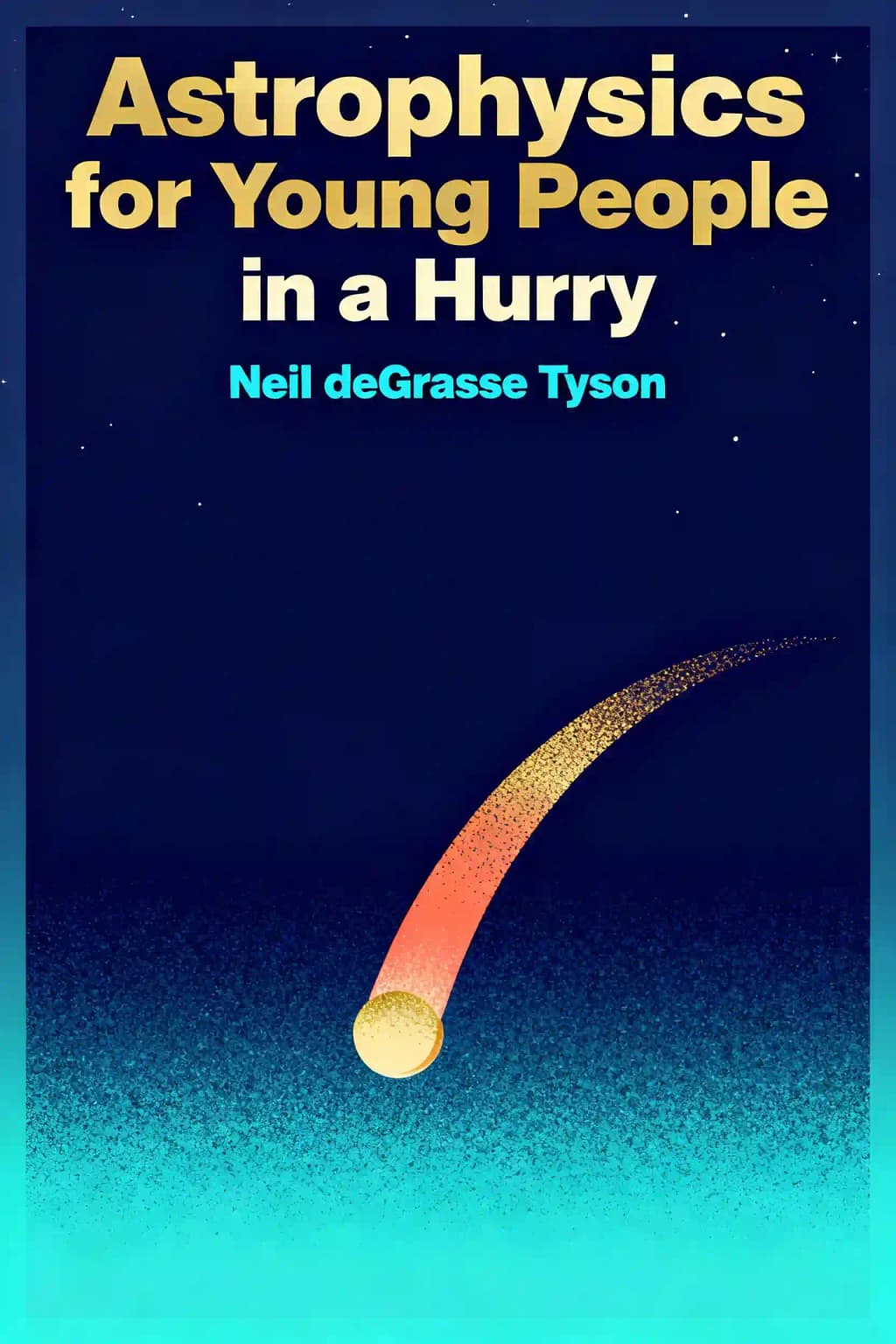
In the vast cosmos of scientific literature, Neil deGrasse Tyson's "Astrophysics for Young People in a Hurry" shines like a supernova. This cosmic primer has captured imaginations across generations, becoming a staple on bookshelves of curious minds from age 8 to 80. The book has sold over two million copies worldwide and frequently appears on celebrity reading lists - Bill Gates called it "the perfect gateway to the wonders of our universe." Even pop culture hasn't escaped its gravitational pull, with references appearing in shows like "The Big Bang Theory" and "Rick and Morty." What makes this astronomical achievement so special? Perhaps it's Tyson's rare gift for making the incomprehensible feel intimate, turning the cold vastness of space into a warm invitation to explore. His journey from a young boy gazing at planetarium stars to becoming America's most recognized astrophysicist mirrors the very journey he invites readers to take - from cosmic curiosity to profound understanding. As we embark on this stellar expedition together, prepare to see your place in the universe with fresh eyes and a renewed sense of wonder.
Capítulo 2
The Greatest Story Ever Told: Our Cosmic Origins
Have you ever wondered where everything came from? The story begins not with a gentle whisper but with an explosive moment of creation. About 13.8 billion years ago, our universe burst into existence from an infinitesimally small point, expanding faster than the blink of an eye. In those first moments, the universe was an unimaginably hot soup of particles - too hot for even atoms to form.
As this cosmic cauldron cooled to below 3,000 Kelvin (still scorching by Earth standards), something remarkable happened. Electrons finally paired with protons, forming the first atoms of hydrogen. This coupling freed photons - particles of light - to travel unimpeded through space for the first time. These ancient light particles still race through the cosmos today as the cosmic microwave background, a faint glow that serves as the universe's baby picture.
For 380,000 years, the universe existed in darkness. Then, as gravity pulled matter together, the first stars ignited like cosmic candles, illuminating the void. These stellar nurseries clustered together, forming the first galaxies - island universes that would become the building blocks of our cosmic neighborhood.
The earliest stars were massive, burning hot and fast. Inside their nuclear furnaces, they forged heavier elements - carbon, oxygen, iron - the essential ingredients for planets and eventually life itself. When these stellar giants exhausted their fuel, they exploded in spectacular supernovas, scattering these newly created elements across space.
Nine billion years after the big bang, in an unremarkable spiral arm of an ordinary galaxy, a cloud of gas and dust began to collapse. At its center formed our Sun, while the leftover material swirled into a disk that would coalesce into planets. Earth formed at just the right distance - not too hot like Mercury, not too cold like Neptune, but in a "Goldilocks zone" where water could exist as a liquid. This cosmic coincidence set the stage for something unprecedented: life.
The first microorganisms were simple but revolutionary. Ancient bacteria transformed our atmosphere by releasing oxygen, making Earth hospitable for more complex life forms. Through billions of years of evolution, interrupted by catastrophic extinctions (like the asteroid impact that eliminated the dinosaurs), life diversified into countless species, eventually producing beings capable of contemplating their own origins - us.
When we look at the night sky, we're not just seeing distant lights; we're witnessing our cosmic heritage. The calcium in our bones, the iron in our blood, the carbon in our cells - all were forged in stellar furnaces billions of years ago. We are, quite literally, made of stardust. Our existence connects us to the universe's earliest moments in an unbroken chain of cosmic events.
Capítulo 3
Universal Laws: The Cosmic Language
Imagine landing on a distant planet and encountering alien life. How would you communicate? You couldn't rely on shared languages, customs, or even biological similarities. But there's one thing you could count on: the laws of physics work the same everywhere in the universe. This universality is the foundation of all astrophysics.
Isaac Newton made one of the most profound discoveries in scientific history when he realized that the force making apples fall from trees is the same force keeping planets in orbit around the Sun. This insight revolutionized our understanding of the cosmos - gravity isn't just an earthly phenomenon but a universal force that shapes galaxies and governs cosmic dance.
When 19th-century astronomers first pointed their spectroscopes at the Sun, they discovered something astonishing: our star contains the same elements found on Earth. They even discovered a new element - helium - before finding it on Earth! This revelation confirmed that the chemical building blocks of our world aren't unique but common throughout the universe.
The light from distant stars tells an incredible story. When we observe a star 100 light-years away, we're seeing it as it existed 100 years ago - light as a time machine. Despite this temporal distance, the physics governing those stars remains identical to what we observe in our laboratories. A hydrogen atom in the Andromeda galaxy behaves exactly like a hydrogen atom in your water glass.
Some cosmic phenomena might seem alien - black holes that warp space and time, neutron stars that pack the mass of our Sun into a city-sized sphere - but they all obey the same fundamental laws that govern our everyday experiences. They're extreme examples, but not exceptions to the rules.
What makes these physical laws so powerful is their mathematical precision. The gravitational constant (G), the speed of light (c), and other fundamental values remain unchanged across the vastness of space and time. The speed of light represents the ultimate cosmic speed limit - nothing, not even information, can travel faster. This constraint applies equally to humans and any alien civilizations we might encounter.
Think about pouring chocolate syrup into milk. The syrup sinks because it's denser than milk - a simple demonstration of physical principles that would work exactly the same way on a planet orbiting Alpha Centauri. These universal constants and laws form a cosmic language that transcends all barriers, a potential basis for communication with intelligent life elsewhere in the universe.
When scientists debate theories, the arguments can be passionate, but the underlying commitment to universal physical laws remains steadfast. In a universe of constant change, these laws provide a framework of reliability - a cosmic grammar that helps us read the story of creation itself.
Capítulo 4
Cosmic Shortcuts: The Possibility of Wormholes
Have you ever wished you could fold a map to bring two distant points together? This simple analogy helps us understand one of the most fascinating concepts in astrophysics: wormholes. These theoretical tunnels through spacetime could potentially connect vastly separated regions of the universe, offering cosmic shortcuts that boggle the mind.
Einstein's general theory of relativity, which describes how mass warps the fabric of spacetime, allows for the mathematical possibility of wormholes. Imagine space as a sheet of paper - normally, to get from one point to another, you'd travel across the surface. But what if you could fold the paper and punch a hole through it? That's essentially what a wormhole might do with the fabric of spacetime itself.
The implications are staggering. A journey that might take thousands of years at the speed of light could theoretically be completed in moments through a wormhole passage. Distant galaxies that seem forever beyond our reach might become accessible if such cosmic tunnels exist and could be traversed.
But before you pack your bags for Alpha Centauri, consider the challenges. First, no wormhole has ever been observed - they remain purely theoretical constructs that satisfy certain equations. Second, even if they do exist naturally, they would likely be microscopic, perhaps at the quantum scale. Enlarging one to accommodate a spaceship would require manipulations of energy and matter beyond our current technological capabilities.
Perhaps the most significant obstacle comes from physics itself. Natural wormholes, if they exist, would likely be unstable, collapsing instantly before anything could pass through them. Keeping them open would require something called "negative energy" - an exotic form of matter with properties unlike anything we've ever observed.
Science fiction loves wormholes, from the stable wormhole in "Star Trek: Deep Space Nine" to the mysterious portals in "Interstellar." These fictional depictions capture our imagination because they offer a way around one of nature's most strict limitations: the cosmic speed limit set by light.
While current science suggests that practical wormhole travel remains firmly in the realm of speculation, the mathematics behind them continues to intrigue physicists. They represent the tantalizing possibility that the universe might contain shortcuts through its vast expanses - passages that could one day transform our understanding of distance and perhaps even time itself.
As we gaze at distant stars, the light from which has traveled for years to reach our eyes, the possibility of wormholes reminds us that the universe might be stranger and more wonderful than we can imagine. The cosmos may yet reveal paths between stars that defy our conventional understanding of space and time.
Capítulo 5
The Cosmic Void: What Lies Between Galaxies
When we think of space, we often picture stars, planets, and galaxies - the cosmic landmarks that capture our imagination. But what about the vast expanses between these celestial objects? Far from being empty, intergalactic space teems with fascinating phenomena that tell us much about the universe's evolution and structure.
Imagine galaxies as cosmic cities, clustered together like metropolitan areas. Just as cities sometimes merge in expanding urban sprawl, galaxies frequently collide in slow-motion cosmic crashes that unfold over millions of years. During these collisions, some stars escape their galaxies' gravitational embrace and are flung into intergalactic space. These "runaway stars" become cosmic wanderers, drifting through the void without a galactic home.
Sometimes, groups of these stellar refugees cluster together to form dwarf galaxies - smaller collections of stars that exist in the spaces between larger galactic systems. Others remain solitary travelers in the cosmic wilderness, their light barely detectable against the darkness of deep space. How many such homeless stars might exist? The number could be staggering, with countless suns drifting through the cosmos, potentially harboring planets and perhaps even life.
Occasionally, astronomers spot brilliant supernovas flaring in seemingly empty regions of space. These explosive stellar deaths reveal the presence of massive stars that lived their lives far from any visible galaxy. Each such discovery hints at an unseen population of stars scattered throughout the cosmic void.
Perhaps most surprising is the discovery that intergalactic space isn't cold and empty but filled with gas heated to millions of degrees. This superheated plasma glows in X-ray wavelengths, invisible to human eyes but detectable with specialized telescopes. This gas acts as a cosmic bully, stripping excess matter from galaxies that move through it and preventing them from forming new stars. The space between galaxies, far from being a passive vacuum, actively shapes the evolution of the very galaxies it separates.
Looking deeper into space (and thus further back in time), astronomers have discovered "faint blue galaxies" - mysterious objects that were common billions of years ago but seem to have disappeared from our current cosmic neighborhood. Did they burn out their star-forming fuel? Were they consumed by larger galaxies? Their fate remains one of astronomy's compelling mysteries.
Even in the emptiest regions of space, quantum physics tells us that virtual particles continuously pop in and out of existence, generating what scientists call "vacuum energy." This energy may be responsible for the accelerating expansion of the universe, acting as a force that pushes galaxies apart at an ever-increasing rate. The emptiness between galaxies, it seems, contains the very energy that determines the universe's ultimate fate.
Capítulo 6
Cosmic Illumination: The Journey of Light
Have you ever considered that when you look at the night sky, you're actually looking back in time? Light, traveling at an astounding 186,000 miles per second, takes time to reach us from distant objects. The light from our Sun takes about eight minutes to reach Earth, meaning we see the Sun as it was eight minutes ago. The light from the nearest star system, Alpha Centauri, takes over four years to reach us. When we observe galaxies millions of light-years away, we're seeing them as they existed millions of years in the past - a natural time machine built into the very fabric of the cosmos.
This delay in light's journey creates what astronomers call the "observable universe" - the spherical region around Earth from which light has had time to reach us since the beginning of the universe. Beyond this cosmic horizon lies territory forever hidden from our view, at least for now, as its light hasn't had sufficient time to reach us in the 13.8 billion years since the Big Bang.
One of the most profound discoveries in astrophysics came about through a happy accident. In 1964, two Bell Laboratories scientists, Arno Penzias and Robert Wilson, were testing a sensitive radio antenna when they detected a persistent background noise. This mysterious signal came from every direction in the sky with equal strength, baffling the researchers who initially suspected everything from pigeon droppings on their equipment to nuclear tests.
What they had stumbled upon was the cosmic microwave background radiation - the afterglow of the Big Bang itself. This faint radiation permeates all of space as a remnant from when the universe was just 380,000 years old. Like cosmic fossil evidence, this background radiation provides crucial confirmation of the Big Bang theory and offers insights into the earliest moments of our universe.
The cosmic microwave background appears remarkably uniform at first glance, with a temperature of about 2.7 Kelvin (just above absolute zero) throughout the observable universe. However, sensitive measurements reveal tiny temperature variations - just a few parts in 100,000 - that correspond to regions of slightly different density in the early universe. These minute differences became the seeds from which all cosmic structure - galaxies, galaxy clusters, and the vast cosmic web - would eventually grow.
Light's journey through the cosmos isn't always straightforward. It can be bent by gravity, stretched by the expansion of space, and absorbed and re-emitted by cosmic dust. Each of these interactions leaves telltale signatures that astronomers can decode, revealing information about the matter and energy through which the light has passed on its billion-year journey to Earth.
By studying light across the electromagnetic spectrum - from radio waves to gamma rays - astronomers piece together the universe's history and structure. Each wavelength tells a different part of the cosmic story, from the radio emissions of hydrogen gas clouds to the infrared glow of stellar nurseries to the X-ray signatures of material spiraling into black holes.
Capítulo 7
The Dark Side: Matter We Cannot See
Imagine building a house where 85% of your materials are invisible. You can feel their weight, see their effects on visible materials, but never directly observe them. This bizarre scenario mirrors one of modern astrophysics' greatest puzzles: dark matter. This mysterious substance doesn't emit, absorb, or reflect light - it's completely invisible - yet its gravitational influence shapes the very structure of our universe.
The first hints of dark matter came in the 1930s when Swiss astronomer Fritz Zwicky studied the Coma galaxy cluster. He calculated that the visible galaxies were moving so quickly that the cluster should fly apart unless held together by far more mass than could be seen. Zwicky proposed the existence of "dunkle materie" - dark matter - but his revolutionary idea wouldn't gain traction for decades.
In the 1970s, astronomer Vera Rubin made observations that could no longer be ignored. Studying spiral galaxies, she discovered that stars at the galaxies' edges orbit at nearly the same speeds as stars near the center - a finding that contradicted the basic physics of orbital motion. According to Newtonian gravity, stars farther from the galactic center should orbit more slowly, just as Pluto moves more slowly around the Sun than Mercury does. The only explanation was that spiral galaxies must be embedded within much larger halos of invisible mass - dark matter - extending far beyond their visible boundaries.
What exactly is dark matter? Despite decades of research, we still don't know. It doesn't seem to be made of the same particles as ordinary matter. Leading theories suggest it might consist of yet-undiscovered subatomic particles that interact only through gravity and possibly the weak nuclear force, but not electromagnetism (which is why they neither emit nor absorb light).
The evidence for dark matter's existence is overwhelming. Beyond galaxy rotation curves, we see its effects in gravitational lensing (where mass bends light from distant objects), in the formation of large-scale cosmic structures, and in the temperature fluctuations of the cosmic microwave background radiation. Without dark matter, the universe as we observe it simply couldn't exist.
Vera Rubin's pioneering work on dark matter came at a time when women faced significant barriers in astronomy. Despite her groundbreaking discoveries, she was never awarded the Nobel Prize - an oversight many consider one of the prize committee's greatest mistakes. Her perseverance in the face of skepticism and gender bias mirrors the determination required to chase invisible cosmic mysteries.
Today, sophisticated experiments search for direct evidence of dark matter particles. Deep underground laboratories shield ultrasensitive detectors from cosmic rays, hoping to catch the rare interaction between a dark matter particle and ordinary matter. Meanwhile, the Large Hadron Collider attempts to create dark matter particles in high-energy collisions, and space-based observatories map dark matter's distribution across the cosmos.
The pursuit of dark matter reminds us that the universe doesn't conform to our expectations or reveal all its secrets easily. Sometimes the most important components of reality remain hidden from direct view, detectable only through their effects on what we can see.
Capítulo 8
Cosmic Acceleration: The Mystery of Dark Energy
Remember when you were a child and blew up a balloon? You had to keep adding air to make it expand. Now imagine a balloon that keeps expanding on its own, getting bigger at an ever-increasing rate without anyone adding more air. That's essentially what our universe is doing, and the mysterious force behind this acceleration is what scientists call dark energy.
In the late 1990s, two independent teams of astronomers set out to measure how the universe's expansion was slowing down due to gravity. They used Type Ia supernovas - exploding white dwarf stars that always reach the same peak brightness - as "standard candles" to measure cosmic distances. What they discovered shocked the scientific community: the universe's expansion wasn't slowing down at all - it was speeding up!
This accelerating expansion contradicted everything we thought we knew about cosmic evolution. Gravity should be pulling everything together, gradually slowing the expansion that began with the Big Bang. The only explanation was that some unknown force must be pushing galaxies apart with increasing strength over vast distances. This force was dubbed "dark energy."
Dark energy represents about 68% of all the energy and matter in the universe - making it the dominant component of our cosmos. Yet we know remarkably little about what it actually is. The leading hypothesis suggests it might be an intrinsic property of space itself - what Einstein called the "cosmological constant" in his equations of general relativity.
Einstein originally introduced this constant as a mathematical trick to create a static universe, before Edwin Hubble discovered that the universe was actually expanding. Einstein later called this his "greatest blunder." Ironically, a modified version of this same concept might explain the cosmic acceleration we observe today.
Another possibility is that dark energy represents a new type of energy field that fills space and may change over time. Some theories even suggest that our understanding of gravity itself might be incomplete at cosmic scales.
The implications of dark energy extend to the ultimate fate of our universe. If dark energy continues to dominate, the universe will expand forever, eventually becoming a cold, dark place where stars burn out and galaxies are so far apart that they're invisible to each other. This "Big Freeze" scenario presents a somber but fascinating possible future.
What's particularly humbling about dark energy is how it highlights the limits of our knowledge. After centuries of scientific progress, we've discovered that we can only directly observe and understand about 5% of the universe - the "normal" matter and energy that makes up stars, planets, and everything we can see. The rest - dark matter and dark energy - remains mysterious, detectable only through its gravitational effects.
Dark energy reminds us that the universe is stranger than we imagine - perhaps stranger than we can imagine. Each answer in science often leads to deeper questions, and the pursuit of understanding continues to drive us forward into new frontiers of knowledge.
Here's the condensed version, maintaining the same heading while reducing length by approximately 35%:
Capítulo 9
Cosmic Building Blocks: The Story of Elements
What do party balloons, nuclear reactors, and distant stars have in common? They're all manifestations of elements - nature's fundamental building blocks. Each element has its own origin story and cosmic significance.
Hydrogen, the simplest and most abundant element, emerged from the big bang. Making up 75% of all normal matter, it fuels our Sun and other stars through fusion, powers life through water formation, and is crucial to all organic molecules.
Helium, also born in the big bang, is known for floating balloons but serves critical scientific purposes. Its extremely low boiling point makes it essential for cooling superconducting magnets in MRI machines and particle accelerators.
Lithium, the final direct product of the big bang, exists in small cosmic quantities. Its scarcity serves as a crucial test of big bang theory, while today it powers our smartphones and electric vehicles.
Carbon, forged in stellar cores, is life's cornerstone. Its unique ability to form complex, stable molecules makes it essential for all known life. Supernovas scatter carbon through space, seeding planets with life's potential.
Iron represents a crucial turning point in stellar evolution. When stars begin fusing iron, they consume rather than generate energy, triggering supernovas. Earth's iron abundance - from its core to our blood - links us to these cosmic explosions.
Iridium, extremely rare on Earth, marks the dinosaur extinction boundary from 66 million years ago. This layer came from an asteroid impact that enabled mammals' rise to dominance.
The heaviest natural elements, like uranium and plutonium, originate from neutron star collisions and supernovas. These radioactive elements serve as cosmic clocks, helping scientists date rocks, meteorites, and Earth itself.
Many elements' names reflect their cosmic connections, linking our understanding of matter to space exploration.
Capítulo 10
Cosmic Shapes: The Universe's Preference for Spheres
Have you ever wondered why planets, stars, and even galaxies tend to be round? This cosmic preference for spherical shapes reveals fundamental principles about how gravity and energy work throughout the universe. The story of cosmic roundness is a tale of forces in perfect balance.
Gravity pulls matter toward a central point from all directions equally. Given enough time and the right conditions, this uniform pull naturally creates spheres. Any irregularity or bulge experiences stronger gravitational forces, eventually getting pulled inward until balance is achieved. This is why large cosmic bodies - from stars to planets - adopt spherical shapes once they grow large enough for gravity to overcome the strength of their materials.
Earth isn't a perfect sphere, however - it bulges slightly at the equator and flattens at the poles, making it what scientists call an "oblate spheroid." This deviation from perfect roundness comes from Earth's rotation. As our planet spins, centrifugal force pushes outward most strongly at the equator, partially counteracting gravity and creating the bulge. Earth's rotation makes objects at the equator about 0.3% lighter than they would be at the poles - a small but measurable difference.
Saturn takes this effect to an extreme. Spinning much faster than Earth and composed mostly of gas rather than rock, Saturn's equatorial bulge is dramatically visible even through small telescopes. Its diameter at the equator is about 10% greater than the distance from pole to pole, making it the most visibly flattened planet in our solar system.
In space, liquid droplets naturally form perfect spheres without any solid surface to constrain them. Astronauts on the International Space Station have demonstrated this by releasing water into the microgravity environment, where surface tension pulls the liquid into nearly perfect spheres. This same principle applies to molten materials in space, explaining why many small asteroids and moons that were once partially melted have surprisingly round features.
Stars achieve their roundness through the perfect balance between two opposing forces: gravity pulling inward and the pressure from nuclear fusion pushing outward. This equilibrium, maintained for billions of years, creates the stable, spherical shapes we see lighting up the night sky.
Even at the largest scales, the universe shows preferences for rounded forms. Galaxy clusters often adopt roughly spherical shapes as their member galaxies orbit a common center of mass. The cosmic microwave background radiation - the oldest light in the universe - shows that even the early universe had a remarkable degree of spherical symmetry on large scales.
The prevalence of spheres in the cosmos reflects a fundamental principle: nature tends toward states of minimum energy. A sphere represents the shape with the smallest surface area for a given volume, making it energetically favorable. From tiny water droplets to massive stars, the universe consistently demonstrates this preference for efficient, balanced forms.
Capítulo 11
Invisible Light: Seeing Beyond Human Vision
What if I told you that the universe you see with your eyes represents just a tiny fraction of what's actually out there? The visible light that human eyes can detect makes up less than one-trillionth of the full electromagnetic spectrum. To truly understand the cosmos, we need to "see" beyond this narrow band of visibility into wavelengths that reveal hidden wonders.
The story of invisible light begins in 1800 with astronomer William Herschel's curious experiment. While measuring temperatures of different colors in a spectrum created by a prism, he discovered something unexpected: the temperature increased beyond the red end of the visible spectrum, where no light was visible to the human eye. He had discovered infrared radiation - light with wavelengths too long for human eyes to detect.
This breakthrough opened the floodgates to exploring the full electromagnetic spectrum. Soon after, scientists discovered ultraviolet light beyond the violet end of the visible spectrum. Later came the discoveries of radio waves, microwaves, X-rays, and gamma rays - all forms of light differing only in their wavelengths.
Each of these invisible forms of light reveals different aspects of the cosmos. Radio telescopes detect the cold hydrogen gas between stars and the afterglow of the Big Bang. Infrared telescopes peer through cosmic dust clouds to witness the birth of stars and planets. X-ray observatories capture the violent emissions from matter spiraling into black holes. Gamma-ray detectors spot the most energetic explosions in the universe.
In the early 1930s, engineer Karl Jansky built the first radio telescope while investigating sources of static in transatlantic radio communications. To his surprise, he detected radio emissions coming from the center of our Milky Way galaxy. This accidental discovery launched the field of radio astronomy, which has since revealed pulsars, quasars, and the cosmic microwave background radiation - none of which would be known to us if we relied solely on visible light.
Modern astronomy relies on a global network of specialized telescopes, each designed to capture different parts of the electromagnetic spectrum. Some operate from mountaintops, others from space, free from the filtering effects of Earth's atmosphere. Together, they provide a comprehensive view of cosmic phenomena that would be impossible with visible light alone.
This multi-wavelength approach has revolutionized our understanding of the universe. For example, what appears as an ordinary galaxy in visible light might reveal itself as a powerhouse of activity when viewed in X-rays or radio waves. A seemingly empty region of space might glow brilliantly in infrared, revealing hidden star formation.
The ability to detect invisible light has practical applications too. The same principles that allow astronomers to study distant stars help medical professionals see inside the human body with X-rays and MRI scans. Weather satellites use infrared and microwave detectors to track storms, while your microwave oven uses the same type of radiation to heat food.
The story of invisible light reminds us that our natural senses provide just one perspective on reality. The universe contains wonders beyond our direct perception, accessible only through the tools and techniques of modern science. By extending our vision beyond the visible, we've transformed our understanding of the cosmos and our place within it.
Capítulo 12
Cosmic Perspective: Looking Up, Thinking Big
Have you ever gazed at the night sky and felt simultaneously tiny and connected to something vast? That sensation - the cosmic perspective - might be the most valuable gift astrophysics offers us. It's not just about understanding distant galaxies and exotic phenomena; it's about reframing our place in the universe and reconsidering what truly matters.
The cosmic perspective begins with a humbling realization: Earth is not the center of the universe. We orbit an ordinary star, in an ordinary galaxy, in an ordinary cosmic neighborhood. There's nothing particularly special about our location in space - a fact that has profound implications for how we view ourselves and our problems.
From space, astronauts report experiencing what psychologists call the "overview effect" - a cognitive shift that occurs when viewing Earth from orbit or the moon. National boundaries vanish, conflicts seem petty, and the fragility of our planetary home becomes starkly apparent. This perspective doesn't diminish human experience but enriches it by placing it within its true cosmic context.
Consider how differently we might approach global challenges if we maintained this broader view. Climate change, resource depletion, and biodiversity loss might be recognized as the planetary emergencies they are. International conflicts might seem as misguided as neighbors fighting over fence boundaries while their shared forest burns down around them.
The cosmic perspective also offers a unique temporal context. The universe has existed for 13.8 billion years. Human civilization represents just a tiny fraction of that time. Yet in our brief moment on the cosmic stage, we've developed the capacity to understand the universe's history and contemplate its future - a remarkable achievement for beings evolved from stardust.
This extended timescale can be liberating. The pressures of daily deadlines and quarterly reports fade when placed against the backdrop of cosmic time. Yet it also imposes a responsibility - to think beyond our immediate concerns to the legacy we leave for future generations, who might extend humanity's journey among the stars long after we're gone.
Perhaps most profoundly, the cosmic perspective reminds us of our connectedness. The atoms in our bodies were forged in stellar furnaces billions of years ago. We share this cosmic heritage not just with other humans but with all life on Earth and potentially with life elsewhere in the universe. As Carl Sagan eloquently put it, "We are a way for the cosmos to know itself."
This perspective doesn't provide easy answers to life's big questions about purpose and meaning. Instead, it invites us to participate in a grand cosmic story - to recognize that we are both infinitesimally small in the cosmic scheme and yet capable of comprehending the vastness in which we find ourselves.
The next time you look up at the night sky, remember that you're not just observing the universe - you're part of it. The light from distant stars has traveled across space and time to reach your eyes, connecting you directly to cosmic events that occurred long before humans walked the Earth. In that moment of connection lies the essence of the cosmic perspective - a viewpoint that transcends our differences and reminds us of our shared journey through the cosmos.