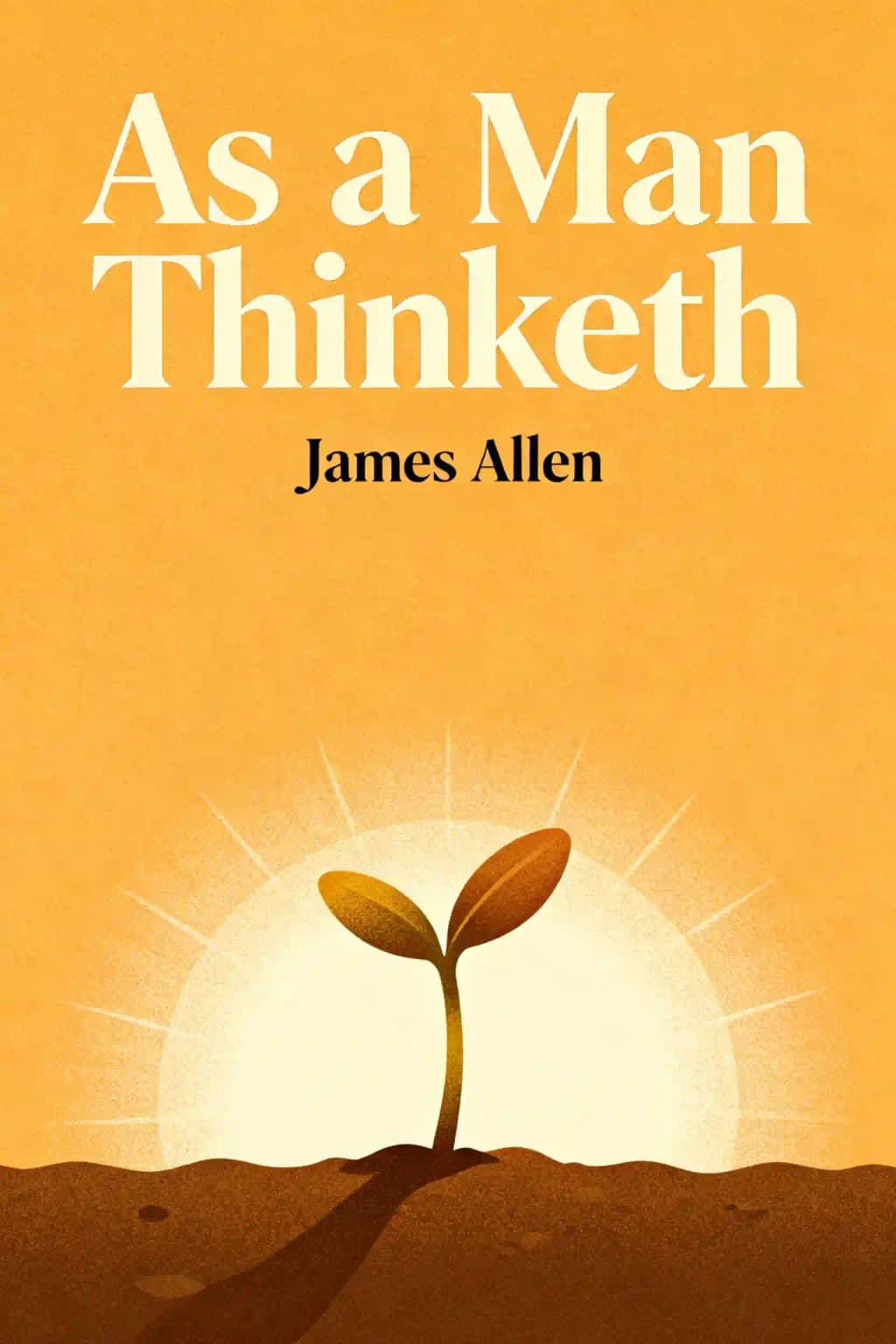
As a Man Thinketh
A Book That Will Help You to Help Yourself
Resumen de As a Man Thinketh
In 1903, "As a Man Thinketh" revealed a revolutionary truth: your thoughts shape your reality. This timeless classic influenced the entire self-help genre, becoming required reading for anyone seeking personal transformation. What one thought could change your entire life?

Temas clave en As a Man Thinketh
- mental gardening
- thought manifestation
- radical personal responsibility
- internal locus of control
- mind-body connection
Citas de As a Man Thinketh
A man's mind may be likened to a garden, which may be intelligently cultivated or allowed to run wild; but whether cultivated or neglected, it must, and will, bring forth.
As the physically weak man can make himself strong by careful and patient training, so the man of weak thoughts can make them strong by exercising himself in right thinking.
Good thoughts and actions can never produce bad results; bad thoughts and actions can never produce good results.
They themselves are makers of themselves by virtue of the thoughts which they choose and encourage; that mind is the master-weaver, both of the inner garment of character and the outer garment of circumstance.
Personajes en As a Man Thinketh
- James AllenAuthor and philosopher of the text
- Norman Vincent PealeThought leader influenced by the book's principles
Sobre el Autor
Sobre el autor de As a Man Thinketh
James Allen (1864–1912), the British philosophical writer and pioneer of the self-help movement, authored the seminal work As a Man Thinketh, a cornerstone of personal development literature.
Blending philosophy and practical wisdom, the book explores themes of mental mastery, self-responsibility, and the transformative power of thought—principles rooted in Allen’s own resilience after childhood adversity and his study of Eastern and Western philosophies.
A prolific writer, Allen produced over 20 inspirational works, including From Poverty to Power and The Way of Peace, which solidify his legacy in motivational discourse. His insights on conscious thinking influenced generations of authors, from Napoleon Hill to Norman Vincent Peale, and remain foundational to modern psychology and success frameworks.
Originally published in 1903, As a Man Thinketh has been translated into multiple languages and continues to inspire millions worldwide, cementing Allen’s status as a timeless voice in spiritual and personal growth.
Descargar resumen de As a Man Thinketh
Obtén el resumen de As a Man Thinketh como PDF o EPUB gratis. Imprímelo o léelo sin conexión en cualquier momento.
Preguntas Frecuentes Sobre Este Libro
As a Man Thinketh (1903) is a foundational self-help classic exploring how thoughts shape character, circumstances, and destiny. James Allen argues that individuals craft their realities through disciplined mental habits, emphasizing that "man is the sum of his thoughts." The book links mindset to outcomes across health, success, and peace, urging readers to master their inner world to transform their external lives.
This book suits seekers of personal growth, mindset coaching, or philosophical self-help. Its concise, metaphor-driven essays resonate with readers interested in Stoicism, positive psychology, or the law of attraction. Allen’s insights appeal to those navigating career pivots, health challenges, or spiritual development.
Yes—its 22-page length delivers timeless, actionable wisdom. Modern self-help pillars like The Secret and Atomic Habits build on Allen’s ideas, making this a concise primer on thought mastery. Critics note its simplicity, but its influence on 20th-century personal development remains unmatched.
- Thoughts create reality: Like seeds growing into plants, mental patterns shape actions and outcomes.
- Purpose eliminates fear: Focused goals displace doubt, enabling achievement.
- Serenity through self-mastery: Calm minds attract harmonious circumstances.
Allen compares thoughts to seeds: just as a plant cannot exist without a seed, actions cannot arise without prior thinking. He states, “Man is made or unmade by himself; in the armory of thought, he forges the weapons by which he destroys himself.” This underscores proactive mental discipline as the root of integrity and resilience.
- “As a man thinks, so he is”.
- “Circumstance does not make man—it reveals him to himself”.
- “Cherish your visions; cherish your ideals… your world will at last be built”.
Allen’s work pioneered concepts like the law of attraction and growth mindset. Unlike later authors, he frames thought mastery as moral duty rather than mere success tactic. Critics argue it oversimplifies systemic barriers, but its focus on agency remains influential.
Dreams are “the architects of destiny,” per Allen. He urges readers to nurture lofty ideals, as sustained focus on visions gradually materializes them. This mirrors modern neuroscience on visualization’s impact on goal achievement.
By reframing setbacks as mental tests, the book encourages proactive problem-solving. For example, Allen argues unemployment often stems from complacent thinking, urging readers to “search for hidden justice” in difficulties.
Some find its blame-the-victim tone harsh, noting it overlooks socioeconomic factors. Others call its advice generic, though defenders argue its brevity forces actionable clarity. Modern readers may prefer updated examples but acknowledge its philosophical depth.
Achievement requires linking thought to purpose and persistent effort. Allen warns against “petty fears” that derail progress, advocating for courage and incremental habit changes. This aligns with contemporary research on grit and deliberate practice.
Pair it with Meditations by Marcus Aurelius (Stoic philosophy), The Power of Now (mindfulness), or Atomic Habits (habit science). These expand on Allen’s themes with modern psychology or practical frameworks.