Capítulo 1
The Cosmic Quest for Alien Earths
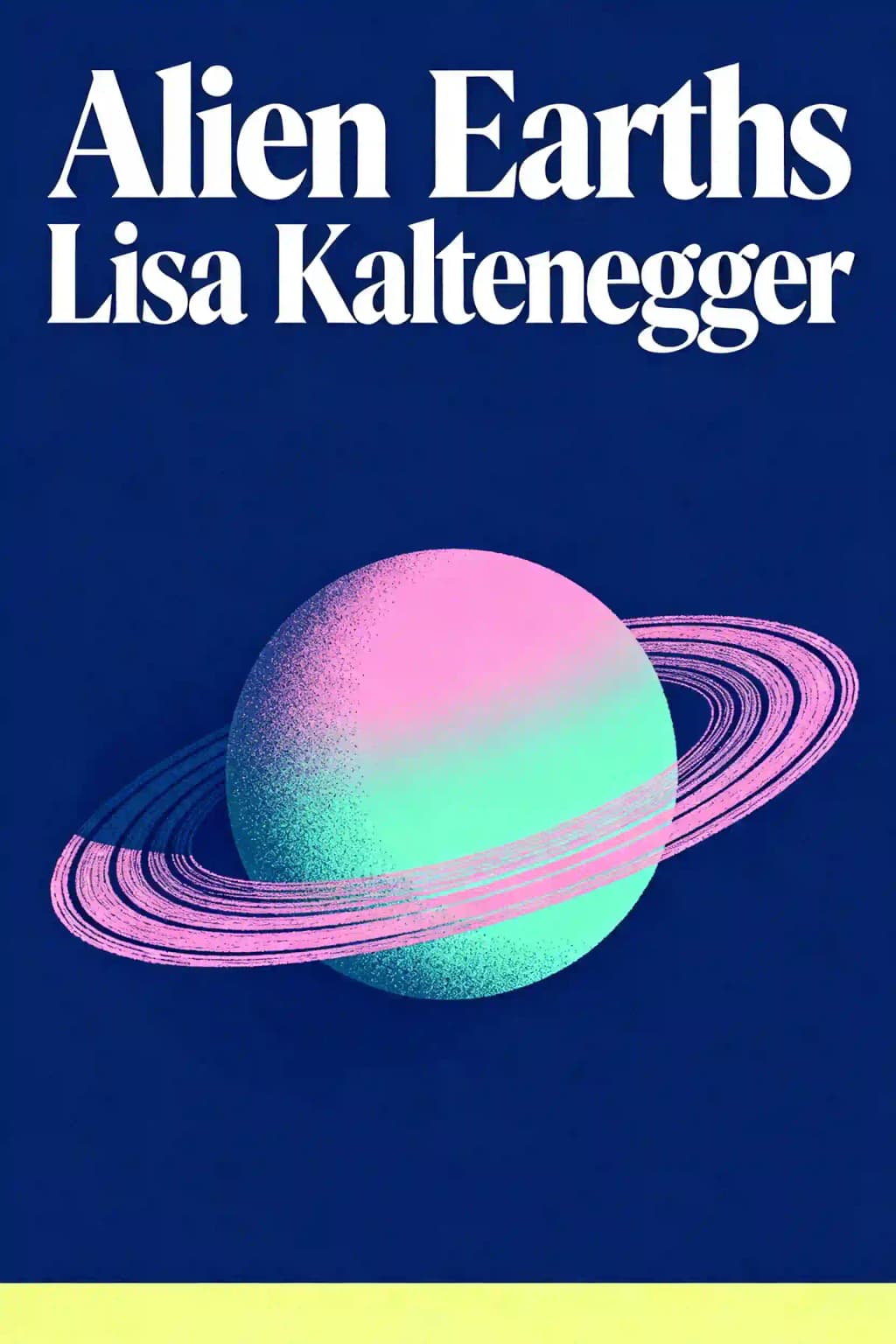
Standing at the edge of a crimson landscape, imagine gazing upward at orange skies where strange biofluorescent creatures thrive in perpetual twilight. This isn't science fiction-it's a scientifically plausible alien world that could exist right now, orbiting one of the billions of stars in our galaxy. Lisa Kaltenegger's "Alien Earths" takes us on this extraordinary journey, exploring humanity's most profound question: Are we alone? Since the discovery of the first exoplanet in 1995, astronomers have found over 5,000 worlds beyond our solar system-roughly one every other day. The book has captivated scientists and celebrities alike, with endorsements from Neil deGrasse Tyson and Alan Alda, and has been featured in Time Magazine's "Books to Watch." As director of Cornell University's Carl Sagan Institute, Kaltenegger combines cutting-edge astronomy with astrobiology to reveal how we might finally answer the question that has haunted humanity since we first looked skyward.
Capítulo 2
The Great Cosmic Silence: Why Haven't We Found Aliens Yet?
The famous physicist Enrico Fermi once asked a deceptively simple question during lunch with colleagues: "Where is everybody?" This query, now known as the Fermi Paradox, highlights a puzzling contradiction-if the universe contains countless planets capable of supporting life, why haven't we encountered any evidence of alien civilizations?
When I pose this question to my astronomy students, they typically offer two explanations: either civilizations inevitably destroy themselves before making contact (a sobering thought given our own environmental challenges), or we truly are alone in the cosmos. Frank Drake formalized this question into an equation that weighs factors from star formation rates to the longevity of technological civilizations, attempting to quantify the probability of intelligent life.
The vastness of space presents staggering challenges for contact. Even light, the fastest thing in the universe, takes four years to reach our nearest stellar neighbor. Crossing our galaxy would require a million years at 10% light speed. While science fiction imagines faster-than-light travel, the laws of physics suggest this is likely impossible. Radio signals offer better hope for communication, though they weaken dramatically with distance.
Perhaps the "Great Filter" hypothesis explains this silence-some catastrophic barrier prevents civilizations from spreading through the cosmos. This filter might lie in our past (perhaps life's emergence is exceptionally rare) or in our future (technological civilizations might inevitably destroy themselves).
But we're making assumptions about alien motivations. Would advanced civilizations even find Earth interesting? Compared to worlds thousands of years more technologically advanced, our planet might seem primitive. The premise that capable civilizations would immediately contact us seems deeply flawed, making the cosmic silence less mysterious.
If we ever established contact, communication would present enormous challenges. Without shared language or context, the exchange might resemble my fruitless attempts to communicate with jellyfish at an aquarium-fascinating creatures with whom I share no common reference points. Even with direct observation, interspecies communication remains difficult-imagine the complexity across interstellar distances! However, spacefaring civilizations would likely share one fundamental tool with humans: the scientific method. This brutal but effective approach to understanding reality might provide our only common language with alien minds.
Capítulo 3
Searching for Life Beyond Earth: A Detective Story
Our search for extraterrestrial life requires overcoming powerful cognitive biases. Human brains evolved to recognize patterns-a survival advantage for spotting predators, but also a source of false positives. When confronted with extraordinary claims about alien life, people often abandon their natural skepticism. The scientific method helps counter these biases by demanding rigorous evidence and independent confirmation. As Carl Sagan wisely noted, "Extraordinary claims require extraordinary evidence"-a standard no purported alien discovery has yet met.
Mathematics serves as our universal language for describing cosmic problems, allowing scientists to model distant worlds on computer screens, simulating conditions that might support life. By studying Earth from space, as the Galileo spacecraft did in 1989, we can learn to recognize biosignatures-combinations of gases that indicate life's presence-enabling us to search for similar signs on distant worlds.
In my lab, we collect and analyze diverse microorganisms in all their vibrant colors-not just the familiar green of Earth's vegetation. This catalog of life's colors serves as a detective's toolkit for identifying potential biosignatures on distant worlds. By measuring how light bounces off different organisms using spectrometers, we create "fingerprints" that could help identify similar life forms on other planets.
Earth hosts an estimated eight million species with breathtaking diversity. Life can be categorized by how it obtains carbon (autotrophs vs. heterotrophs) and energy (photo vs. chemo). Despite thriving in environments from deep-sea vents to Antarctic ice, all Earth life uses just twenty-four elements and twenty-two amino acids. When searching for life on planets orbiting different colored stars, we must abandon Earth-centric assumptions-plants under a red sun might evolve to be black rather than green to capture maximum energy.
Yellowstone National Park, with its vivid sulfur springs and unique ecosystems, offers a glimpse into life's adaptability in extreme conditions. During my first visit there for a NASA Astrobiology Institute meeting, I experienced both the beauty and scientific significance of these colorful pools. These colorful displays inspired me to create a color catalog of life-a database of diverse Earth biota and how they reflect starlight-to help astronomers identify potential life on exoplanets.
Capítulo 4
Building Blocks of Habitable Worlds
When searching for life in the cosmos, Earth provides our only reference point for what's required. The essential ingredients are simple yet critical: a rock in space, energy from a star, an atmosphere, and liquid water. Without an atmosphere, a planet remains static like Mercury. With it, things get interesting. The "habitable zone" or "Goldilocks zone" around a star marks where planets are neither too hot nor too cold for surface water-prime real estate for life that can transform its environment.
Our solar system formed 4.5 billion years ago when a shock wave collapsed a cold, rotating cloud of hydrogen, gas, and minerals. Gravity pulled particles together until the center became so dense that hydrogen atoms fused into helium, creating our Sun. The planets formed from the remaining material in a flat rotating disk around the young star. The inner planets like Earth formed from rocks, while beyond the "ice line," gas and ice created giants like Saturn.
Earth's birth was nightmarish-a collision of space rocks creating a molten world wrapped in toxic gases and steam, constantly bombarded from space. The familiar Moon formed when a Mars-sized planet called Theia catastrophically collided with early Earth, ejecting molten material that coalesced into our unusually large satellite. We know Earth's age through meteorites-ancient space rocks containing radioactive elements that act as precise cosmic clocks, dating our planet to 4.5 billion years.
Our solar system showcases incredible planetary diversity-from Mercury's scorched, atmosphere-less surface with extreme temperature swings, to Venus, Earth's toxic twin shrouded in sulfuric acid clouds with lead-melting temperatures. Mars displays red volcanic landscapes and ancient waterways, while beyond the asteroid belt lie the gas and ice giants-majestic Jupiter with its enormous storms, ringed Saturn, and stormy Uranus and Neptune.
Energy is essential for life, with our Sun providing Earth's largest input. Born 4.5 billion years ago, our Sun will continue fusing hydrogen to helium for another 6 billion years. Light from the Sun takes eight minutes to reach Earth, while light from our nearest stellar neighbor, Proxima Centauri, takes four years-meaning we observe the cosmos as it was in the past, not as it exists in the present moment.
Capítulo 5
The Time Machine of Earth's Evolution
To comprehend Earth's 4.5-billion-year history, imagine it compressed into 24 hours. Life emerged by 5:00 a.m. (3.5 billion years ago), oxygen transformed the atmosphere around noon (2.4 billion years ago), and multicellular life appeared at 1:00 p.m. (2.1 billion years ago). Land plants developed at 8:00 p.m. (750 million years ago), followed by the Cambrian explosion at 9:00 p.m. (530 million years ago). Dinosaurs roamed from 10:40 to 11:40 p.m., and humans appeared just seconds before midnight.
Earth's appearance has dramatically changed over time. A young Earth featured a cooling black magma crust with toxic gases and a massive Moon looming in the sky. As Earth cooled, oceans formed, creating a Blue Earth with massive tides and emerging landmasses. After 2.5 billion years, oxygen accumulated in the atmosphere, causing the barren continents to rust, creating a Red Earth. Earth has also experienced several "White Earth" periods when it froze over completely, before warming again to become the Pale Blue Dot we know today.
Life on Earth is built on carbon scaffolding and uses water as its solvent. Though silicon is more abundant on Earth than carbon, carbon forms a greater variety of stable yet breakable bonds with many atoms, including itself. Water is uniquely suited for life, existing in three phases on Earth and functioning as a powerful solvent. It remains liquid across a wide temperature range, offers protection from UV radiation, and uniquely expands when frozen, creating insulation that allows life to survive in lakes through winter.
Defining life is surprisingly difficult. Movement, evolution, and reproduction all seem like characteristics of life, yet fire moves, computer viruses evolve, and mules (which are sterile) can't reproduce. NASA defines life as "a self-sustaining chemical system capable of Darwinian evolution," while Nobel Prize winner Paul Nurse suggests three principles: ability to evolve through natural selection, existence as bounded physical entities, and functioning as chemical, physical, and informational machines.
Single-celled organisms dominated Earth for its first two billion years. The Great Oxidation Event about 2.4 billion years ago transformed Earth when cyanobacteria evolved to use sunlight and water as energy sources, producing oxygen as waste. This oxygen was initially toxic to most life forms but eventually enabled multicellular organisms by providing more energy and forming the protective ozone layer that allowed life to move onto land.
Capítulo 6
Alien Worlds in Our Cosmic Backyard
Our solar system offers several potential habitats for life beyond Earth. While Venus is shrouded in sulfuric acid clouds, Mars presents a more promising environment despite its freezing temperatures and thin atmosphere. Once possibly a warm blue planet with oceans, Mars lost its habitability when its core froze, ending tectonic activity and atmospheric replenishment. Today, any Martian life would likely be microbial and hiding underground to escape radiation.
Further out, Jupiter's moon Europa and Saturn's moon Enceladus harbor oceans beneath their icy crusts, kept liquid by gravitational kneading. Europa could contain twice Earth's water volume despite surface temperatures of -260F. Enceladus, even colder at -330F, spews water jets containing organic material. Both moons are targets for upcoming missions searching for extraterrestrial life.
Saturn's moon Titan presents a completely different potential habitat. Despite receiving sunlight a hundred times fainter than Earth and having surface temperatures of -290F, Titan features rivers, lakes, and seas-not of water, but of liquid methane and ethane. This orange-hazed moon is rich in organic material, with hydrocarbons sculpting its surface much as water does on Earth. NASA's upcoming Dragonfly mission, launching in 2027, will explore this intriguing hazy moon with an eight-bladed rotorcraft.
Earth's blue sky results from our atmosphere scattering high-energy blue light more than red light. Alien worlds could have pink or purple skies depending on their atmospheric makeup, though such exotic colors would likely indicate air lethal to humans. Not all worlds have colored skies; the Moon's black sky results from its lack of atmosphere.
A planet's atmosphere can reveal the presence of life through spectroscopic analysis. Light interacts uniquely with different molecules-oxygen and water each absorb specific wavelengths, creating "spectral features" like passport stamps that reveal a world's chemical composition. My team created a light-fingerprint catalog for diverse planets and moons in our solar system, serving as a comparison basis for exoplanet discoveries.
Life on planets orbiting red dwarf stars must withstand harsh conditions, particularly intense UV radiation from stellar flares. Biofluorescence offers a fascinating defense mechanism. Unlike bioluminescence (where organisms generate light through chemical reactions), biofluorescent organisms absorb high-energy UV light and re-emit it as visible light in brilliant blues, greens, pinks, oranges, and reds. This led me to imagine exoplanets circling flare-prone red suns where oceans might light up in colorful displays as life forms protect themselves from harsh radiation.
Capítulo 7
The Revolutionary Hunt for Exoplanets
The discovery of exoplanets began with detecting a mysterious wobble in the star 51 Pegasi by Swiss astronomers Michel Mayor and Didier Queloz in 1995. This wobble phenomenon occurs because planets gravitationally pull on their host stars, similar to how Jupiter makes our Sun wobble slightly. Finding exoplanets is extraordinarily difficult because planets don't produce their own light but merely reflect starlight. The Sun is over one billion times brighter than Earth when viewed from space.
The relationship between a star and its planet can be compared to someone walking a dog-when the dog pulls, the owner leans back to maintain balance, with the leash representing gravity. Similarly, astronomers can detect planets by observing the subtle wobble they cause in their host stars. A star's chemical composition can be identified by analyzing which wavelengths of light are absorbed by its hot gaseous surface layer, creating distinctive patterns like barcodes unique to each element. These patterns shift when a star moves-redshifting when moving away from us, blueshifting when moving toward us.
When a planet transits across its star, it blocks part of the starlight for minutes to hours, causing a measurable dimming. HD 209458 b, one of the first dozen exoplanets discovered, dims its star by 2% every 3.5 days for three hours. This transit method reveals the planet's size, while the wobble method shows its mass. Together, they confirmed HD 209458 b as a hot, fluffy gas ball with only half Saturn's density-about as dense as a marshmallow, though made mostly of hydrogen bloated by intense heat.
In 2008, astronomer Christian Marois captured the first actual photograph of an exoplanet family-four young planets orbiting star HR 8799, located 130 light-years away in the constellation Pegasus. These planets remain visible because they're still hot from their formation, glowing brightly enough to be seen despite their star's glare.
Some exoplanets resemble science fiction worlds like Crematoria from "The Chronicles of Riddick." CoRoT-7 b, discovered in 2009, is Earth-sized but utterly inhospitable-a rocky world with surface temperatures reaching 3,500F. On this lava world, rocks melt, evaporate, and rain down again in a hellish version of Earth's water cycle. To study such worlds without visiting them, scientists create miniature "lava worlds" in laboratories, melting different rock mixtures to simulate exoplanet surfaces.
Capítulo 8
The Quest for Earth's Cosmic Twins
In Vienna at a European Geosciences Union conference, I had a chance encounter with William Borucki, the tenacious astronomer who launched the Kepler mission after five attempts. He shared an incredible secret: Kepler had discovered two small rocky exoplanets in the habitable zone of Kepler-62. This moment transformed my research from theoretical to urgently practical-the planets I'd been modeling might actually exist.
Despite senior scientists repeatedly suggesting I abandon my "misguided" research on finding life on exoplanets, I had developed complex computer models to predict how life might alter a planet's atmosphere. Now, I became part of discovering two of the most exciting exoplanets-Kepler-62e and Kepler-62f-potential Earths circling another star.
Kepler-62e and Kepler-62f, orbiting a star 1,200 light-years away in Lyra, could be ocean worlds with deep waters covering their surfaces. As super-Earths (60% and 40% larger than Earth respectively), their stronger gravity might retain more water. These oceans could be so deep that intense pressure would create warm ice at their bottoms-not from cold but from immense pressure.
Our closest stellar neighbor, Proxima Centauri, just four light-years away, hosts one of my favorite planets-Proxima Centauri b. This potentially habitable world orbits its red sun every eleven days, likely tidally locked with one side in perpetual daylight and the other in eternal darkness. The planet experiences intense radiation from its active star, creating conditions like those described at the beginning of this book.
A planetary system with multiple Earth-like worlds would be the perfect laboratory for understanding habitability. The TRAPPIST-1 system, discovered in 2017 about forty light-years away, offers exactly this: seven Earth-sized planets orbiting a small red sun, with three in the habitable zone. These planets orbit incredibly close to their star, with "years" lasting between 1.5 and 19 Earth-days. From TRAPPIST-1e, which sits in the middle of the habitable zone, the other planets would appear as large as our Moon in the night sky, creating a mesmerizing celestial display.
While Kepler revolutionized our understanding by discovering thousands of exoplanets, these worlds were typically a thousand light-years away-too distant to explore closely. Our team proposed TESS (Transiting Exoplanet Survey Satellite) to NASA as a relatively affordable space telescope that could search the entire sky for potentially habitable planets around nearby stars, creating a target list for JWST. With Kepler having shown that nearly every star has planets, TESS could observe each star for shorter periods rather than staring continuously for years.
Capítulo 9
Cosmic Perspectives: From Ancient Worlds to Stellar Corpses
While science fiction depicts countless worlds of varying ages, real ancient planets exist that are far older than Earth, which has existed for just over a third of the universe's lifetime. The Kepler-444 system, about 117 light-years away, contains five small rocky planets orbiting an ancient orange star that's about 11 billion years old-more than double our Sun's age. These scorching worlds complete their orbits in less than ten days, making them too hot for liquid water, but they were already older than Earth is now when our planet formed.
In 2020, TESS discovered WD 1586 b, a gas giant orbiting a white dwarf-the remnant core of a dead star. This extraordinary finding challenged conventional wisdom, as a star's death typically disrupts planetary orbits when it expels half its mass. When stars like our Sun die, nuclear fusion in their cores stops, causing outer layers to crash inward before being expelled as a planetary nebula. The remaining stellar core becomes a white dwarf-incredibly dense (a teaspoonful weighs about 15 tons) and only slightly larger than Earth.
For stars at least eight times the Sun's mass, death is catastrophically violent. When nuclear fusion stops, the core collapses with unimaginable force, compressing electrons and protons into densely packed neutrons, creating a neutron star while triggering a spectacular cosmic explosion. A teaspoon of neutron star material weighs about four billion tons-as much as 40 million blue whales. For even more massive stars (thirty times the Sun or more), gravity forms black holes, singularities with gravity so enormous they can capture light itself.
Rogue planets hurtle alone through space without stars to light their way, likely kicked out of their systems by early collisions. These planets were ejected during the chaotic early formation of their systems, when migration and gravitational interactions pushed some worlds beyond the point of no return. Though forever cooling in the darkness of space, they raise questions about whether life might briefly form in their residual heat before freezing in the eternal night.
Science fiction imagined planets orbiting binary stars long before we found them-like Tatooine from Star Wars with its twin suns. In 2011, NASA's Kepler mission discovered Kepler-16 b, a real "Tatooine" planet orbiting two stars 250 light-years away. Even more spectacular is Kepler-64 b, a Neptune-like planet 130 light-years away that orbits a double-star system which itself orbits another pair of stars-four suns in its sky.
Capítulo 10
Our Cosmic Legacy and Future
From Carl Sagan's former office at Cornell, I ponder the same view he once had, though the trees are taller and the whiteboard now shows exoplanet formulas rather than Voyager mission notes. Here I founded the interdisciplinary Carl Sagan Institute, bringing together fifteen departments to search for life in the cosmos. Science is a rich fabric of knowledge spanning time and place, with each researcher adding one lifetime's discoveries to an invisible net of ideas stretching above us like a second sky.
The night sky shows us space and time simultaneously, with everything we see having already happened. Our understanding of our place in the cosmos has evolved from believing Earth was the center of the universe to recognizing we're on an ordinary planet circling an ordinary star-one of two hundred billion in our galaxy. Though we have no photo of our entire Milky Way, astronomers have determined its shape by measuring star positions and movements, comparing it to thousands of other galaxies.
Looking far enough into space reveals the early universe through radiation that's traveled billions of years to reach us-a baby picture of the cosmos. This cosmic microwave background (CMB) radiation appears as microwaves because the light waves from the hot young universe were stretched during their journey through expanding spacetime. The CMB shows tiny temperature variations-just 1 part in 100,000-that created everything we see today, as gravity gradually pulled material into slightly denser regions that eventually formed galaxies.
If alien civilizations exist with technology like ours, could they spot Earth? Within 300 light-years, about 1,500 star systems are positioned to see Earth transit across our Sun this year-fewer than 1% of our neighboring stars. This number increases to nearly 2,000 systems when considering observers from 5,000 years ago to 5,000 years in the future. About 100 of these stars are close enough that our radio waves have already reached them, including three with confirmed habitable zone planets.
In the far future, imagine journeying to an alien Earth where we've found clear evidence of life. Such a trip would require a starship beyond our current technology-one that perfectly recycles everything needed for survival during the long voyage. After takeoff, looking back at Earth, you realize our planet is itself a ginormous spacecraft with an incredibly effective life-support system-the biosphere. Earth is our true Spaceship, carrying us through the cosmos, its fate bound to the solar system. We must become better stewards of the only home we've ever known.
No planet will ever be as perfectly suited for us as Earth-we evolved together with our astonishing Pale Blue Dot. Space exploration gives us knowledge to protect ourselves from asteroids and pollution while preserving our limited resources. Though we can't yet physically visit other worlds, we've created the first travel charts for future explorers, putting intriguing destinations on the map. The thousands of stars visible on a clear night hold the breathtaking promise that we might not be alone in the cosmos.