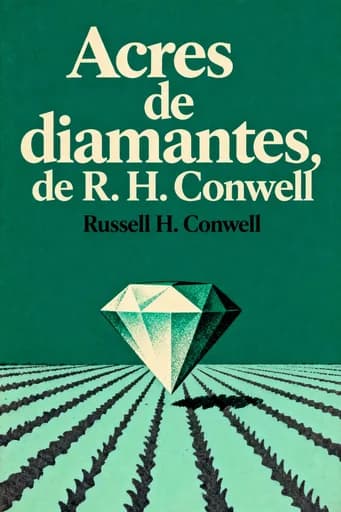
Discover the lecture that built a university! Russell Conwell's "Acres of Diamonds" - delivered 5,000+ times - reveals why opportunity exists right where you stand. What if the fortune you're searching elsewhere is already beneath your feet, just as Henry Ford and Warren Buffett discovered?
Russell Herman Conwell (1843–1925) was the author of Acres of Diamonds and a renowned Baptist minister, orator, and educational entrepreneur.
His inspirational lecture on success and self-achievement became one of the most delivered speeches in American history, addressing over 8 million people during his lifetime.
Conwell founded Temple University in Philadelphia with a vision to democratize higher education for working-class students and immigrants. He also established hospitals for the poor and served as pastor of Grace Baptist Church, where he built the largest church auditorium in North America. His other works include Every Man His Own University and The Key to Success.
Conwell delivered "Acres of Diamonds" more than 6,000 times on the Chautauqua lecture circuit, earning approximately $8 million—all of which he devoted to funding education for young men. The speech was even featured in Ripley's Believe It or Not for its remarkable delivery record.
Acres of Diamonds by Russell H. Conwell tells the parable of a Persian farmer, Ali Hafed, who sold his prosperous farm to search for diamonds elsewhere, only to end in despair. Meanwhile, the new owner discovered that the farm itself contained one of the richest diamond mines in history. The book teaches that opportunities for success and wealth exist in your current situation—you don't need to search elsewhere.
Russell H. Conwell (1843-1925) was a Baptist minister, lawyer, Civil War officer, and founder of Temple University. He delivered the Acres of Diamonds lecture over 6,000 times on the Chautauqua circuit, earning approximately $8 million. Conwell used these proceeds to establish Temple University, providing affordable education to working-class Americans. His message emphasized education as the pathway to success and the obligation to serve others.
Acres of Diamonds is ideal for entrepreneurs, career changers, and anyone feeling dissatisfied with their current situation. It's particularly valuable for people who believe success requires dramatic life changes or relocating elsewhere. Students, professionals seeking purpose, and those interested in self-improvement will benefit from Conwell's message about recognizing opportunities close to home. The book offers timeless wisdom about developing an open mind to possibilities around you.
Yes, Acres of Diamonds remains relevant because its core message—that we often overlook valuable opportunities right in front of us—transcends time. While written during the Gilded Age, the principle of recognizing potential in your current circumstances applies to modern career transitions, entrepreneurship, and personal growth. The book's brevity (originally a lecture transcript) makes it accessible, though some readers may find its success ideology oversimplified compared to contemporary self-help literature.
The central parable follows Ali Hafed, a wealthy Persian farmer living near the River Indus. After a priest told him about diamonds, Hafed became discontent, sold his farm, and wandered across Persia, Palestine, and Europe searching for diamonds. Eventually penniless and despairing, he drowned himself in the sea. The farmer who purchased his land discovered a sparkling stone in the stream—one of many diamonds on the property, which became the famous Golconda mines.
"Acres of diamonds" symbolizes the hidden opportunities and untapped potential in your current situation—your job, location, relationships, or skills. Russell Conwell uses this metaphor to illustrate that people often abandon valuable resources while chasing distant dreams. The concept teaches that success doesn't require abandoning your circumstances but rather developing awareness to recognize value where you already are. It challenges the assumption that greener pastures always exist elsewhere.
Acres of Diamonds by Russell H. Conwell addresses career dissatisfaction by challenging the belief that better opportunities exist elsewhere. Before pursuing dramatic career changes or relocations, Conwell advises thoroughly exploring your current role's potential—perhaps advancement, skill development, or entrepreneurial opportunities exist within your present situation. The book encourages developing awareness of overlooked possibilities rather than assuming the grass is greener at another company or in another city. This doesn't mean staying stagnant, but making informed decisions after genuine exploration.
Russell Conwell promoted the "success ideology" that anyone could achieve wealth through hard work and recognizing local opportunities. In the lecture, he declared that people in Philadelphia had "acres of diamonds" within reach and emphasized getting "rich quickly and honestly". However, Conwell's vision extended beyond materialism—he believed educated, successful people had obligations to serve the less fortunate and meet community needs. He stated, "We must know what the world needs first, and then invest ourselves to supply that need".
Acres of Diamonds remains relevant in 2025 because modern workers still struggle with "grass is greener" syndrome, especially amid remote work options, social media comparisons, and constant opportunity exposure. The book's warning against abandoning situations prematurely applies to job-hopping culture, entrepreneurial trends, and location-independent lifestyle narratives. Conwell's message about thoroughly exploring current circumstances before pursuing distant dreams counters impulsive decision-making. The core insight—that your most valuable opportunities may be unrecognized assets you already possess—transcends technological and economic changes.
Critics argue that Acres of Diamonds oversimplifies success by promoting individualistic "pull yourself up by your bootstraps" ideology without acknowledging systemic barriers. The Gilded Age success narrative may ignore structural inequalities, privilege, and circumstances beyond personal control. Some find Conwell's material prosperity emphasis problematic, especially given the era's extreme wealth disparity. Additionally, the advice to "bloom where you're planted" could discourage necessary changes when situations are genuinely toxic or limiting. Modern readers may view the 1890s-era optimism about wealth accumulation as naive or dated.
Acres of Diamonds shares thematic DNA with Think and Grow Rich (opportunity mindset) and The Power of Positive Thinking (attitude transformation), but emphasizes local opportunity over universal principles. Unlike Atomic Habits, which provides systematic behavior frameworks, Conwell offers inspirational storytelling rather than actionable processes. Compared to The Alchemist, both use journey metaphors, but Conwell's message is precisely opposite—don't journey elsewhere; your treasure is home. While 7 Habits of Highly Effective People focuses on character development, Acres of Diamonds prioritizes opportunity recognition.
Siente el libro a través de la voz del autor
Convierte el conocimiento en ideas atractivas y llenas de ejemplos
Captura ideas clave en un instante para un aprendizaje rápido
Disfruta el libro de una manera divertida y atractiva
I say that you ought to get rich, and it is your duty to get rich.
Money is power.
The opportunity to make money is here in Philadelphia now, within the reach of almost every man and woman who hears me speak to-night.
The love of money is the root of all evil-a crucial distinction.
Desglosa las ideas clave de Acres of Diamonds by Conwell, R. H. en puntos fáciles de entender para comprender cómo los equipos innovadores crean, colaboran y crecen.
Destila Acres of Diamonds by Conwell, R. H. en pistas de memoria rápidas que resaltan los principios clave de franqueza, trabajo en equipo y resiliencia creativa.

Experimenta Acres of Diamonds by Conwell, R. H. a través de narraciones vívidas que convierten las lecciones de innovación en momentos que recordarás y aplicarás.
Pregunta lo que quieras, elige la voz y co-crea ideas que realmente resuenen contigo.

Creado por exalumnos de la Universidad de Columbia en San Francisco
"Instead of endless scrolling, I just hit play on BeFreed. It saves me so much time."
"I never knew where to start with nonfiction—BeFreed’s book lists turned into podcasts gave me a clear path."
"Perfect balance between learning and entertainment. Finished ‘Thinking, Fast and Slow’ on my commute this week."
"Crazy how much I learned while walking the dog. BeFreed = small habits → big gains."
"Reading used to feel like a chore. Now it’s just part of my lifestyle."
"Feels effortless compared to reading. I’ve finished 6 books this month already."
"BeFreed turned my guilty doomscrolling into something that feels productive and inspiring."
"BeFreed turned my commute into learning time. 20-min podcasts are perfect for finishing books I never had time for."
"BeFreed replaced my podcast queue. Imagine Spotify for books — that’s it. 🙌"
"It is great for me to learn something from the book without reading it."
"The themed book list podcasts help me connect ideas across authors—like a guided audio journey."
"Makes me feel smarter every time before going to work"
Creado por exalumnos de la Universidad de Columbia en San Francisco

Obtén el resumen de Acres of Diamonds by Conwell, R. H. como PDF o EPUB gratis. Imprímelo o léelo sin conexión en cualquier momento.
Have you ever felt that success must be somewhere else-in another city, another job, or another life? "Acres of Diamonds" challenges this notion with a message that has resonated for over a century. Delivered as a lecture more than 6,000 times across America, Russell Conwell's message became one of the most influential self-improvement works ever created. Warren Buffett credits it as a formative influence, while countless entrepreneurs have found inspiration in its pages. What makes this slim volume so powerful is its radical yet simple premise: the opportunities for success aren't in distant places but right where you stand. Originally delivered to fund Temple University's founding, this message feels surprisingly relevant in our era of constant FOMO and grass-is-greener thinking. Perhaps we need this wisdom now more than ever.