Capítulo 1
Unleashing Your Mind's Hidden Potential
When Coldplay frontman Chris Martin was asked about his creative process, he described a peculiar habit: writing down every idea that comes to mind, no matter how absurd. "I have a theory that all of the best songs are hidden in the subconscious," he explained. This approach isn't just for rock stars-it's the secret weapon of countless innovators, from Richard Branson to J.K. Rowling. What these creative powerhouses understand is that our minds contain vast reserves of untapped genius waiting to be accessed. The technique they use? Freewriting-a deceptively simple practice that has transformed businesses, launched bestsellers, and solved seemingly impossible problems.
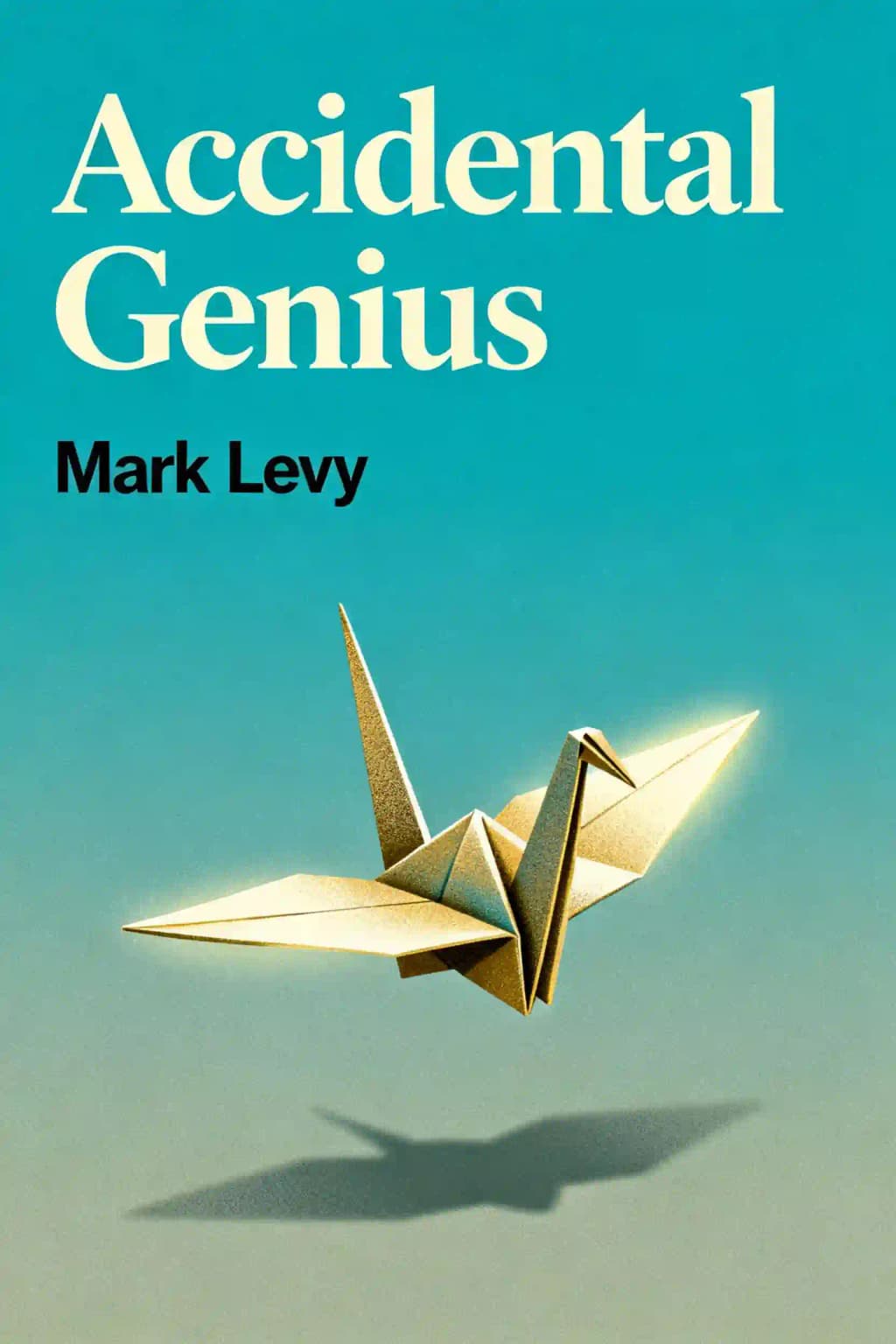
Mark Levy's "Accidental Genius" has become a cult favorite among Silicon Valley executives, creative professionals, and entrepreneurs precisely because it offers a concrete method for mining this hidden wealth of ideas. Since its publication, the book has been translated into 13 languages and is frequently cited by thought leaders like Seth Godin and Tim Ferriss as essential reading for anyone seeking to break through creative barriers. What makes this approach so powerful isn't just its simplicity-it's the neurological magic that happens when we bypass our inner critic and allow our authentic thoughts to flow unfiltered onto the page.
Capítulo 2
The Six Secrets That Unlock Your Mind
We all have an internal editor that sanitizes our thoughts. This mental gatekeeper helps us navigate social situations but severely limits our ability to think differently and powerfully. The true breakthroughs-the ideas that change businesses, solve intractable problems, and spark innovation-often come from thoughts that are raw, unusual, and initially uncomfortable.
Freewriting temporarily forces this editor into a subservient role, giving you access to your mind's full capacity. The technique works through six fundamental principles that anyone can master, regardless of writing ability or creative confidence.
First, "try easy." Business consultant Robert Kriegel discovered that Olympic sprinters ran faster when they relaxed and ran at 90% intensity rather than pushing at full force. This counterintuitive approach works equally well for thinking. Rather than approaching writing with gritted teeth and furrowed brow, ease into it with your best 90% effort. Begin by reminding yourself to stay centered-like a baseball player's pre-batting ritual. Most productive freewriting sessions start with self-reminders to relax and not expect immediate brilliance. Despite these calming self-instructions, your mind naturally seeks to solve problems. By easing perfectionistic demands, you give your thoughts more room to maneuver.
Second, write fast and continuously. Speed naturally forces you to adopt an easy, accepting attitude. Fast writing invites your mind to operate closer to its normal rate of thought rather than the lethargic crawl of slow, deliberate writing. When writing continuously, you force the edit-crazy part of your mind into submission, allowing the idea-producing part to keep generating words. Your "inappropriate" thoughts-those bone-honest notions you wouldn't normally share-often contain your genius. If you run out of things to say, keep your hand moving by repeating words or even writing nonsense. Remember: quantity before quality-the bad brings the good.
Capítulo 3
Setting Boundaries for Unlimited Thinking
A kitchen timer becomes your most valuable writing tool by creating parameters that energize your writing process. When freewriting, you're essentially sprinting-and just like athletes, sprinters need to know their exact distance to pace themselves effectively. A preset timer for 10-15 minutes creates a self-imposed behavioral contract that focuses your effort and creates a psychological container for creativity. Even on days when you're brain-dead, overwhelmed, or completely uninspired, your commitment to the timer keeps you writing through the resistance.
Paradoxically, your freshest notions often emerge when you've let down your guard and are writing absolute junk. This happens because the pressure of perfection dissolves after about 7-8 minutes of continuous writing, allowing your authentic voice to surface. The key is to keep working until your timer stops-just make sure to get a timer that doesn't make distracting clicking noises as it counts down. You can use various timing devices, from digital watches to smartphone apps to laundry cycles (as author Chuck Palahniuk does), which provides the added benefit of alternating thoughtful writing with mindless tasks to generate new insights. Some writers even use music playlists of specific lengths to mark their writing intervals.
When freewriting, don't just "write the way you speak"-"write the way you think." Unlike polished business writing, freewriting demands capturing raw thoughts before your prissy mind sanitizes them. This means embracing "kitchen language" (personal slang, abbreviations, and shorthand that perfectly captures ideas even if only you understand them), skipping background details obvious to yourself, and jumping around freely without worrying about logical connections. Your notes might include arrows, diagrams, incomplete sentences, or even made-up words that serve as perfect placeholders for complex concepts.
Remember, freewriting isn't writing-it's watching yourself think in real-time. Your raw thoughts don't need to please others or follow conventional logic, as long as you understand them. This unfiltered approach reveals connections and solutions that would never emerge through traditional brainstorming. Many breakthrough ideas come from allowing seemingly unrelated concepts to collide on the page. Some writers report their best insights appearing in the margins or between lines of text, where their minds made unexpected leaps. The goal is to capture the lightning-quick associations your brain makes before your internal editor can shut them down.
The timed container creates a safe space for experimentation - knowing you only have to sustain the exercise for a defined period helps overcome perfectionism and self-censorship. Many writers find that their most valuable insights come in the final two minutes of a timed session, just when they thought they had nothing left to say.
Capítulo 4
Following the Thread of Thought
Despite initially rejecting improvisational theater philosophy in my youth, I later embraced its core principle in freewriting: "go with what you're given." This approach liberates the mind by providing a specific starting point. When freewriting, constantly remind yourself to "agree and extend"-take whatever thought just appeared on the page and logically build upon it.
This creates an intoxicating flow where each new idea naturally extends from the previous one. Like in improv, you don't contradict what came before; you accept it and build forward. For example, if exploring how to make salami upscale, each idea (gold foil wrapping, wooden cigar-style boxes, medals and ribbons) flows naturally from the previous one, eventually leading to unexpected directions like creating an international standards organization.
The beauty is that any thought can branch in multiple directions, allowing exploration of numerous solution paths. This approach prevents the common brainstorming problem of rejecting ideas before they've had a chance to develop.
When your freewriting hits a roadblock, focus-changers can help you navigate around it. These are questions you ask yourself on paper that redirect your attention to unexplored aspects of your subject. While staring at a mental dead-end, look for alternative paths-they're always there if you ask the right questions. Focus-changers come in countless forms, from "What else can I say about this?" to "How would I describe this to my mother?" to "What am I missing here?"
These simple redirections keep your fingers moving and your mind engaged, preventing the dreaded freewriting standstill. They work not just in private writing but in published work too, constantly pushing you to see things from fresh angles even after you think you've exhausted a topic.
Capítulo 5
The Tangible Power of Written Thought
Writing isn't just thinking-it's thinking made tangible. While writing teachers correctly say "writing is thinking" to demystify the process, physically putting ideas on paper offers two crucial advantages. First, the act of writing focuses your naturally wandering mind. Without this physical anchor, problem-solving sessions easily degenerate into daydreaming about unrelated matters.
The writing process serves as your "handful of coins"-like Edison holding coins while resting so their fall would wake him-jarring you back to your purpose when you drift. Second, writing creates a record of your thinking journey, including valuable digressions that might otherwise be lost. Most people drastically overestimate their ability to remember their own thoughts-studies show students typically recall only half of what they've just discussed.
By treating passing thoughts as gold and capturing them on paper, you create a map of bread crumbs to retrace your steps. Even apparent digressions, when preserved, often contain unexpected solutions. Your written product not only shows where you've been but suggests where you haven't yet explored.
Prompts-predetermined phrases that guide your freewriting-can unlock unexpected directions in your thinking. Rather than starting with whatever's on your mind, you begin by completing an open-ended statement like "The best part of my workday is..." or "I remember..." The most effective prompts are short and open-ended, offering just enough structure to nudge writers toward unexplored territory without dictating the destination.
Good examples include "After the storm..." which could refer to weather, emotions, or something completely different. Prompts can warm up your mind and send it in unanticipated directions, whether they're personal ("I love..."), professional ("The three things my boss can do to help me are..."), or imaginative ("If I were giving a commencement speech, I'd tell the students...").
Capítulo 6
Breaking Through Mental Barriers
When you "open up a word," you strip away conventional meanings to discover what truly lies beneath. This technique transforms jargon and overused terms into personally meaningful concepts by dissecting their fundamental premises.
The process is simple: First, select a word whose definition seems taken for granted-perhaps "empowerment" which people uncritically accept as positive, or even seemingly neutral terms like "industry." Second, write down the common definition. Third, examine whether you agree with this definition and explain why or why not. Finally, consider how your perspective on this word has changed.
This approach reveals that many concepts we take as given are simply inherited from those before us, not inherently true or necessary. For example, when examining "work-around," you might discover it represents valuable divergent thinking rather than mere rule-breaking. When helping a bookstore client get books for an author signing through unconventional means, you're not just breaking protocol-you're recognizing that processes are merely tools for achieving goals, not sacred rituals.
Sometimes our intelligence becomes our greatest obstacle. We complicate ideas with sophisticated theories and abstract models until we're trapped in our own complexity. I witnessed this when a business professor showed me her elaborate communication model scribbled across butcher paper-circles, triangles, equations, and arrows pointing everywhere. Despite her academic brilliance, she couldn't make it work because she was building theory upon theory rather than starting from lived reality.
The solution? Follow Ken Macrorie's advice: "Rather than trying to be lucky with a Great Idea, reach for a fact." Facts ground you by shifting attention from tangled thoughts to the tangible world. When freewriting, start with obvious facts right in front of you. For example, if you're struggling with creating a company newsletter, begin by stating simple truths: who your clients are, what resources you have, what constraints you face. This practical approach often reveals solutions that remained invisible while lost in abstract thinking.
Capítulo 7
Embracing Productive Disconnection
When freewriting for extended periods, there's a visible moment when people's thinking transforms-their handwriting loosens, becoming larger and fainter as their internal editor recedes and they connect viscerally with the material. This unclenching happens for different reasons: some get tired and drop their mental pose, others become absorbed following a thought, but many experience breakthroughs when they disconnect from unproductive ideas.
As Pat Schneider wisely noted, "disconnections are as important as connections." Like crossing a creek by stepping on rocks, we must abandon earlier thoughts to reach our destination. Don't cling to ideas out of duty or investment-treat thoughts as useful but expendable rocket stages that fall away as you reach higher.
When abandoning ideas, you can be blunt ("Whoa! A white paper series? I can't even feign excitement"), simply move on without comment, or extract lessons before shifting direction. The page is alive with possibilities if you remain open to the truth of what emerges rather than forcing predetermined paths.
Sometimes our mental frameworks trap us without our awareness. When my wife asked me to design a "mathematical algorithm" for her computer class, I balked-math had always been my weakness. Yet when she reframed it as creating a "magic trick" to guess numbers, I solved it effortlessly, not realizing I was actually creating the algorithm she needed.
This concept substitution-replacing unfamiliar frameworks with familiar ones-can unlock solutions hidden by our paradigms. Paradigms are situation-dependent assumptions that both help and hinder us. Like ancient beliefs about a flat Earth that kept people "safe" but limited exploration, our modern paradigms constrain our thinking in invisible ways.
Capítulo 8
Abundance as a Creative Strategy
Searching for a single perfect idea is self-defeating for four reasons: we demand perfection from it, magnifying flaws; this critical approach depresses our creative powers; desperation makes us settle for mediocre ideas in brainstorming sessions; and laziness tempts us to grab the first idea to avoid further thinking.
The solution? Search for a hundred ideas instead. The "lots of ideas game" is fundamentally different from the "best idea game"-you're collecting volume without judgment, like picking apples without tasting each one. This approach works because killer ideas don't emerge from thin air but from an inventory of thoughts to work with.
Keep your idea threshold low. For an antique furniture store owner starting a blog, each possible topic counts as an idea-about inventory, specific periods of furniture, collector lifestyles, or themed posting schedules. Writing coach Donald Murray understood this abundance approach, advising newspaper reporters to write fifty to seventy-five lead paragraphs before choosing one. Rather than wasting time, this saved time by ensuring they started with their strongest option.
Problem situations often feel like closed environments with fixed parameters, players, and goals. This rigidity is usually an illusion. By deliberately lying to yourself during freewriting, you can escape this claustrophobia and see new possibilities.
Consider a computer consultant struggling to balance client service with prospecting for new business. Current clients love getting extra work for free, but this leaves no time for finding new clients. What if you lied and imagined charging an astronomical rate-1000 times normal-for those extra hours?
Following this fantasy reveals cascading consequences: clients would value your regular hours more, prepare better to avoid overtime charges, and you'd have evenings free for marketing. Companies might view your services as more valuable, offer retainers to keep you from competitors, and media attention could eliminate the need for prospecting entirely.
Capítulo 9
Conversations That Unlock Solutions
When I struggle with resistance from sales prospects despite my track record, I feel frustrated. To gain perspective, I created a paper conversation with David Reynolds, a Zen therapist I know. In this imagined dialogue, "David" reminded me that feelings happen naturally and aren't wrong-what matters is not letting them negatively affect my behavior with prospects.
This conversation helped me realize my job is to accept my feelings while educating new prospects about my value through words and actions. Though this specific exchange never actually happened with the real David Reynolds, the paper version provided valuable counsel. I could have just as easily summoned Steve Jobs, Susan B. Anthony, or my local grocer for different perspectives.
This make-believe game during freewriting offers genuine benefits by providing fresh viewpoints and indirect approaches to problems. One executive used imaginary dialogues to prepare for a board meeting with Alan Greenspan, anticipating and answering every objection before securing hefty bonuses for employees.
For effective paper conversations, follow two rules: First, flesh out your characters vividly before making them speak-experience their presence, mannerisms, and surroundings. Second, let your characters make you speak-they serve as sounding boards drawing fresh observations from your own mind, acting as paper Socrates to your knowing-student self.
Think of freewriting as a system of components you can deploy strategically over time. You might dump information about a subject one day, explore scenarios the next, then free-associate from your accumulated thoughts later. This messy but effective process often leads to breakthrough moments when solutions suddenly emerge-sometimes rejecting all your previous ideas yet benefiting from their fertilizing effect.
Capítulo 10
From Private Insights to Public Impact
While freewriting's effectiveness depends on assuming no one else will see what you've written during a session, over time, you can and should use ideas and prose from your private writing for public documents like blogs and books.
Writing a "talking letter" to someone you trust can help overcome the intimidation of creating formal documents. Rather than forcing yourself to produce a comprehensive proposal immediately, try articulating your unfinished ideas in letter form. This freedom to express rough thinking provides a foundation for more polished work later.
"Talking documents" (whether as letters or collages) provide tangible form to rough thinking that others can react to. You might create a freestyle collage combining freewriting segments, quotes, and other relevant materials. The key is finding someone willing to engage with your developing ideas and provide meaningful feedback.
As a positioning consultant, I don't assign prework questionnaires because clients are typically stuck in repetitive thinking patterns. Instead, I use freewriting to knock them off-balance and help them discover fresh insights. I ease clients into writing by first discussing standard topics, then steering toward specific examples like their four or five best customers ever.
When they struggle to access these memories, I introduce freewriting-fast, continuous writing for ten minutes without concern for spelling, grammar or even relevance. This approach invariably produces surprising insights they're proud to share. These techniques work one-on-one or with groups, though participants need physical space to write honestly.
Stories reveal what's significant and raw in our experiences. Some people naturally collect and recall stories-not because they prepare them in advance, but because they've trained themselves to notice and remember meaningful moments. As writer John Vorhaus says, "Stories only happen to people who can tell them." For writers, life becomes material.
Instead of deleting exploratory freewriting, save promising "thought chunks"-complete ideas, observations, stories, or hypotheses-by cutting them from your freewriting documents and organizing them into topic-specific files. These chunks are complete thoughts ranging from a few sentences to three-quarters of a page that would make sense even years later.
Maintain files with straightforward titles like "Positioning," "Marketing Strategy," "Customer Experience," or "Childhood," each containing hundreds of chunks. When a new project arises, you can dip into these documents and find relevant material-using chunks as-is, revising them, or stitching several together. This approach helps you write faster with fewer headaches and produce truer content since you're using material you've had time to think about rather than forcing ideas under pressure.
Capítulo 11
Finding Your Authentic Voice
Even Hemingway needed writing rules to face the blank page-he set word quotas (500-1,000 words daily) and deliberately stopped mid-sentence to give himself a starting point for the next day. Good writing rules should be uncomplicated, actionable, measurable, and things you know you can accomplish.
They narrow your focus to something concrete and doable while keeping you from constantly wondering "What do I do now?" Different parts of the creative process call for different rules-warm-ups, ideation, writing-but their sole purpose is to help you get the job done.
As a writing coach for businesspeople, I've learned that focusing too early on market demands leads to bland books. Instead of trying to read minds and give audiences what they expect, writers should first look inward at what fascinates them. I ask clients to inventory everything that has ever fascinated them-facts, insights, anecdotes, philosophies, experiences, controversies, memories, dreams-without judging whether items are "book-worthy."
This collection becomes raw material we can arrange, group, and analyze for themes. Only after identifying these personal fascinations do we consider audience needs and business goals. By combining personal material that radiates energy with audience focus, writers create unique, meaningful work rather than becoming yes-men parroting what they think others want.
Thoughtful business writer Geoff Bellman doesn't start books as books, but as explorations-essentially freewriting his way into them. During four-hour sessions, he follows ideas without worrying about style or editing, producing 10 double-spaced pages daily. After 4-6 weeks, he has 200-300 pages to analyze for useful content.
My own approach is similar but more structured. I warm up with unrelated freewriting exercises, then conduct focused freewriting sessions on my topic. I'm not trying to write the final piece yet-I'm playing with ideas. Afterward, I separate dead material from living concepts, arrange promising content in a provisional order, and create an outline by summarizing each chunk in a sentence.
This reveals gaps needing additional freewriting. I take multiple "passes" at the material, working on it intermittently to maintain fresh perspective. No piece is ever truly finished-even Walt Whitman released six editions of "Leaves of Grass"-so I simply deliver "Wednesday's version" by Wednesday's deadline.
The magic of freewriting lies not in producing perfect prose but in creating a space where your mind can wander, discover, and connect in ways that conventional thinking never allows. By temporarily suspending judgment and embracing the messy process of thinking on paper, you access parts of your intelligence that remain dormant during everyday problem-solving. Whether you're writing a book, launching a business, or simply trying to navigate a difficult conversation, these techniques offer a path to clearer thinking and more original solutions than you ever thought possible.