Capítulo 1
A Witness to Our Planet's Decline and Revival
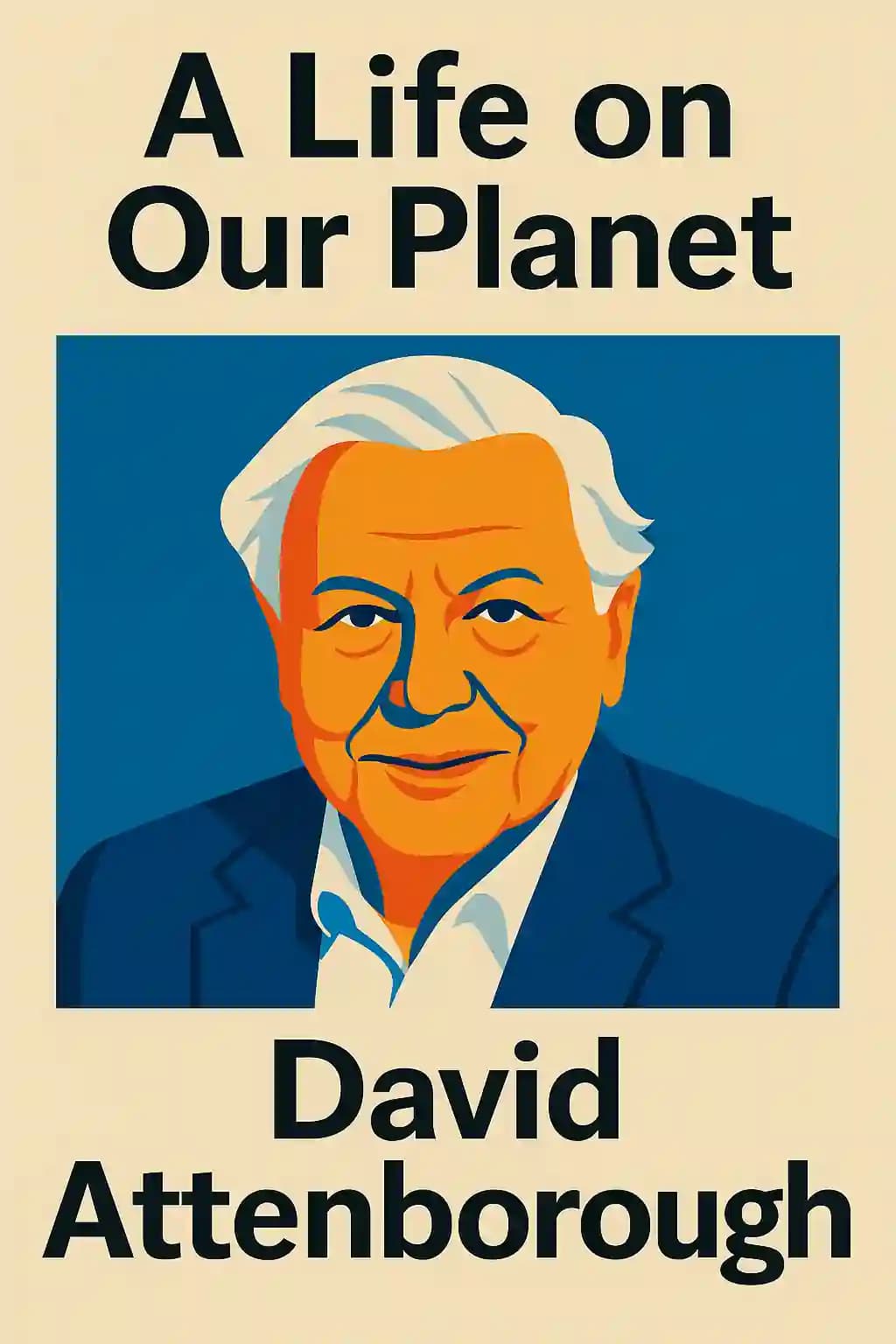
In the twilight of his remarkable career, Sir David Attenborough delivers his most urgent message yet. At 94, having spent more time exploring Earth's wild places than perhaps any other human, his perspective carries unparalleled weight. "A Life On Our Planet" has become a cultural touchstone, praised by world leaders and celebrities alike - from Barack Obama to Leonardo DiCaprio - for its clear-eyed assessment of humanity's greatest challenge. The book spent months on bestseller lists worldwide, with the accompanying Netflix documentary viewed by over 60 million people. What makes this work so compelling isn't just Attenborough's unmatched credibility, but how he transforms what could be a tale of despair into one of possibility. Imagine standing at the edge of an abyss with the world's most trusted naturalist, who not only explains how we arrived at this precipice but also reveals the bridge we could build to cross it. This is the story of how we broke our planet - and how we might yet fix it.
Capítulo 2
From Fossil Hunter to Planetary Witness
David Attenborough's journey began with simple childhood curiosity. As an 11-year-old in 1937, he would cycle from his Leicester home into the countryside, splitting open limestone rocks to discover perfectly preserved ammonite fossils. These ancient sea creatures, untouched by human eyes for millions of years, sparked a lifelong fascination with the natural world. While other children memorized cricket statistics or studied human history, young David was captivated by the principles governing plants and animals. This curiosity would eventually lead him to discover what he calls "the most marvelous story of all" - the history of life on Earth.
After studying natural sciences at Cambridge and completing his national service in the Royal Navy, Attenborough joined the fledgling BBC Television Service in the early 1950s. His career coincided with television's infancy - the service had only begun in 1936, broadcasting in black and white to a tiny audience in London and Birmingham. Initially producing various non-fiction programs, he gradually specialized in natural history as the medium expanded.
The early wildlife programs were primitive by today's standards - animals from London Zoo placed on tables with doormats beneath them, presented as curiosities rather than creatures with complex lives in natural habitats. Frustrated by these limitations, Attenborough developed "Zoo Quest," traveling to Sierra Leone to film animals in their native environments. When his co-presenter fell ill, Attenborough reluctantly stepped before the camera, handling pythons, monkeys, and chameleons - beginning his accidental career as television's most trusted nature guide.
The popular series took him around the world - Guyana, Borneo, New Guinea, Madagascar, Paraguay - showing viewers animals they'd never seen before: pangolins, sloths, Komodo dragons. These expeditions occurred during the optimistic 1950s, an era of technological innovation and seemingly limitless progress, before environmental concerns had entered public consciousness. As Attenborough reflects, "That was before any of us were aware there were problems."
Capítulo 3
The Revelation of Earth's Fragility
Attenborough's first visit to the African plains in 1960 revealed not just magnificent wildlife but the sheer vastness of landscapes like the Serengeti. The endless plains could swallow immense herds - a million wildebeest, quarter million zebra, half million gazelle - appearing empty one day and teeming with life the next. It seemed inconceivable that humans could threaten something so vast.
Yet scientist Bernhard Grzimek, Frankfurt Zoo's Director and creator of the Academy Award-winning documentary "Serengeti Shall Not Die," harbored precisely this fear. His aerial surveys tracking wildebeest migrations revealed the delicate interdependence of the ecosystem - the grasses needed the herbivores as much as the herbivores needed the grasses. The emerging science of ecology was demonstrating how animal communities were interconnected in webs of infinite complexity, with everything relying on everything else.
This understanding of nature's interconnectedness would be dramatically reinforced in 1968 when Attenborough, then controller of BBC2, watched the Apollo 8 mission with the rest of the world. While the mission focused on the Moon, it was images of Earth that unexpectedly captivated everyone. Frank Borman, Jim Lovell, and Bill Anders were the first humans to see our entire planet, repeatedly describing it as "beautiful." When the image finally appeared on televisions worldwide, an estimated one billion people - the largest audience in history - watched themselves from space.
That single photograph revealed perhaps the most important truth of our times: our planet is small, isolated, and vulnerable. As astronaut Bill Anders later reflected, "We came all this way to explore the Moon, and the most important thing is that we discovered the Earth." We had all simultaneously realized that our home was not limitless - there was an edge to our existence.
Capítulo 4
Glimpses of Sustainable Living
Throughout his travels, Attenborough occasionally encountered human societies living in balance with their environment. In 1971, while temporarily stepping away from his BBC administrative duties, he joined a government expedition into New Guinea's interior - one of the last places where exploration was still done entirely on foot. After weeks of arduous trekking through dense rainforest, the expedition encountered a group of indigenous people who had never met outsiders.
These small-statured men, wearing only bark belts with leaves and some with bats' teeth through their noses, represented a glimpse of how all humans once lived - in small groups that found everything they needed in the natural world. They used self-renewing resources, produced minimal waste, and lived sustainably, in balance with their environment in a way that could continue indefinitely.
This stark contrast with modern industrial society would become increasingly significant as Attenborough's career progressed. While filming the landmark series "Life on Earth" in the late 1970s, he had two transformative encounters that deepened his understanding of our connection to other species and their vulnerability to human activities.
The first came in Rwanda, sitting among mountain gorillas as they fed peacefully around him. Speaking quietly to camera, he reflected: "There is more meaning and mutual understanding in exchanging a glance with a gorilla than with any other animal I know." As he prepared for another segment, a female gorilla approached from behind, placed her hand on his head, and gently pulled down his lip to examine his teeth. Two infant gorillas simultaneously sat on his feet, playing with his bootlaces. This extraordinary interaction left him overwhelmed with a feeling of profound privilege and connection to our evolutionary cousins.
The second revelation came while filming whales - the largest creatures ever to exist. Attenborough learned how industrial whaling had decimated their populations, with 50,000 killed annually in the mid-20th century. Blue whale numbers had plummeted from 250,000 to just a few thousand. The team recorded the complex songs of humpback whales, which were transforming public perception of these animals from mere resources to sentient beings with their own culture. This shift in perspective helped fuel anti-whaling campaigns that exposed the bloody reality of industrial whale hunting.
Capítulo 5
Witnessing the Great Acceleration
As Attenborough's career progressed through the 1980s and 1990s, he began noticing alarming changes in environments he had previously visited. Returning to Borneo, where he had first encountered wild orangutans in 1956, he discovered that what appeared from the ground to be intact rainforest was actually just narrow strips along waterways. Flying overhead revealed the truth - endless regimented rows of oil palm plantations stretching to the horizon.
Southeast Asia had been replacing its diverse rainforests with these monocultures since the 1960s. By 1989, Malaysia alone had 2 million hectares of oil palm. The orangutan population of Borneo had declined by two-thirds in just sixty years as their habitat disappeared. Half the world's rainforests - the most biodiverse habitats on Earth - had already been destroyed.
While filming "The Blue Planet" series in the late 1990s, Attenborough's team documented the extraordinary complexity of ocean ecosystems. Camera operators captured remarkable behaviors: cuttlefish courtship displays, sea otters using tools, hermit crabs battling over shells, and spectacular feeding frenzies where tuna, dolphins, sharks, gannets and sometimes whales cooperatively hunted shoals of smaller fish.
Yet they also discovered disturbing changes in the oceans. Commercial fishing fleets had ventured into international waters in the 1950s, initially making rich catches. But within years, nets were coming up empty, forcing fleets to constantly move to new areas. By the century's end, we had removed 90 percent of large fish from all oceans. Historical accounts from the 19th and early 20th centuries described fish abundance that seemed almost mythical by modern standards - salmon runs so thick people stood thigh-deep among them, and New Englanders wading in to catch fish with table forks.
Even more alarming was the discovery of coral reefs turning white - not a beautiful transformation but a tragic one. These white structures were the skeletons of dead creatures. The bleaching occurred because warming oceans stressed corals into ejecting their symbiotic algae, exposing white calcium carbonate skeletons. Without algae, the coral polyps diminished and seaweeds colonized, rapidly transforming underwater wonderlands into wastelands.
This coral bleaching was the first unmistakable indication that Earth was becoming fundamentally unbalanced - like canaries in a coal mine warning of approaching catastrophe. By burning fossil fuels, we were releasing carbon dioxide captured by prehistoric plants over millions of years in just decades, potentially triggering something similar to a mass extinction event.
Capítulo 6
The Great Decline: Our Projected Future
By 2020, our impact had become truly global, fundamentally changing the living world. We cut down over 15 billion trees annually, reducing rainforests by half. Beef production emerged as the top driver of deforestation, with Brazil dedicating 170 million hectares (seven times the UK's size) to cattle pasture on former rainforest land. Soy cultivation (70% used for livestock feed) and oil palm plantations followed as major deforestation drivers.
Remaining forests became severely fragmented, with 70% having their edges within one kilometer of human development. Few truly deep forests remained. Insect populations plummeted - down 25% globally in just 30 years, with Germany losing 75% of flying insects and Puerto Rico losing 90% of canopy insects and spiders. These losses devastated ecosystems as insects are essential pollinators and pest controllers.
Half of Earth's fertile land was converted to agriculture, often managed destructively. We overloaded it with chemicals, overgrazed it, and killed soil invertebrates with pesticides, transforming rich ecosystems into sterile ground where rainwater runs off like from pavement.
Our domination of the animal kingdom reached staggering proportions: 70% of bird biomass on Earth became domesticated (mostly chickens - 50 billion eaten yearly). Even more startling, 96% of all mammal biomass on Earth consisted of humans (one-third) and our livestock (60%), leaving wild mammals at just 4%. Since the 1950s, wild animal populations more than halved. We had replaced the wild with the tame, creating an impoverished planet run primarily for ourselves.
If we continue on this trajectory, scientific understanding suggests the living world is on course for collapse, with effects accelerating and compounding. Within the lifetime of someone born today, our species is on track to take our planet through a series of irreversible changes that will end the stability of the Holocene - our planetary Garden of Eden.
By the 2030s, the Amazon rainforest is projected to shrink to 75% of its original extent, potentially triggering a devastating tipping point called "forest dieback" - where the diminished canopy can't produce enough moisture to feed rainclouds, causing vulnerable forest areas to degrade into seasonal dry forest and eventually open savannah. This self-reinforcing cycle would accelerate rapidly across the basin, causing widespread flooding as tree roots no longer hold soil, forcing 30 million people to relocate.
The Arctic Ocean is expected to have its first entirely ice-free summer in the 2030s, causing the loss of algal forests that support the Arctic food chain. With less white ice reflecting sunlight back to space, global warming would accelerate as the Arctic loses its cooling effect on the planet.
By the 2040s, thawing permafrost across Alaska, northern Canada and Russia could release an estimated 1,400 gigatonnes of carbon - four times more than humanity has emitted in 200 years and twice what currently exists in the atmosphere. This gradual release of methane and carbon dioxide might prove impossible to stop once started.
The 2050s could see ocean acidification devastate marine ecosystems, particularly coral reefs. Already weakened by bleaching events, corals will struggle to maintain their calcium carbonate skeletons in increasingly acidic water. Combined with warmer temperatures and stronger storms, this could destroy 90% of Earth's coral reefs within just a few years.
By the 2080s, global food production could reach crisis point as soils become exhausted, climate change brings higher temperatures and extreme weather, and the collapse of insect populations affects three-quarters of our food crops that depend on pollinators.
The twenty-second century could begin with the largest forced human migration in history as coastal cities worldwide face sea levels rising by 0.9 meters, making major cities like Rotterdam, Ho Chi Minh City, and Miami uninhabitable. Even more catastrophic, our planet could be 4C warmer by 2100, with over a quarter of humanity living in areas with average temperatures above 29C - heat levels currently found only in the Sahara.
Capítulo 7
The Doughnut Model: A Framework for Sustainable Living
The solution to this crisis is straightforward: to restore stability to our planet, we must restore its biodiversity - the very thing we've been destroying. We share Earth with the living world, a remarkable life-support system built over billions of years that refreshes food supplies, absorbs waste, and maintains planetary balance. The planet's instability has increased precisely as biodiversity has declined because the two are inextricably linked.
Scientists have identified nine "planetary boundaries" - critical thresholds hardwired into Earth's environment. We've already pushed through four: disrupting nitrogen and phosphorus cycles with excessive fertilizers, converting natural habitats to farmland too rapidly, warming Earth at unprecedented rates, and causing biodiversity loss 100 times faster than the average rate.
However, this planetary boundaries model lacks a critical component: nearly 50% of humanity's impact on the living world comes from just 16% of the human population - the wealthiest among us whose lifestyles are wholly unsustainable.
Economist Kate Raworth addresses this by adding an inner ring to the planetary boundaries model, representing minimum requirements for human well-being: housing, healthcare, clean water, food, energy, education, income, political voice and justice. This "Doughnut Model" provides a compass with two boundaries - an outer ecological ceiling we must remain below for planetary stability, and an inner social foundation we must raise everyone above for a just world.
This model offers a safe and just future for all, with a simple yet formidable challenge: improve lives everywhere while radically reducing our environmental impact. For inspiration in meeting this challenge, we need look no further than the living world itself.
Capítulo 8
Beyond Perpetual Growth: Learning from Nature's Maturity
Nature teaches us that nothing increases forever in a finite world. While trees, ant colonies, and ecosystems grow initially, they eventually mature and thrive without getting bigger. The Amazon rainforest has existed for tens of millions of years, constantly changing internally while maintaining its overall footprint. Yet humanity remains fixated on perpetual economic growth, stealing resources from the living world to fuel our expansion.
Environmental economists now advocate for "green growth" through sustainability innovations - the sixth revolutionary wave after water power, fossil fuels, electrification, the space age, and digital technology. But eventually, we must move beyond growth entirely.
New Zealand has already abandoned GDP as its primary success measure, creating an index that balances profit, people, and planet. All nations must now embark on this journey to maturity - wealthy ones maintaining standards while reducing footprints, poorer ones raising living standards sustainably. Only by curbing our growth addiction can we enjoy an enduring, meaningful existence.
The living world operates on solar power, with plants capturing twenty times more energy daily than humans use. This solar energy drives photosynthesis, powering all life processes. When we burn fossil fuels - ancient plant and plankton remains - we release millions of years' worth of stored carbon back into the atmosphere in mere decades, creating a greenhouse effect that traps heat and acidifies oceans.
We now face an urgent challenge: fossil fuels still provide 85% of global energy, with renewables accounting for just 4%. To bridge our energy transition, we may need temporary solutions with "regrets" - nuclear power, large hydropower, and natural gas. Bioenergy, hydrogen fuel cells and sustainable biofuels could complement electric vehicles, while air transport remains the most difficult problem to solve.
Affordability concerns are diminishing as renewable costs have dropped below coal, hydropower and nuclear, approaching gas and oil prices. The greatest barrier may be vested interests - six of the world's ten largest companies are oil and gas companies, with most industries, banks and pension funds heavily invested in fossil fuels.
Capítulo 9
Rewilding Our Oceans: The Power of No-Fish Zones
The ocean, covering two-thirds of Earth's surface and containing most of its inhabitable space, offers a triple opportunity: carbon capture, biodiversity restoration, and food security. Current fishing practices damage marine ecosystems by overfishing certain species, creating waste, using destructive techniques, and leaving nowhere for marine life to hide. The solution lies in creating a network of no-fish zones throughout coastal waters.
While Marine Protected Areas cover less than 7% of oceans (with many still permitting some fishing), strict no-fish zones allow fish to grow larger and produce disproportionately more offspring that repopulate neighboring waters. The Mexican community of Cabo Pulmo demonstrates this success - after establishing a 7,000-hectare no-fish zone in 1995 and enduring difficult years, marine life increased by 400% within 15 years, benefiting both fishing and tourism.
No-fish zones covering a third of our oceans would enable fish stocks to recover sustainably. The most effective locations are marine nurseries: reefs, seamounts, kelp forests, mangroves, seagrass meadows and saltmarshes - areas that also capture significant carbon. Smarter fishing techniques, sustainable yields, and blockchain tracking from dock to dish would ensure responsible harvesting.
The high seas - international waters owned by no one yet comprising half of Earth's surface - present an enormous opportunity for conservation. Currently, a few wealthy nations subsidize their fishing fleets to continue operating in these waters even when fish populations make it unprofitable, effectively using public money to empty the ocean. If all international waters became no-fish zones, the open ocean would transform from an exhausted resource into a flourishing wilderness that seeds coastal waters with fish and captures carbon.
Traditional industrial aquaculture has been environmentally problematic, but sustainable fish farms now spread pens miles offshore in strong currents, raise fish at lower densities to reduce disease, vaccinate rather than use antibiotics, and feed predatory fish with agricultural crop oils and insect protein. These operations are multi-layered - with sea cucumbers and urchins in cages below fish pens consuming waste, while surrounding ropes grow mussels, clams and edible seaweeds that benefit from excess nutrients.
Ocean forestry also shows promise, particularly with kelp - the fastest-growing seaweed that can increase by half a meter daily. Kelp forests support remarkable biodiversity and capture significant carbon. When harvested sustainably, kelp can provide bioenergy, food, livestock feed, or biochemicals while helping restore biodiversity and stabilize the planet.
Capítulo 10
Feeding Humanity on Less Land: Agricultural Revolution
Converting wild habitat to farmland has been the single greatest direct cause of biodiversity loss in human history. In 1700, we farmed only 1 billion hectares; today, we farm nearly 5 billion hectares - an area equivalent to North America, South America, and Australia combined, representing over half of Earth's habitable land.
To end biodiversity loss and operate sustainably, we must not only halt farmland expansion but actively reduce our land footprint to allow nature to recover. This presents a critical challenge: how to produce more food on less land, especially when we'll need to grow more food in the next four decades than all farmers harvested throughout the entire Holocene.
The Netherlands offers inspiration for high-yield, reduced-impact farming. As one of the world's most densely populated countries with limited farmland, Dutch farmers have evolved through three generations of agricultural practice, culminating in a pioneering approach that increases yields while reducing environmental impact. They installed renewable energy systems to heat greenhouses, implemented automated climate-control, collected rainwater from greenhouse roofs, grew crops in nutrient-rich water gutters rather than soil, replaced pesticides with natural predators, measured soil conditions precisely, and created fertilizer and packaging from crop waste.
These innovative Dutch farms are now among the world's highest-yielding, lowest-impact food producers. If their methods were adopted globally, we could produce significantly more food on much less land.
Regenerative farming offers an inexpensive approach to revive exhausted soils by returning carbon-rich organic matter to topsoil. Farmers avoid tilling or plowing which releases carbon, phase out fertilizers that reduce soil biodiversity, plant diverse "cover crops" after harvest to protect soil, and rotate up to ten different crop species in each field over years. These techniques eventually eliminate the need for fertilizers while capturing carbon from the air.
Urban farming produces food commercially within cities - on rooftops, in abandoned buildings, underground, on office window ledges, down building exteriors, in shipping containers on brownfield sites, and even above car parks. These operations typically use climate-control, low-energy lighting and hydroponics to maximize growing conditions while minimizing soil, water and nutrient requirements.
Vertical farming stacks layers of different plants one above another, lit with renewable-powered LEDs and supplied nutrients via feeder pipes. Though expensive to establish, these farms multiply yield per hectare by up to 20 times, operate independent of weather conditions, and can be sealed environments free of herbicides and pesticides.
Despite these innovations, feeding 9-11 billion people sustainably will require changing what we eat. Nearly 80% of farmland worldwide supports meat and dairy production, with beef being particularly land-intensive, using 15 times more land per kilogram than pork or chicken. Research consistently shows that a largely plant-based diet with much less meat would be healthier for people and planet, potentially reducing deaths from heart disease, obesity and some cancers by 20% while saving healthcare costs.
Capítulo 11
Rewilding the Land: From Farms to Forests
As food production becomes more efficient, we have an unprecedented opportunity to return land to nature. European governments are already shifting agricultural subsidies to reward biodiversity and carbon capture rather than just food production. This could transform millions of hectares with returning hedgerows, agroforestry, restored waterways, and reduced chemical use.
At Knepp Estate in England, Charlie Burrell and Isabella Tree abandoned conventional farming to create a "wildland farm" where carefully selected breeds of cattle, ponies, pigs and deer roam freely, mimicking prehistoric herbivore communities. Within just 15 years, biodiversity exploded as the animals transformed uniform fields into diverse marshes, thickets and woodlands. The farm produces meat sustainably while sequestering carbon, mitigating flooding, and generating income through eco-tourism.
When neighboring landowners unite to create borderless wild parks, the benefits multiply exponentially. Large-scale rewilding enables the reintroduction of apex predators, triggering powerful "trophic cascades" that transform entire ecosystems. Yellowstone's wolf reintroduction in 1995 demonstrates this dramatically - not by decimating deer populations, but by changing their behavior. Deer no longer lingered browsing in valleys, allowing trees and shrubs to regenerate, which cooled streams for fish, created habitat for birds, and supported beavers. Wolf predation on coyotes helped rabbits and mice thrive, boosting fox and hawk numbers. Even bears increased from scavenging wolf kills and feasting on newly abundant berries.
With Europe expecting 20-30 million hectares of abandoned farmland by 2030, such rewilding approaches could maximize biodiversity and carbon capture. Costa Rica proves what's possible - after losing three-quarters of its forests by the 1980s, government grants for native tree planting helped restore forest cover to half the country within just 25 years. A 2019 study suggests global reforestation could theoretically absorb two-thirds of human carbon emissions.
Capítulo 12
Planning for Peak Human: Empowering Women and Education
While rewilding reduces our ecological footprint, we must also address human population growth to achieve the Doughnut Model's vision of a stable world with fair resource distribution. Since 1987, we've calculated "Earth Overshoot Day" - in 2019, we consumed a year's worth of resources by July 29, using 1.7 times what Earth can regenerate annually.
Nations follow a four-stage demographic transition during development. In Stage 1 (pre-industrial), both birth and death rates are high, with slow population growth. Stage 2 brings industrialization, where birth rates remain high but death rates drop, causing population explosions. Stage 3 occurs when birth rates fall as societies develop, and Stage 4 represents stability with low birth and death rates.
Japan exemplifies this journey - its population doubled between 1900-1955 during industrialization, then stabilized at 126 million by 2000 as family sizes shrank from 5-6 children to just two. Globally, population growth rates peaked in 1962, marking our transition from Stage 2 to 3, with average family sizes halving from five children to 2.5 today.
The most effective way to accelerate demographic transition isn't through coercive policies like China's one-child rule, but by supporting development and particularly empowering women. Wherever women have voting rights, education, healthcare access, contraception, and career opportunities, birth rates fall dramatically. Simple interventions like providing bicycles to rural Indian girls have increased school attendance by solving transportation barriers.
Research from Austria's Wittgenstein Centre shows that rapidly improving education in the poorest nations could bring "peak human" forward to 2060 at just 8.9 billion people - potentially reducing our population peak by over 2 billion and achieving it 50 years earlier. This represents a win-win solution: raising people from poverty and empowering women both addresses population growth and creates a more just world.
Capítulo 13
Creating a Circular Future: Cities as Ecosystems
In a sustainable future, our individual lives would transform fundamentally. We'd follow plant-based diets, use clean energy, make sustainable investments, have smaller families, and produce minimal waste. The circular economy would replace our wasteful take-make-use-discard model with one mimicking nature's efficient nutrient cycles.
Food waste - currently one-third of global production - would be dramatically reduced through better infrastructure and innovative recycling into livestock feed, bioenergy, or biochar. Technical products would be designed for longevity, easy disassembly and component reuse, with standardized manufacturing enabling efficient recycling.
Cities, despite housing 68% of humanity by 2050, could become sustainability hubs through efficient public transport, district heating, green spaces, and buildings that generate energy rather than consuming it. Singapore exemplifies this transformation, requiring new buildings to replace lost ground greenery with equivalent plant life above ground. The ultimate goal is for cities to provide environmental services equal to the natural habitats they replaced - generating energy, cleaning air, treating water, and hosting biodiversity.
Balance means giving back to nature at least as much as we take. If every nation adopted best practices from around the world - New Zealand's triple-bottom-line targets, Japan's high living standards with low consumption, Morocco's renewable revolution, Palau's marine management, Dutch sustainable farming, India's low-meat diet, Costa Rica's rewilding efforts, and Singapore's nature-integrated cities - humanity could achieve harmony with the natural world.
Though some resist change by focusing on what they'll lose, the sustainable world offers tremendous gains: clean air and water, affordable renewable energy, healthier oceans, improved physical health, and a profound reconnection with nature. We have the plan and know what to do - the path to sustainability exists.
Capítulo 14
Our Greatest Opportunity: Becoming Earth's Stewards
I was born in the Holocene geological period but will die, as will everyone alive today, in the Anthropocene - the time of humans. This new epoch, formally proposed by geologists in 2016, is marked by distinctive markers in today's forming rocks: plastic fragments, nuclear plutonium, and globally distributed bones of domesticated chickens. Beginning around the 1950s, this period represents humanity's unprecedented influence on Earth's systems.
The Anthropocene could be alarmingly brief, ending with civilization's collapse, or it could mark the beginning of a sustainable relationship with our planet where we become attentive stewards helping biodiversity recover. Which version unfolds depends entirely on us.
Though human history is dominated by national conflicts, these global challenges require unprecedented unity. We have precedents for such cooperation, like the 1986 international agreement to end whale hunting and cross-border agreements that helped mountain gorilla populations recover from just 300 to over a thousand today. These examples show we can unite when necessary.
Nature demonstrates remarkable resilience - as seen in Pripyat near Chernobyl, where forests have reclaimed the abandoned city and wildlife thrives 34 years after the nuclear disaster. This gives hope that with wisdom, not just intelligence, we can make amends and restore harmony with nature.
We have all the tools we need - the thoughts of billions of minds, nature's energies, and our unique ability to imagine and work toward a better future. The next few decades represent our final opportunity to build a stable home and restore the rich, healthy world we inherited.