Kapitel 1
The Fascinating Science Behind Our Everyday Blunders
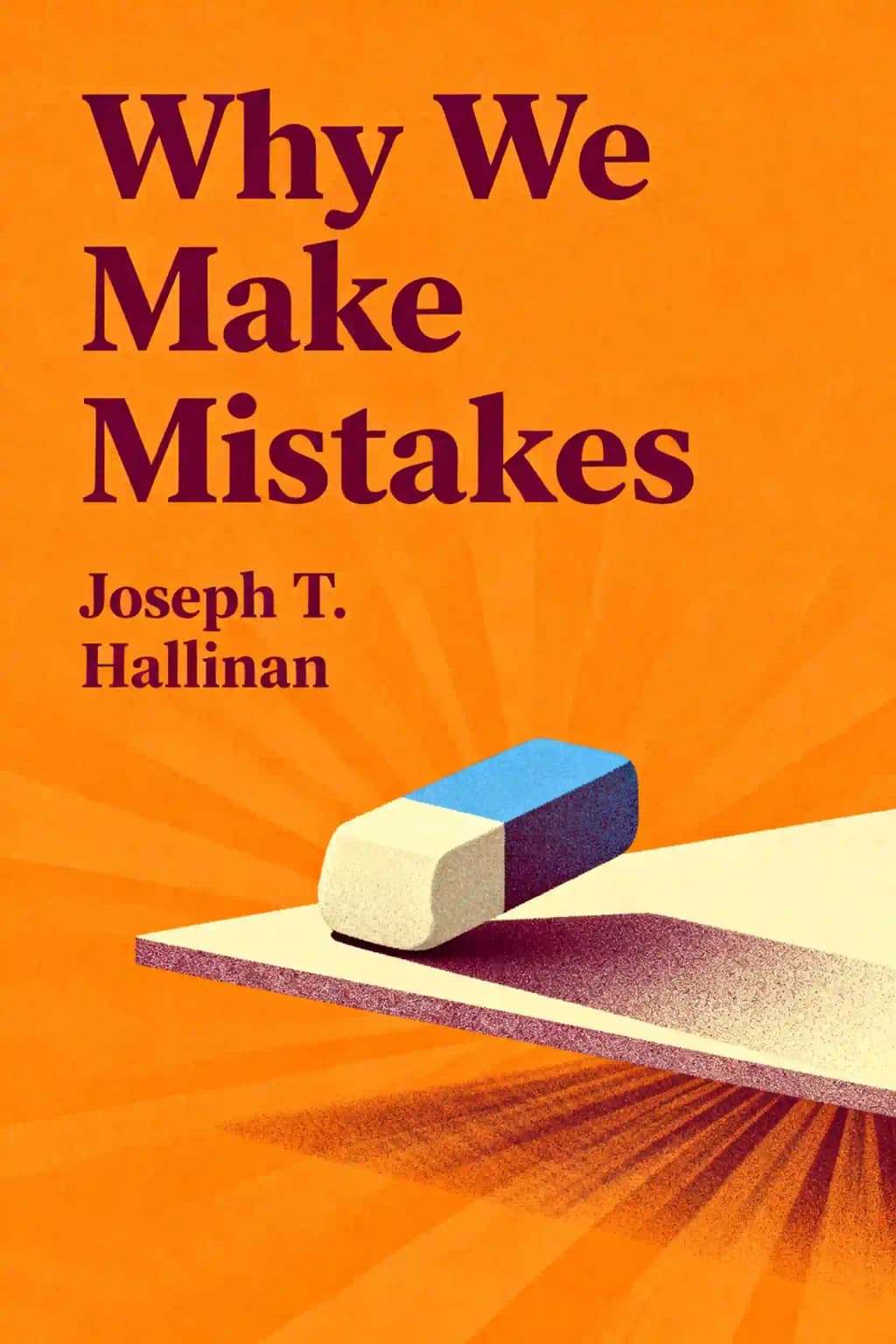
We all make mistakes-from real estate opportunities we should have seized to relationships we should have avoided. But these errors aren't entirely our fault. Our brains come with built-in biases that shape how we perceive the world, often operating outside our conscious awareness. We prefer turning right when entering buildings, favor the number 7, and stubbornly stick with first answers on tests despite evidence we should change them. These aren't random quirks but systematic patterns in human cognition.
"Why We Make Mistakes" has garnered praise from cognitive scientists and business leaders alike for its accessible approach to understanding human error. The book has become required reading in many psychology programs and has influenced corporate training programs at companies like Google and Microsoft. Author Joseph Hallinan, a Pulitzer Prize-winning journalist, spent over two decades collecting fascinating stories of human error-from the vigilantes who attacked a pediatrician's office because they confused "pediatrician" with "pedophile" to the casino mogul who put his elbow through his $139 million Picasso painting while showing it to friends.
Kapitel 2
The Illusion of Complete Vision
Our eyes don't work like cameras capturing complete images, despite our intuitive belief that we see everything before us in perfect detail. Instead, they perform rapid movements called saccades, darting about three times per second, with only a quarter-sized area of clear vision at normal reading distance. These movements are so quick and automatic that we're never aware of them happening. The brain stitches together these fragmentary glimpses to create our seamless perception of the world.
What we notice depends greatly on who we are and our personal characteristics. Men and women observe entirely different details in the same scene - studies show men tend to focus more on movement and spatial relationships, while women often notice more details about people and colors. Right-handed people remember visual orientation differently than left-handed people, typically showing better recall for objects positioned on their dominant side. Cultural background and professional training also influence what catches our attention - an architect might immediately notice building features that others overlook.
This selective perception explains why we miss obvious movie mistakes, even when watching attentively. Even epic films like Ben-Hur, which won eleven Academy Awards, contain glaring continuity errors - damaged chariots that appear undamaged in subsequent shots, soldiers wearing watches in ancient Rome, and numerical inconsistencies in the race sequence where the number of chariots changes between shots. Despite having dedicated script supervisors and multiple viewing passes, these errors persist because our brains aren't designed to maintain perfect visual continuity. Script supervisors openly admit it's "not humanly possible" to spot everything, even with careful documentation and multiple viewings.
Our confidence in our visual abilities is wildly misplaced, a phenomenon known as change blindness. In one striking study, all fifty participating students believed they would notice if an actor was substituted during a brief interaction, yet only a third actually detected the switch when it happened. The eye has high resolution only within a narrow two-degree angle - roughly the width of your thumb at arm's length. Beyond that, our vision becomes progressively blurrier, though we rarely notice this limitation because our eyes constantly move to bring different areas into focus.
How we perceive others depends heavily on how we categorize them, a process that occurs automatically and often unconsciously. When experimenters dressed as construction workers approached students, only four of twelve pedestrians noticed when the person was switched, compared to seven of fifteen when dressed as fellow students. This demonstrates how we tend to see categories rather than individuals when looking at people from groups different than our own. This "out-group homogeneity effect" explains why people often have trouble distinguishing between members of other racial or ethnic groups while easily recognizing differences among their own group.
Even when we know we're susceptible to visual errors, we remain vulnerable to them - knowledge doesn't override our automatic perceptual processes. The famous Shepard "Turning the Tables" illusion demonstrates this perfectly - two identical tabletops appear dramatically different in shape, and this perception persists even after measuring proves they're identical. Our perceptual machinery is deeply entrenched in our nervous system and operates automatically, making errors without our awareness or consent. This has important implications for eyewitness testimony, surveillance, and any situation where we rely on human visual perception.
Kapitel 3
Memory's Selective Filter
Our memory prioritizes meaning over surface details. When Nickerson and Adams asked twenty people to draw a penny from memory, only one person (a collector) accurately recalled all eight critical features. Most remembered just three features, commonly omitting the word "LIBERTY." In follow-up tests, fewer than half could identify the accurate penny among fifteen variations.
Names, like penny features, are forgettable because they lack inherent meaning-they're just arbitrary labels. In a British study where people read fake biographies, they remembered jobs (69%) and hobbies (68%) far better than first names (31%) or last names (30%). This happens because occupations and activities are "semantically richer"-they connect to our experiences while names are just labels without meaning.
Our minds struggle with meaningless information. Hermann Ebbinghaus proved this over a century ago by memorizing nonsense syllables, finding he forgot more than half within just one hour. We can overcome this limitation through mnemonics-associating meaningless data with meaningful concepts. A college runner with average intelligence expanded his digit span from seven (normal) to eighty by converting number sequences into running times (5-1-3 became "5 minutes, 13 seconds").
We consistently overestimate our ability to remember meaningless information. The New York Times reports 1,000 readers weekly forget their passwords, and up to 80% of corporate help desk calls involve password recovery. One survey found 38% of lost items were eventually found in "illogical" places-people mistakenly believe unusual hiding spots are more memorable when they're actually more forgettable.
Our brains naturally extract meaning from seemingly meaningless information, making it memorable without conscious effort. This is especially true with faces-humans have an innate ability to recognize and judge faces almost from birth. Surprisingly, we remember faces better when we judge them for emotional traits like honesty rather than physical features like hair. This deeper processing creates stronger memory connections.
Kapitel 4
The Automatic Connections We Can't Control
Our brains automatically make connections and form perceptions without our conscious awareness. We form impressions about people's competence from facial appearances in less than one second, and these quick judgments are remarkably persistent. In a Princeton study, researchers found that perceptions of competence based solely on candidates' faces predicted U.S. congressional election outcomes better than chance-the seemingly more competent-looking candidate won 72% of Senate races.
Our brains detect incredibly subtle cues about others without our conscious awareness. Women undergo physical changes throughout their menstrual cycle that affect their attractiveness, with facial appearance, waist-to-hip ratio, and body scent all peaking just before ovulation. Research with topless dancers revealed they earned significantly more ($335 vs $185 per shift) during fertile periods compared to menstruation-a 45% difference. Somehow, male customers detected fertility signals despite having no obvious visual cues.
We form unconscious associations between price and quality despite knowing better intellectually. Stanford and Caltech researchers demonstrated this when volunteers tasted wines labeled with different prices. Participants consistently preferred the "expensive" wines, even when researchers secretly served the same wine in differently priced bottles. Brain scans confirmed this wasn't mere snobbery-the medial orbitofrontal cortex (which processes pleasure) showed more activity when drinking "expensive" wine.
Color profoundly influences our judgments. People rate black and red pills as "strongest" and white ones as "weakest." This association extends to sports: referees shown identical aggressive football plays judged the team in black uniforms more harshly than the same team in white. Real-world data confirms this bias-NFL and NHL teams wearing black uniforms receive significantly more penalties.
We stubbornly cling to first impressions despite evidence against them. Three-quarters of college students and most professors believe sticking with initial test answers is better than changing them. Test prep guides like Barron's even advise against changing answers. Yet over seventy years of research proves this completely wrong-most answer changes are from wrong to right, and people who change answers typically improve their scores.
Kapitel 5
Our Rose-Colored Memory Glasses
People consistently misremember their past in self-flattering ways. When college students were asked to recall their high school grades, 29% remembered incorrectly, with most errors shifting grades upward. The recall accuracy for As was 89%, but only 29% for Ds. Similarly, parents remember their parenting methods as closer to expert recommendations than they actually were, and gamblers recall wins more fondly than losses.
John Dean's testimony during the Watergate scandal provides a perfect case study of self-serving memory. Though known as "the human tape recorder" for his supposedly excellent recall, when Dean's testimony about conversations with Nixon was compared to actual tape recordings, his account was wildly inaccurate. Dean's memory systematically distorted events to make his role seem more central and important than it actually was.
Hindsight bias fundamentally distorts our memories of past events. Knowing how something turned out profoundly influences how we perceive and remember it, giving outcomes an appearance of inevitability they never had. Baruch Fischhoff's research during Nixon's historic 1972 trips to China and the Soviet Union demonstrated that people misremember their predictions to make themselves appear more prescient than they were.
Our memories of our sex lives are often inaccurate and self-serving. Men routinely report more lifetime sexual partners than women do on national surveys-up to four times as many-even though logically these numbers should be equal. This discrepancy doesn't appear to be intentional deception, as men and women give similar answers about other intimate aspects of their sex lives. Rather, both genders seem to misremember in stereotypical, self-serving directions.
Gamblers display a similar pattern of self-serving memory bias. Tom Gilovich's research found that when gamblers win, they make "bolstering comments" about their foresight, but when they lose, they offer "undoing comments" explaining how the game should have gone differently. They blame losses on flukes like fourth-quarter fumbles, reframing defeats not as true losses but as "near wins."
We often don't recognize when our judgments are biased. Research shows that snap judgments based merely on politicians' faces can anchor our voting preferences, even when we later receive substantial information about their positions. These quick, shallow impressions influence our decisions without our awareness. George Loewenstein of Carnegie Mellon notes that "people always think they're not biased-even when you can document statistically that there's a huge bias."
Kapitel 6
The Multitasking Myth
Despite our cultural obsession with multitasking, our brains don't actually process multiple conscious tasks simultaneously. Instead, our attention jumps rapidly between activities, creating an illusion of simultaneity. Office workers face interruptions roughly twenty times per hour, limiting focused work to mere three-minute intervals. Even computers don't truly multitask-they switch between tasks thousands of times per second.
The cognitive costs of task-switching are substantial. Our working memory-that mental to-do list-begins evaporating after just two seconds, with up to 40% forgotten within fifteen seconds of considering a new problem. Workplace studies reveal it takes up to fifteen minutes to regain deep concentration after interruptions like phone calls or emails.
Divided attention can cause "inattentional blindness"-failing to see objects directly in our visual field. This phenomenon turned deadly when bus driver James Anthony Jones, distracted by a cell phone call to his sister, drove straight into a bridge despite warning signs about insufficient clearance. Though his bus was two feet too tall for the right lane, Jones never changed lanes, applied brakes, or even saw the bridge itself before impact.
Driver distraction causes far more accidents than previously believed. Video studies reveal that in 78% of crashes, drivers were looking away or engaged in secondary tasks-triple the rate estimated by self-reporting studies. Even a two-second glance doubles accident risk, yet entering an address into a GPS typically takes 86 seconds and 20-35 glances away from the road.
Carmakers are increasingly outfitting vehicles with distracting devices despite safety concerns. Chrysler's CEO Robert Nardelli even described cars as "your most favorite room under your roof," calling them "living rooms on wheels." Microsoft partnered with Ford to create Sync, a $395 system allowing drivers to operate phones, iPods, and send text messages while driving. Yet these entertainment systems create dangerous distractions, particularly for older drivers whose recovery times between tasks can be twice as long as younger drivers.
Multitasking while driving isn't just about keeping hands on the wheel-it's about cognitive interference. The Stroop effect, discovered in 1935, shows how processing one task creates interference with another. This explains why "safety" devices like Volvo's Blind Spot Information System (BLIS) can actually become dangerous distractions, constantly interrupting drivers at critical moments.
Kapitel 7
How Framing Shapes Our Decisions
Kahneman and Tversky's research showed how framing dramatically affects our decisions. In one experiment, they presented two groups with identical scenarios about disease prevention, but framed differently. When options were presented as lives saved, 72% chose the conservative option guaranteeing 200 people saved. When framed as lives lost, 78% chose the risky option with a one-third chance of saving everyone. The same choices with different frames produced opposite preferences.
When facing potential losses, we tend to take risks, but when considering gains, we become conservative. This pattern stems from our dual risk analysis systems: an automatic, intuitive system and a more thoughtful one, with feelings dominating our risk perception. David Romer's NFL study demonstrates this bias even among professionals-coaches go for it on fourth down only 13% of the time, though statistical analysis shows they'd be better off doing so 40% of the time.
Time horizons dramatically influence our decision frames. When consequences seem distant, we take bigger risks; when immediate, we become conservative. Women's preferences for childbirth anesthesia change before, during, and after labor. After 9/11, shortened time horizons led many Americans to abandon long-term health goals for immediate gratification. Studies show people choose highbrow movies for future viewing but action films for immediate watching.
Corporations increasingly leverage psychological framing to influence customer decisions. A South African bank experiment found that including a woman's photo on loan offer letters increased demand among male customers as much as dropping the interest rate five percentage points-a stunning psychological effect with significant profit implications.
We anchor our decisions to almost any number presented first, even implausible ones. McCracken's grocery price study revealed that while stores lowered prices on advertised items, they simultaneously raised prices on non-published items to compensate. Stores use multiple-unit pricing ("4 for $2" instead of "50 each") to anchor shoppers to buying more, increasing sales by 32%. Similarly, quantity limits like "Limit 12 per customer" boost purchases by setting higher anchors.
The listing price of a home serves as a powerful anchor in real estate negotiations. In a revealing experiment comparing college students to seasoned real estate agents, both groups' estimates of a home's value were significantly biased by the initial listing price, despite having extensive property information. Surprisingly, the professionals' estimates were just as influenced as the amateurs', yet the agents denied using listing price in their considerations.
Kapitel 8
Pattern Recognition: Blessing and Curse
We rarely read every letter of every word. Instead, we recognize patterns and pay more attention to the beginnings of words than their endings, which explains errors like confusing "unicycles" with "unicorns." This tendency to skim increases with expertise-the better we are at something, the more we rely on pattern recognition rather than detailed inspection.
Expertise comes with a trade-off: increased speed but decreased attention to detail. Piano teacher Boris Goldovsky discovered this when only a novice student noticed a misprint in a Brahms capriccio that had been overlooked by countless experts. When Goldovsky challenged skilled sight readers to find the error, none could locate it without being told which measure contained the mistake. Their expertise had led them to automatically "correct" the error in their minds.
The world abounds with "Goldovsky" errors-mistakes overlooked by experts but caught by novices. A thirteen-year-old schoolboy corrected NASA's asteroid collision estimates. A fifth-grader discovered an error at a Smithsonian exhibit undetected for 27 years. And another thirteen-year-old in Finland recognized that footage purported to be a Russian submarine was actually from the movie Titanic.
John Sloboda's research extended Goldovsky's findings by introducing altered notes into sheet music. When musicians played the piece once, they missed about 38 percent of the alterations. Surprisingly, when they played it a second time, error detection got worse, not better. This suggests musicians were no longer playing note by note but looking for patterns-essentially skimming. As something becomes familiar, we notice less, not more.
Context profoundly affects perception. In Frederica, Delaware, a woman's suicide by hanging went unreported for fourteen hours because neighbors thought her body was a Halloween decoration. Without proper context, recognition becomes difficult-whether it's identifying a person out of their usual setting or understanding written passages. Researchers Bransford and Johnson found that without contextual clues (like knowing a passage was about washing clothes), readers struggled to comprehend seemingly straightforward text.
Context is crucial for memory. When preschoolers were asked to recall a park visit, their memory was significantly better when physically back in the park than when in a quiet room. Adults show the same tendency: in an experiment, people who memorized words underwater recalled them best underwater, while those who learned on land remembered best on land. Physical context provides powerful memory cues that aid recall.
Kapitel 9
Designing Systems for Human Fallibility
One effective way to reduce errors is through constraints-simple mental aids that keep us on track by limiting our alternatives. These "bumpers" nudge us back on course and block potential errors. Constraints come in various forms-physical shapes, colors, sounds, or smells-and well-designed products incorporate them so seamlessly we barely notice their presence.
The lack of effective constraints can lead to serious errors. In November 2007, newborn twins Thomas Boone and Zoe Grace Quaid nearly died when nurses at Cedars-Sinai hospital twice administered massive overdoses of heparin (10,000 units/ml instead of 10 units/ml). The error occurred because the vials lacked strong constraints-both had similar size, shape, and blue labels (one dark, one light).
Drug name confusion causes frequent mix-ups. The FDA warned about edetate disodium and edetate calcium disodium-both commonly called EDTA but used for entirely different conditions-after nearly a dozen deaths over thirty years. Unlike aviation navigation points with meaningful names (ALAMO for San Antonio, MICKI/MINEE/GOOFY for Orlando), prescription drug names offer no clues to their purpose.
Uncertainty breeds error, as shown by the Quaid twins' heparin incident. Many everyday products are needlessly complex, like BMW's infamous iDrive system that controlled over 700 functions through a single knob, forcing drivers to take their eyes off the road. The lesson is clear: simplify where possible and build in constraints to block errors.
Mistakes attributed to "human error" often have deeper roots elsewhere. Like a ceiling leak whose source may be far from where it appears, the root causes of errors require deep understanding of human motivation. Organizations serious about eliminating errors design systems that account for human fallibility. After the Indianapolis tragedy, Methodist Hospital replaced high-dose heparin vials with specially designed syringes and required two healthcare workers to verify doses.
When errors occur, we typically look down the chain to blame the last person involved. But this approach rarely prevents recurrence. When multiple people make identical mistakes, the problem is likely systemic, not individual. Many errors stem from workplace culture. High-reliability organizations (HROs) like naval aviation achieve remarkably low failure rates through rigorous safety protocols. While hospitals claim similar safety standards, surveys reveal striking differences: problematic safety responses appear three times more frequently among medical staff than pilots.
Kapitel 10
Making Fewer Mistakes
The key to making fewer mistakes is to think small. In the United States, 7,000 people die annually from doctors' sloppy handwriting. South African borrowers were influenced more by an attractive woman's picture than by interest rates. NHL and NFL penalties are affected by uniform colors. As Cornell professor Tom Gilovich notes about the black uniforms experiment: "The tiniest little change in circumstance can have big impacts on people's behavior."
Overconfidence can be corrected through proper calibration. Royal Dutch Shell discovered their geologists were consistently overconfident in predicting oil deposits, so they implemented training that made geologists more like weather forecasters-providing precise probability estimates and receiving direct feedback. This dramatically improved accuracy. For personal decisions like stock picks, track not just what you chose but what you considered but rejected.
When making major decisions, ask "What could go wrong?" Atul Gawande calls this "the power of negative thinking." Walter Reed Army Medical Center reduced soldier death rates from 25% to 10% by actively tracking failures and finding solutions. When they discovered soldiers weren't wearing protective eyewear because they were "too ugly," they switched to cooler-looking glasses, immediately reducing eye injuries.
Habit makes us see patterns rather than details, causing us to miss errors. When proofreading, don't just rely on colleagues who might miss the same errors you do-have partners or even children review your work. Slowing down helps too. Multitasking is largely a mirage with strict cognitive limits. Like the pilot who crashed while hunting for a $12 lightbulb, we get distracted by small things like GPS devices or iPods.
Sleep deprivation causes numerous errors and increases risk-taking behavior. Even moderate sleep deprivation impairs the brain equivalent to driving drunk. Between 2003-2007, at least six cases of pilots falling asleep mid-flight occurred in the US. Medical residents working marathon shifts show a 700% increase in fatigue-related patient harm and a 300% increase in errors leading to death.
Happy people make fewer habit-induced errors and show more creativity in problem-solving. In experiments with the candle-and-box-of-tacks problem, 75% of participants who watched comedy bloopers solved it correctly, compared to only 20% who watched a math film. Even small mood boosters like candy can help-doctors given chocolate diagnosed liver problems more quickly than those without.
After more than a decade studying happiness, David Schkade concluded that time, not money, is life's true currency. People's biggest mistake when making major life changes is not changing how they use their time. Many retirees return to work because they continue old routines rather than developing new ones. The key insight: happiness comes not from where you live but how you use your time. Forgetting this may be our biggest mistake of all.


![[PDF] Toward a Theory of Behavioral Operations - Harvard Business School](/_next/image?url=https%3A%2F%2Fd1y2du6z1jfm9e.cloudfront.net%2Fassets%2Fpodcast%2Fblue.png&w=1024&q=50)