Kapitel 1
The Evolutionary Paradox of Modern Health
Have you ever wondered why your back aches after sitting at a desk all day, or why you crave sugary foods despite knowing they're unhealthy? The answers lie not in modern medicine, but in our evolutionary past. Daniel Lieberman's "The Story of the Human Body" offers a fascinating perspective on why our Stone Age bodies struggle in our Space Age world. As a Harvard professor of human evolutionary biology, Lieberman has crafted what Bill Gates calls "a fascinating read" that has influenced thinking across fields from medicine to fitness. The book has gained particular traction among health professionals seeking to understand the root causes of modern ailments rather than just treating symptoms. Its cultural impact extends beyond academia, inspiring movements like "evolutionary fitness" that attempt to align modern lifestyles with our biological heritage. At its core, this book challenges us to reconsider what "normal" human health actually means through the lens of our evolutionary journey.
Kapitel 2
The Paradox of Modern Human Health
We live in a strange medical paradox. While developed nations enjoy unprecedented health and longevity, we simultaneously face a tsunami of preventable chronic diseases-obesity, diabetes, heart disease, and back pain-that cause not just suffering but economic strain on healthcare systems worldwide. This contradiction stems from our failure to consider human evolution when addressing health problems.
Our bodies have an evolutionary story that explains why we're prone to certain ailments-why we get fat, why our backs ache, why our arches flatten. Understanding what our bodies are and aren't adapted for has profound implications for health. Most importantly, while biological evolution continues, cultural evolution now dominates how our bodies develop and function, often making us sick through novel behaviors, especially regarding diet and physical activity.
This mismatch between our evolved biology and modern environments creates what Lieberman calls "mismatch diseases." These conditions emerge when our Paleolithic bodies encounter environments for which they're poorly adapted. Like a zebra transplanted to New England would struggle without its natural habitat, humans face numerous health challenges from novel cultural practices despite many beneficial advances.
Mismatch diseases-which most of us will eventually die from-result from our bodies being inadequately adapted to modern behaviors and conditions. These diseases arise when environmental stimuli are either too much, too little, or too new compared to what our bodies evolved to handle. Understanding this evolutionary perspective is crucial because it explains why we didn't evolve to be healthy but to maximize reproduction under challenging conditions. We never evolved to make rational choices about eating or exercise in conditions of abundance.
The interaction between our inherited bodies, created environments, and personal choices has created an insidious feedback loop of illness that we pass to our children. Breaking this cycle requires nudging ourselves toward healthier eating and physical activity-exactly what we evolved to do.
Kapitel 3
From Apes to Upright Walkers: The First Major Transformation
The contrast between human and chimpanzee bodies reveals how athletically limited humans are. Chimps hunt with spectacular speed, power, and agility, especially in trees. They can climb effortlessly, leap between branches, and make flying grabs that would be impossible for even the most skilled human gymnast. On land, the fastest humans sprint at about 23 miles per hour briefly, while chimps and many other mammals can run twice that speed for minutes. Despite their smaller size, chimps can generate more than twice the muscle force of elite human athletes.
What we lost in raw power and agility, we gained in efficiency through bipedalism-the ability to walk upright on two legs. Darwin correctly identified bipedalism as the first major transformation in human evolution. He reasoned that upright posture freed our ancestors' hands for tool use, which then favored larger brains. Modern evidence supports this view, showing that our earliest ancestors developed adaptations for bipedal walking that differentiated them from other apes.
These adaptations included restructured hips with sideways-facing ilia to stabilize the body when walking, S-shaped spines that positioned the torso above the hips, and feet with partial arches capable of generating effective propulsion. Despite these changes, early hominins like Ardipithecus (nicknamed Ardi) and Sahelanthropus (nicknamed Toumai) retained many ape-like features useful for climbing trees, suggesting they walked differently than modern humans.
Bipedalism likely evolved to help early hominins forage more effectively during significant climate change that occurred when human and chimpanzee lineages diverged. Between 10-5 million years ago, global cooling caused African rainforests to shrink and woodlands to expand, making preferred fruits less abundant and more dispersed. Bipedalism offered two key advantages: standing upright made it easier to forage for certain fruits, and walking on two legs likely saved energy compared to knuckle-walking. Studies show chimps expend four times more energy than humans to walk a given distance, limiting them to 2-3 kilometers daily versus humans' 8-12 kilometers.
This energy efficiency would have been tremendously advantageous as food sources became more scattered, though early hominins were likely only somewhat more efficient than chimps, not as efficient as later humans. The evolution of bipedalism was a contingent rather than inevitable development, dependent on a series of chance climate shifts and the prior evolution of knuckle-walking, fruit-eating apes in African rainforests.
Kapitel 4
Dietary Adaptations: Beyond Fruit to Fallback Foods
Unlike modern humans who spend less than thirty minutes daily chewing mostly soft, processed foods, chimpanzees devote nearly half their waking hours to chewing fibrous, less sweet wild fruits. This dietary shift from fruit-eating represents the second major transformation in human body evolution, occurring dramatically about 4 million years ago with the australopiths.
The australopiths, living in Africa between 4 and 1 million years ago, were upright but still apelike creatures. They were chimpanzee-sized (females averaging 3'7" and 65 pounds, males 4'7" and 90-100 pounds), with small brains, long snouts, and apelike growth patterns. However, they showed significant adaptations for chewing harder, tougher foods than their fruit-eating ancestors, with larger teeth, more massive jaws, and wider faces with forward-placed cheekbones.
These adaptations emerged as Africa's climate continued cooling and drying during the Pliocene, reducing fruit availability and forcing australopiths to rely on lower-quality "fallback foods." While they still ate fruit when available, they likely incorporated more leaves, stems, seeds, and critically, underground storage organs (USOs) like tubers, roots, and bulbs. These USOs, while requiring effort to extract, provided year-round nutrition and water, potentially enabling the remarkable radiation of australopith species.
The australopiths evolved remarkably specialized dental adaptations to process their tough, fibrous diet. Their defining characteristic was massive, flat cheek teeth with exceptionally thick enamel. Gracile australopiths like Au. africanus had molars 50% larger than chimps with twice the enamel thickness, while robust species like Au. boisei had even more extreme adaptations-molars over twice the size with triple the enamel thickness.
These millstone-like teeth were perfectly adapted for grinding tough foods under high pressure. Their flat, expansive surfaces spread bite forces over large areas, allowing sideways grinding motions that efficiently broke down fibrous foods. This dental specialization involved trade-offs. As australopith cheek teeth grew larger, their front teeth became smaller and more vertical, with canines reduced to incisor size-reflecting both the declining importance of fruit and the need to accommodate larger molars.
The australopiths' dietary shift fundamentally transformed their locomotor needs. Unlike forest-dwelling apes who rarely travel far to find abundant fruit or fallback foods, australopiths living in open woodlands and grasslands faced widely dispersed food sources. This environmental challenge drove the evolution of more efficient bipedal walking. Starting around 4 million years ago, several australopith species developed crucial adaptations for efficient, human-like walking that we still retain today, including human-shaped big toes, partial foot arches, and large flat heel bones adapted for heel-striking gaits.
Kapitel 5
The First Hunter-Gatherers: Energy, Tools, and Brains
The dawn of the Ice Age triggered the next major transformation in human evolution. Beginning 3-2 million years ago, global cooling caused ice caps to expand and eastern Africa's Great Rift Valley created a rain shadow that dried out the region. As forests shrank while woodlands and grasslands expanded, hominins faced a critical challenge: finding food in changing habitats where preferred fruits became increasingly scarce.
Homo erectus emerged as the most consequential early human species, first appearing in Africa by 1.9 million years ago before rapidly dispersing throughout the Old World. These hominins varied considerably in size (88-150 pounds, 4-6 feet tall) but possessed essentially modern human body proportions with long legs, short arms, tall narrow waists, modern feet, low wide shoulders, and barrel-shaped chests.
Their heads, however, were less modern, featuring tall deep faces, enormous browridges in males, and skulls that were long and flat on top rather than round. Their brains were intermediate between australopiths and modern humans, and their teeth were nearly identical to ours but slightly larger.
Hunter-gatherers needed to rely on diverse extracted foods that required significant effort to obtain. While plant foods were predictable and didn't run away, they were high in fiber and low in nutrient density. A female H. erectus would have needed 3,000-4,500 calories daily for herself and dependent offspring, yet studies show mothers could gather only 1,700-4,000 calories per day from plants.
This caloric deficit was solved through meat consumption, which began at least 2.6 million years ago as evidenced by cut-marked bones. Meat provided five times more energy than an equal mass of vegetables, plus essential proteins and fats. This led to a division of labor where females primarily gathered while males hunted and scavenged, with food sharing becoming essential to survival.
Food sharing extended beyond mates to include grandmothers, extended family, and the entire community. This intense social cooperation-helping watch children, distributing meat from large kills, and reducing risk through reciprocity-became fundamental to hunter-gatherer survival.
While walking was fundamental to hunter-gatherer survival, our ancestors also evolved exceptional endurance running capabilities. Though humans are pathetic sprinters compared to predators, by H. erectus times we had developed remarkable abilities to run long distances at moderate speeds in hot conditions.
The evolution of endurance running likely stemmed from meat acquisition-both scavenging and hunting. Early humans could "power scavenge" by watching for circling vultures and running to carcasses before other scavengers arrived. More significantly, they developed persistence hunting, exploiting two unique human characteristics: the ability to run at speeds that force quadrupeds to gallop rather than trot, and cooling by sweating rather than panting (which animals cannot do while galloping).
The human digestive system and brain represent an evolutionary trade-off unique to our species. Both organs are metabolically expensive, each consuming about 15% of our body's basal energy and requiring substantial blood supply. Unlike most mammals our size, humans have relatively small guts and exceptionally large brains.
Leslie Aiello and Peter Wheeler proposed that early Homo essentially traded large guts for large brains by switching to higher-quality diets that included meat and processed foods. This dietary shift reduced digestive demands, allowing more energy to fuel brain growth. These larger brains supported cognitive abilities essential for hunter-gatherer success: cooperation among unrelated individuals, theory of mind, language, reasoning, memory, and tracking skills.
Kapitel 6
Energy in the Ice Age: Growing Bodies, Growing Brains
The evolution from Homo erectus to modern humans represents a profound revolution in energy management that transformed our species. While we share with apes the strategy of investing heavily in fewer offspring (unlike mice who reproduce rapidly with minimal investment), humans uniquely combined slow maturation with faster reproduction rates than apes.
Modern humans take 18 years to mature (versus 12-13 for chimps) and grow larger, costlier bodies with energy-demanding brains. Yet paradoxically, hunter-gatherers reproduce nearly twice as fast as apes, having babies every three years rather than every five to six. This requires mothers to simultaneously care for infants and older children not yet able to forage independently-a challenge no ape faces.
The most striking change in the human genus during the Ice Age was brain enlargement, nearly doubling in size. This evolution occurred because hunting and gathering provided the energy necessary to fuel larger, costlier brains.
Human brains average about 1,350 cubic centimeters-three times larger than chimps' brains (390 cc) and gorillas' brains (465 cc). Using the encephalization quotient (EQ), which compares actual brain size to expected size based on body mass, humans score 5.1, meaning our brains are five times larger than typical mammals of similar size.
Compared to apes, humans grow larger brains both faster and longer. At birth, a chimpanzee's brain is 130 cubic centimeters and triples over three years, while human brains start at 330 cubic centimeters and quadruple over six to seven years. The human neocortex contains twice as many neurons with millions more connections, enabling complex cognitive functions like memory, language, and reasoning.
These larger brains come with substantial costs-consuming 20-25% of the body's energy budget (280-420 calories daily), requiring specialized blood circulation, needing protection from injury, and complicating childbirth. The benefits of increased intelligence must have outweighed these costs, particularly in enhancing cooperation and naturalist knowledge essential for hunting and gathering.
Humans pay a high evolutionary price for our prolonged maturation. It takes approximately eighteen years and twelve million calories to grow a human adult-twice the energy cost of growing a chimpanzee. This extended development reduces parental fitness by limiting how many children they can have.
Unlike other mammals that progress directly from infancy to juvenile stage to adolescence, humans uniquely insert a "childhood" stage after weaning but before self-sufficiency. While chimpanzees complete brain growth and erupt first permanent teeth at age three (while still nursing), humans wean earlier (by age three) but continue brain growth for three more years, requiring intensive adult provisioning during childhood.
Humans are uniquely fat compared to other primates, an adaptation that evolved to support our energy-hungry brains and slow-growing bodies. While modern humans often worry about having too much fat, our ancestors worried about not having enough. This fat storage became crucial for archaic humans facing two major energetic challenges: nursing infants while simultaneously caring for dependent children, and providing constant glucose supply for our large brains during inevitable periods of food scarcity or illness.
Kapitel 7
A Very Cultured Species: The Rise of Homo sapiens
Modern humans colonized the world not through superior physical traits, but through our unprecedented capacity for cultural innovation and information transmission. Genetic evidence conclusively places modern human origins in Africa 200,000-300,000 years ago, with a small population (fewer than 14,000 individuals) giving rise to all humans living today. Our species dispersed out of Africa around 80,000-100,000 years ago, with the initial non-African population numbering perhaps just 3,000 people.
The most distinctive anatomical differences between modern and archaic humans appear in our heads. Modern humans have smaller, more retracted faces tucked beneath the forebrain rather than projecting forward, resulting in reduced browridges, shorter nasal and oral cavities, and squarer eye sockets. Our skulls are also more globular-orange-shaped rather than lemon-shaped-with rounder brains and less flat skull bases.
Despite equal brain volumes between Neanderthals and early modern humans, structural differences in brain architecture likely explain our cognitive advantages. Modern human skulls are more globular partly due to temporal lobes approximately 20% larger than those of archaic humans. These lobes, located behind the temples, process language, organize memories, and may even facilitate spiritual experiences. Our parietal lobes are also relatively larger, enhancing spatial awareness, symbol interpretation, tool manipulation, and abstract thinking.
Modern humans' uniquely short, retracted faces created a vocal tract configuration that revolutionized communication. Speech sounds are essentially pressurized puffs of air modified by the vocal tract-an r-shaped tube running from larynx to lips. While most mammals vocalize, humans excel at precisely controlling tongue movements and possess a distinctive vocal anatomy with superior acoustic properties.
Our shortened face creates a compact oral cavity requiring a short, rounded tongue rather than a long, flat one. This configuration positions our larynx much lower in the neck than in other animals, resulting in vertical and horizontal tubes of equal length in our vocal tract-unlike other mammals where the horizontal portion is at least twice as long. This unique vocal tract configuration produces more distinct vowel sounds requiring less precision to articulate clearly. However, this adaptation comes at a cost: humans are the only species that can choke on food.
Cultural evolution has been a far more powerful and rapid force than natural selection in shaping human history. Cultural traits ("memes") differ fundamentally from genes: they can be created intentionally rather than randomly, can be transmitted horizontally rather than just vertically, and can change through deliberate agency rather than just random processes. These differences make cultural evolution dramatically faster than biological evolution.
Modern humans' exceptional evolutionary success stems primarily from our adaptability-our extraordinary capacities to communicate, cooperate, think, and invent. These abilities, manifested through cultural innovation, enabled us to outcompete Neanderthals and other archaic humans, inhabit diverse environments worldwide, and eventually develop farming, writing, cities, and modern technology.
Kapitel 8
Progress, Mismatch, and Dysevolution
While civilization has brought tremendous advantages to humanity, our bodies remain adapted to Paleolithic conditions, creating tensions between our evolutionary past and modern lifestyles. Though human population has grown thousandfold since the Stone Age with unprecedented health improvements in recent centuries, our progress has introduced new challenges.
The agricultural revolution and industrialization spawned infectious diseases previously unknown to hunter-gatherers, while modern lifestyles have fostered noncommunicable illnesses like heart disease, diabetes, and mental disorders. Progress hasn't been uniformly positive-early farmers typically worked harder than hunter-gatherers and experienced worse health outcomes.
Dysevolution-a term Lieberman introduces-describes the harmful feedback loop where we treat symptoms of mismatch diseases rather than their causes, then pass on the environmental conditions that create these diseases to future generations. Unlike scurvy, which we effectively prevent with vitamin C supplements, cavities persist because we continue consuming cavity-causing foods while merely treating their effects through dental work rather than preventing them through dietary change.
This pernicious cycle characterizes many modern ailments like hypertension, where medications mask symptoms while we continue passing on the environmental factors (poor diet, inactivity) that cause the disease. Dysevolution particularly affects chronic, non-infectious diseases with complex causes, especially those that emerge after reproductive age or have minimal impact on reproduction. Most critically, dysevolution persists when the cultural benefits of disease-causing behaviors (convenience, pleasure, economic advantage) outweigh their perceived health costs.
While most doctors and patients rarely consider evolution when treating diseases like cancer or heart attacks, this perspective is shortsighted. Unlike cars, our bodies weren't engineered but evolved through descent with modification. Understanding this evolutionary history helps explain why we get sick.
Evolutionary medicine provides crucial insights into disease origins and treatment. Cancer itself is an evolutionary process where cells with advantageous mutations outcompete healthy cells. Infectious diseases represent ongoing evolutionary arms races between humans and pathogens, requiring Darwinian approaches to prevent creating superbugs through antibiotic misuse.
Many symptoms we rush to suppress-fever, nausea, diarrhea-are actually adaptive responses that help fight infections or purge toxins. Our bodies evolved to prioritize fertility over health, explaining why we crave energy-rich foods and rest, making diets and fitness programs difficult to maintain. The human body is a complex collection of compromises, not an optimized machine.
Kapitel 9
Paradise Lost? The Agricultural Revolution's Mixed Legacy
The biblical expulsion from Eden serves as an allegory for the transition from hunter-gathering to farming-humanity's punishment to toil for bread rather than plucking abundant fruit. Despite providing more food, farming required harder work, delivered lower-quality diets, and created vulnerability to crop failures, while higher population densities promoted infectious diseases and social stress.
Farming emerged independently in multiple locations shortly after the Ice Age ended 11,700 years ago. The Holocene epoch's more stable climate allowed agricultural experiments to succeed where previous attempts had failed. Population pressure was another crucial factor, as warming climates triggered a hunter-gatherer population boom. This created a vicious circle where families needed more food, driving further cultivation.
Farming spread rapidly because it enabled dramatic population growth. While hunter-gatherer mothers typically weaned children at age three and had children every three to four years, farming mothers could wean children between one and two years, thanks to easily digestible foods like cereal and animal milk. This allowed farming populations to double approximately every 2,000 years compared to hunter-gatherers' doubling time of 5,000 years.
While farming produced greater quantities of food-early Neolithic farmers could produce about 12,800 calories per day compared to hunter-gatherers' 2,000-6,000 calories-agricultural diets sacrificed quality and diversity for quantity. Farmers focused on a few staple crops with high yields but less nutritional value than the diverse plants consumed by hunter-gatherers. This made farmers susceptible to nutritional deficiencies like scurvy, pellagra, beriberi, goiter, and anemia.
The most fundamental advantage of farming was that increased calorie production allowed for larger families and population growth. This led to exponential population growth, with the world's population growing from 5-6 million people 12,000 years ago to 600 million by Jesus's birth. However, larger populations and permanent settlements created ideal conditions for infectious diseases. Villages grew into towns and cities with high population densities, while trade spread microbes between communities.
Despite famines, increased work, and diseases, farming brought mixed results for human bodies. From an evolutionary perspective, farming succeeded by allowing population growth, with nearly six billion more people alive today than would exist without agriculture. Early farming initially benefited human health in many regions, with stature increasing by about 4 centimeters in the Middle East during the early Neolithic. However, as agricultural economies intensified, health generally declined. Heights decreased significantly in China, Japan, and Mesoamerica as farming progressed.
Kapitel 10
Modern Times, Modern Bodies: The Industrial Revolution
The Industrial Revolution transformed human existence more rapidly than any previous cultural shift. While it brought tremendous benefits like reduced infant mortality and increased lifespans, it also created new mismatch diseases like type 2 diabetes, heart disease, and cancer. This paradox requires understanding how industrialization affected human bodies through an evolutionary lens.
The Industrial Revolution fundamentally transformed human existence by harnessing fossil fuels to power machines for manufacturing and transportation. Beginning in late eighteenth-century England and spreading globally, this shift occurred in evolutionary terms with unprecedented speed. Within a dozen generations, humans altered their existence more profoundly than any previous cultural transformation. The population exploded from less than one billion rural farmers to seven billion people, most living in cities.
In the 1936 movie Modern Times, Charlie Chaplin illustrates the demanding nature of assembly line work. While the Industrial Revolution replaced muscles with engines, factory workers still performed arduous labor under harsh conditions. Workers faced 80+ hour weeks with minimal protections until labor reforms gradually improved conditions.
The energetic costs of industrial jobs vary enormously. The most strenuous jobs (mining, loading) rival or exceed farming in caloric expenditure. Moderate industrial jobs like assembly line work equal the energy cost of comfortable walking. Increasingly common sedentary jobs require minimal energy-a receptionist burns about 775 calories during an eight-hour shift (equivalent to three donuts), while a coal miner might burn 3,400 calories (fifteen donuts).
The Industrial Revolution transformed our diets even more dramatically than the Agricultural Revolution did. Modern food production resembles manufacturing, with corporations replacing small-scale farmers. The industrial food system has perfected producing exactly what humans have always craved: fat, starch, sugar, and salt-now available in unprecedented abundance and at historically low prices.
Processing food by grinding it into tiny particles, removing fiber, and increasing starch and sugar content significantly changes digestion. Processed foods require less energy to digest-more than 10 percent less-because smaller particles have more surface area for enzymes to work on. White flour and white rice require fewer steps to digest, causing blood sugar levels to rise more quickly.
Modern sleep patterns differ dramatically from our ancestors'. Today's typical American spends 7.5 hours in bed but sleeps only 6.1 hours-one hour less than in 1970 and 2-3 hours less than in 1900. Only a third of Americans nap. We sleep alone or with a single partner on soft, elevated beds, and isolate our children in separate rooms with minimal sensory stimulation.
The industrial transformation of human life over the past 150 years has been so profound our ancestors would barely comprehend our daily existence, despite us being genetically and anatomically identical. Was this transformation worth it? From a bodily perspective, the answer is "very much so-but not much at first."
Early industrialization meant brutal working conditions in polluted cities filled with contagion. Yet health gradually improved as wealth accumulated and medical advances accelerated. Sewers, soap, and vaccinations stemmed infectious diseases that had plagued humanity since the Agricultural Revolution. Food production innovations increased both quantity and quality available to most people.
Despite impressive health improvements during the industrial era, significant drawbacks have emerged alongside progress. An epidemiological transition has occurred: as fewer people die young from malnutrition and infections, more develop noncommunicable diseases as they age. Between 1970 and 2010, worldwide deaths from infectious disease fell by 17% while deaths from noncommunicable diseases rose by 30%.
Kapitel 11
Survival of the Fitter: Finding Balance in Modern Life
Though often misquoted as "survival of the fittest," evolution is better described as "survival of the fitter"-not producing perfection but eliminating the less fit. This principle remains relevant today despite our technological advances.
Evolution explains not just our bodies' design but also our remarkable transformation from forest apes to galaxy-observing bipeds over just 6 million years. Our most transformative adaptation may be our capacity for cultural evolution, which now outpaces biological evolution. While cultural innovations have helped us produce more food and harness more energy, they've also brought unintended consequences like infectious diseases, famines, and modern health problems.
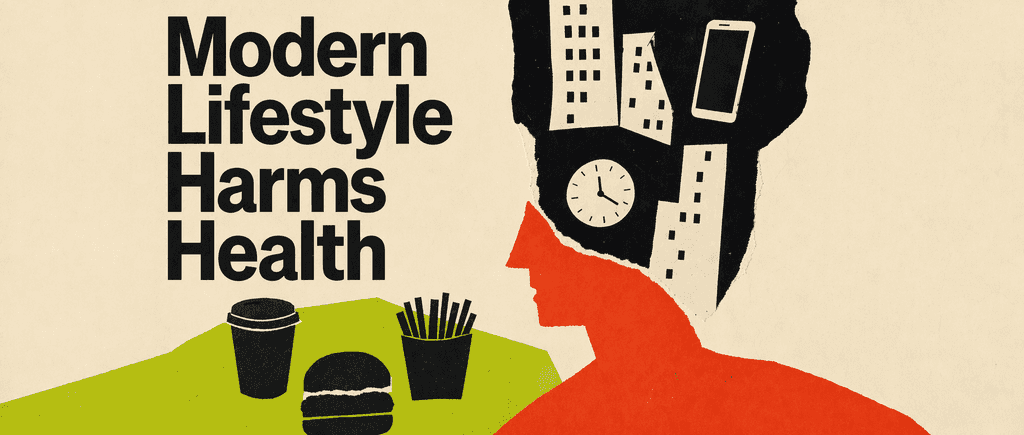
The crucial lesson from our evolutionary history is that culture cannot transcend biology. Despite our cleverness, we cannot fundamentally redesign our bodies. We remain primates adapted to diverse diets of fibrous foods, regular physical activity, and outdoor living-not to sugar-laden processed foods, sedentary lifestyles, and hours in chairs staring at screens. The resulting diseases of affluence, novelty and disuse create a pernicious feedback loop of dysevolution as we treat symptoms rather than causes.
If medical treatments remain inadequate and education has limited impact on behavior, then changing our environment becomes the most viable approach to preventing mismatch diseases. An evolutionary perspective suggests two key principles: first, since we cannot reengineer our genes, we must modify our environments; second, humans evolved under conditions where nature coerced healthy behaviors rather than allowing free choice in abundance.
While a tyrannical health regime would violate fundamental freedoms, "libertarian paternalism" offers a middle path. This approach recognizes that humans often make poor health decisions due to evolved cravings for calories and comfort that were once rare. Government can legitimately help people make choices they would rationally judge to be in their own interest while preserving their right to choose otherwise.
Rather than waiting for future scientists to conquer preventable diseases, we can use evolutionary knowledge to prevent them now by using our bodies more as they evolved to be used. Just as Voltaire's Candide concludes "We must cultivate our garden," we must cultivate our bodies-the only ones we'll ever have.