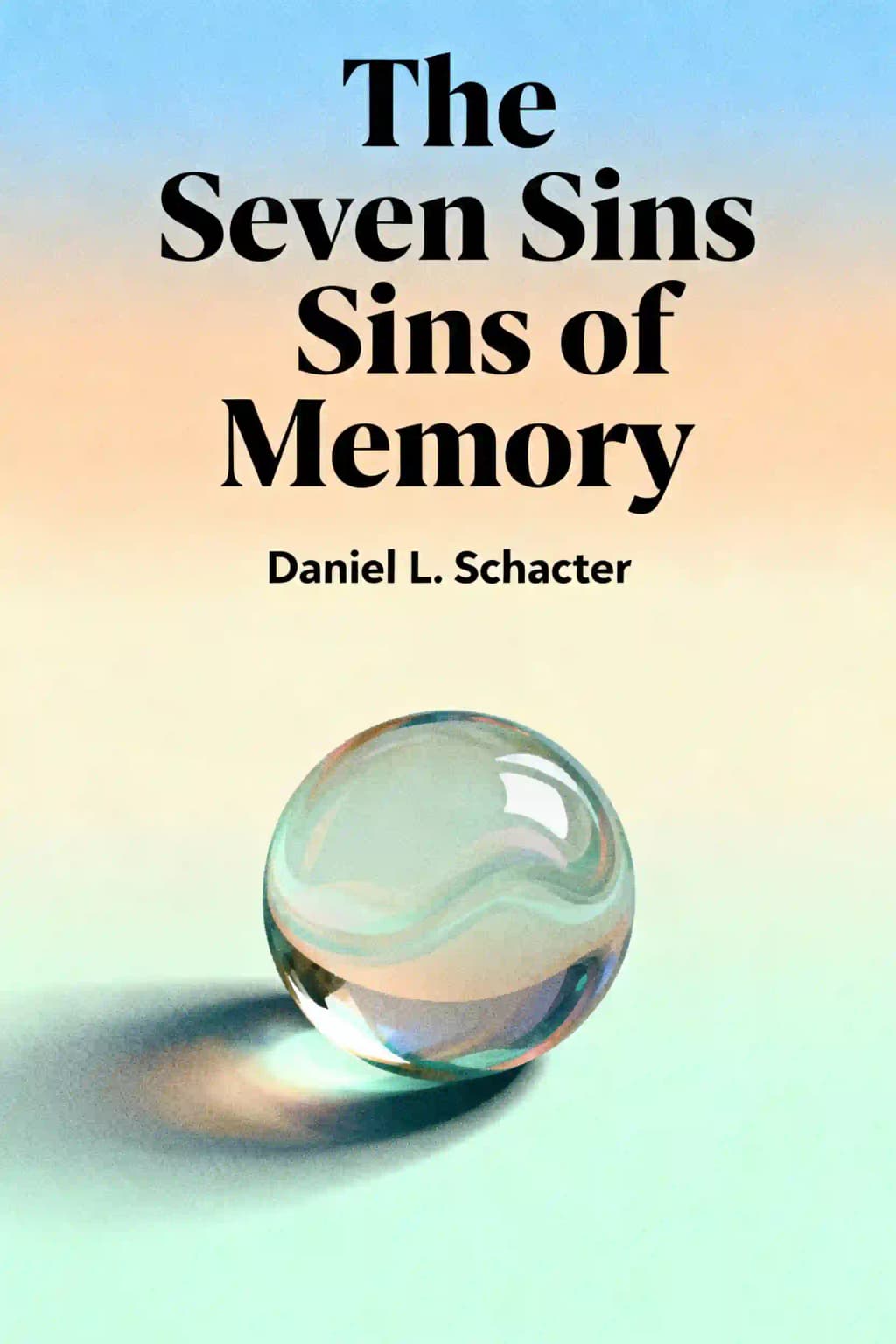
Why do you forget your keys but remember childhood trauma? Schacter's groundbreaking "Seven Sins of Memory" revolutionized psychology and legal testimony procedures by revealing how our minds betray us. This APA award-winning work offers practical solutions for our most frustrating memory failures.
Daniel L. Schacter is a renowned psychologist and memory expert, acclaimed for his seminal work The Seven Sins of Memory: How the Mind Forgets and Remembers.
As the William R. Kenan, Jr. Professor of Psychology at Harvard University, Schacter combines cognitive neuroscience with real-world applications to explore memory’s complexities. His research on constructive memory—how recollection shapes identity and imagination—forms the foundation of this psychology classic.
Schacter’s earlier book, Searching for Memory: The Brain, The Mind, and The Past, established him as a leading voice in memory studies. Elected to the National Academy of Sciences and honored with the American Psychological Association’s Distinguished Scientific Contribution Award, his work bridges academic rigor and public understanding.
The Seven Sins of Memory was named a New York Times Notable Book and has been translated into over 20 languages, cementing its status as essential reading in cognitive psychology.
The Seven Sins of Memory explores seven common memory flaws: transience, absent-mindedness, blocking, misattribution, suggestibility, bias, and persistence. Daniel Schacter, a Harvard memory researcher, argues these "sins" are adaptive byproducts of an efficient cognitive system, balancing accuracy with survival needs. The book blends real-life examples with scientific insights to explain why memories fade, distort, or haunt us.
Psychology students, mental health professionals, and general readers interested in memory science will find this book accessible and insightful. Its non-technical language makes it ideal for anyone curious about why memories fail or how to improve recall, though experts may seek deeper technical analyses.
Yes—it offers a engaging, research-backed guide to memory’s quirks without oversimplifying. Schacter’s use of relatable examples (e.g., forgetting keys or traumatic memory persistence) makes complex concepts digestible. A 2024 Goodreads review praised it as a "great introductory book" for newcomers to psychology.
Schacter categorizes memory errors into:
Schacter attributes false memories to misattribution (assigning correct details to wrong sources) and suggestibility (external influences altering recollections). He ties these to brain mechanisms that prioritize memory efficiency over precision, such as blending similar experiences or filling gaps with plausible details.
To counter memory sins, Schacter recommends:
While Kahneman’s Thinking, Fast and Slow focuses on decision-making biases, Schacter’s work targets memory-specific errors. Both highlight cognitive imperfections but from distinct angles: Schacter emphasizes adaptive memory trade-offs, whereas Kahneman explores systemic reasoning flaws.
Some critics note the book prioritizes accessibility over depth, making it less suitable for advanced researchers. A 2024 reviewer cautioned it’s "not the right book" for those seeking technical neuropsychological models.
As a Harvard psychology professor and memory neuroscientist, Schacter draws on decades of lab work, neuroimaging studies, and clinical cases. His expertise in constructive memory—how the brain assembles past experiences—shapes the book’s focus on memory’s flexibility and fragility.
In an era of information overload and AI-driven memory aids, Schacter’s framework helps users navigate attention divides and digital dependency. The book’s insights into suggestibility and bias also resonate amid concerns about misinformation and AI-generated content.
Schacter explains common issues like forgetfulness (absent-mindedness) or false memories (misattribution) as natural outcomes of an efficient brain. By normalizing these errors, the book reduces anxiety around memory lapses and offers science-backed coping strategies.
Erlebe das Buch durch die Stimme des Autors
Verwandle Wissen in fesselnde, beispielreiche Erkenntnisse
Erfasse Schlüsselideen blitzschnell für effektives Lernen
Genieße das Buch auf unterhaltsame und ansprechende Weise
Memories fade.
You can't forget what you never properly registered in the first place.
It's on the tip of my tongue!
Forgetting is as crucial as remembering.
Zerlegen Sie die Kernideen von Seven Sins of Memory in leicht verständliche Punkte, um zu verstehen, wie innovative Teams kreieren, zusammenarbeiten und wachsen.
Erleben Sie Seven Sins of Memory durch lebhafte Erzählungen, die Innovationslektionen in unvergessliche und anwendbare Momente verwandeln.
Fragen Sie alles, wählen Sie Ihren Lernstil und gestalten Sie Erkenntnisse, die wirklich zu Ihnen passen.

Von Columbia University Alumni in San Francisco entwickelt
"Instead of endless scrolling, I just hit play on BeFreed. It saves me so much time."
"I never knew where to start with nonfiction—BeFreed’s book lists turned into podcasts gave me a clear path."
"Perfect balance between learning and entertainment. Finished ‘Thinking, Fast and Slow’ on my commute this week."
"Crazy how much I learned while walking the dog. BeFreed = small habits → big gains."
"Reading used to feel like a chore. Now it’s just part of my lifestyle."
"Feels effortless compared to reading. I’ve finished 6 books this month already."
"BeFreed turned my guilty doomscrolling into something that feels productive and inspiring."
"BeFreed turned my commute into learning time. 20-min podcasts are perfect for finishing books I never had time for."
"BeFreed replaced my podcast queue. Imagine Spotify for books — that’s it. 🙌"
"It is great for me to learn something from the book without reading it."
"The themed book list podcasts help me connect ideas across authors—like a guided audio journey."
"Makes me feel smarter every time before going to work"
Von Columbia University Alumni in San Francisco entwickelt

Erhalten Sie die Seven Sins of Memory-Zusammenfassung als kostenloses PDF oder EPUB. Drucken Sie es aus oder lesen Sie es jederzeit offline.
You're standing in your kitchen, staring blankly at the open refrigerator. You came here for something specific-but what? The memory has vanished like smoke. Before you spiral into worry about cognitive decline, consider this: your brain isn't broken. It's working exactly as designed. What we call memory "failures" are actually sophisticated features of an incredibly efficient system. Think of your brain as a ruthless editor, constantly deciding what deserves storage space and what gets deleted. Every forgotten name, every misplaced memory, every frustrating tip-of-the-tongue moment reveals something profound about how we think, who we are, and why perfect memory would actually be a curse rather than a blessing.
Within an hour of meeting someone, you've forgotten half of what they said. By tomorrow, 70% has vanished. This isn't failure - it's transience, your brain's efficiency system. Without this filter, you'd drown in trivial details. Your grandmother remembers her wedding vividly but not this morning's meal. That's prioritization. Her brain determined that a life-defining ceremony deserves permanent storage while routine meals don't. Emotional intensity overrides this process, which is why you remember exactly where you were during major life events. Your amygdala stamps these memories "IMPORTANT - DO NOT DELETE." But what about memories that never form? You're cooking while texting, half-listening to a podcast, glancing at your kids. Suddenly you freeze - did you add salt? This is absentmindedness: encoding failure. Your attention was elsewhere, so no memory formed. The average person checks their phone 96 times daily, each interruption creating an encoding gap. When multitasking, you're rapidly switching tasks, each switch creating vulnerability. The doorway effect - forgetting why you entered a room - occurs because your brain files away the previous context. Stress amplifies this by flooding your prefrontal cortex with cortisol. Einstein famously used a $1,500 check as a bookmark and lost the book.
"It's right there! I know it!" The tip-of-the-tongue state reveals memory's filing system in action - the information exists but remains temporarily inaccessible, like a misfiled book. Your brain often retains partial access: the first letter, syllable count, related concepts. Neuroimaging shows your anterior cingulate cortex lighting up with cognitive conflict and incomplete language area activation. Proper names prove especially vulnerable because they're arbitrary labels disconnected from meaning. You remember everything about your former colleague except their name. This intensifies with age, not from deterioration but from accumulated interference - decades of competing associations crowding each retrieval pathway. Paradoxically, trying harder worsens blocking. Increased anxiety creates cognitive load that interferes with retrieval, which explains why blocked words often surface during relaxation. Your brain's default mode network activates, allowing diffuse associative processing that bypasses the block. Blocking isn't malfunction but necessary filtering preventing memory overload. Effective strategies: temporarily shift attention, pursue alternative retrieval paths, or create distinctive encoding contexts that reduce future interference.
You're certain you locked the door-you visualize doing it. But you return home to find it open. Memories aren't recordings but reconstructions, assembled anew each time. Misattribution occurs when we correctly remember content but incorrectly identify its source, or mistake imagination for reality. Your brain prioritizes coherent narratives over accuracy, seamlessly blending experience with knowledge, beliefs, and suggestions. This happens in the hippocampus, which binds memory elements stored across your cortex. When binding mechanisms falter, elements from different experiences intermingle. Similar brain regions activate whether you're remembering actual events or imagining hypothetical ones, explaining the confusion. Suggestibility increases misattribution dramatically. In one study, participants saw ads suggesting they'd met Bugs Bunny at Disneyland-impossible since Bugs is Warner Bros. property. Yet 16% later "remembered" this fictional encounter. Sleep deprivation worsens the problem because sleep consolidates memories, strengthening accurate connections. Most troubling: confidence bears little relationship to accuracy. People can be absolutely certain about completely false memories, devastating for eyewitness testimony. Understanding misattribution means recognizing memory's constructed nature and approaching important recollections with appropriate humility.
We don't simply remember our past - we continuously rewrite it through our current lens. Memory bias represents our tendency to unconsciously edit memories to align with present perspectives. When researchers asked participants to recall past attitudes on marijuana legalization years later, recollections shifted dramatically toward current positions, even with documentation proving otherwise. This retrospective revision preserves coherent identity and avoids cognitive dissonance. Emotional state profoundly influences recall through mood-congruent memory - when depressed, negative memories surface more readily; when happy, positive ones dominate. That first date might seem endearingly awkward during happy relationship periods but reveal warning signs during conflict. Hindsight bias - the "I-knew-it-all-along" effect - leads us to overestimate how predictable outcomes seemed beforehand. Self-serving biases ensure we remember successes as personal achievements while attributing failures to circumstances. Aging amplifies this through a "positivity effect," preferentially recalling positive experiences. Rather than viewing these as distortions, consider them adaptive mechanisms supporting psychological health and coherent identity.
Sometimes the problem isn't forgetting but remembering too well. Persistence-intrusive recollection of unwanted memories-represents memory's most emotionally painful feature, from minor embarrassments to traumatic experiences that repeatedly intrude into consciousness. Your amygdala tags emotionally charged experiences as important, leading to enhanced encoding. The same system that helps you remember genuine threats also ensures you vividly recall public humiliations or painful betrayals. Traumatic memories show distinctive characteristics: fragmented rather than coherent, with vivid sensory details but disjointed narrative. During recall, language-processing areas show reduced activity while sensory regions become hyperactive-explaining why trauma survivors struggle to verbalize experiences while being overwhelmed by sensory flashbacks. For most people, unwanted recollections naturally diminish through emotional processing. However, approximately 8-12% develop persistent intrusions that fail to resolve, forming the core of PTSD. Rumination-repetitive negative thinking-significantly exacerbates persistence. When you repeatedly rehearse negative memories, you strengthen their neural pathways, making them more accessible. Overthinking embarrassing moments makes them more likely to spontaneously intrude later. Exposure-based therapies help properly contextualize traumatic memories through repeated, controlled recollection in safe environments. Understanding persistence helps us recognize that intrusive memories reflect normal mechanisms functioning too intensely rather than mental weakness.
Memory's seven sins aren't flaws - they're adaptive features. Our memory evolved not as a recorder but as a tool for navigating present challenges and imagining futures. Transience prevents overload by clearing irrelevant information. Suggestibility enables cultural learning. Bias maintains psychological well-being and coherent identity. Persistence keeps threat information accessible. Memory's reconstructive nature - the source of many errors - is actually its greatest strength. By storing gist rather than exact replicas, our brains flexibly recombine elements to solve new problems. Perfect memory would ironically impair these functions. People with highly superior autobiographical memory struggle with decision-making, unable to prioritize relevant details, often finding their extraordinary recall burdensome. Rather than fighting memory's tendencies, work with them: create encoding environments leveraging attention, use spaced repetition, implement verification strategies, develop healthy emotional processing. Your forgetting isn't failure - it's your brain helping you focus on what matters, freeing you to imagine, create, and thrive.