Kapitel 1
The Mind's Fractured Mirror: Navigating the Depths of Human Consciousness
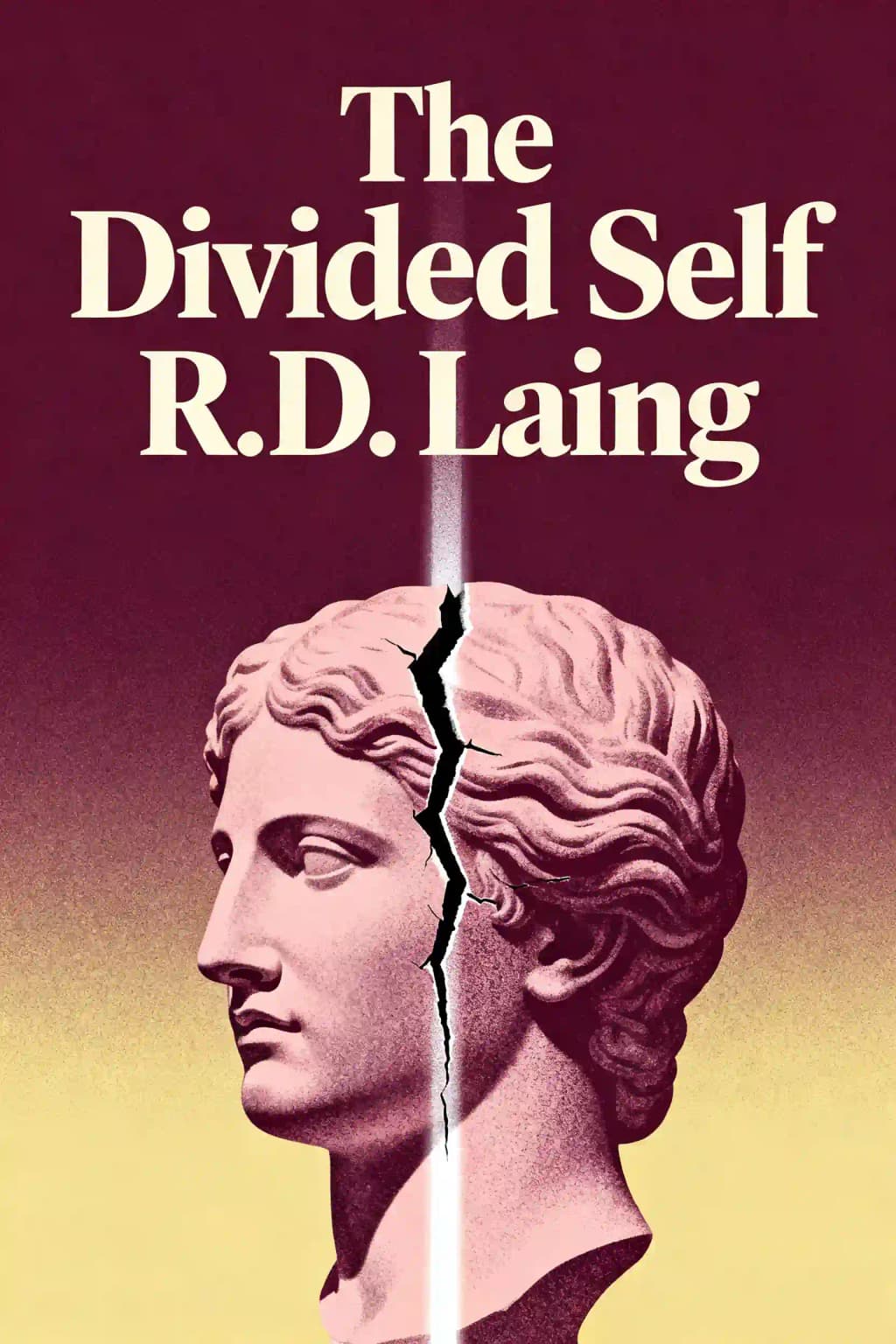
R.D. Laing's "The Divided Self" arrived like a thunderbolt in the psychiatric landscape of 1960. What began as an unlikely success-a philosophical exploration of schizophrenia by a young Scottish psychiatrist-became a counterculture touchstone that fundamentally changed how we understand mental illness. Born to a lower-middle-class Glasgow family, Laing discovered his remarkable ability to connect with psychotic patients during his army service, later developing innovative approaches at Glasgow's Royal Mental Hospital. Unlike his later more radical works that aligned with "antipsychiatry," this book represents Laing as a reformer working within psychiatry, attempting to humanize our understanding of madness rather than reject psychiatric frameworks entirely. Even his harshest critics acknowledged his contribution to demystifying mental illness. The book's enduring appeal lies in Laing's attempt to understand psychosis-to reach across what philosopher Karl Jaspers called the "abyss" separating us from those isolated in their psychotic worlds.
Kapitel 2
The Existential Foundations of a Human Science
Traditional psychiatric language splits humans verbally in ways that mirror the very existential splits being described in patients. We speak of mind, body, psyche, soma-abstractions that fail to capture the original bond between "I" and "You." This fragmentation extends beyond mere terminology - it shapes how we conceptualize mental illness, treatment approaches, and the fundamental nature of human consciousness. This fundamental problem in psychiatry creates a conceptual prison that prevents genuine understanding of the person suffering from mental illness, often reducing complex human experiences to simplified diagnostic categories.
When encountering another human, we can adopt two radically different perspectives: seeing them as a person or as a thing. Viewed as a person, the other appears responsible and capable of choice; seen as an organism, they become a complex of "it-processes." While physical sciences have overcome tendencies to personalize objects, psychiatry struggles against the opposite problem-the tendency to depersonalize humans. This depersonalization manifests in multiple ways: reducing patients to their symptoms, viewing behaviors solely through the lens of pathology, and treating the person as a collection of measurable variables rather than a conscious, experiencing being.
The existential-phenomenological approach attempts to understand the patient's way of being-in-their-world without prejudgment. This requires what Dilthey called "the cooperation of all the powers of the mind in comprehension." It demands attention to the patient's lived experience, their unique temporal and spatial orientation, and their particular way of making meaning in the world. With psychotic patients, this understanding is particularly challenging-perhaps more difficult than deciphering ancient hieroglyphic texts-because we cannot presume a shared context of living experience. The psychotic person often inhabits a radically different experiential world, with altered perceptions of time, space, and causality.
The therapist must transpose themselves into this alien worldview by drawing on their own psychotic possibilities without forgoing sanity. This requires a delicate balance between empathic immersion and professional distance, between understanding the patient's reality while maintaining one's own ground. This understanding isn't purely intellectual-it requires love, knowing how the patient experiences themselves and the world. As one schizophrenic patient explained, "The doctor's love lets me unfold and reveal myself." This therapeutic love differs from personal love - it's a form of profound acceptance and recognition of the patient's humanity, even in their most disturbed states.
The paradox of human existence is that our relatedness to others is as essential as our separateness, though no particular person is necessary to our being. This fundamental tension between connection and individuation plays out in every therapeutic relationship, where the goal is to help patients discover their authentic way of being while acknowledging their inevitable embeddedness in a world of others. The therapeutic process thus becomes a careful navigation between fostering independence and maintaining healing connection.
Kapitel 3
The Precarious Self: Understanding Ontological Insecurity
A mentally healthy person experiences themselves as real, alive, whole, and continuous-able to encounter others and the world as equally real and substantial. The ontologically insecure person lacks these basic self-validating certainties. Literary examples illustrate this contrast: Shakespeare's characters feel complete despite suffering, while Kafka's exist stripped of everything "becoming to a man except his abstract humanity."
The ontologically insecure individual feels more unreal than real, more dead than alive, with identity and autonomy perpetually in question. For such a person, ordinary circumstances constitute continual threats rather than opportunities for gratification. They struggle with three primary anxieties: engulfment (fear of being overwhelmed by relationships), implosion (terror of reality obliterating identity), and petrification (dread of being turned into a thing).
Engulfment describes the terror experienced when any relationship threatens to overwhelm one's precarious identity. A patient once broke off a group argument saying, "I am arguing in order to preserve my existence." Without a firm sense of autonomous identity, being understood, loved, or even seen risks the loss of their identity. The primary defense is isolation, creating a painful dichotomy: either complete absorption into another or complete aloneness.
Implosion represents the terror of reality crashing in and obliterating identity-like gas rushing into a vacuum. The ontologically insecure person feels empty, yet this emptiness constitutes their being. Though longing for this emptiness to be filled, they simultaneously dread it happening, having come to identify with the nothingness itself.
Petrification encompasses multiple related terrors: being turned to stone, becoming a dead thing or automaton without personal autonomy, and the "magical" act of negating another's autonomy by treating them as an object. The ontologically insecure person both fears being depersonalized and tends to depersonalize others.
Consider James, a 28-year-old chemist who complained of having "no self" and being "only a response to other people." He felt perpetually caught between insubstantiality and engulfment. Compared to others who seemed "large scale," solid and substantial, he felt lightweight and empty. To preserve his security, he employed two defensive maneuvers: outward compliance with others while secretly maintaining an intellectual "Medusa's head" that turned others into things.
Kapitel 4
The Divided Self: Mind Against Body
For the ontologically insecure person, a persistent and profound split develops between mind and body. The individual's "true self" is experienced as fundamentally disembodied, while bodily experiences and actions are relegated to a false-self system. This unembodied self experiences itself as divorced from the body, viewing the body as an object rather than the core of being-a perspective that creates a deep existential alienation from one's physical existence.
The embodied person, by contrast, feels thoroughly alive, real, and substantial through their body-they are inextricably bound up with their physical existence. They experience emotions directly through bodily sensations, feel grounded in their physical presence, and engage with the world through spontaneous bodily actions. Their thoughts, feelings, and actions form a unified whole, allowing for authentic self-expression and genuine engagement with others.
In contrast, the unembodied person experiences themselves as fundamentally detached from their body, viewing it as one object among others in the world. This detachment deprives them of direct participation in life, as everything becomes mediated through a body that feels separate and alien. Simple activities like walking, talking, or expressing emotions become complex, calculated performances rather than natural expressions of self. The body becomes a tool to be manipulated rather than the foundation of being.
David, an eighteen-year-old philosophy student, provides a striking example of this unembodied existence. Following his mother's death when he was ten, he developed increasingly eccentric behaviors-wearing a theatrical cloak, carrying a cane, and speaking entirely in quotations from philosophers and poets. David had grown up taking for granted that his "self" and his "personality" were entirely separate entities. This split allowed him to be whatever his mother wanted, as his actions belonged to a "false self" acting according to her will, not his. His true self remained hidden, never directly revealed through his actions, existing only as a detached observer of his own performance.
This division isn't merely a philosophical position but a lived reality with profound psychological and social consequences. The unembodied self becomes hyper-conscious, developing an intensely complex relationship with itself, constantly monitoring and analyzing its own thoughts and behaviors. It views its body as an alien entity that must be controlled and directed rather than lived through naturally. Physical sensations become threatening, emotions are intellectualized rather than felt, and spontaneous action becomes nearly impossible.
While neither the embodied nor unembodied position inherently guarantees mental health or indicates pathology, the unembodied position can provide fertile ground for developments that may end in psychosis. The persistent denial of bodily experience and the maintenance of a false-self system can lead to increasing fragmentation of the personality, severe anxiety, and ultimately, a complete break with shared reality.
Kapitel 5
The Inner Fortress: The Schizoid Condition
The schizoid individual maintains a persistent split between self and body as a defense against underlying ontological insecurity. The central dichotomy is between what the person considers their "own," "inner," "true," or "real" self and their "personality"-what I term a false-self system. This system often comprises various part-selves, none fully developed enough to constitute a complete personality.
The inner secret self hates and fears the characteristics of the false self, experiencing the assumption of alien identity as a threat to its own existence. The false-self system becomes increasingly dead, with the individual surrendering to a robot-like existence rather than facing frightening helplessness.
The schizoid individual's anxieties center on engulfment, implosion, and the dread of losing inner autonomy-essentially the fear of being turned from a subject into an object. When the self withdraws into mental activity, it experiences itself as an entity perhaps localized somewhere in the body. This withdrawal attempts to preserve its being, as relationships with others threaten the self's identity.
Yet this defensive maneuver fails. No one feels more vulnerable to exposure by another's gaze than the schizoid person. To manage this anxiety, they either turn others into things, depersonalizing their feelings toward them, or affect indifference. Unlike temporary dissociation that normal people might experience in threatening situations, the schizoid's splitting is a fundamental orientation to life, often traceable to early infancy.
The tragic paradox of the schizoid condition is that the more the self is defended through withdrawal, the more it is destroyed. When the self delegates all transactions between itself and others to a false-self system, the world is experienced as unreal, and all actions feel false, futile, and meaningless. The relationship becomes not "self/body -> other" but rather "self -> (body-other)"-creating a vicious circle where everything, including the self, becomes increasingly unreal and dead.
The schizoid prefers phantasy to reality not merely for its content but for its very nature as an escape from the demands of presence and adaptation that reality requires. In phantasy, the self can be anyone, do anything, have everything-omnipotent and completely free. Yet committing to any real project brings agonies of humiliation simply through subjection to necessity and contingency. The more this phantastic omnipotence is indulged, the weaker and more fettered the self becomes in actuality.
Kapitel 6
The Mask That Consumes: The False-Self System
The false-self system exists as the complement to an inner self preoccupied with maintaining its freedom by remaining transcendent and unembodied. While the inner self observes, the false self manages all direct relationships with the world. Unlike the masks worn in ordinary life, the schizoid's false self is experienced as mechanical, alien, and autonomous-something that must be repudiated as a foreign body.
This differs from the normal person's social masks, which don't preclude spontaneity or feel fundamentally alien. It also differs from the hysteric's dissociation, where one evades the personal implications of one's actions while secretly fulfilling one's desires through those very actions. The hysteric dissociates from his actions while secretly gaining gratification through them. In contrast, the schizoid's false self doesn't serve to gratify the inner self. Instead, it's compulsively compliant to others' will, partially autonomous, felt as alien, and permeated by unrealness and deadness.
The false self arises in compliance with others' expectations-being excessively "good" or sometimes deliberately "bad," but always responding to others' definitions rather than expressing one's own authentic desires. This compliance is motivated by fear and contains hidden hatred toward those who endanger the self. The false self often assumes characteristics of those it complies with, sometimes developing into total impersonation. These impersonations frequently become caricatures, revealing the hatred beneath the compliance.
Through exaggerated conformity, the schizoid paradoxically expresses negative will and hatred, as seen in James's compulsive caricature of his father's table manners or in the extreme obedience of catatonic patients that becomes a grotesque parody. The false-self system attempts to wall off dangerous intrusions like the body's reticulo-endothelial system, but ultimately fails in this defensive function.
Kapitel 7
The Paradox of Self-Consciousness
Self-consciousness involves both awareness of oneself by oneself and awareness of oneself as an object of others' observation. In the schizoid individual, both forms are enhanced to a compulsive degree, creating torment about one's own processes and body as an object in others' world. The sense of being constantly observed may extend to feeling one's mind or soul is penetrable, with others' gazes experienced as actual penetration in psychotic states.
For the ontologically insecure person, self-consciousness serves two critical functions. First, being aware of himself and others' awareness of him provides reassurance of his existence-as with Kafka's suppliant who made it "the aim of my life to get people to look at me" to gain conviction of being alive. Second, visibility creates vulnerability-to be seen is to be exposed to danger, making invisibility a natural defense.
The balance between needing to be seen to feel real and fearing visibility as dangerous creates a fundamental tension in the schizoid condition. Being visible exposes one to biological risk while invisibility offers defense. A twelve-year-old patient described playing a game of "blending with the landscape" to cope with anxiety, staring at her surroundings until she felt she'd disappeared, then repeating her name to "bring me back to life."
The schizoid individual uses self-consciousness paradoxically-both dreading and longing for aliveness. Unlike the hysteric who gladly "represses," the schizoid strives to make his self-awareness as intensive and extensive as possible. Yet this self-scrutiny isn't narcissistic warmth but hostile examination-he exists under "the black sun of his own scrutiny" that kills spontaneity and joy. He depersonalizes his relationship with himself, turning living spontaneity into something dead by inspecting it.
The "self-conscious" person faces an impossible dilemma: needing to be seen to maintain a sense of realness while simultaneously experiencing others as threats to identity. This produces elaborate defenses like James, who feels empty without others yet in danger with them. He compulsively seeks company but never allows himself to "be himself" with anyone, playing parts, laughing at jokes he finds unfunny, befriending those he dislikes.
Kapitel 8
When Defenses Fail: The Path to Psychosis
The transition from sanity to insanity often lacks clear boundaries, sometimes occurring dramatically but frequently extending over years with no definitive turning point. To understand this transition from a schizoid position, we must examine what happens when the self cuts itself off from direct relatedness with others to become its own object.
This defensive position creates a fundamental problem: the self loses its "sentiment du reel" by never actually meeting reality. Instead, relationships are delegated to a false-self system whose perceptions possess a diminished sense of realness. The individual appears normal but maintains this semblance through increasingly abnormal means.
These defenses ultimately fail their primary functions: preventing persecutory impingements and keeping the self alive. Anxiety intensifies as unrealness and falsity spread to the shared world, body, and even the "true" self. Everything becomes suffused with nothingness. The inner self becomes unreal, phantasticized, split, and dead, unable to sustain its precarious identity.
As the dissociation between self and body deepens, the body begins to feel not just compliant with others but actually possessed by them. The individual starts to feel their perceptions are false because they're seeing through others' eyes, or that people are looking at the world through their eyes.
The situation becomes critical as the individual feels increasingly unreal and dead. Realness and life exist elsewhere-in others, in Nature, or attainable through intellectual disciplines. The empty, dry self envies the rich, vivid life it perceives outside itself but cannot incorporate. Like a bottomless pit that can never be filled, it destroys rather than assimilates reality.
The individual attempts to surreptitiously acquire reality through magical means: touching, copying, imitating, or stealing it. Some seek reassurance by evoking impressions of realness in others. Others subject themselves to intense pain or terror-stubbing cigarettes on their hands or setting fire to clothing-not for masochistic pleasure but to feel something "real."
For the individual whose world has become deadened, two final possibilities remain: to "be himself" despite everything, or to attempt to murder his self. Both paths likely result in manifest psychosis. A person whose false-self system remains intact may present complete normality while an interior psychotic process unfolds secretly. Their apparently normal adjustment comes to be seen by their "true" self as a shameful pretense. If this volatilized self conceives the desire to escape its confinement, to end the pretense and reveal itself honestly, an acute psychosis may erupt seemingly "out of a blue sky."
Kapitel 9
The Fragmented Self: Julie's Story
Julie, a 26-year-old woman who had been hospitalized as a "chronic schizophrenic" for nine years, presented as the archetypal "inaccessible and withdrawn" patient-hallucinated, mute or speaking incomprehensible "schizophrenese," and engaging in bizarre behaviors and posturing. Her core complaint was that she "was not a real person" but "was trying to become a person." She described feeling empty, unreal, and separated from others by an invisible barrier.
Julie's development reveals a child who never achieved autonomy. Her mother proudly described traits indicating existential deadness: being clean from fifteen months, always doing what she was told, and never being "trouble." While her mother praised this compliance, Julie was actually petrified into what she later called herself-a "tolled bell" or "told belle," someone who was only what she was told to do.
Her obedience became pathological-requiring complete instructions for each day, refusing to make decisions, and never expressing desires. Brief episodes of nail-biting, word-reversal, and overeating offered glimpses of a suppressed inner world of destructiveness.
At seventeen, Julie crossed from being "bad" to being "mad" following a pivotal incident involving her childhood doll. This doll-which she had from infancy and called "Julie Doll"-represented a secret enclave in her life. When her mother insisted she give it up "because she was a big girl now," the doll mysteriously disappeared. Shortly after, Julie began hearing voices telling her that her mother had "beaten a child wearing her clothes to pulp."
Julie's self-being had fragmented into what Laing describes as "a death-in-life existence approaching chaotic nonentity." When with her, one experienced the uncanny "praecox feeling"-sensing another human being's presence yet feeling no one was there. Her speech resembled group therapy with a single patient-a jumble of disparate attitudes, feelings, and expressions that changed from moment to moment.
Julie's fragmentation manifested in both molar splits (several quasi-autonomous "partial assemblies" each with its own stereotyped personality) and molecular splits (fragmentation of behavior sequences down to disrupted word integrity). Without personal unity, Julie lacked reflective awareness-the ability to be aware of herself acting. Each partial system could perceive objects but remained unaware of processes in other split-off systems.
Her existence was depicted in images of desolation: "I'm the prairie. She's a ruined city." "She's the ghost of the weed garden." "The pitcher is broken, the well is dry." Yet within this barrenness, she maintained a psychotic belief in something valuable buried deep within: "the bright gold" or "the pearl at the bottom of the sea."
Kapitel 10
Finding the Path Back: The Possibility of Healing
Despite the profound fragmentation of the schizophrenic self, healing remains possible. Joan, a twenty-six-year-old schizophrenic woman in recovery, articulates the fundamental schizophrenic dilemma: the self desires connection with the body yet fears lodging within it due to perceived dangers. This divorce of self from body becomes both a painful condition and the primary defense mechanism.
Schizophrenics deliberately use obscurity and nonsense as protective strategies. Joan explains that patients "laugh and posture" to distract doctors from important matters, simultaneously pleasing and confusing them. This supports Jung's observation that schizophrenic symptoms often "evaporate" when the person feels genuinely understood. Joan poignantly compares schizophrenia to "nightmares where you try to call for help and no sound comes out," emphasizing that only a doctor's unconditional love and acceptance can begin healing the fragmented self.
The schizophrenic self, having lost contact with its own sense of realness, desperately seeks external validation of its existence. Joan describes how patients "kick and scream" when they feel invisible to their doctors-not out of mere defiance but from the terrifying sense that without being seen, they might not exist at all.
Joan articulates a crucial paradox: "Hate has to come first." The schizophrenic patient must express hatred before love can emerge, yet feels tremendous guilt about this hatred potentially harming the doctor. The therapist must "fight to get in" despite resistance, demonstrating both strength and genuine care.
Even in the most deteriorated schizophrenic, some vestige of self remains-an 'I' that cannot find a 'me'. This disembodied 'I' lacks substance and identity but persists nonetheless. Without this remnant, therapy would be impossible. Joan's struggle centered on preserving her identity while feeling unable to exist as an embodied person. Her madness gave her distinction-"catatonic, paranoid and schizophrenic" provided an identity when she couldn't be herself. Her healing began when she felt securely loved: "If you could like the real me, then I could too."
The schizophrenic's fundamental split severs self from body, creating confusion between inside/outside boundaries. Healing requires establishing clear distinctions between self and other, allowing the person to embody their true self rather than mirroring others or retreating into defensive "death-in-life"-a state Joan described perfectly: "I had to die to keep from dying."