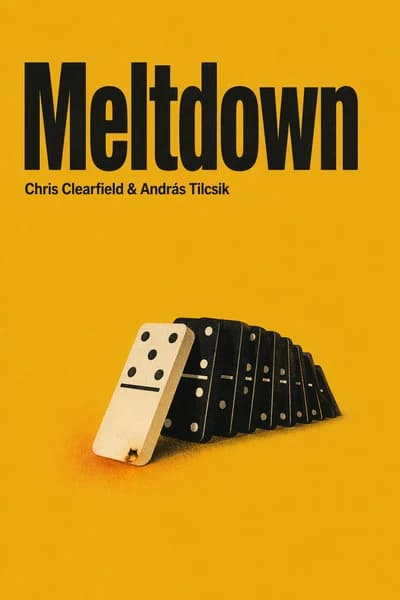
"Meltdown" reveals why complex systems fail catastrophically - from nuclear disasters to financial crashes. Winner of the National Business Book Award, this Financial Times best book offers what Charles Duhigg calls "insight more fun than a book about failure has any right to be."
Erlebe das Buch durch die Stimme des Autors
Verwandle Wissen in fesselnde, beispielreiche Erkenntnisse
Erfasse Schlüsselideen blitzschnell für effektives Lernen
Genieße das Buch auf unterhaltsame und ansprechende Weise
On June 28, 1979, operators at Three Mile Island stared at a control room in chaos. Alarms screamed. Readings contradicted each other. The computer monitoring system printed only question marks. Within thirteen seconds, critical failures had cascaded through the reactor. In under ten minutes, the core was damaged. The operators believed they had too much water in the reactor when, in fact, they had too little-a misinterpretation that nearly caused a catastrophic meltdown. This wasn't a story of incompetence or negligence. It was something far more unsettling: a preview of how modern disasters unfold in systems so complex that failure becomes not just possible, but inevitable. Sociologist Charles Perrow revolutionized our understanding of disasters when he identified two characteristics that make systems vulnerable. First, complexity-when components interact in ways operators can't anticipate. Second, "tight coupling"-when little slack exists between parts, allowing failures to spread with terrifying speed. When both factors align, you enter what Perrow called the "danger zone," where accidents aren't aberrations but natural outcomes of system design itself. Nuclear plants live permanently in this zone. Chain reactions require precise conditions where small deviations trigger major problems. Timing is everything. You can't pause a reactor mid-crisis to think things through. From nuclear plants to social media campaigns, from financial markets to hospital wards, we're living in what experts call "the golden age of meltdowns"-and most of us don't even realize it.
Zerlegen Sie die Kernideen von Meltdown in leicht verständliche Punkte, um zu verstehen, wie innovative Teams kreieren, zusammenarbeiten und wachsen.
Destillieren Sie Meltdown in schnelle Gedächtnisstützen, die die Schlüsselprinzipien von Offenheit, Teamarbeit und kreativer Resilienz hervorheben.

Erleben Sie Meltdown durch lebhafte Erzählungen, die Innovationslektionen in unvergessliche und anwendbare Momente verwandeln.
Fragen Sie alles, wählen Sie die Stimme und erschaffen Sie gemeinsam Erkenntnisse, die wirklich bei Ihnen ankommen.

Von Columbia University Alumni in San Francisco entwickelt
"Instead of endless scrolling, I just hit play on BeFreed. It saves me so much time."
"I never knew where to start with nonfiction—BeFreed’s book lists turned into podcasts gave me a clear path."
"Perfect balance between learning and entertainment. Finished ‘Thinking, Fast and Slow’ on my commute this week."
"Crazy how much I learned while walking the dog. BeFreed = small habits → big gains."
"Reading used to feel like a chore. Now it’s just part of my lifestyle."
"Feels effortless compared to reading. I’ve finished 6 books this month already."
"BeFreed turned my guilty doomscrolling into something that feels productive and inspiring."
"BeFreed turned my commute into learning time. 20-min podcasts are perfect for finishing books I never had time for."
"BeFreed replaced my podcast queue. Imagine Spotify for books — that’s it. 🙌"
"It is great for me to learn something from the book without reading it."
"The themed book list podcasts help me connect ideas across authors—like a guided audio journey."
"Makes me feel smarter every time before going to work"
Von Columbia University Alumni in San Francisco entwickelt

Erhalten Sie die Meltdown-Zusammenfassung als kostenloses PDF oder EPUB. Drucken Sie es aus oder lesen Sie es jederzeit offline.