Kapitel 1
When Following Orders Can Be Deadly: The Art of Intelligent Resistance
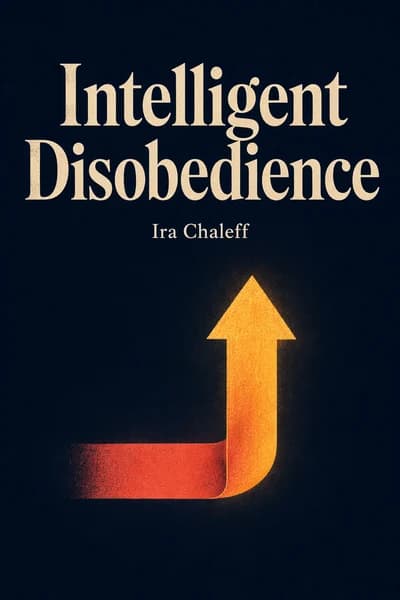
What if the most dangerous words in the world are "I was just following orders"? From the Holocaust to corporate fraud scandals, history is littered with devastating consequences of blind obedience. Yet most of us believe we would resist harmful directives. The uncomfortable truth? Research shows roughly two-thirds of us will follow authority figures' instructions even when they clearly cause harm. Ira Chaleff's groundbreaking book "Intelligent Disobedience" tackles this disturbing human tendency head-on, offering a revolutionary framework for knowing when-and how-to say no to authority. Named one of the "100 best minds on leadership" by Leadership Excellence magazine, Chaleff draws inspiration from an unexpected source: guide dog training. These remarkable animals are taught to disobey commands that would endanger their handlers-a skill desperately needed in human organizations. With applications spanning from corporate ethics to childhood development, this book has become required reading in leadership programs worldwide, offering a powerful antidote to the "just following orders" mentality that continues to threaten our institutions and lives.
Kapitel 2
The Delicate Balance Between Obedience and Personal Responsibility
Obedience and disobedience aren't inherently good or bad-context determines their value. Human society requires organization around rules to function effectively, but blind obedience can lead to catastrophe. Appropriate obedience requires three components: a reasonably fair and functioning system; a legitimate and reasonably competent authority figure; and an order that is reasonably constructive. When any of these elements is missing, intelligent disobedience may be necessary.
The simplest test for when to disobey is straightforward: if obeying will likely produce more harm than good based on available information, disobeying is right-at least until the situation is clarified. This isn't about rebellion but about upholding higher values and preventing harm.
We're wired to obey through evolutionary adaptation. Our reasons for obeying evolve as we grow-from obeying because authority says to, to obeying for social rewards, to recognizing society's need for predictability, and finally to obeying because we recognize the intrinsic value of rules in context. Yet we must develop two social algorithms: the dominant algorithm of obedience (used most often) and the crucial override algorithm of intelligent disobedience (used when necessary).
Unlike civil disobedience, which intentionally challenges an entire system through public violations of laws, intelligent disobedience works within the system to prevent specific harmful outcomes. It's about finding the third option between blind obedience and outright defiance that best serves immediate needs while preserving the possibility for later systemic change.
Wise leaders actually value intelligent disobedience, recognizing it protects them from their own mistakes. Many executives are horrified to discover what's being done "because you said so"-casual comments misinterpreted as directives that create inefficiencies or problems. The capacity for appropriate questioning serves both the leader's self-interest and the organization's wellbeing.
Kapitel 3
Finding Your Voice When It Matters Most
Intelligent disobedience requires not just refusing orders but communicating effectively why you're questioning them. Your voice level may vary by situation, but clarity is essential when warning of danger. The challenge is balancing respect for authority with the responsibility to prevent harm.
Service dogs must develop appropriate "voices" for intelligent disobedience based on their natural temperament and their handler's needs. Guide dogs communicate through unambiguous body language when refusing commands that would endanger their team. The handler must trust that when the dog refuses a command, there's good reason, and must reward this protective behavior or it will deteriorate over time-a lesson that applies equally to human organizations.
Humans have a broader range of "voice" options than service animals. In clear danger situations, firm refusal is necessary-like the soldier who refused to fire on what he correctly identified as friendly troops. The greater challenge comes when we're uncertain about our interpretation of danger, where we must still take responsibility through appropriate communication.
Mitigating language-deferential or indirect speech used by those with less formal power-can be useful in non-urgent situations but dangerous in emergencies. The Air Florida Flight 90 crash illustrates this danger: when the captain dismissed the first officer's concerns about instrument readings, the officer backed down with "maybe it is" instead of escalating his warning. This deference to authority resulted in disaster.
The aviation industry's Crew Resource Management training helps override cultural deference to authority by teaching all crew members to communicate risks assertively. This is especially important in cultures with high deference to authority, where training can reframe assertiveness as protecting the group rather than criticizing leaders. The medical field has adapted similar protocols, requiring every surgical team member to vocally confirm procedures regardless of hierarchy, reducing hospital errors.
Kapitel 4
Understanding the True Risks of Compliance
When faced with sudden, questionable orders, we need mental strength to slow things down and process rationally. The challenge is cognitive dissonance-when new information conflicts with existing beliefs, we tend to rationalize away the conflict rather than confront it. Unlike a guide dog that pauses firmly to assess risks, humans often rush to comply with authority despite warning signs.
Betty Vinson's story at WorldCom illustrates this danger. As a loyal accounting manager, she was instructed to make improper financial adjustments to mask the company's difficulties. Despite initial hesitation about violating accounting rules, she succumbed to authority pressure when assured this was a one-time action for the company's benefit. Her cognitive dissonance led her to rationalize away warning signs. When the underlying problems persisted, she continued making fraudulent entries for six quarters until discovery. Though she cooperated with federal prosecutors, she still served jail time, having prioritized short-term job security over the true long-term risks of her actions.
Pressure to violate standards happens across all professions-from teachers giving test answers to police underreporting crime statistics, medical administrators filing fraudulent claims, and VA administrators falsifying wait times. These situations typically involve meeting numerical quotas or goals, which quality management expert W. Edwards Deming warned against.
When faced with sudden inappropriate instructions, we must: recognize our discomfort as an ally, resist rationalizing, slow down the action, allow higher mental processes to recover, identify violated values and true risks, ask tough questions, reject inadequate rationalizations, engage authorities with alternatives, refuse to join harmful actions, and accept short-term consequences while appreciating the long-term dangers avoided.
Kapitel 5
The Disturbing Science of Obedience
Why do people demonstrate such poor judgment when following authority figures? Research from over fifty years ago provides disturbing evidence that approximately two-thirds of us would obey harmful orders under certain circumstances. Despite its critical importance, this research remains insufficiently incorporated into professional training across sensitive fields.
Stanley Milgram's experiments emerged from post-World War II questions about how "civilized" people could follow orders to commit atrocities. The experiments revealed that two-thirds of subjects obeyed orders to administer what they believed were potentially lethal electric shocks to victims. When subjects were asked to predict their own behavior beforehand, over 75% believed they would stop at moderate shock levels, yet in practice many continued to the maximum 450 volts. This disconnect between self-perception and actual behavior highlights the power of authority over personal ethics.
Milgram's experiment used three key roles: "the experimenter" (an authority figure in a lab coat), "the victim" (an actor playing a learner receiving fake shocks), and "the teacher" (the actual subject). The teacher administered increasingly severe shocks whenever the learner made mistakes. As shocks increased, the victim displayed escalating distress-grunting at 75 volts, shouting at 120, screaming at 270, and falling silent after 330 volts. Though most teachers expressed discomfort, they continued when the experimenter used four escalating "prods": "Please continue," "The experiment requires that you continue," "It is absolutely essential," and "You have no other choice."
A 2010 French documentary replicated Milgram's experiment as a TV game show called "Game of Death." Despite the victim's screams and pleas, 80% of participants continued to the maximum 460-volt shock when urged on by the presenter and audience. Only 16 of 80 participants refused. We continue to confuse technical agents with legitimate authority and derive satisfaction from efficiently complying with orders while ignoring their morality.
Kapitel 6
Breaking the Spell of Harmful Authority
Milgram conducted variations on his famous experiment to identify factors that could encourage intelligent disobedience. When he varied the physical proximity between teacher and learner, compliance rates changed dramatically. With the learner in another room (only voice feedback), 65% of teachers administered the maximum shock. When the learner was visible in the same room, compliance dropped to 40%. When teachers had to physically force the learner's hand onto the shock plate, only 30% complied fully. This raises concerning questions about modern remote warfare and cyberattacks, where operators never witness the suffering they cause.
When authority figures were physically distant (giving orders by telephone instead of being present), full compliance dropped to just 20%. Some subjects even covertly disobeyed by administering lower shocks while falsely reporting compliance. The physical presence requirement for compliance suggests a criterion for evaluating legitimacy of authority.
When Milgram introduced two researchers giving contradictory instructions-one insisting the experiment continue and one demanding it stop-not a single subject followed orders to continue. This reveals that obedience occurs within a social context where multiple authorities often exist. One authority figure countermanding another completely disrupted compliance with harmful orders, even when both held equal status.
Literature on bullying increasingly recognizes the bystander as potentially the most powerful actor to interrupt destructive behavior. Milgram's variation placing the subject between two confederates who refused to continue demonstrated this power-when both confederates quit, 90% of subjects also refused to continue. Seeing others resist normalizes resistance, witnessing others take stands without penalty recalibrates perceived risk, and fear of group sanctions shifts toward those who continue compliance.
The most disturbing variation revealed 90% compliance when subjects performed ancillary roles rather than administering shocks directly. Without immediate psychological strain, most participants followed experiment norms over moral considerations. This explains why individuals in bureaucracies participate in harmful systems-they're distanced from consequences.
Ten key lessons emerge from these variations: 1) Speak up early about discomfort with orders; 2) Request morally questionable orders in writing; 3) Rely on higher values when orders conflict with them; 4) Create opportunities for others to practice questioning technical orders that conflict with moral ones; 5) Visualize remote impacts of your actions; 6) Question orders you avoid implementing when authority is absent; 7) Recognize that feeling bad while complying doesn't absolve you; 8) Authorities must speak against wrong orders; 9) Don't let politeness prevent you from speaking up; 10) Support others who resist wrong orders before you do.
Kapitel 7
Learning from Guide Dogs: The Art of Intelligent Disobedience
Guide dog training offers a powerful model for developing human capacity for intelligent disobedience. The fundamental principle is that the leader sets the direction while the guide dog finds a safe way to get there. Guide dogs are trained to stop at intersections and wait for commands. While the human listens for traffic patterns to determine when to cross, the dog must decide whether it's actually safe to proceed when commanded. If a danger like a fast-moving bike appears, the dog must override the command and stay put.
Guide dog training balances praise with correction. When a dog successfully executes a skill, it receives hearty verbal and physical praise, building confidence and trust. When correction is needed, trainers use a firm leash pull with the expression "phooey." Crucially, after any correction, the dog is always given the chance to retry the action correctly, with three opportunities to succeed. If the dog still doesn't understand after three attempts, trainers stop for the day to prevent creating fear or anxiety-an important principle applicable to all education and training contexts.
The effectiveness of intelligent disobedience depends greatly on how authority figures respond when disobeyed. Guide dog handlers who override their dog's refusal to obey typically suffer consequences like walking into obstacles. This happens because we proceed through life with mental maps that can be incorrect yet difficult to question. Leaders, whether literally or metaphorically blind, must train themselves to be responsive to acts of intelligent disobedience.
Dogs learn through experiencing consequences-if they obey a dangerous command during training, they experience controlled negative outcomes like a trainer's staged stumble or a gentle car "sideswiping." Training progresses to complex scenarios like "box traps" where dogs must problem-solve to lead their handlers safely around obstacles. Most importantly, dogs eventually transition from acting based on praise or correction to genuinely caring about their handler's well-being. This progression mirrors human moral development, moving from avoiding punishment to valuing others' welfare.
Ten key lessons from guide dog training can develop human capacity for intelligent disobedience: 1) It can be developed through carefully designed training and practice; 2) Begin with simple simulations and progress to complex situations; 3) Emphasize praise for appropriate acts during practice; 4) Demonstrate adverse consequences of inappropriate compliance; 5) After failure, restart the simulation to build confidence; 6) Allow three attempts to generate effective responses before stopping for the day; 7) Practice counter-pulls to bring leaders to safer positions; 8) Create complex scenarios requiring creative alternative solutions; 9) Have followers return lead roles to authorized leaders after danger passes; 10) Have individuals practice both roles to better understand follower perspectives.
Kapitel 8
The Price of Teaching Obedience Too Well
Unfortunately, there is virtually no intelligent disobedience training in human school systems, leading to disturbing cases of misplaced obedience. In 2004, eighteen-year-old Louise Ogborn became the victim of a horrific hoax at a Kentucky McDonald's when a caller impersonating a police officer convinced her manager to strip-search her. For four hours, Louise endured escalating humiliation and sexual abuse as restaurant staff followed the caller's increasingly sadistic instructions. This wasn't an isolated incident-the same caller successfully targeted nearly seventy establishments across thirty states.
When asked why she complied with such degrading treatment, Louise heartbreakingly explained: "My parents taught me when an adult tells you to do something, you don't argue. If someone swipes you on the hand you listen." This reveals the unrecognized conundrum parents face: teaching children to respect authority while leaving them vulnerable to its abuse. At eighteen, Louise still felt powerless against "higher authority," demonstrating how deeply ingrained childhood obedience training can remain.
Classroom management systems like Fred Jones's and Lee Canter's teach precise techniques for student compliance that mirror authority dynamics. Jones instructs teachers on specific nonverbal cues-eye contact, hand placement, jaw position-creating an authoritative presence like "the dour Queen Victoria." Canter emphasizes explicit directions ("eyes on me, nothing in your hands but pencil, no one talking") and structured consequences for disobedience. Both systems regulate every aspect of classroom life from pencil sharpening to bathroom visits.
With students spending approximately 15,000 hours under these systems before graduating-well beyond the 10,000 hours Malcolm Gladwell identifies as needed for mastery-we may be creating citizens who are "masterfully obedient." While these systems replaced harsher disciplinary methods, they raise critical questions about how to maintain classroom order while developing healthy autonomy and teaching students when to question inappropriate authority.
Kapitel 9
Teaching the Courage to Question Authority
How can we develop intelligent disobedience in human development when formal education has given it little attention? The challenge lies in the paradoxical structure of teacher-student relationships-teachers must simultaneously exercise authority while teaching its appropriate limits.
Milgram's research reveals that humans exist in two distinct states: an autonomous state where we make choices based on our own understanding of right and wrong, and an agentic state where we become agents of those in authority. Once shifted into the agentic state, most find it difficult to shift back, yet remaining solely in this state is dangerous. We must teach children about these two states, help them recognize when they're in each, and develop their ability to self-regulate and move between them appropriately.
We cannot wait until age nine or ten to begin teaching intelligent disobedience to children. The story of the boy at camp who refused to change without privacy demonstrates how effective this training can be. When the counselor demanded he change in a bathroom without stalls, the child firmly stated his boundary: "I don't want anyone to see me and I don't want to see anyone else's privates." Despite the counselor's pressure, he maintained his position until the camp director ultimately respected his right to privacy. This experience equipped him to move from Milgram's "agentic state" to his own "autonomous state."
Refusal skills form the essential toolbox of intelligent disobedience. Children taught these skills make better choices and avoid high-risk behaviors. While many educational programs teach resistance to peer pressure, they often omit practicing resistance to authority figures-a serious gap in preparing for intelligent disobedience.
Role play and improvisational theater provide powerful tools for building the neural networks, language patterns, and muscle memory needed for intelligent disobedience. Just as guide dogs and airline crews train through simulations, children can practice resistance skills through structured scenarios. Such role plays allow participants to experience the emotions of challenging authority and develop effective responses using voice, body language, and persistence. However, these exercises must be tailored to different cultural contexts-for example, boys of color may need specific training on safely navigating police encounters where complete outward obedience might be necessary for survival.
Key principles include: instilling attitudes and skills from the earliest developmental age; teachers balancing their authority with inviting appropriate questioning; making individuals aware they are responsible for choices even when following authority; engaging children from preschool onward about why actions are appropriate; developing awareness of legitimate requests versus one's moral sense; using teaching stories and demonstrations with guide dogs; designing age-appropriate role plays to practice skills; teaching children to respect their feelings about their bodies; addressing physical posture and voice elements; and intentionally balancing cultural training for obedience with explicit skills for disobeying when necessary.
Kapitel 10
The Courage to Do Right: From Preparation to Action
Whether in workplace settings or childhood development, preparation for intelligent disobedience is critical-it may be too late to develop this discipline when most needed. Rick Rescorla's actions on September 11, 2001, illustrate this principle. As Morgan Stanley's security vice president, he disregarded Port Authority announcements to stay put and instead evacuated 3,700 employees from the World Trade Center. His prior acts of intelligent disobedience-insisting on monthly evacuation drills despite executive resistance-made his decisive action possible when disaster struck, saving thousands of lives.
Professor James Reason identifies three pillars that supported Rescorla's successful actions: identifying and assessing expected hazards, developing countermeasures through testing and training, and effectively deploying these countermeasures through situational awareness. Reason's work also describes "correct violation"-when following usual rules would be harmful, making intelligent disobedience appropriate.
The timing of resistance is crucial. Betty Vinson, the WorldCom accountant who participated in accounting fraud, initially hesitated but eventually complied, finding herself unable to extract herself once entangled. Research analyzing Milgram's experiments shows that subjects who resisted earlier were more likely to ultimately refuse harmful orders.
Analysis of Milgram's experiments reveals three important insights for intelligent disobedience training: First, earlier questioning increases likelihood of breaking from harmful compliance; second, the strain of values clash must be consciously resolved rather than automatically relieved through compliance; and third, the mesmerizing flow of obedience must be deliberately interrupted. Voicing discomfort or asking clarifying questions is insufficient-direct objections are needed to break authority's spell and recover autonomy.
Creative intelligent disobedience involves overcoming systemic barriers rather than just disobeying direct orders. Barry Richmond, a retired National Guard colonel, exemplifies this approach by questioning what intelligent disobedience truly means: "Is it simply disobeying a problematic order? Or disobeying command intent? Or a particular interpretation of a regulation? Or, even more profoundly, is it disobeying the barriers we ourselves erect to discovering ways to do what is needed?"
Richmond demonstrated this when he acquired 40 used SUVs from the Department of Natural Resources for his National Guard unit despite initial rejections. He later secured an entire closing state hospital campus for emergency response training by overcoming both internal and external roadblocks. His success demonstrated the key elements of creative intelligent disobedience: commitment to mission, situational awareness, autonomous thinking, bias for action, and perseverance against bureaucratic barriers.
Kapitel 11
Building Cultures of Moral Courage and Personal Accountability
Intelligent disobedience operates at all levels of human activity, from personal safety to cultural identity. The tension between individual autonomy and authority must remain in dynamic balance-when individuals dismiss authority, culture cannot maintain order; when authority dismisses individuals, it dehumanizes those it serves. Modern technology poses new challenges as states and corporations can monitor and potentially control individuals, making moral development and resistance to unwarranted authority even more crucial.
Unlike civil disobedience, intelligent disobedience creates balance within existing systems-protecting both individuals and the true interests of the group. The goal is to prepare greater segments of the population to distinguish between appropriate and inappropriate obedience, developing personal accountability regardless of where orders originate. Like guide dogs, not all humans will master this distinction, but we can aspire to this capacity: to do the right thing when told to do wrong.
If intelligent disobedience becomes part of our cultural identity, future generations would rather resist than bring shame through blind obedience. This could prevent the rise of destructive leaders, as people would resist harmful orders from the beginning. The time to develop these competencies is now, before they're needed-through preparation and practice in families, schools, hospitals, corporations, and beyond.
The concept of courageous followership offers complementary strategies for developing trusted relationships with leaders that support speaking candidly while preserving integrity. The model consists of five behaviors: the courage to assume responsibility (taking action without orders); the courage to support the leader (when aligned with mission and values); the courage to challenge the leader (questioning inconsistencies); the courage to participate in transformation (supporting improvement); and the courage to take a moral stand (refusing immoral activities).
These behaviors require courage because they carry risk, but we can develop this courage regardless of leadership encouragement. Leaders who actively foster these behaviors create safer organizations and cultures of intelligent disobedience. The ultimate question remains: What action will you take?