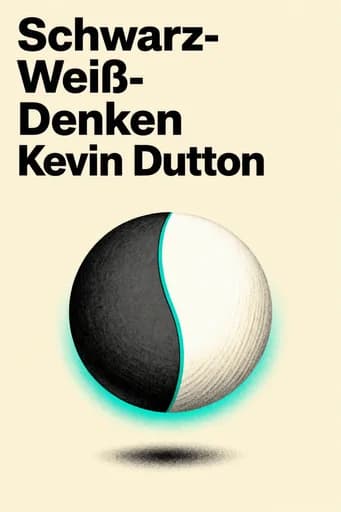
Black-And-White Thinking
The Burden of a Binary Brain in a Complex World
Überblick über Black-And-White Thinking
In "Black-and-White Thinking," Kevin Dutton reveals how our binary brains sabotage modern decision-making. Endorsed by Sir Philip Pullman as "entirely convincing," this eye-opening exploration explains Brexit, political extremism, and why your brain's evolutionary shortcuts might be your biggest liability.
Kernthemen in Black-And-White Thinking
- binary categorization
- evolutionary psychology
- cognitive shortcuts
- social polarization
- taxonomic thinking
Zitate aus Black-And-White Thinking
Everyone has a right to run!
I was just doing my job-sorting things into boxes.
Life proceeds in imperceptible grains, yet our attention fixates only on heaps.
Personen in Black-And-White Thinking
- Kevin DuttonAuthor and psychologist exploring binary thinking
- Lynn KimseyEntomologist who used insect taxonomy for the FBI
- Vincent BrothersMurder suspect whose alibi was tested by science
- Paul Sinton-HewittFounder of the global running phenomenon Parkrun
- Lisa OakesPsychologist who studied categorization in infants
Über den Autor
Über den Autor von Black-And-White Thinking
Kevin Dutton is a research psychologist, bestselling author, and expert in cognitive psychology and social influence, best known for Black and White Thinking: The Burden of a Binary Brain in a Complex World.
A longtime academic at Oxford and Cambridge Universities, his work explores how polarized thinking shapes human behavior, drawing from his studies of psychopathic traits and persuasion.
Dutton’s fascination with rigid mental frameworks stems partly from observing his father, a charismatic London market trader whose psychopathic tendencies inspired his research. His other notable works include The Wisdom of Psychopaths, which examines the advantages of psychopathic traits in high-pressure professions, and Flipnosis, a study of split-second persuasion translated into 18 languages.
Co-author of The Good Psychopath’s Guide to Success with SAS veteran Andy McNab, Dutton frequently appears on platforms like Channel 4’s Psychopath Night and co-hosts the Psycho Schizo Espresso podcast. His SPICE model of social influence is used by military and corporate leaders to optimize decision-making.
Black and White Thinking synthesizes decades of research into why humans default to binary choices—a concept he popularized through TED-style talks and collaborations with Oxford Elite Performance.
Zusammenfassung von Black-And-White Thinking herunterladen
Erhalten Sie die Black-And-White Thinking-Zusammenfassung als kostenloses PDF oder EPUB. Drucken Sie es aus oder lesen Sie es jederzeit offline.
FAQ zu diesem Buch
Black-and-White Thinking explores how the human brain defaults to binary categorization as an evolutionary survival mechanism, examining both its advantages (quick decisions) and pitfalls (oversimplification). Dutton blends psychology, philosophy, and real-world examples like Brexit and COVID-19 policy debates to illustrate how rigid thinking shapes societal and personal choices.
This book appeals to psychology enthusiasts, leaders navigating complex decisions, and anyone seeking to recognize cognitive biases. It’s particularly relevant for readers interested in persuasion tactics, social dynamics, or improving emotional resilience in polarized environments.
Yes, for its insightful analysis of mental shortcuts and their societal impacts. Reviews praise its depth but note occasional repetitiveness. Readers gain actionable frameworks to identify and mitigate binary thinking in relationships, politics, and career decisions.
Dutton argues binary thinking evolved to help early humans quickly assess threats and opportunities. While effective for survival, this "cognitive shortcut" becomes problematic in modern contexts requiring nuanced judgment, such as gender identity debates or ethical dilemmas.
The book analyzes Brexit’s divisive rhetoric, COVID-19 policy polarization, and historical events like the Cold War. These cases demonstrate how binary frameworks amplify conflict and hinder compromise.
Co-developed by Dutton, the SPICE model identifies five persuasion principles: Simplicity, Perceived self-interest, Incongruity, Confidence, and Empathy. It’s used to dissect how leaders, marketers, and conspiracy theorists exploit binary narratives.
Dutton critiques rigid gender classifications as a cultural example of black-and-white thinking. He highlights evolving social norms to argue for spectrum-based perspectives, though some readers desire deeper exploration of this topic.
Critics note repetitive explanations and uneven depth in applying concepts to contemporary issues. Some argue Dutton’s focus on academic theories overshadows practical solutions for overcoming cognitive biases.
While both books examine extreme cognition, The Wisdom of Psychopaths focuses on harnessing traits like fearlessness for success. Black-and-White Thinking broadens the scope to societal polarization, offering a more systematic critique of mental rigidity.
Yes. Dutton provides tools to recognize oversimplification in high-stakes environments like finance or healthcare. Techniques include "cognitive recalibration" to balance intuition with analytical thinking, fostering adaptability in leadership.
- “The brain is a prediction machine wired for certainty, not truth.”
- “In a complex world, the most dangerous illusion is clarity.”
These lines underscore the tension between evolutionary instincts and modern demands for nuance.
As AI and global crises amplify information overload, Dutton’s framework helps navigate misinformation and ideological echo chambers. The book equips readers to engage constructively in debates about technology, climate, and equity.