Kapitel 1
Through the Rabbit Hole: A Journey into Nonsensical Wonder
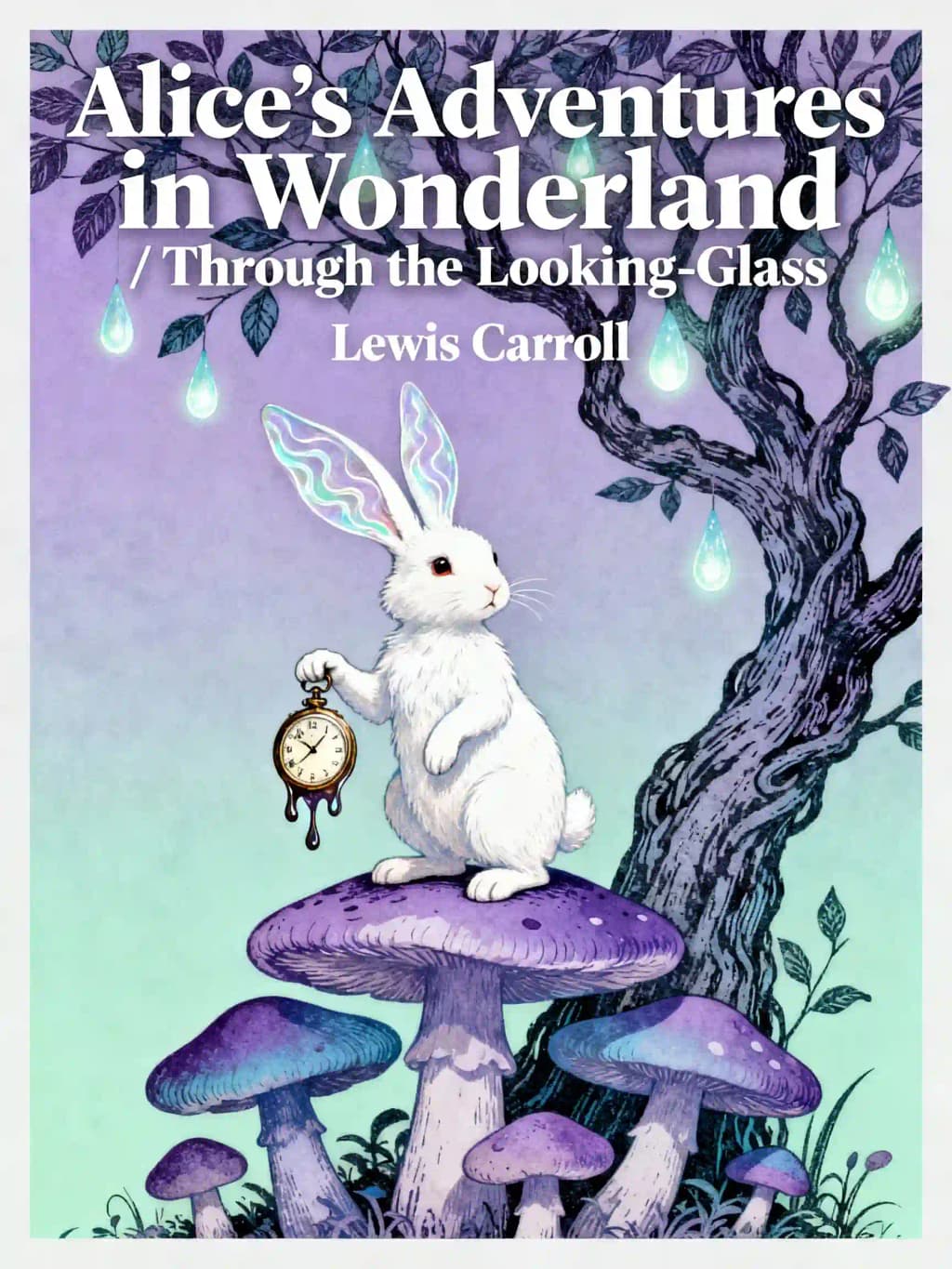
Lewis Carroll's Alice books have enchanted readers for over 150 years, creating a cultural phenomenon that extends far beyond literature. Originally told during boat trips with the Liddell sisters in 1862, these tales have influenced everything from psychology to modern cinema. Salvador Dali created surrealist illustrations for them, while Jefferson Airplane's "White Rabbit" used Carroll's imagery to capture 1960s counterculture. The books have been translated into more than 170 languages and adapted countless times-Disney's animated version alone has shaped how generations visualize Wonderland.
What makes these stories endure? Perhaps it's Carroll's revolutionary approach to children's literature, treating young readers as intelligent beings capable of appreciating linguistic play and philosophical paradoxes. Or maybe it's the books' surprising psychological depth, which prompted Freud to reference them in his work on dreams and the unconscious. Whatever the reason, these seemingly simple tales continue to delight both children encountering them for the first time and adults rediscovering their hidden complexities.
Kapitel 2
The Paradox of Childhood: Boredom and Nonsense
What is the use of a child without any meaning? This provocative question lies at the heart of Carroll's fantastical worlds. In Wonderland and beyond the looking-glass, meaning itself becomes fluid, rules arbitrary, and logic delightfully inverted. Children exist not as vessels to be filled with adult wisdom but as creatures of pure imagination, unburdened by the constraints of rationality.
Alice's adventures begin with boredom-her rejection of her sister's book "without pictures or conversations" and her abandoned attempt at making a daisy chain. This boredom transforms into curiosity and desire as she encounters the White Rabbit, falls down the rabbit hole, and confronts a series of bizarre obstacles. The mirror opposite of boredom turns out to be a book filled with mathematical puzzles and literary comfits that invert everyday problems: extinction of species, shifting sizes, identity loss, and the physics of falling bodies.
Carroll's genius lies in recognizing that children's natural resistance to boredom-their insistence on play, wonder, and nonsensical exploration-represents not a deficiency to be corrected but a virtue to be celebrated. The Alice books invert the conventional quest narrative; Alice doesn't mature toward wisdom but arrives already more reasonable than any creature she encounters. Her journey reveals the absurdity of growing up itself-the paradoxical forgetting required to become an adult.
By Chapter IV of Wonderland, Alice has learned that drinking from mysterious bottles ensures "something interesting is sure to happen." Yet Carroll suggests that ending boredom may be more dangerous than it appears. Alice experiences bewilderment, exasperation, anger, enchantment, fear, and loneliness-an unsettling mix that replaces her initial tedium. The paradox of the Alice books is that what appears trivial or nonsensical might contain profound lessons, turning Victorian children's literature upside down while somehow fulfilling its educational purpose.
Kapitel 3
The Language of Desire: Communication and Misunderstanding
Alice stands apart from Wonderland's creatures in her genuine concern for others, embodying a distinctly human empathy in a world of linguistic chaos. When she asks Humpty Dumpty about the dangers of sitting on a wall, he responds with literal nonsense, addressing trees rather than her questions. This exchange perfectly illustrates the fundamental disconnect between sincere communication and the playful but often meaningless wordplay that characterizes Wonderland. Alice's inquiries come from "good-natured anxiety," while his responses serve only his linguistic games, highlighting the gap between emotional authenticity and verbal artifice.
For children, language acquisition may paradoxically diminish their ability to express primal feelings, creating a tension between vocabulary and genuine emotion. The creatures of Wonderland become allegories for emotions like hunger and love that Alice struggles to communicate - the ravenous Mock Turtle, the passionate Queen of Hearts, and the melancholic Mouse each represent different aspects of emotional experience. Language enables naming the world but seems impoverished when expressing feelings, particularly in childhood where complex emotions often exceed available vocabulary. Alice often misunderstands others' emotions, asking the Mouse why his tale is sad or preferring the Walrus because he felt "a little sorry" for the oysters he devoured, demonstrating how language can both reveal and obscure emotional truth.
Carroll's books are dramas of arbitrary transformations and erasures that characterize games, conversations, and literature. Many characters don't merely speak in puns and riddles-they are linguistic puzzles transformed into beings, like Humpty Dumpty whose name might be "written a hundred times, easily, on that enormous face." The March Hare, the Mad Hatter, and the Cheshire Cat exist as both characters and linguistic constructs, their very names containing multiple layers of meaning and wordplay.
Like desire, the pun is inexpressible with meanings that sprawl endlessly and non-purposively, creating a web of associations that defies logical interpretation. Our wishes, which take grammatical form as questions, are metaphysical nonsense about unspecified things they may become. Childhood desires exist to transform into something else: a book, a pet kitten, a lover, a grown-up sister - each representing both literal objects of desire and symbolic transformations of deeper longings.
In a world where desires are like puns, the dispute between true versus false becomes absurd-a puzzle without solution, a game without rules, effects without causes, desires without satisfactions, or a grin without the cat. The Queen, "an embodiment of ungovernable passion," demands that "everybody executed, all round" when faced with chaos, representing the ultimate futility of trying to impose order on the inherently chaotic nature of desire and language. This tension between order and chaos, meaning and nonsense, desire and fulfillment runs throughout the narrative, creating a complex meditation on the nature of communication itself.
Kapitel 4
Indeterminism and Appetite: The Rules of Wonderland
In Carroll's indeterministic world, chance rules and creates what statistician Poisson termed "very rare events." All events in the Alice books are equally unexpected concatenations, with many characters being improbable hybrids of animals, people, and insects who speak reasonably well.
Alice wonders what she will eat but also worries if she will be eaten, failing to realize that for something to eat, something else must be eaten. The creatures of Wonderland are like strange recipes for inedible foods that would prefer to talk back than be consumed-from the Rocking-horse-fly made of wood to the Bread-and-butter fly with wings of thin bread slices and a sugar lump head.
These cross-pollinated creatures resemble Carroll's portmanteau words-highly individuated, one-of-a-kind linguistic phenomena unreliable at communicating meaning. They seem governed neither by rule nor law, frustratingly abstract and as unpredictable as unsolved problems. Like anomalous specimens and unappeasable desires, they appear extinct before their proper time.
For all her worrying, Alice does little eating, suggesting her desire to eat remains unresolved, her consumption patterns anarchic, and that she's too reasonable with her appetites, conversing with foods she should be eating. Worries are a form of policing one's desires before they become desires-almost-feelings that disappear and begin again.
Near the end, Alice angrily pulls the tablecloth from under the diners' meal. Both books end violently, suggesting the end of an unsuccessful game and the figurative death of Alice's desires. Both Alice books begin with dullness, pass through fantasy, and end with waking back to dullness. For Carroll, boredom maintains a moral impetus: it teaches that nonsense is both possible and necessary, but also a regressive fiction one wakes from and then mourns.
Kapitel 5
Down the Rabbit Hole: Alice's First Adventure
Alice's journey into Wonderland begins with her boredom on a riverbank, where her sister reads a book "without pictures or conversations." When a White Rabbit with pink eyes runs by checking a pocket watch, Alice's curiosity overwhelms her. Following him down a rabbit hole, she falls for what seems like hours through a well lined with cupboards and bookshelves.
Upon landing, Alice discovers a small door behind a curtain that fits her golden key. Looking through, she sees a beautiful garden but can't fit through the tiny passage. Wishing she could "shut up like a telescope," Alice returns to the table where she finds a bottle labeled "DRINK ME." Being cautious, she first checks it isn't marked "poison," remembering cautionary tales about children who ignored simple rules.
The liquid tastes deliciously of "cherry-tart, custard, pineapple, roast turkey, toffee, and hot buttered toast" and shrinks her to ten inches tall. Now the right size for the door, she realizes she's left the golden key on the table and can't reach it. After crying in frustration, she scolds herself and discovers a small cake box under the table marked "EAT ME" in currants. She eats it hoping to either grow tall enough to reach the key or small enough to slip under the door.
Growing enormously tall, Alice cries "Curiouser and curiouser!" as she stretches like a telescope. Frustrated at being too large for the garden door, she cries until a pool of tears forms around her. When the White Rabbit returns, elegantly dressed with gloves and fan, she tries to speak to him, but he flees in terror, dropping his accessories. Using the fan causes Alice to shrink rapidly, and she finds herself stranded beside her own pool of tears.
Kapitel 6
Encounters with Wonderland's Inhabitants
Falling into the saltwater pool of her own tears, Alice meets a Mouse swimming nearby. Attempting conversation, she unfortunately mentions her cat Dinah, terrifying the Mouse. Despite trying to change the subject to dogs, she only makes matters worse. The Mouse eventually leads a growing party of wet creatures (including a Duck, Dodo, Lory, and Eaglet) out of the pool.
The animals discuss how to get dry, with Alice joining their conversation naturally. When the Dodo suggests a "Caucus race" as a remedy, they run in a disorganized circle until dry. The Dodo declares everyone has won, and Alice distributes comfits as prizes, receiving her own thimble back as an award.
Later, trapped in the Rabbit's house after growing too large, Alice hears the creatures outside plotting to remove her. Bill the lizard is sent down the chimney, but Alice kicks him back out "like a sky-rocket." When the Rabbit threatens to burn the house down, Alice threatens to set her cat Dinah on them, causing silence. They begin throwing pebbles that transform into cakes when they land inside. Alice eats one, shrinks, and escapes into the woods.
Outside a small house, Alice encounters two footmen with fish and frog faces delivering an invitation from the Queen to the Duchess for croquet. After a nonsensical exchange about knocking on doors, Alice enters the pepper-filled kitchen where she finds the Duchess nursing a howling baby, a grinning Cheshire Cat, and a cook violently throwing dishes. The Duchess sings a brutal lullaby about beating a sneezing child before tossing the baby to Alice and departing for the Queen's croquet game. As Alice carries the infant outside, it transforms into a pig and trots away into the woods.
Kapitel 7
Mad Tea Parties and Croquet with the Queen
Alice approaches the March Hare's house, a peculiar dwelling that immediately catches her attention with its whimsical architecture - chimneys crafted to resemble rabbit ears and a roof meticulously thatched with fur. In the garden, beneath a large tree, she discovers an unusual sight: the March Hare and the Mad Hatter hosting what appears to be an endless tea party, with a drowsy Dormouse squeezed between them at a table overcrowded with teacups and saucers.
Despite their loud protests of "No room! No room!" when Alice approaches uninvited, she notices numerous empty seats and boldly takes her place. The conversation that follows defies all logic and social conventions. They offer her wine that doesn't exist, make personal remarks about her hair length, and pose the famously puzzling riddle "Why is a raven like a writing-desk?" - a question that the Hatter himself admits has no answer. The table is littered with broken cups, butter-smeared watches, and half-eaten cakes, creating a scene of cheerful chaos.
The Hatter, dressed in his signature top hat with a price tag still attached reading "10/6," reveals a curious tale about his quarrel with Time itself. After "murdering time" while singing at the Queen of Hearts' concert, Time has stopped altogether at six o'clock, condemning them to an eternal tea-time. They must continuously move around the table as dishes become dirty, never having a chance to wash up. The sleepy Dormouse occasionally wakes to tell a confusing story about three sisters - Elsie, Lacie, and Tillie - who lived at the bottom of a treacle-well, learning to draw things that begin with M, like memory and mystery.
When the royal procession arrives, it presents an extraordinary spectacle of walking playing cards, led by the imposing Queen of Hearts. Her first interaction with Alice sets the tone for her character - demanding, quick to anger, and fond of ordering beheadings. The Queen's appearance is striking, with her heart-adorned dress and crown, but her manners are decidedly unroyal. When questioned about the gardeners (who are painting white roses red), Alice responds with unexpected courage, leading to the Queen's infamous cry of "Off with her head!" The timid King, wearing his crown slightly askew, attempts to maintain peace by quietly reminding his wife of Alice's youth.
The croquet match that follows is perhaps the most unusual game ever played. Instead of traditional equipment, live flamingos serve as mallets (who often bend their necks at crucial moments), hedgehogs act as balls (frequently uncurling and walking away), and card soldiers bend over to form the arches (but frequently stand up to watch the game). The playing field becomes increasingly chaotic as the Queen storms about, ordering executions for the slightest infractions. The Cheshire Cat appears periodically to comment on the absurdity, floating his grin above the proceedings and causing further confusion. When the King demands the Cat's execution, a logical impossibility arises - how can one behead a cat that consists mainly of a smile? The philosophical debate that ensues between the executioner, King, and Queen perfectly exemplifies the wonderful nonsense that characterizes Wonderland.
Kapitel 8
Through the Looking-Glass: A Chess Game Adventure
Six months after her remarkable Wonderland adventure, Alice sits in her cozy drawing room by the crackling fireplace, engaging in whimsical conversation with her black kitten, Kitty. While stroking the kitten's fur, she contemplates the mysterious nature of the world beyond the looking-glass, imagining the solid glass surface transforming into a soft, gauzy material like morning mist. In a moment that bridges reality and fantasy, she finds herself inexplicably climbing onto the chimney-piece as the mirror begins dissolving into a shimmering, silvery fog.
Upon jumping through the mirror, Alice enters Looking-glass House, a perfect reflection of her own home, yet fundamentally different. She's delighted to discover a world where everything has come alive - ornate picture frames contain moving scenes, the grandfather clock sports a grinning face that winks at her, and most remarkably, the chess pieces from her own set are walking about in pairs, engaged in their own miniature dramas. The room itself seems warmer and more inviting than its real-world counterpart, with a genuine fire blazing in the hearth.
The looking-glass world reveals itself as an enormous chessboard, with brooks and hedges forming the squares. In this strategic landscape, Alice encounters the imposing Red Queen, who offers her a pivotal role as a White Queen's Pawn. The Queen explains the grand game's rules: Alice must traverse the entire board, square by square, to reach the Eighth Square and achieve her transformation into a queen. During a peculiar running sequence, the Queen demonstrates one of the looking-glass world's most confounding principles: "It takes all the running you can do, to keep in the same place," as they sprint frantically without advancing an inch, trees and landscape whirling around them.
Throughout her journey, Alice meets an array of increasingly bizarre characters that make her Wonderland acquaintances seem almost ordinary. In a magnificent garden, she encounters talking flowers - proud Tigers-lilies, haughty Roses, and gossipy Daisies - who critique her appearance with botanical prejudice. The insects she meets are impossible hybrids that could only exist in this topsy-turvy realm: the Bread-and-butter-fly, with wings made of thin slices of bread-and-butter, surviving solely on a diet of weak tea with cream; the Rocking-horse-fly, made of wood and rocking back and forth; and the Snap-dragon-fly, whose body is made of plum pudding.
The memorable twins Tweedledum and Tweedledee, rotund and identical to the last detail, provide both entertainment and philosophical puzzlement. Their recitation of "The Walrus and the Carpenter" serves as a cautionary tale about trust and deception, as they tell the story of two seemingly friendly characters who convince young oysters to join them for a walk, only to devour them in the end. The poem's dark humor and moral ambiguity perfectly reflect the looking-glass world's twisted logic.
The White Queen emerges as one of the most peculiar characters, running wildly through the wood with her arms stretched out like wings, her shawl and hair streaming behind her in complete disarray. Her logic operates entirely in reverse, offering Alice employment with terms that defy conventional reasoning: "twopence a week, and jam every other day." The Queen's explanation of jam availability - "to-morrow and yesterday - but never to-day" - exemplifies the looking-glass world's temporal confusion. Most remarkably, she claims to possess two-way memory, remembering not only the past but also future events, specifically "things that happen the week after next," introducing a mind-bending concept of time that challenges Alice's understanding of reality.
Kapitel 9
Philosophical Nonsense and the Question of Reality
Carroll's books aren't merely whimsical stories but contain sophisticated philosophical ideas disguised as nonsense. Humpty Dumpty exemplifies this when he declares, "When I use a word, it means just what I choose it to mean-neither more nor less." This arbitrary approach to language foreshadows twentieth-century philosophical debates about meaning and reference.
When Alice meets the sleeping Red King, Tweedledee claims she's merely a thing in his dream, existing only in his imagination. When Alice protests tearfully, they dismiss her tears as not real. This introduces the profound philosophical question that concludes Through the Looking-Glass: who dreamed it all? Was it Alice or the Red King?
The White Knight, who constantly falls off his horse in all directions, carries numerous impractical inventions-an upside-down box for clothes and sandwiches (with the lid open), a bee-hive on his saddle, a mouse-trap to keep mice off his horse, and anklets to protect against shark bites. His absurd inventions and his lengthy nonsense ballad about an old man who makes butterfly mutton-pies and dyes whiskers green represent Carroll's playful approach to logic and reason.
At the Looking-Glass banquet celebrating "Queen Alice," food behaves strangely-the leg of mutton bows to Alice, and the Red Queen forbids Alice from cutting it as "it isn't etiquette to cut anyone you've been introduced to." The plum pudding speaks indignantly when Alice attempts to serve it. These personifications challenge our assumptions about the boundaries between animate and inanimate objects.
Both books end with Alice waking from her dream adventures. In Wonderland, she awakes on the riverbank with her sister, realizing it was all a dream. In Through the Looking-Glass, she discovers that the Red Queen has transformed into her kitten. These endings raise questions about the nature of reality and imagination-themes that continue to fascinate readers and scholars today.
Kapitel 10
Legacy and Cultural Impact: Beyond the Looking-Glass
The enduring appeal of Carroll's Alice books extends far beyond their original Victorian audience. They've inspired countless adaptations across all media-from the earliest 1903 silent film through Disney's iconic 1951 animated feature to Tim Burton's reimagined blockbuster. The books have influenced artists from Salvador Dali to Japanese anime creators, musicians from Jefferson Airplane to Tom Waits, and writers from James Joyce to Neil Gaiman.
Carroll's linguistic innovations have entered our everyday language. Terms like "down the rabbit hole" describe falling into unexpected or absurdist situations, while "looking-glass" has become shorthand for alternative realities or perspectives. His portmanteau words-combining two words to create a new meaning-influenced later writers like James Joyce and inspired the field of linguistic play.
The books' philosophical underpinnings continue to engage scholars. Carroll's "What the Tortoise Said to Achilles," published in 1895, presents a logical paradox through a conversation between Achilles and the Tortoise about Euclidean geometry and the nature of logical inference. This piece inspired later mathematicians like Douglas Hofstadter in his Pulitzer Prize-winning book "Godel, Escher, Bach."
Perhaps most remarkably, the Alice books remain accessible and entertaining for children while offering layers of meaning for adults. As W.H. Auden observed, they have been among the most quoted works in British public discourse. Their blend of mathematical logic, linguistic play, philosophical questions, and pure imaginative delight creates a unique reading experience that continues to captivate new generations.
In a world increasingly dominated by reason and technology, Carroll's celebration of nonsense, imagination, and the wisdom of childhood offers a refreshing counterbalance. The question that ends Through the Looking-Glass-"Which dreamed it?"-invites us to consider the boundaries between reality and imagination, between waking and dreaming, between childhood and adulthood. In doing so, it reminds us that sometimes the most profound truths are found not in rational discourse but in the playful nonsense of a children's story.