Kapitel 1
Through the Wardrobe: A Gateway to Wonder and Wisdom
When C.S. Lewis first published "The Lion, the Witch and the Wardrobe" in 1950, he couldn't have imagined its enduring cultural impact. This seemingly simple children's tale about four siblings who discover a magical world hidden inside a wardrobe has sold over 100 million copies and been translated into 47 languages. The book has captivated readers across generations, from J.K. Rowling who cited it as a major influence on her Harry Potter series, to Neil Gaiman who called it "the gateway drug to reading." Even celebrities like Jennifer Lawrence and Emma Watson have named it among their childhood favorites. What makes this story so compelling? Perhaps it's the perfect blend of adventure, mythology, and moral lessons wrapped in a narrative that speaks to both children and adults. Or maybe it's because, like the wardrobe itself, Lewis's tale offers an escape into a world where courage, loyalty, and sacrifice triumph over darkness.
Kapitel 2
A House of Endless Possibilities
Four siblings-Peter, Susan, Edmund, and Lucy Pevensie-find themselves evacuated from London during the air raids of World War II, sent to stay with an eccentric old Professor in a sprawling countryside mansion. The Professor himself is a curious character-odd-looking but kind, with a house that seems designed for adventure. With its countless rooms, winding passages, and unexpected treasures, the house becomes a character in itself-a labyrinth of possibilities waiting to be explored.
When rain prevents outdoor activities on their first full day, the children embark on an indoor expedition. Room after room reveals new wonders, but it's an apparently empty chamber containing nothing but a large wardrobe that will change their lives forever. While the others quickly dismiss it as uninteresting, young Lucy lingers behind, drawn to the wardrobe's mysterious presence.
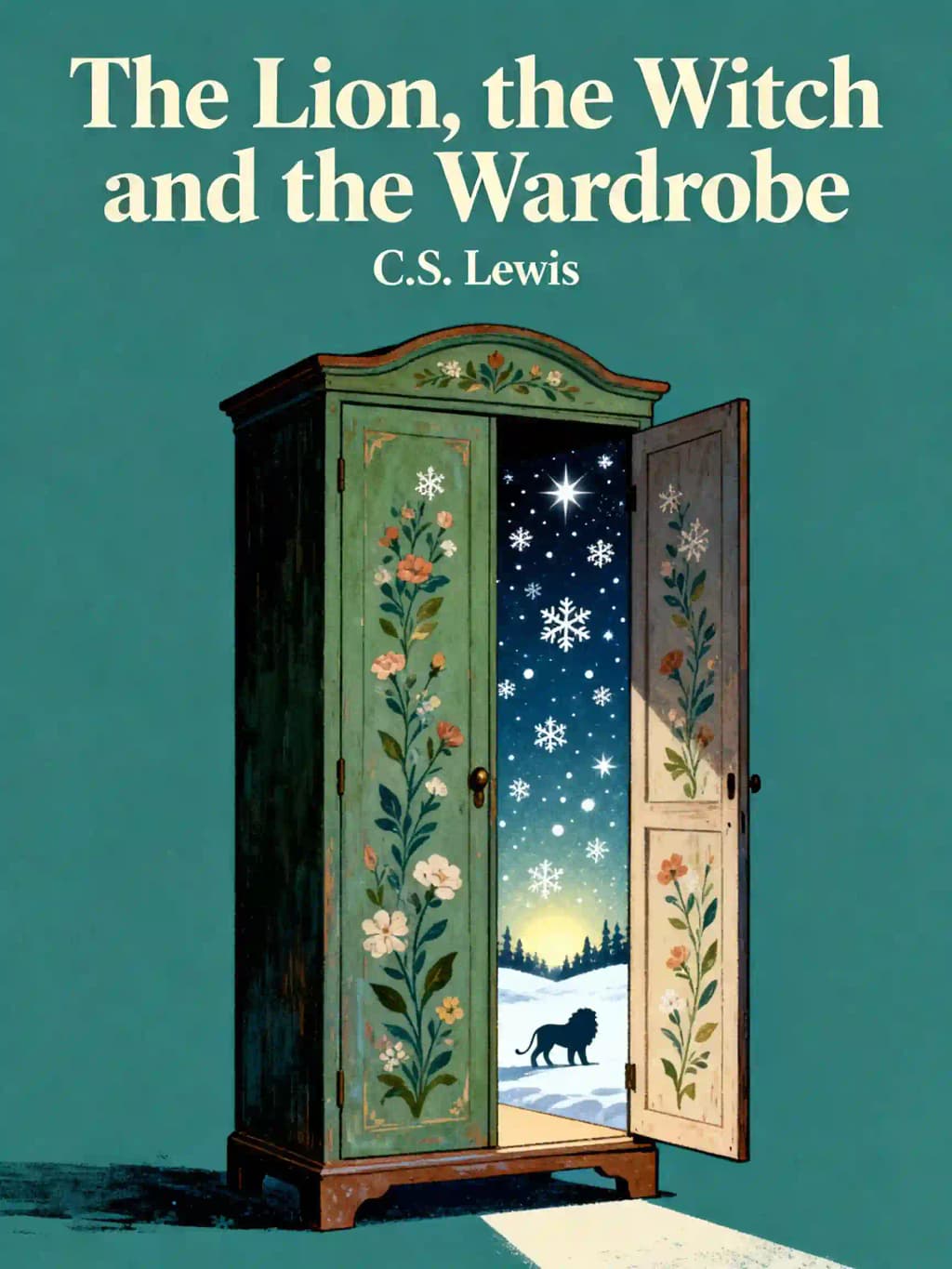
Opening the door, she steps inside among the hanging fur coats, keeping the door ajar as common sense dictates. But as she pushes deeper, expecting to feel the wooden back, Lucy instead finds snow beneath her feet and tree branches against her face. The ordinary has become extraordinary-the back of the wardrobe has vanished, replaced by an entire world of winter woods bathed in night.
This moment captures the essence of childhood imagination-the belief that magic might exist just beyond our everyday perception. Haven't we all, at some point, hoped to find something miraculous hidden in an ordinary place? Lucy's discovery speaks to that universal longing for wonder, for worlds beyond our own where the impossible becomes possible. The wardrobe serves as more than just a magical portal; it represents the threshold between childhood and adventure, between the mundane and the magnificent.
Kapitel 3
First Steps in a Strange Land
Standing in the snowy woods with lamplight glowing against the darkness, Lucy encounters her first Narnian-a Faun named Mr. Tumnus, carrying parcels and an umbrella. Their meeting is both comical and profound-two beings from different worlds, equally startled by each other's existence. Mr. Tumnus identifies Lucy as a "Daughter of Eve"-a human-while she struggles to comprehend this creature with the legs of a goat and the torso of a man.
Despite his initial shock, Mr. Tumnus invites Lucy to tea, and she follows him to his cozy cave dwelling. Inside, a crackling fire warms the space as they share a delightful meal. The scene is wonderfully domestic yet utterly magical-toasted bread with sardines, buttered toast with honey, a sugar-topped cake, and of course, tea. This simple hospitality creates an immediate bond between them.
As they eat, Mr. Tumnus shares enchanting stories of forest life in Narnia-midnight dances with wood-nymphs, hunting parties in pursuit of the wish-granting White Stag, and wild summer feasts with Silenus and Bacchus. These tales paint Narnia as a land where ancient mythology lives and breathes, where the boundary between reality and legend dissolves.
Then comes the music-Mr. Tumnus plays his flute, creating melodies that stir something primal in Lucy's heart. The notes conjure visions of dancing trees and mountains that seem alive, of summer mornings and winter nights. The music embodies the very soul of Narnia-beautiful, wild, and somehow beyond human understanding.
But this idyllic moment shatters when Lucy mentions returning home. Mr. Tumnus breaks down in tears, confessing a terrible truth-he is a kidnapper in service to the White Witch, the tyrannical ruler who has cursed Narnia to be "always winter and never Christmas." His orders were to capture any human he encountered, yet faced with Lucy's kindness, he cannot bring himself to betray her.
This moment reveals the moral core of Narnia-a world where choices matter, where even the smallest creature can choose courage over fear. Despite knowing the Witch might turn him to stone or cut off his tail, Mr. Tumnus decides to help Lucy escape, guiding her back to the lamp-post and warning her of the forest's dangers. His act of bravery, choosing what is right over what is safe, establishes one of the book's central themes: the power of moral courage in the face of tyranny.
Kapitel 4
Disbelief and Discovery
When Lucy returns through the wardrobe, she's shocked to discover that no time has passed in our world. Bursting with excitement, she tells her siblings about Narnia, Mr. Tumnus, and her adventure-only to meet with disbelief. Peter and Susan assume she's playing a game, while Edmund cruelly mocks her. When they investigate the wardrobe together, they find only an ordinary cabinet with coats and a solid wooden back.
Lucy's distress is palpable. The joy of her discovery turns to misery as she faces not just disbelief but ridicule, particularly from Edmund who taunts her about "finding other countries in cupboards." This scenario resonates deeply with the childhood experience of having one's imagination dismissed by others. Haven't we all felt the sting of having something we know to be true treated as fantasy by those around us?
During a game of hide-and-seek days later, Lucy returns to the wardrobe-not to prove anything, but simply to check if Narnia was real. Edmund follows her, intending to continue his teasing, but finds himself stepping into the snowy forest alongside her. Suddenly, the impossible becomes undeniable. Edmund calls out for Lucy but receives no answer, finding himself alone in this strange world.
Instead of Lucy, Edmund encounters a different Narnian-the White Witch herself, though he doesn't yet know her true nature. Riding in a sledge pulled by white reindeer and driven by a dwarf, she presents an imposing figure-tall, beautiful, and crowned, but with a face both stern and cold. When she questions him sharply, Edmund fumbles through an awkward introduction, unsure how to address royalty.
This parallel introduction to Narnia reveals the stark contrast between Lucy and Edmund's characters. Where Lucy met friendship and warmth, Edmund encounters cold majesty. Where she approached the new world with openness, he enters with skepticism. These different first impressions set the stage for the diverging paths they will take in Narnia-one led by wonder and compassion, the other by selfishness and temptation.
Kapitel 5
The Taste of Temptation
The White Witch's interaction with Edmund reveals her cunning manipulation. Sensing his weakness, she softens her approach, inviting him to sit beside her and wrapping him in her fur mantle. Her questions come with calculated gentleness-"How did you come into my dominions?" and "Are you a Son of Adam?" When Edmund admits to being human, her interest visibly intensifies.
Then comes the moment of temptation-she offers Edmund magical Turkish Delight, enchanted to make anyone who tastes it crave more and more. As Edmund gorges himself on the sweet, the Witch extracts critical information: he has one brother and two sisters, and one sister has already visited Narnia. The Witch's reaction to learning there are exactly "two Sons of Adam and two Daughters of Eve" reveals her fear of an ancient prophecy.
With Edmund now under her spell, both from the magical candy and her flattery, she manipulates him into promising to bring his siblings to her house between two hills. "It would be lovely to see them all," she says with false warmth, suggesting he keep their meeting a secret to make it a "lovely surprise." When Edmund begs for more Turkish Delight, she refuses, promising endless sweets once he returns with the others.
After the Witch departs, Edmund encounters Lucy, who's delighted he's discovered Narnia too. She eagerly tells him about Mr. Tumnus and warns about the "White Witch" who makes it always winter but never Christmas. Yet Edmund, already corrupted by the Witch's influence, dismisses Lucy's concerns. As they return through the wardrobe, Edmund feels physically sick from overindulgence and dreads having to admit Lucy was right all along.
This scene brilliantly illustrates how temptation works-it rarely appears threatening at first. The Witch doesn't intimidate Edmund into betrayal; she seduces him with sweetness, comfort, and the promise of being special. Edmund's failing isn't unique to villains-it's the universal human weakness for pleasure and recognition over principle. His situation prompts us to ask ourselves: What Turkish Delights might we be vulnerable to? What principles might we compromise for comfort or status?
The enchanted candy serves as a perfect metaphor for addiction and desire-the more Edmund consumes, the more he craves, yet the satisfaction never lasts. His physical sickness upon returning symbolizes how pursuing selfish desires often leaves us feeling empty rather than fulfilled.
Kapitel 6
Logic and Belief
Back in the Professor's house, Lucy's insistence that Narnia exists creates a dilemma for Peter and Susan. When Edmund betrays Lucy by denying he ever entered Narnia, the older siblings face a troubling situation: either Lucy is lying deliberately, or she's going mad. Concerned, they approach the Professor for guidance, expecting him to suggest a practical solution.
Instead, the Professor surprises them with his response. Rather than dismissing Lucy's claims, he applies logic to examine them. "There are only three possibilities," he explains. "Either your sister is telling lies, or she is mad, or she is telling the truth." He then methodically eliminates the first two possibilities-Lucy isn't known for lying, and she shows no other signs of insanity. The only logical conclusion, however fantastic, is that she's telling the truth.
When Peter objects that "if things are real, they're there all the time," the Professor challenges this assumption. "Are they?" he asks, suggesting that other worlds might operate by different rules. He explains that if a door to another world exists, "I should not be at all surprised to find that the other world had a separate time of its own," making Lucy's claim of spending hours in Narnia while no time passed here entirely plausible.
The Professor's approach represents a fascinating intersection of logic and imagination. Rather than rejecting the fantastic because it seems impossible, he applies reason to consider whether our understanding of "impossible" might be limited. When Peter asks if there could be other worlds "just round the corner," the Professor replies, "Nothing is more probable," while muttering about what they teach in schools these days.
This scene subtly challenges the false dichotomy between reason and imagination. The Professor-clearly an educated, logical man-sees no contradiction in believing both in rational thought and in possibilities beyond our normal experience. His approach suggests that true rationality remains open to evidence, even when that evidence points to the extraordinary.
After this conversation, the siblings' relationship improves. Peter ensures Edmund stops teasing Lucy, though the wardrobe becomes an avoided topic. It seems their Narnian adventures might end-until one day when they're forced to hide from Mrs. Macready's tour group. Seeking refuge in the wardrobe room, all four pile into the wardrobe itself, with Peter carefully leaving the door open. And suddenly, they all find themselves tumbling into the snowy woods of Narnia.
Kapitel 7
Winter's Grip and Spring's Promise
The children's arrival in Narnia marks their first shared experience of this magical world. Lucy's vindication is immediate-"Didn't I tell you?" she exclaims, while Edmund's discomfort is evident as his siblings realize he had lied about his previous visit. Lucy leads them to Mr. Tumnus's cave, only to find it ransacked, with a notice declaring the Faun arrested for high treason against "Her Imperial Majesty Jadis, Queen of Narnia" for harboring humans.
The devastation of Tumnus's home-broken furniture, torn books, and the lingering smell of Faun-makes his sacrifice for Lucy painfully real. The children debate what to do, with Edmund suggesting they return home while the others feel compelled to help. As they stand uncertain, a robin appears, seeming to beckon them. "They don't talk in our world," Lucy reminds the others, but in Narnia, animals often have voices.
Following the robin deeper into the forest, they encounter Mr. Beaver, who confirms his trustworthiness by producing Lucy's handkerchief-given to him by Mr. Tumnus before his arrest. The Beaver whispers words that stir strange feelings in all four children: "Aslan is on the move." This name affects each differently-creating mysterious horror in Edmund, courage in Peter, delightful sensations in Susan, and holiday excitement in Lucy. Even before meeting him, Aslan's mere name has power.
At the Beavers' cozy dam home, Mrs. Beaver welcomes them with a delicious meal while Mr. Beaver explains Narnia's situation. The White Witch, he reveals, isn't truly Narnian royalty but a usurper-"no Daughter of Eve. She comes of your father Adam's first wife, her they called Lilith." Her claim to the throne rests solely on might and fear.
Mr. Beaver shares ancient prophecies: when Aslan appears, the Witch's winter will end, and when two Sons of Adam and two Daughters of Eve sit on the thrones at Cair Paravel, her reign will be over entirely. The children struggle to comprehend their apparent destiny-they're expected to become kings and queens of Narnia and defeat the Witch.
Suddenly, they notice Edmund is missing. After searching frantically, Mr. Beaver grimly concludes Edmund has betrayed them to the White Witch, explaining that the enchanted Turkish Delight would have heightened his worst qualities. With the Witch now hunting them, they must flee immediately to meet Aslan at the Stone Table.
This section introduces the central conflict between winter's oppression and spring's promise. The Witch's endless winter represents tyranny-a freezing of natural growth and joy. Aslan's approach, already melting this winter, symbolizes renewal and liberation. The children find themselves caught in this cosmic struggle, with Edmund's betrayal raising the stakes dramatically. His choice-born of selfishness and enchantment-endangers them all, yet the narrative suggests even this might be redeemable in Aslan's greater plan.
Kapitel 8
Betrayal's Bitter Fruit
Edmund's journey to the Witch's castle reveals the hollow nature of temptation's promises. Trudging through snow without his coat, cold and miserable, he keeps going only by fantasizing about being King of Narnia and keeping Peter "in his place." The contrast between his expectations and reality grows starker with each painful step through deep drifts and over fallen trees.
When he finally reaches the Witch's castle-a small fortress with needle-like towers-Edmund encounters what appears to be a stone lion in the courtyard. Assuming it's Aslan turned to stone by the Witch, he feels momentary triumph and childishly scribbles a mustache and spectacles on its face. This petty act reveals both his immaturity and his misunderstanding of who Aslan truly is.
The courtyard is filled with stone statues-satyrs, wolves, bears, and even a giant-all victims of the Witch's wand. This grim gallery foreshadows the fate Edmund himself might face, though he doesn't yet realize it. At the entrance, he meets Maugrim, Chief of the Witch's Secret Police, who escorts him to the Witch herself.
Her reception shatters Edmund's illusions. Rather than the warmth and Turkish Delight he expected, he finds cold fury that he came alone. When Edmund reveals his siblings' location at the Beavers' house and mentions Aslan, the Witch's reaction is immediate and terrifying-her face turns deathly white and she orders her sledge prepared "without bells" for silent pursuit.
Meanwhile, the Beavers rush the other children to safety in an underground hiding place. Hours later, they wake to the sound of jingling bells-their greatest fear. But when Mr. Beaver investigates, he returns with unexpected joy: "It isn't Her!" Instead, they find Father Christmas himself, whose presence proves the Witch's power is weakening. "I've come at last," he announces. "Aslan is on the move. The Witch's magic is weakening."
Father Christmas distributes meaningful gifts: for Peter, a shield and sword; for Susan, a bow with arrows and a magical horn; for Lucy, a healing cordial and a small dagger. He explains that the girls aren't meant to fight in battle but will find their own uses for their gifts. After serving them hot tea and wishing "Merry Christmas!" he disappears, leaving them with renewed hope.
This section contrasts Edmund's bitter disappointment with his siblings' unexpected joy. Edmund's betrayal leads only to misery and danger, while the others' faithfulness is rewarded with gifts that will prove crucial in the coming conflict. Yet even as Edmund suffers the consequences of his choices, the narrative hints at redemption-his genuine sorrow for the stone creatures shows the first awakening of compassion beyond self-interest.
Kapitel 9
The Deepening Thaw
As Edmund continues his journey with the Witch, he witnesses the beginning of a profound transformation in Narnia. The endless winter-the Witch's signature curse-begins to break. First, the snow becomes wetter, then the air warmer and foggier. Soon the sledge moves more slowly until it stops completely in slush. In the silence, Edmund recognizes a familiar sound-running water.
The world transforms around them-patches of green grass appear, trees shed their snow, and birds begin to sing. When the dwarf declares this is no ordinary thaw but Spring itself, he blames it on Aslan, causing the Witch to threaten death to anyone who mentions that name again. This breaking of winter's grip symbolizes the weakening of the Witch's power as Aslan's presence grows stronger in Narnia.
Meanwhile, the Beavers lead the children through this awakening landscape toward the Stone Table where they will meet Aslan. They walk for hours through a world changing from January to May-bluebells blooming, kingfishers darting about, and trees bursting with new leaves. The journey itself becomes a metaphor for hope and renewal.
At last, they reach an open hilltop with the ancient Stone Table at its center-a grim gray slab covered with strange markings. Nearby stands a magnificent pavilion with a banner bearing a red rampant lion. There they finally behold Aslan himself, surrounded by magical creatures including centaurs, dryads, and talking animals.
The children's first encounter with Aslan captures the book's spiritual heart. They find themselves trembling in his presence, for he is both good and terrible at once, with overwhelming royal eyes and a golden mane. When Mr. Beaver had earlier described Aslan as "not safe, but good," this seeming paradox becomes clear in their meeting-Aslan's goodness includes majesty and power that inspire awe as much as comfort.
When Peter finally approaches and introduces them, Aslan welcomes them warmly but immediately asks about the missing fourth child. After learning of Edmund's betrayal, Aslan promises to help save him, though warns it might be difficult. This conversation is interrupted by Susan's horn-a wolf is attacking her. Peter rushes to her aid and, despite his fear, plunges his sword into the wolf's heart. After this first battle, Aslan knights him "Sir Peter Wolf's-Bane," marking his growth from boy to warrior.
This section illustrates how Aslan's mere presence begins healing Narnia from the Witch's corruption. The thawing of winter parallels the thawing of hearts-Edmund begins questioning his choices, Peter finds courage he didn't know he possessed, and all of Narnia awakens to new possibilities. The transformation is both physical and spiritual, showing how tyranny's effects can be reversed when true authority returns.
Kapitel 10
Sacrifice Beyond Understanding
The narrative reaches its emotional and spiritual core as Edmund is rescued from the Witch's camp just before she can sacrifice him. After a private conversation with Aslan-one that Edmund will never forget but readers aren't privy to-he reconciles with his siblings with a simple apology. Aslan tells the others there is "no need to talk about what is past," establishing a theme of forgiveness and fresh starts.
This reconciliation is interrupted by the arrival of the White Witch herself, coming under safe conduct to speak with Aslan. She claims Edmund as her lawful prey, citing the Deep Magic from the dawn of time: "Every traitor belongs to me as my lawful prey and... for every treachery I have a right to kill." Aslan acknowledges the truth of this ancient law but negotiates a private agreement with the Witch. Afterward, he announces she has renounced her claim on Edmund's blood, though the terms remain secret.
That evening, Aslan grows increasingly sad and withdrawn. Unable to sleep, Susan and Lucy discover him leaving camp and follow him to the Stone Table. "I am sad and lonely," he tells them before asking them to hide nearby. From their hiding place, the girls watch in horror as the Witch's evil followers-ogres, wolves, and unspeakable creatures-bind, shave, and mock Aslan, who offers no resistance.
Tied to the Stone Table, Aslan remains dignified while the Witch taunts him: "You have given me Narnia forever, you have lost your own life and you have not saved his." The children cover their eyes as she kills him with her stone knife. The sacrifice is complete-Aslan has traded his life for Edmund's.
After the Witch and her followers depart to prepare for battle, Susan and Lucy stay with Aslan's body through the night. As dawn approaches, they hear a great cracking noise-the Stone Table has split in two, and Aslan's body is gone. Suddenly, there stands Aslan himself, alive and larger than before, his mane regrown.
When the girls ask how this is possible, Aslan explains the Witch knew only the Deep Magic from the dawn of time, but there was a deeper magic she didn't know: "when a willing victim who had committed no treachery was killed in a traitor's stead, the Table would crack and Death itself would work backward."
This resurrection scene forms the spiritual centerpiece of the narrative. Aslan's willing sacrifice for Edmund-who had betrayed him-and his triumph over death through "deeper magic" clearly parallels Christian theology. Yet it works equally well as a profound mythological moment, speaking to universal themes of sacrifice, redemption, and the ultimate triumph of good over evil.
The scene's power comes from its emotional truth-we witness Aslan's suffering through the eyes of children who love him, making his death and return deeply personal rather than abstractly theological. His explanation of the "deeper magic" suggests that self-sacrificing love represents a more fundamental reality than even the ancient laws of justice.
Kapitel 11
Restoration and Coronation
With death defeated, Aslan leads Susan and Lucy to the Witch's castle, leaping over its walls in a single bound. In the courtyard filled with stone statues, Aslan breathes upon each figure, restoring them to life. The deadly white courtyard transforms into a blaze of colors and joyful sounds as creatures of all kinds-centaurs, unicorns, birds, foxes, dogs, satyrs, dwarfs, and tree-girls-return to life.
This restoration scene mirrors Aslan's own resurrection, extending its power to all the Witch's victims. Lucy joyfully discovers Mr. Tumnus among the statues, their reunion completing the circle that began with their first meeting by the lamp-post. With the castle emptied of prisoners and filled with light, they prepare to join Peter's army in battle against the Witch.
Meanwhile, Peter has been leading the Narnian forces according to Aslan's instructions, showing his growth into leadership. When Aslan arrives with reinforcements, the tide of battle turns decisively. The Witch herself is defeated by Aslan, while Edmund proves his redemption by breaking her wand at the cost of a serious wound.
After the battle, Lucy uses her healing cordial to save Edmund and other wounded fighters. The four children are then crowned Kings and Queens of Narnia at Cair Paravel by Aslan himself: "Once a King or Queen in Narnia, always a King or Queen." Under their rule, Narnia enters a Golden Age where justice prevails, evil creatures are driven out, and peace extends to neighboring lands.
Years pass-the children grow into adults, ruling wisely and well. King Peter becomes "Peter the Magnificent," Queen Susan "Susan the Gentle," King Edmund "Edmund the Just," and Queen Lucy "Lucy the Valiant," their titles reflecting how they've grown into their best selves. They govern Narnia for many years, almost forgetting their life in our world.
One day, while hunting the legendary White Stag who grants wishes to those who catch him, they rediscover the lamp-post in the western woods. Something about it stirs distant memories, and following a strange feeling, they push through thickets that become coats rather than branches. Suddenly, they tumble out of the wardrobe back into the empty room in the Professor's house-no longer kings and queens but ordinary children again, returned at the exact moment they had left.
When they tell the Professor their story, he believes them completely, advising them not to try returning through the wardrobe. "You won't get into Narnia again by that route," he explains, but assures them they will find their way back someday when they aren't looking for it. "Once a King in Narnia, always a King in Narnia," he reminds them, suggesting they might recognize fellow travelers by odd things they say or their very looks.
This ending completes the children's journey while leaving the door open for future adventures. Their return to childhood after living full adult lives in Narnia creates a poignant sense of both loss and possibility. They've carried back the wisdom and growth from their experiences, even as they must navigate being children again. The Professor's final advice-"Keep your eyes open"-suggests that Narnia's magic might be found in unexpected places, even in our ordinary world.
Kapitel 12
A Tapestry of Meaning
"The Lion, the Witch and the Wardrobe" weaves together adventure, mythology, and moral lessons into a tapestry that has captivated generations of readers. On the surface, it's a thrilling tale of four ordinary children who discover an extraordinary world. Deeper examination reveals a rich exploration of universal themes-courage versus cowardice, temptation and betrayal, sacrifice and redemption, and the nature of good and evil.
The character arcs throughout the story show meaningful growth. Edmund's journey from selfish betrayer to "Edmund the Just" demonstrates how even profound mistakes can be redeemed. Lucy's unwavering faith in both Narnia and Aslan represents the power of childlike belief. Susan's practical nature evolves into gentle wisdom, while Peter grows from protective older brother to High King.
Aslan himself stands as the narrative's moral center-embodying both terrible goodness and tender mercy. His sacrifice for Edmund provides the story's emotional and spiritual climax, while his resurrection affirms the book's ultimate message that love is stronger than death and good more powerful than evil.
The world of Narnia itself offers a vision of reality where the physical and spiritual aren't separated-where animals talk, trees dance, and the deepest magic comes from self-sacrificing love. This integration of the material and spiritual reflects Lewis's own worldview, suggesting that the universe is more wonderful, more alive, and more meaningful than a purely materialistic perspective allows.
Perhaps this explains the enduring appeal of "The Lion, the Witch and the Wardrobe" across cultures and generations. In a world often divided between cold rationalism and ungrounded fantasy, Lewis offers a middle way-a vision where reason and imagination work together, where ordinary children can become kings and queens, and where even the deepest winter eventually gives way to spring. The wardrobe door remains open, inviting each new reader to step through into a world where magic feels not just possible, but somehow true.