Kapitel 1
When Play Became the Blueprint for Our Future
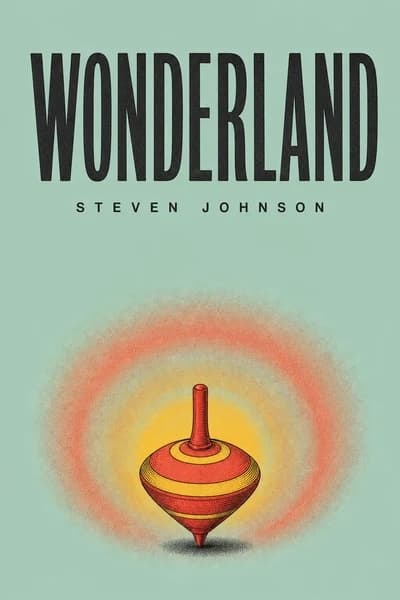
Have you ever wondered why we're drawn to games, spectacles, and illusions that serve no obvious survival purpose? In Steven Johnson's "Wonderland," we discover that what humans create for amusement often becomes civilization's blueprint for the future. This isn't just another history of innovation-it's a revelation about how our pursuit of pleasure has shaped the modern world in unexpected ways. From mechanical toys that prefigured robotics to fashion crazes that triggered the industrial revolution, Johnson reveals how seemingly frivolous pastimes contain the seeds of transformative technologies. Beloved by tech pioneers like Elon Musk and praised by The New York Times as "exhilarating," this book challenges our understanding of historical progress. While necessity may mother invention, Johnson shows us that play was often involved in conception-and the results have changed our world in ways both magnificent and sometimes tragic.
Kapitel 2
The Mechanical Marvels That Sparked a Revolution
In the early Islamic Golden Age, Baghdad's House of Wisdom became home to remarkable innovations that would echo through centuries. The Banu Musa brothers created what might be history's most significant toy: a programmable hydraulic organ called "The Instrument Which Plays by Itself." What made this device revolutionary wasn't just its ability to produce music automatically, but that it introduced a conceptual breakthrough-the separation of hardware from software. The pinned cylinders that controlled which notes played when could be swapped out or modified, allowing entirely new patterns of sound through code rather than mechanics.
This programming concept would remain confined to music for nearly a millennium. Jacques de Vaucanson's life-sized automaton shepherd from the 1730s could play twelve distinct songs on an actual flute by controlling air pressure and finger movements through similar pinned cylinders. While audiences marveled at these mechanical musicians, few recognized the transformative potential of programmability itself.
The breakthrough came when Vaucanson realized that if cylinders could trigger complex sound patterns, they might also create complex patterns of color in textiles. Appointed by Louis XV to revitalize the French weaving industry, he designed looms controlled by pinned cylinders-teaching machines to weave silk patterns. Though his prototypes struggled with practical implementation, one survived long enough to inspire Joseph-Marie Jacquard in 1803, who replaced cylinders with punch cards to determine which threads would be woven into fabric.
This textile innovation caught Charles Babbage's attention in 1839 when he encountered a silk portrait of Jacquard himself, woven using thousands of punch cards. Babbage borrowed this programming concept for his Calculating Engine, using similar punch card systems to perform mathematical operations. When Ada Lovelace observed that Babbage's machine could potentially compose music, she was unknowingly bringing the technology full circle, back to its musical origins.
The QWERTY keyboard-essential to the digital revolution-evolved directly from musical instruments. Giuseppe Ravizza's first functioning typewriter in 1855 was explicitly called a "writing harpsichord," with early typewriters often using piano-style keyboards with interspersed white and black keys. Our entire computing infrastructure owes a profound debt to musical innovation, showing how instruments of song have been as transformative as any military technology in shaping our information age.
Kapitel 3
How Shopping Transformed the Global Economy
In late 17th century London, a revolutionary retail concept emerged: shops with elaborate window displays, gilded interiors, and theatrical atmospheres that transformed shopping from necessity to entertainment. These "perfectly gilded theaters" in fashionable neighborhoods made browsing an end in itself, creating what contemporaries called an "agreeable amusement" where ladies could pleasurably pass hours.
These lavish shops primarily showcased cotton calico prints from India-fabrics with vibrant, colorfast dyes unlike anything Europeans had seen. Though cotton had been known since Vasco da Gama's 1498 expedition, it took these theatrical retail spaces to transform it from curiosity to craze. The "Calico Madams" who adopted cotton fashions sparked a moral panic among British wool producers, leading to protectionist legislation and riots.
Ironically, this cotton obsession didn't undermine Britain's economy as feared-it sparked the industrial revolution. The immense demand drove inventors like John Kay, Richard Arkwright, and Eli Whitney to create mechanical tools for mass production. The traditional view that industrialization created consumer culture gets it backward-the "agreeable amusements" of shopping came first, setting industrialization in motion through seemingly trivial pursuits.
By the late eighteenth century, the calico craze had birthed the first true fashion industry. Women in 1770s London could choose from dozens of illustrated periodicals with names like "Ladies' Pocket Book" and "Polite and Fashionable Ladies' Companion." Fashion's pace accelerated dramatically-in 1723, Bernard Mandeville noted contemptuously that fashion "modes seldom last above Ten or Twelve Years." By the 1750s, cycles shortened to six months, and by the 1770s settled into the annual rotation we know today.
Fashion democratized society by allowing middle-class women to "pass" for aristocrats by following fashion publications. This blurring of class distinctions alarmed conservatives-in 1763, the British Magazine complained about "the present rage of imitating the manners of high life" spreading among "gentle folks of lower life."
The nineteenth century brought another revolution: the department store. Boucicaut transformed his modest shop into a wonderland of goods after visiting the 1855 World's Fair. His "cathedral of commerce" was designed to disorient shoppers, making them "walk around for hours, get lost" so they'd visit departments they hadn't intended to see. Built around cast-iron frameworks topped by enormous skylights, these grand spaces introduced modern retail practices: fixed prices instead of haggling, charge cards extending credit, and complex service organizations managing thousands of employees.
Victor Gruen later adapted these concepts when creating America's first shopping mall-Southdale Center near Minneapolis in 1956. Despite his socialist background and disdain for suburban commercialism, Gruen's "Garden Court of Perpetual Spring" became the most influential new building archetype of the postwar era. The tragic irony is that Gruen's vision was for dense, mixed-use urban centers with apartments, schools, and parks-not just shopping. Developers took only the mall concept, surrounding it with parking lots instead of walkable communities, ultimately amplifying suburban sprawl rather than combating it.
Kapitel 4
The Spice of Life: How Taste Transformed Trade
Deep history lurks in even the most mundane modern products. The humble Doritos chip contains ingredients from across the globe-corn from Mexico, soybeans from East Asia, cheddar from England, Romano from Italy, tomatoes from South America, and numerous spices. This global convergence of flavors represents the culmination of trade networks established thousands of years ago.
The spice trade fundamentally shaped world history. Without it, the wealth of Venice, Amsterdam and London dissipates, along with their art and architecture. Without pepper trade with India, calico fabrics never reach London, potentially delaying the industrial revolution by decades.
Queen Elizabeth I recognized this global interconnection when writing to the King of Aceh in 1602, describing how God distributed "good things of his creation...into the most remote places" so lands would need each other, creating both commerce and friendship. Despite the colonial exploitation that followed, Elizabeth correctly identified how spices were scattered across distant regions, compelling humans to develop new navigation, cartography, ships, and corporate structures to shrink the globe.
The geographical distribution of spices wasn't random. Mediterranean climates fostered early civilization through large-seeded grains, while tropical biodiversity produced more complex chemical compounds. Black pepper contains piperine that activates our transient receptor potential channels (TRP receptors), creating the sensation of heat-a defense mechanism that evolved in response to tropical biodiversity. Like the tarantula venom that triggers the same receptors, pepper essentially sends a "Fire!" signal to our bodies.
What's remarkable is how humans transformed these warning signals into pleasurable experiences. While some cultural patterns flow naturally from our evolutionary heritage, the true measure of cultural innovation is how far we've moved from our genetic programming. The taste for spice expanded our map of possible desires, which in turn expanded our map of the world. This boundary-pushing-this reimagining of what our needs and appetites should be-is fundamentally human. Our exploratory need for new experiences drives human expansion and development. It is, quite literally, the spice of life.
Kapitel 5
The Phantasmagoria: How Illusion Shaped Reality
Leipzig, 1771: A group of young men enter a darkened room above a coffeehouse where death's-head masks line walls and an altar draped in black stands ominously. Their hooded host conjures spirits through ancient incantations. Suddenly, darkness falls, a ghost appears above the altar, and the spectators feel electric shocks course through their bodies as the apparition speaks in "a hoarse and terrible tone."
This eerie spectacle was created by Johann Georg Schropfer, who transformed from Freemason lodge waiter to Europe's famous "Gespenstermacher" (ghost maker). Schropfer retrofitted his coffeehouse billiards room into an immersive theater of terror, using magic lanterns to project ghostly images on smoke screens while delivering electric shocks to his audience. His techniques were improved upon by imitators like Paul Philidor, who named his show the "Phantasmagoria" and perfected rear-projection onto semitransparent curtains.
Beyond mere entertainment, the Phantasmagoria became a powerful philosophical metaphor. Hegel referenced it in his Jena lectures while writing Phenomenology of Spirit. Schopenhauer described human sensory apparatus as a "cerebral phantasmagoria," while Thomas Carlyle popularized the term as a metaphor for societies losing their grasp on reality. Most significantly, Karl Marx used the phantasmagoria as a metaphor for commodity fetishism in Das Kapital, describing capitalism as creating "the fantastic form" ("die phantasmagorische Form") where objects are wrapped in ghostly illusions that obscure economic oppression.
Scottish scientist David Brewster-inventor of the kaleidoscope-approached these spectacles with scientific curiosity, documenting how the illusions worked while recognizing their profound implications. Brewster noted that the eye is "the most fertile source of mental illusions" and "the principal seat of the supernatural," an insight that remains true today. While our visual system processes approximately 85% of the information we receive, it's remarkably vulnerable to deception because our brains rely on interpretive shortcuts that fill in missing information and make assumptions about three-dimensional relationships.
Robert Barker's Panorama revolutionized visual experience when he constructed a six-story building near Leicester Square in 1793, designed exclusively for displaying immense 1,479-square-foot vistas that attracted royalty and critical acclaim. One observer noted that "no device has approached so nearly to the power of placing the scene itself in the presence of the spectator."
By the early nineteenth century, Barker's Panorama and Philipsthal's Phantasmagoria had triggered an entertainment version of the Cambrian explosion. Strange new forms of illusion proliferated across London's West End, bearing exotic Greek neologisms: the Akolouthorama, Phantascopia, Spectrographia, Eidophusikon, Panstereomachia, and dozens of Panorama derivatives. What made this collection remarkable was its sheer diversity-unlike today's West End, the entertainment landscape of 1820 featured not just plays and musicals but a carnival of illusions, each dependent on its own unique technology.
Perhaps most significant is that almost every species in this genus of illusion disappeared by the dawn of the twentieth century, extinguished by a single new technology: the cinema. While cinema initially lacked color and the 360-degree vista of the Panorama, once actual people could be projected onto screens-dancing, gesticulating, emoting-the appeal of mechanical illusions dissolved.
Cinema's movement was merely a trick of the eye-a stream of still images that our brain perceives as continuous motion through persistence of vision. This quirk in human vision-our tendency to stitch together images flashed at more than ten or twelve frames per second into continuous motion-is actually a defect. Unlike other technologies that exploit our evolutionary strengths, cinema succeeds precisely because our eyes fail to perceive reality accurately.
The most dramatic acceleration in the history of visual illusion occurred between 1928 and 1937, from Disney's "Steamboat Willie" to "Snow White." To create "Snow White," Disney's team invented entirely new techniques: pencil tests on cheap negative film, storyboarding to map narrative, rewettable paints, and most impressively, the multiplane camera-an eleven-foot-tall device that created unprecedented visual depth by separating animation cels at different distances from the camera.
Kapitel 6
From Chess to Computers: How Games Rewired the World
In the thirteenth century, Dominican friar Jacobus de Cessolis delivered sermons that became one of history's most influential texts. His work, "The Game of Chess," used the game as an allegory for proper social organization, helping dismantle the thousand-year-old "body politic" metaphor in favor of a society governed by laws and contracts rather than biology.
Chess has generated an unparalleled array of metaphors throughout history, influencing everything from romance to literature. In the mid-twentieth century, it became central to understanding intelligence itself, forming the foundation of artificial intelligence research when Alan Turing asked if machines could play chess.
American board games were traditionally designed to impart ethical lessons. The 1840s "Mansion of Happiness" embedded stern Puritan values, reading more like a sermon than entertainment. Most revolutionary was Lizzie Magie's creation: "The Landlord's Game" in 1904-the primordial version of Monopoly. Unlike conventional morality games, hers critiqued unfettered capitalism, featuring two play modes: one competitive (like modern Monopoly) and one focused on wealth-sharing.
The Landlord's Game developed an underground following, spreading through universities and among social reformers. As it traveled, the rules evolved-fixed property prices were added, and Atlantic City street names replaced the generic locations. Charles Darrow, encountering the game through Atlantic City Quakers, became one of gaming history's great charlatans. Without meaningful changes, he redesigned the board, sold it through department stores, and eventually to Parker Brothers, becoming a millionaire while Lizzie Magie's role was completely erased.
The revolutionary field of probability theory emerged from games of chance. In 1564, Girolamo Cardano, a hot-tempered gambling physician, wrote "The Book of Games of Chance," developing formulas for calculating dice game odds. A century later, correspondence between Blaise Pascal and Pierre de Fermat established modern probability theory. This mathematical breakthrough quickly transformed society, enabling Edward Halley to calculate mortality rates and the Huygens brothers to determine life expectancy. These concepts fueled the modern insurance industry, capital markets, election forecasting, medical research, and aviation safety.
In 1961, three MIT grad students created Spacewar!-a simple two-player game where spaceships dart around firing torpedoes at each other. Despite primitive graphics, Spacewar! proved hypnotic and spread across computer labs nationwide. This collaborative development process anticipated modern open-source software practices. Spacewar! demonstrated that serious computers could be vehicles for play, setting the foundation for the video game industry. More importantly, it pioneered real-time visual human-computer interaction through on-screen icons responding to physical movements-the paradigm we still use today with mice and touchscreens.
The marriage between games and computing reveals a profound pattern: from Babbage's chess-playing "analytic engine" to Turing's chess musings, from Shannon and Thorp's roulette system to Spacewar's interface innovations, from Deep Blue versus Kasparov to Watson on Jeopardy!, games have consistently driven computational breakthroughs. Why have games been so crucial to computing? They provide clear metrics for success and challenge our minds in uniquely human ways. It seems fitting that when we finally became smart enough to build artificial minds, we taught them to play along with us.
Kapitel 7
The Social Spaces That Changed History
In 1741, Manhattan's racial boundaries were dramatically crossed at John Hughson's tavern, where slaves and whites mingled freely-with catastrophic results. When suspicious fires erupted across the city, rumors spread of slave rebellion. After sixteen-year-old Mary Burton informed on her boss Hughson, claiming he and slaves Caesar and Cuffee had plotted rebellion, brutal state violence followed. Their true crime was creating an integrated social space that threatened racial hierarchy.
Taverns represent one of humanity's oldest leisure institutions-spaces designed explicitly for pleasure rather than work, worship, or home life. Beyond their reputation for debauchery, taverns played transformative political roles. In colonial America, taverns became revolutionary incubators-the Boston Tea Party was planned at the Green Dragon, while Thomas Paine's Common Sense was read aloud in taverns across the colonies.
On New Year's Eve 1966, Los Angeles's Black Cat Tavern became the site of violent confrontation when LAPD officers raided the gay establishment, arresting sixteen men for "lewd conduct" like kissing. The raid-predating the more famous Stonewall riots by two years-catalyzed the gay rights movement. Like the colonial taverns before them, gay bars provided crucial semi-public spaces where marginalized communities could organize resistance.
Coffee's active ingredient, caffeine-now the world's most popular psychoactive compound-evolved as a chemical weapon in plants to poison insects. Yet for humans, it enhanced memory and combated drowsiness, helping fuel Europe's intellectual expansion as the continent swapped its default daytime depressant (alcohol) for a stimulant. But coffee's true revolutionary power came through architecture and urbanism rather than pharmacology. When Sicilian servant Pasqua Rosee opened London's first coffeehouse in 1652, he launched an institution that would transform English society more profoundly than any other public space over the next century.
London's coffeehouses evolved into specialized venues serving distinct communities: Lloyd's catered to maritime interests (eventually becoming the insurance giant Lloyd's of London), Exchange Alley focused on stock speculation, and Waghorn's on political gossip. These establishments became intellectual crossroads where social classes converged-poets, lords, speculators, scientists all found seats. This democratic environment spawned numerous innovations: public museums, insurance corporations, formal stock exchanges, weekly magazines, and the Royal Society of Arts.
As urban spaces for leisure proliferated during industrialization, a parallel revolution transformed attitudes toward wilderness. Early European settlers viewed nature as "hideous and desolate," with mountains particularly reviled as "warts" and "boils." By the late 1700s, however, this perception dramatically shifted. Nature itself became a wonderland, with the middle class seeking out remote landscapes as destinations rather than obstacles. By 1872, this love of wilderness led to the creation of Yellowstone, the world's first national park-a "pleasuring-ground for the benefit and enjoyment of the people."
In 1897, animal trader Carl Hagenbeck purchased land outside Hamburg to create what's now considered one of the world's first theme parks. Opening in 1907, Tierpark Hagenbeck offered an immersive simulation of global exploration without actual risk. Across 80 acres, Hagenbeck constructed artificial mountains concealing service infrastructure, created fake landscapes populated with animals and native peoples, and used hidden trenches instead of bars to separate predators from prey. The park was wildly successful, drawing 7.5 million visitors by 1914 and establishing the commercial template for today's $50 billion theme park industry.
Kapitel 8
The Surprise Instinct: Why Play Matters
A history of play and wonder would be justified solely for the pleasure these experiences have brought us. Yet beyond their inherent value, these wonderlands of illusion and delight have driven remarkable innovations and historical changes: public museums emerged from private cabinets of curiosities, exploration was fueled by tales of exotic wonders, and the rubber industry began with bouncing balls. Stock markets evolved from gaming houses, computers descended from mechanical toys, and the industrial revolution was sparked by recreational automata. The public sphere grew from coffee houses where people played games, global trade routes were established in pursuit of novel entertainments, and probability theory emerged from gambling mathematics. Even the American Revolution was partly inspired by theatrical performances, while clinical drug trials grew from parlor game methodologies. The LGBT rights movement gained momentum through underground entertainment venues, and modern celebrity culture traces its roots to 18th-century pleasure gardens.
The mystery of play's productivity finds explanation in contemporary neuroscience and cognitive psychology. Arthur Samuels' groundbreaking work with checkers-playing computers at IBM in the 1950s revealed a fundamental principle: learning accelerates when experiences confound expectations. Our brains are literally wired to pay heightened attention when surprised, with neural pathways lighting up more intensely during unexpected events. Developmental psychologists have documented how infants actively seek out surprising phenomena, preferentially engaging with toys and experiences that defy their expectations. In the 1990s, neuroscientists discovered this "surprise instinct" is regulated by dopamine circuits in the brain. Rather than being simply a "pleasure drug" as previously thought, dopamine creates a "novelty bonus" that heightens mental faculties when we encounter something new or unexpected, promoting learning and memory formation.
All the wonders explored in this history share the common thread of initial surprise - from ancient bone flutes that mimicked bird calls to the first taste of coffee in Europe, from exotic pepper that transformed medieval cuisine to immersive panoramas that revolutionized visual entertainment. The calico fabrics that sparked trading empires and Babbage's mechanical dancer that presaged computing - each represented a radical departure from the familiar. Our genetic appetite for surprise stands unique among instincts, as it drives us not toward predictable patterns but toward undefined new experiences. This explains play's innovative power - it leads us away from nature precisely because of our nature, creating a feedback loop of novelty-seeking and innovation.
We consistently underestimate the significance of novel things that aren't immediately applicable to survival, dismissing them as mere entertainment. Yet these toys and games repeatedly become "the prelude to serious ideas" that transform society. The programmable pen of Jaquet-Droz's Writer automaton contained the seeds of modern programming, while Merlin's dancer with "irresistible eyes" anticipated both humanoid robotics and questions of artificial emotion. The mechanical music boxes that delighted Victorian parlors led to punch card computing, while magic lantern shows preceded cinema and virtual reality. What begins as play often becomes civilization's blueprint for the future - a pattern that continues to shape our world through video games, social media, and emerging technologies whose full impact we're only beginning to understand. This trajectory from playful novelty to transformative innovation remains one of the most reliable yet underappreciated forces in human development.