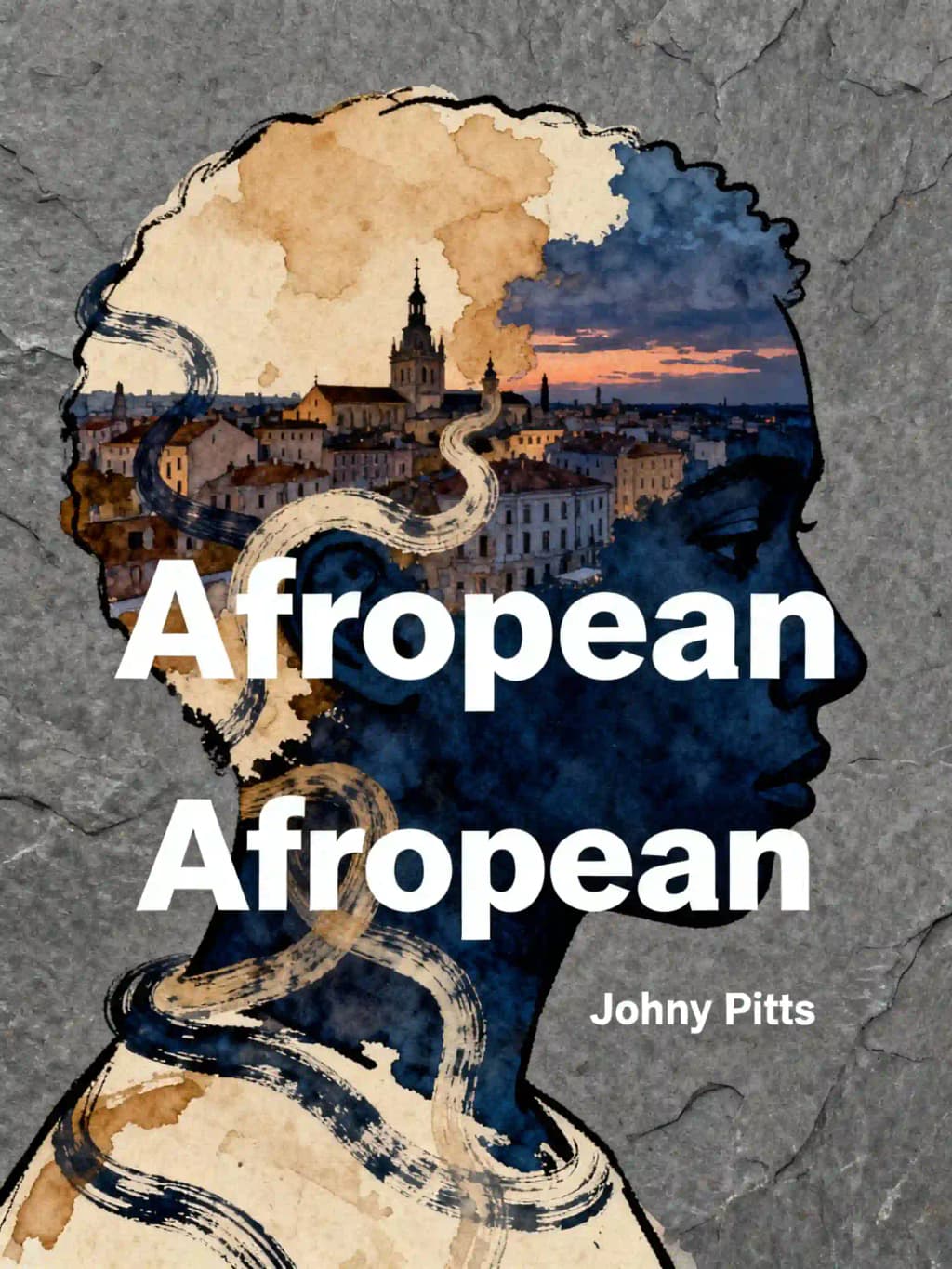
Journey through Black Europe with Johny Pitts' award-winning "Afropean" - winner of four prestigious literary prizes and translated into eight languages. Owen Jones called it "a revelation" for challenging Europe's white-centric narrative through stunning photography and powerful storytelling.
Johny Pitts is an award-winning writer, photographer, and cultural critic, celebrated for his genre-blending work, Afropean: Notes from Black Europe. The book fuses travelogue, memoir, and social critique to map African diasporic experiences across Europe.
Born in Sheffield to an African-American father and white British mother, Pitts draws from his dual heritage to interrogate themes of identity, belonging, and postcolonial legacy. His groundbreaking Afropean.com platform, a digital archive of Black European life, directly informs the book’s blend of street photography, journalism, and historical analysis.
Pitts’ collaborative photobook Home Is Not a Place, co-created with poet Roger Robinson, was shortlisted for the 2023 British Book Awards. His 2024 AFRØPEAN Podcast expands his exploration of Black urban cultures across six European capitals. A regular contributor to The Guardian and The New York Times, his work has been exhibited at Amsterdam’s Foam Gallery and London’s Photographers’ Gallery.
Afropean: Notes from Black Europe has been translated into nine languages and received the Jhalak Prize, Leipzig Book Award for European Understanding, and Bread and Roses Award for Radical Publishing. In 2025, Pitts was honored with the EM Forster Award from the American Academy of Arts and Letters for his contributions to transatlantic cultural discourse.
Afropean documents Johny Pitts’ journey across Europe to explore Black identity in marginalized communities, blending travelogue, history, and cultural analysis. Visiting locations like Lisbon’s Cape Verdean shantytowns and Paris’s Clichy Sous Bois, the book challenges monolithic European narratives by centering Afropean voices. It critiques colonial legacies while highlighting resilience and cultural fusion in diasporic spaces.
This book suits readers interested in multiculturalism, European identity, and diaspora studies. Academics, historians, and general audiences gain insights into how Black communities navigate dual allegiances and shape continental culture. It’s particularly valuable for those seeking alternative perspectives on urban marginalization and postcolonial Europe.
Yes—critics praise its vivid storytelling and fresh lens on Black European experiences. Pitts’ blend of personal narrative, photography, and historical critique offers a poignant examination of identity and belonging. Readers applaud its humanizing portrayal of overlooked communities.
Coined by musician Marie Daulne, "Afropean" describes a dual identity embracing African heritage and European citizenship. Pitts expands it into a cultural framework, exploring how Black Europeans negotiate belonging in societies shaped by colonialism and migration.
The book links Europe’s colonial past to modern racial dynamics, such as critiques of Belgium’s AfricaMuseum and Paris’s banlieues. Pitts underscores how historical amnesia perpetuates systemic inequities, while Afropeans reclaim agency through art and community.
Some readers note a lack of narrative structure, calling it a “series of journalistic articles”. Others desire deeper analysis of systemic racism beyond personal anecdotes. However, most praise its intimate, ground-level perspective.
By centering Black perspectives, Pitts redefines Europe as a mosaic of diasporic cultures. The book contrasts tourist hotspots with marginalized neighborhoods, revealing how Afropeans sustain vibrant communities despite exclusion.
As a British-born writer of mixed heritage, Pitts uses his passport privilege to access diverse Afropean spaces. His photography and journalism background enriches the book’s immersive, visual storytelling.
Key sites include:
Unlike academic texts, Pitts’ on-the-ground reporting prioritizes personal stories over theory. The blend of memoir and documentary journalism offers a visceral, accessible exploration of identity.
Pitts’ photos of neighborhoods like Cova Da Moura complement written narratives, adding visceral depth to discussions of poverty, resilience, and cultural pride. Visuals underscore the book’s commitment to centering Afropean agency.
As Europe grapples with rising nationalism and debates over migration, the book remains a critical resource for understanding systemic racism and multicultural coexistence. Its themes of identity negotiation resonate amid ongoing social fractures.
Erlebe das Buch durch die Stimme des Autors
Verwandle Wissen in fesselnde, beispielreiche Erkenntnisse
Erfasse Schlüsselideen blitzschnell für effektives Lernen
Genieße das Buch auf unterhaltsame und ansprechende Weise
Afropean identity describes a liminal space where African and European cultures merge.
This wasn't the sanitized diversity celebrated by distant politicians.
The experience shattered any notion of an 'unspoken brotherhood among the Black diaspora'.
Clichy embodied profound social failure and the consequences of systemic exclusion.
Maybe that's what I am!
Zerlegen Sie die Kernideen von Afropean in leicht verständliche Punkte, um zu verstehen, wie innovative Teams kreieren, zusammenarbeiten und wachsen.
Erleben Sie Afropean durch lebhafte Erzählungen, die Innovationslektionen in unvergessliche und anwendbare Momente verwandeln.
Fragen Sie alles, wählen Sie Ihren Lernstil und gestalten Sie Erkenntnisse, die wirklich zu Ihnen passen.

Von Columbia University Alumni in San Francisco entwickelt
"Instead of endless scrolling, I just hit play on BeFreed. It saves me so much time."
"I never knew where to start with nonfiction—BeFreed’s book lists turned into podcasts gave me a clear path."
"Perfect balance between learning and entertainment. Finished ‘Thinking, Fast and Slow’ on my commute this week."
"Crazy how much I learned while walking the dog. BeFreed = small habits → big gains."
"Reading used to feel like a chore. Now it’s just part of my lifestyle."
"Feels effortless compared to reading. I’ve finished 6 books this month already."
"BeFreed turned my guilty doomscrolling into something that feels productive and inspiring."
"BeFreed turned my commute into learning time. 20-min podcasts are perfect for finishing books I never had time for."
"BeFreed replaced my podcast queue. Imagine Spotify for books — that’s it. 🙌"
"It is great for me to learn something from the book without reading it."
"The themed book list podcasts help me connect ideas across authors—like a guided audio journey."
"Makes me feel smarter every time before going to work"
Von Columbia University Alumni in San Francisco entwickelt

Erhalten Sie die Afropean-Zusammenfassung als kostenloses PDF oder EPUB. Drucken Sie es aus oder lesen Sie es jederzeit offline.
Imagine standing at Europe's edge, rain-soaked and squinting across the Mediterranean toward Africa, only to realize the continent you seek is already beneath your feet. This is the revelation at the heart of "Afropean," Johny Pitts' remarkable journey through Black Europe's hidden tapestry. The term "Afropean" - borrowed from musician Marie Daulne - describes that liminal space where African and European identities merge to create something entirely new. Through five winter months traversing the continent, Pitts explores communities existing in the shadows of official European narratives, revealing vibrant cultures thriving despite marginalization. What makes this journey so compelling is its rejection of both academic jargon and sensationalism in favor of a deeply personal, street-level view of Black European life. As we follow Pitts from Sheffield's working-class neighborhoods to Paris's banlieues, from Amsterdam's archives to Lisbon's unrecognized settlements, we discover a Europe rarely acknowledged in travel brochures or history books - one where Africa has always been present, though often deliberately obscured. Growing up in Sheffield's Firth Park, I witnessed authentic multiculturalism through friends like Mohammed, who effortlessly blended Yemeni heritage with British working-class culture. This wasn't the sanitized diversity celebrated by politicians but something genuine that emerged through community solidarity and cultural exchange. Yet without support, such communities struggled against overwhelming odds. Before my European journey, I witnessed the tragic deterioration of my Jamaican neighbor Tina from a vibrant woman to a crack addict - one of many casualties in neighborhoods where Black people fought daily against systemic racism.
My upbringing differed thanks to a stable white working-class maternal family and an African-American father who thrived as an entertainer, showing me possibilities beyond our neighborhood. As Thatcher's policies decimated northern industry in the 1980s, Sheffield mirrored 1970s New York's decline, spawning a hip-hop culture where council estates became creative spaces. Though this artistic resistance emerged from poverty, authorities ultimately suppressed it as the city grew corporate. In Paris, a "Black Paris" tour shattered my ideals of Black solidarity when the African-American guide Jimmy displayed shocking xenophobia toward African immigrants - exposing diaspora divisions and pushing me toward an Afropean identity. This evolution led me to witness sophisticated protests against perfumier Jean-Paul Guerlain's racial slur. The educated Black French protesters embodied "Afropean" identity: people connected to both Africa and Europe yet fully accepted by neither. The contrast with Clichy-sous-Bois was stark - this banlieue appeared apocalyptic, with conditions worse than British council estates. The 2005 deaths of two teenagers fleeing police sparked nationwide riots, revealing the deep divide between immigrant communities and the French state.
Brussels' Matonge district embodied Marie Daulne's Afropean vision, where jazz clubs blended with Afro hair salons serving as community hubs. Belgian-Congolese artist Mufuki Mukuna identified as "first a human, next an artist, and finally an Afropean." Belgium's colonial shadow looms in the Royal Museum for Central Africa, where stolen artifacts fill a grand building that sanitizes Leopold's brutal Congo reign. In Liege, Caryl Phillips and Linton Kwesi Johnson recounted how 1980s Black British unity flourished through organizations like the Black Theatre Co-operative - until Thatcher dismantled such funding. Amsterdam's Black Archives preserved Otto and Hermina Huiswoud's journey from British Guyana to Harlem to Amsterdam. As the American communist party's first Black founding member, Otto engaged with Lenin and Fanon globally. When anti-communist policies blocked his U.S. return, the couple settled in Amsterdam, transforming Ons Suriname into a catalyst for Surinamese independence. Hermina's meticulous records safeguarded their legacy despite FBI surveillance.
The Bijlmermeer housing project in Amsterdam, originally planned for white middle-class residents, instead became home to Surinamese immigrants through squatting when Dutch law restricted their housing options elsewhere. Despite negative media portrayals, the community flourished. The ongoing Zwarte Piet controversy has challenged the Netherlands' reputation for tolerance, with protesters facing harsh opposition for speaking against this blackface tradition. In post-reunification Berlin, psychological East-West divisions endured alongside rising racist violence, with over 130 hate-crime deaths in two decades. East German extremists targeted African guest workers, while youth gravitated toward opposing political extremes, leaving Black communities vulnerable. The Young African Artist Market (YAAM) emerged as Berlin's multicultural haven, though primarily centered on reggae culture. Here, West African Rastas adopted Jamaican personas while embracing East African spiritual elements. Many spoke of being trapped in Europe - having come to earn money for homes in Africa but unable to return without achieving their goals.
Meeting the Helmstetters-Ulli (German), Ayellet (Israeli), and their adopted Kenyan daughter Shira-exposed Germany's institutional racism. While a white colleague's family received passports in two days, they faced months of bureaucratic resistance. They chose Berlin for its malleability: "Berlin still feels underdeveloped, allowing capacity for change and the possibility to take part in shaping it." In Stockholm, Tunisian bouncer Saleh critiqued Swedish hypocrisy, noting their racism while acknowledging worse conditions in neighboring countries. He highlighted Sweden's contradiction as the world's third-largest arms exporter per capita despite its peaceful image. "All these people in Europe, they think they give immigrants a favour. But they don't realize that we are only here because they destroy our countries." In Rinkeby, an elderly African freedom fighter who had fought alongside Castro-backed Angolan forces against apartheid reflected on his life's ironies. Though proud of helping end apartheid, he lamented his difficult life in Sweden-a country that once championed anti-apartheid activism but now practiced what Trevor Phillips termed "passive apartheid" through geographical segregation.
In Moscow, the culture shock was stark - Bond villain-like arrivals staff, streets of brown slush and pollution, and oversized brutalist architecture haunted by failed Communism's ghost. At People's Friendship University, African students endured these harsh conditions as a path to better opportunities. Unlike the anger in Clichy-sous-Bois or Rinkeby's banter, here I found resigned acceptance. They weren't "Black students" but simply students pursuing qualifications in difficult circumstances. Lisbon carries Africa's influence everywhere - from animated Angolan and Cape Verdean debates in public squares to its village-like multicultural soul. Yet entering Cova da Moura revealed stark inequality, resembling Rio's Rocinha favela. Though technically illegal, this settlement evolved from shacks to permanent homes adorned with murals of Black icons. Life thrived here - playing children, chattering elders, outdoor cooking, and music floating from colorful stone dwellings.
The Associcao Cultural de Juventude had built impressive community infrastructure, including a kindergarten, recording studio, and literacy courses. Though Avelino insisted "Cova da Moura is here to stay," Lisbon's marketing to wealthy tech workers threatens this vibrant community. My journey ended in Gibraltar, where rain obscured any view of Africa from Europa Point. Yet this seemed fitting - I no longer needed to see Africa in the distance because I'd found it throughout Europe. The Black European experience I'd discovered wasn't culturally barren as I'd been led to believe, but a rich mosaic of communities that had always been present, shaping the continent even as Europe tried to deny their existence.