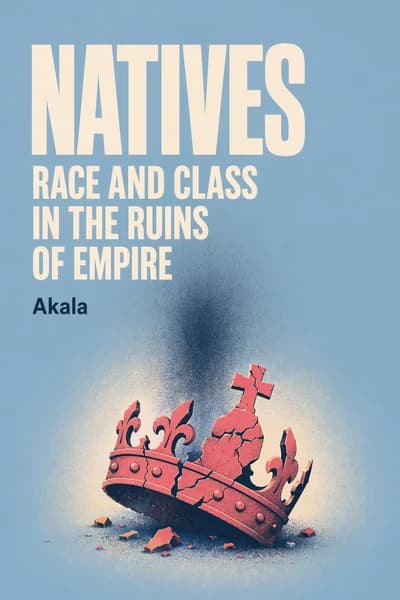
Natives Race and Class in the Ruins of Empire
Überblick über Natives Race and Class in the Ruins of Empire
Akala's "Natives" dissects race and class in Britain through personal experience and historical analysis. Surging in popularity after George Floyd's murder, this unflinching examination impressed even skeptics like Piers Morgan while arming readers with facts to challenge imperial myths and systemic racism.
Kernthemen in Natives Race and Class in the Ruins of Empire
- british imperial legacy
- institutional racism
- class consciousness
- racial identity formation
- educational inequality
Zitate aus Natives Race and Class in the Ruins of Empire
Education as battlefield.
Black excellence in British culture.
Personen in Natives Race and Class in the Ruins of Empire
- AkalaThe author and protagonist of the memoir
- Akala's motherThe author's Scottish/English mother
- MillicentThe author's grandmother
- Malcolm XHistorical figure whose tapes influenced Akala
Über den Autor
Über den Autor von Natives Race and Class in the Ruins of Empire
Kingslee James McLean Daley, better known as Akala, is the award-winning author of Natives: Race and Class in the Ruins of Empire, a Sunday Times Bestseller that blends memoir, history, and social critique. A groundbreaking rapper, historian, and activist, Akala has become a leading voice on systemic racism, colonialism, and class inequality. His work as founder of The Hip-Hip Shakespeare Company and his MOBO Award-winning music career inform the book’s incisive analysis of Britain’s imperial legacy.
Born to a Jamaican father and Scottish mother in 1983, Akala draws from his lived experience of poverty and racial profiling in London to dismantle myths of meritocracy. His 2012 mixtape Knowledge Is Power and graphic novel Visions further cement his reputation as a polymath bridging art and activism. Regularly featured on BBC, MTV, and global speaking circuits, Akala’s TED Talks and university lectures have amplified his call for systemic change.
Natives has been translated into multiple languages and remains a seminal text in anti-racist education. The book’s unflinching exploration of structural oppression has solidified Akala’s status as one of the UK’s most influential Black thinkers.
Zusammenfassung von Natives Race and Class in the Ruins of Empire herunterladen
Erhalten Sie die Natives Race and Class in the Ruins of Empire-Zusammenfassung als kostenloses PDF oder EPUB. Drucken Sie es aus oder lesen Sie es jederzeit offline.
FAQ zu diesem Buch
Natives blends memoir, historical analysis, and social critique to examine Britain’s racial and class inequalities. Akala interweaves his experiences growing up mixed-race in 1980s–90s London with explorations of imperialism, systemic racism, and myths of meritocracy. The book connects historical atrocities like the Atlantic slave trade to modern issues like police violence and educational disparities, arguing that race and class remain inseparable forces shaping British society.
This book is essential for readers interested in anti-racism, British colonialism, or class dynamics. Educators, policymakers, and activists will find its critiques of systemic inequality particularly relevant, while fans of Akala’s music or journalism gain insight into his intellectual foundations. It also appeals to those seeking narratives bridging personal trauma with broader historical patterns.
Yes—Natives offers a searing, well-researched perspective on Britain’s racial and economic hierarchies. Its blend of autobiography and history makes complex theories accessible, while Akala’s sharp critiques of media bias, educational inequity, and imperial legacies provide fresh angles on enduring social issues. The book’s unflinching honesty and multidisciplinary approach have earned praise for illuminating systemic oppression.
Akala (born Kingslee Daley) is a British-Jamaican rapper, historian, and activist known for his work on race and class. A MOBO Award-winning hip-hop artist, he founded the Hip-Hop Shakespeare Company and has become a prominent voice on imperialism. His lived experience with racism in London and autodidactic approach to education inform Natives’ blend of scholarly rigor and personal narrative.
Akala dismantles the myth that Britain rewards talent and effort equally, showing how race and class gatekeep opportunity. He highlights biased teacher expectations, discriminatory policing, and media dehumanization of Black figures like Linford Christie, arguing these systems ensure working-class and minority groups face structural barriers to advancement.
The book examines Japan’s imperialism, Spanish conceptions of Blackness in the 1400s, the Arab and Atlantic slave trades, and British rule in Hong Kong. Akala ties these to modern issues, showing how colonial violence and racial hierarchies underpin contemporary capitalism, immigration policies, and cultural attitudes.
Akala details being placed in remedial classes despite academic talent, linking this to studies showing teachers mark Black students more harshly. He contrasts this with Pan-African Saturday schools that fostered critical thinking, arguing mainstream education often perpetuates racism by erasing non-European histories and lowballing minority students.
This chapter dissects media obsession with athlete Linford Christie’s body instead of his achievements, exposing how Black masculinity is hypersexualized and dehumanized. Akala frames this as part of a broader pattern where Black success is diminished through racist stereotyping in sports and pop culture.
Yes—Akala critiques far-right rhetoric like the “white genocide” conspiracy theory and examines how “free speech” arguments amplify hate groups. He connects modern xenophobia to imperial ideologies, showing how fear of lost dominance fuels anti-immigrant and anti-Black policies.
Unlike purely historical or theoretical works, Natives merges memoir with academic analysis, offering a visceral, intersectional perspective. It complements texts like Brit(ish) by Afua Hirsch but stands out for its class-conscious lens and critique of liberal complacency.
Some argue Akala’s pessimism about systemic change lacks actionable solutions, while others note the dense historical sections demand prior knowledge. However, most praise its ambition in linking personal and political, calling it a vital intervention in debates on race and class.
The book exposes how imperialism’s legacy shapes everything from gentrification to Brexit-era nationalism. By connecting Windrush deportations, knife crime, and media racism to deeper colonial patterns, Akala provides tools to dissect modern inequalities rooted in Britain’s unresolved past.