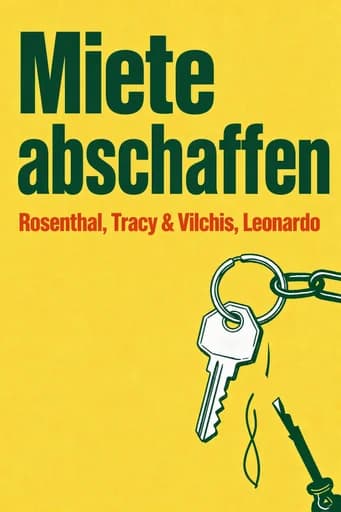
Abolish Rent
How Tenants Can End the Housing Crisis
Überblick über Abolish Rent
"Abolish Rent" reveals how tenants can revolutionize the housing crisis through collective action. Endorsed by Ruth Wilson Gilmore, this manifesto from LA Tenants Union co-founders sparked nationwide debate by asking: What if rent strikes across America could transform housing from commodity to community?
Kernthemen in Abolish Rent
- tenant power
- housing decommodification
- landlord exploitation
- eviction resistance
- racialized displacement
Zitate aus Abolish Rent
Ultimately, rent kills.
The housing market doesn't produce homes but investment opportunities.
Criminalization of homelessness effectively makes it illegal not to pay rent.
The average landlord spends less than four hours monthly maintaining a property.
Personen in Abolish Rent
- Tracy RosenthalAuthor and housing justice advocate
- Leonardo VilchisAuthor and housing justice advocate
- Herbert HooverU.S. President who prioritized homeownership
Über den Autor
Über den Autor von Abolish Rent
Tracy Rosenthal and Leonardo Vilchis, co-authors of Abolish Rent: How Tenants Can End the Housing Crisis, are leading voices in housing justice and tenant activism. Rosenthal, a writer and co-founder of the Los Angeles Tenants Union, brings a sharp analytical lens to housing inequity, with work featured in The New Republic, The Nation, and the Los Angeles Times.
Vilchis, a veteran organizer who co-founded Union de Vecinos in 1996, has spent three decades fighting gentrification and displacement in Boyle Heights, merging grassroots campaigns with academic partnerships at UCLA’s Institute on Inequality and Democracy. Their book, a Haymarket Books release, blends rigorous critique of exploitative rent systems with firsthand accounts of tenant resistance, eviction defenses, and cross-border solidarity.
Rooted in their roles as organizers, the authors interweave tenant-union strategies with abolitionist frameworks, advocating for collective ownership and democratic housing models. Rosenthal currently leads a rent strike in New York City, while Vilchis continues organizing through the L.A. Tenants Union’s Eastside Local.
Praised by Ruth Wilson Gilmore as “essential reading” for housing justice, Abolish Rent has been featured in The Chicago Reader and endorsed by prison abolitionists, cementing its influence in movements for economic and racial equity.
Zusammenfassung von Abolish Rent herunterladen
Erhalten Sie die Abolish Rent-Zusammenfassung als kostenloses PDF oder EPUB. Drucken Sie es aus oder lesen Sie es jederzeit offline.
FAQ zu diesem Buch
Abolish Rent exposes systemic injustices in the U.S. housing crisis, arguing that rent fuels inequality by prioritizing landlord profits over tenant welfare. Through historical analysis and grassroots tenant stories, it advocates for collective organizing to dismantle exploitative rental systems and reimagine housing as a communal right rather than a commodity.
This book is essential for renters, housing activists, policymakers, and social justice advocates seeking actionable insights into tenant empowerment. It resonates with anyone impacted by rising rents, evictions, or urban gentrification, offering a roadmap for building tenant unions and challenging real estate monopolies.
Yes—it combines sharp critique with inspiring examples of tenant victories, though some reviewers note it lacks detailed policy blueprints. Its strengths lie in vivid storytelling and clear-eyed analysis of housing exploitation, making it a rallying cry for urgent reform.
- Rent as exploitation: Landlords profit from hoarding housing, forcing tenants into financial precarity.
- Historical roots: Decades of policy decisions deepened racial and economic disparities in housing.
- Collective action: Tenants can resist evictions, demand rent controls, and build power through unions.
The authors emphasize forming tenant unions to stage eviction defenses, rent strikes, and citywide campaigns. Case studies highlight successes in Los Angeles, where organized tenants secured code enforcement and rent freezes by uniting across neighborhoods.
Both co-founded the Los Angeles Tenants Union, a grassroots organization combating evictions and gentrification. Their firsthand experience in tenant activism informs the book’s practical strategies and ideological framework.
The phrase condemns rent’s societal harm: homelessness, debt, and mental health crises caused by unaffordable housing. The authors argue that profit-driven landlording drains communities’ resources and stability.
While Evicted documents individual eviction stories, Abolish Rent focuses on systemic change through collective resistance. Rosenthal and Vilchis prioritize solutions over lamenting crises, urging readers to join tenant movements rather than solely empathize with victims.
Reviewers note the book overlooks practical challenges like funding community-owned housing and maintaining infrastructure without profit motives. However, its vision for tenant solidarity is widely praised as both radical and necessary.
With 100 million U.S. renters and evictions rising post-pandemic, the book’s call for rent abolition aligns with growing demands for housing justice. Recent tenant victories in cities like L.A. validate its strategies.
Justice entails decommodifying land, guaranteeing stable housing for all, and transferring control from landlords to communities. The book frames this shift as essential to ending racial and economic oppression tied to housing.
Yes—it advocates for social housing models, where tenants collectively manage properties, and campaigns for public investment in affordable units. These alternatives aim to eliminate profit-driven exploitation.