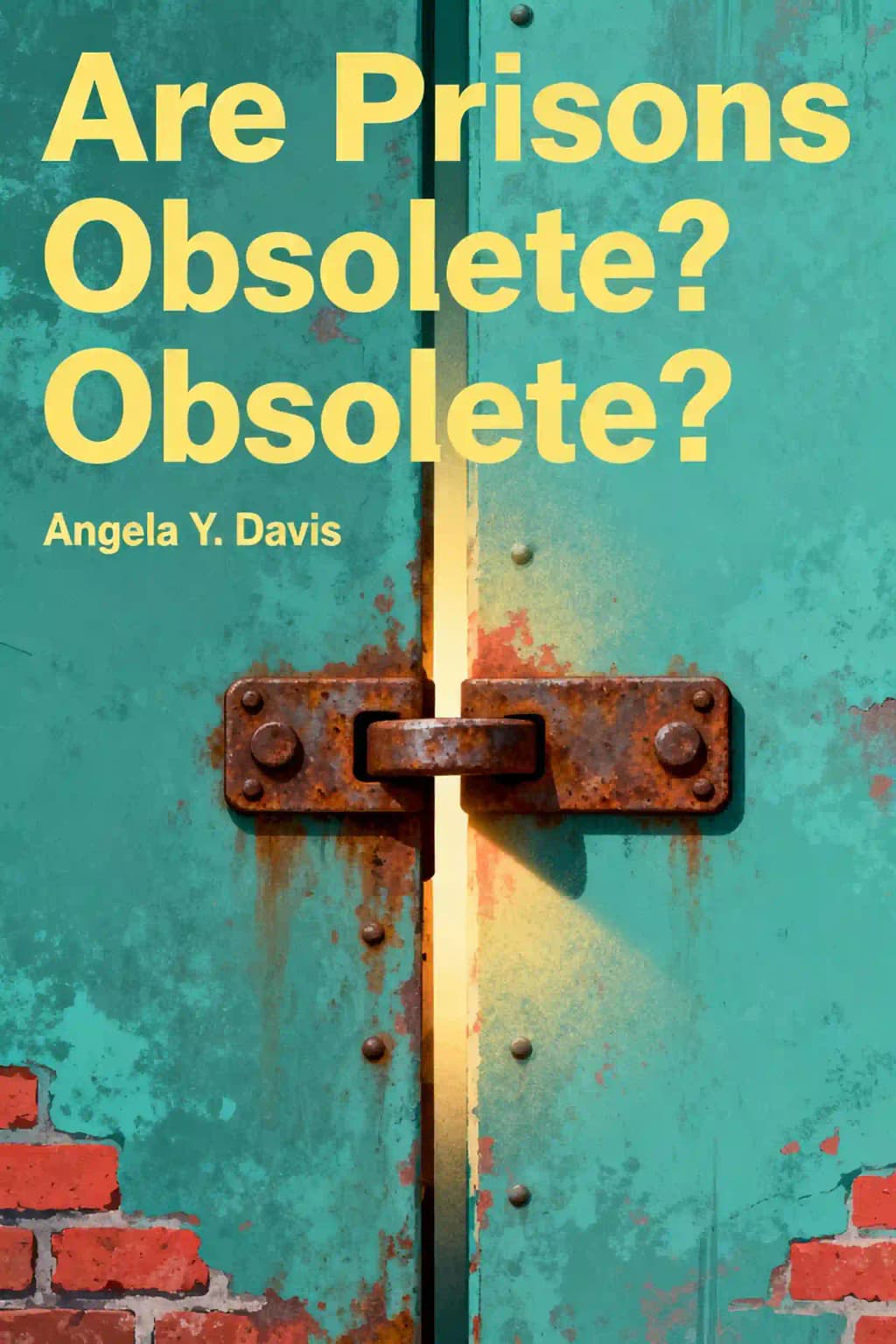
Angela Davis's radical manifesto challenges our core assumptions about justice. With translations in four languages and a 4.52 Goodreads rating, this foundational text sparked the modern prison abolition movement and inspired the prestigious Angela Y. Davis Prize. Can society exist without prisons? Davis dares us to imagine it.
Angela Yvonne Davis is the author of Are Prisons Obsolete? and a pioneering scholar, activist, and philosopher in prison abolition and social justice movements. Born in Birmingham, Alabama in 1944, Davis draws on decades of revolutionary activism and her own experience as a former political prisoner to challenge the foundation of the American prison system in this groundbreaking work. As a founding member of Critical Resistance, she has dedicated her career to dismantling the prison-industrial complex through scholarship and grassroots organizing.
Davis is Distinguished Professor Emerita at the University of California, Santa Cruz, where she taught courses on the history of consciousness.
Her other influential works include Women, Race & Class, Freedom Is a Constant Struggle, and Abolition Democracy. Are Prisons Obsolete? has become essential reading in criminal justice courses worldwide and remains one of the most cited texts in the prison abolition movement.
Are Prisons Obsolete is a 2003 book advocating for the complete abolition of the prison system. Angela Y. Davis examines how prisons fail to reform those they imprison and instead systematically profit from exploitation while perpetuating racism and sexism. The book traces the evolution of incarceration from early carceral systems to the modern prison industrial complex, arguing that mass imprisonment is unnecessary, ineffective, and inhuman.
Are Prisons Obsolete is essential reading for criminal justice reformers, social justice advocates, students of sociology and political science, and anyone questioning the American justice system. The book is praised as "wonderfully digestible, and therefore accessible," making complex abolitionist theory understandable for general readers. It's particularly valuable for those interested in understanding the intersections of racism, capitalism, and mass incarceration in contemporary society.
Are Prisons Obsolete is worth reading because it challenges fundamental assumptions about punishment and justice in American society. Civil rights activist Colin Kaepernick praised it for "effectively analyzing the purpose of prisons." The book provides a well-researched framework for understanding prison abolitionist thought and has become a core text in the prison abolition movement. Its insights remain highly relevant, with U.S. prisons still holding 22% of the world's incarcerated population.
Angela Y. Davis is a professor, activist, and outspoken advocate for Black liberation and prison abolition who has written extensively on the intersections of race, gender, and the justice system. Davis wrote Are Prisons Obsolete to challenge readers to see prisons as they view the death penalty—as an unnecessary feature of society. Her goal was not to provide definitive answers but to create questions that remove readers from the mindset of retribution and expose the ulterior motives of the justice system.
In Are Prisons Obsolete, Angela Y. Davis defines the prison industrial complex as the network of economic and political interests invested in crime and punishment for profit rather than public safety. This system involves corporations benefiting from prison labor and services, government relationships perpetuating prison expansion, and privatization patterns similar to those transforming healthcare and education. Davis connects it to the military industrial complex, showing how distant entities profit from ever-increasing incarceration rates.
Are Prisons Obsolete argues that prisons inherited and perpetuated the racial injustices of slavery by legally restricting the freedoms of formerly enslaved people after emancipation. Angela Y. Davis explains how white Southerners pushed for criminal justice reforms that coded crimes like vagrancy as Black, sending prisoners to forced labor at former slave plantations where the same vicious corporal punishments were used. This historical continuity reveals prisons as tools for economic exploitation and racialized punishment.
Are Prisons Obsolete reveals that women's prisons are "violently sexualized" environments where sexual abuse is an abiding though unacknowledged form of punishment. Angela Y. Davis documents how imprisoned women face near certainty of sexual assault through strip searches, internal cavity searches, or outright violence by guards, with women of color experiencing intersections of both race and gender in their punishments. Davis calls this "state-sanctioned sexual assault" and emphasizes that the combination of racism and misogyny retains devastating consequences in women's prisons.
Are Prisons Obsolete proposes decriminalization programs to reduce prison populations, expanded social welfare infrastructure to prevent survival crimes, and community-based recreation and living wage programs. Angela Y. Davis advocates for restorative justice approaches that focus on reparation rather than retribution, radically addressing "racism, male dominance, homophobia, class bias, and other structures of domination". She shares the story of Amy Biehl and the reconciliation between her parents and her killers as a model for successful alternatives to punitive justice.
Are Prisons Obsolete reveals that between 1960 and 2003, the U.S. prison population exploded from 200,000 to over 2 million, making America home to 20% of the world's incarcerated people despite representing less than 5% of the global population. Angela Y. Davis uses California as a case study, noting that nine prisons were built between 1984 and 1989—matching what took over a hundred years previously. The racial composition shows Latinos at 35.2%, African Americans at 30%, and white prisoners at 29.2%.
The main argument of Are Prisons Obsolete is that prisons are unnecessary, ineffective institutions that should be completely abolished rather than reformed. Angela Y. Davis contends that incarceration fails to deter or solve crime but instead perpetuates racist, sexist, and capitalist structures of oppression. She argues prisons serve as tools for social control and economic exploitation of marginalized populations, systematically profiting from prisoners rather than transforming lives. The book calls for creating an equal society that doesn't use punishment as its first and only form of justice.
Are Prisons Obsolete remains relevant in 2025 because mass incarceration continues as the most thoroughly implemented yet least questioned government social program in U.S. history. The fundamental issues Angela Y. Davis identified—racial disparities, sexual violence in prisons, and the prison industrial complex's profit motives—persist unchanged. With America still holding 22% of the world's prison population, the book's call to question the "naturalness" of prisons and imagine abolitionist alternatives continues to challenge readers to rethink justice.
Erlebe das Buch durch die Stimme des Autors
Verwandle Wissen in fesselnde, beispielreiche Erkenntnisse
Erfasse Schlüsselideen blitzschnell für effektives Lernen
Genieße das Buch auf unterhaltsame und ansprechende Weise
We take prisons for granted while simultaneously fearing what happens inside them.
The prison functions ideologically as an abstract site for undesirables.
The prison system represents a sophisticated evolution of racialized control in America.
The transition from slavery to criminalization was swift and calculated.
Ironically, the prison itself began as a reform movement.
Zerlegen Sie die Kernideen von Podem abolir les presons? in leicht verständliche Punkte, um zu verstehen, wie innovative Teams kreieren, zusammenarbeiten und wachsen.
Erleben Sie Podem abolir les presons? durch lebhafte Erzählungen, die Innovationslektionen in unvergessliche und anwendbare Momente verwandeln.
Fragen Sie alles, wählen Sie Ihren Lernstil und gestalten Sie Erkenntnisse, die wirklich zu Ihnen passen.

Von Columbia University Alumni in San Francisco entwickelt
"Instead of endless scrolling, I just hit play on BeFreed. It saves me so much time."
"I never knew where to start with nonfiction—BeFreed’s book lists turned into podcasts gave me a clear path."
"Perfect balance between learning and entertainment. Finished ‘Thinking, Fast and Slow’ on my commute this week."
"Crazy how much I learned while walking the dog. BeFreed = small habits → big gains."
"Reading used to feel like a chore. Now it’s just part of my lifestyle."
"Feels effortless compared to reading. I’ve finished 6 books this month already."
"BeFreed turned my guilty doomscrolling into something that feels productive and inspiring."
"BeFreed turned my commute into learning time. 20-min podcasts are perfect for finishing books I never had time for."
"BeFreed replaced my podcast queue. Imagine Spotify for books — that’s it. 🙌"
"It is great for me to learn something from the book without reading it."
"The themed book list podcasts help me connect ideas across authors—like a guided audio journey."
"Makes me feel smarter every time before going to work"
Von Columbia University Alumni in San Francisco entwickelt

Erhalten Sie die Podem abolir les presons?-Zusammenfassung als kostenloses PDF oder EPUB. Drucken Sie es aus oder lesen Sie es jederzeit offline.
Imagine a world where prisons don't exist. This thought experiment feels almost impossible for most of us - prisons seem as inevitable as hospitals or schools. Yet Angela Davis's "Are Prisons Obsolete?" challenges this very assumption. Since its 2003 publication, this slim but powerful volume has become foundational to the prison abolition movement, influencing generations of activists and scholars. Davis, who spent 16 months as a political prisoner before being acquitted of all charges in 1972, brings both personal experience and scholarly rigor to her analysis. What makes this work so compelling is how it forces us to question something we've been conditioned to accept as natural and necessary: the prison itself.
We paradoxically take prisons for granted while fearing their reality. When prison abolition movements began in the late 1960s, about 200,000 Americans were incarcerated. Today, that number exceeds two million - over 20% of the world's prisoners despite America having less than 5% of global population. This expansion accelerated during the Reagan era through "tough on crime" policies despite minimal impact on crime rates. The War on Drugs, mandatory minimums, and three-strikes laws swelled prison populations dramatically. California exemplifies this trend: after building nine prisons between 1852-1955, the state opened nine more in just the 1980s, with twelve more following in the 1990s. Media representation has normalized incarceration as inevitable. Racial disparities remain severe: by the 1990s, one-third of Black men aged 20-29 were under criminal justice supervision. Prisons function as repositories for "undesirables," allowing society to avoid addressing community issues while corporations profit from prisoner management. This privatization has transformed incarceration into a profitable industry with powerful lobbying interests, entrenching the system while masking social inequalities.
The prison system evolved directly from slavery through Jim Crow to mass incarceration. Despite slavery's legal abolition, white supremacy persisted through refined institutional methods. Former slave states quickly enacted Black Codes criminalizing ordinary behaviors when performed by Black people. The Thirteenth Amendment's exception clause - allowing slavery "as punishment for crime" - provided constitutional foundation for a new form of bondage. Alabama's prison demographics tell the story: before emancipation, 99% of prisoners were white; shortly after the Civil War, the population became overwhelmingly Black. The convict lease system emerged as slavery's brutal successor, combining economic exploitation with racial control. Unlike slave owners, convict lessees had no incentive to preserve their workers. By 1888, every able-bodied male prisoner in Alabama was leased to mining companies. This forced labor built the South's infrastructure - Georgia's railroads, Atlanta's Peachtree Street, and Birmingham's industrial complex. Today's prison privatization mirrors this system by creating financial incentives for expanded incarceration, disproportionately targeting Black communities and perpetuating historical patterns of disenfranchisement.
Ironically, the prison began as a reform movement. Before standardized prisons, punishment was public spectacle-executions and torture meant to affect spectators more than the punished. These displays often became carnival-like events rather than deterrents. Reformers argued that isolated punishment would reform lawbreakers instead of exacting revenge. They believed solitude with labor and religious instruction would lead to spiritual transformation, shifting from public spectacle to private reformation. The term "penitentiary" emerged in 1758 England for "penitent prostitutes" seeking redemption through prayer and work. Bentham's panopticon featured a circular prison where inmates could be constantly observed by unseen guards-psychology aligned with industrial capitalism's need for self-disciplined workers. America developed two competing models: the "Pennsylvania system" of total isolation and the "Auburn model" allowing group labor under strict silence. Dickens's 1842 visit produced a scathing critique, condemning solitary confinement as "immeasurably worse than any torture of the body." Today's supermax prisons echo historical penitentiaries but abandon rehabilitative pretenses, making no claims of respecting rights while justifying harsh conditions for "the worst of the worst"-often reflecting racial and social biases more than behavior.
Women comprise only five percent of global prison populations yet represent the fastest-growing demographic in U.S. prisons. Since the late eighteenth century, female criminality has been portrayed as more threatening and aberrant than male criminality, considered relatively "normal." Nineteenth-century Quaker reformers established separate women's prisons, believing "fallen women" could be redeemed through domestic training - ultimately creating systems that funneled poor and Black women into service jobs after release. Black and Native American women faced heightened challenges, often segregated or sent to men's prisons. In post-Civil War southern states, Black women endured the brutal convict lease system without feminized punishment protections. Today's women's prisons increasingly mirror men's facilities. "Reforms" have ironically adopted "separate but equal" approaches that sometimes impose harsher conditions in the name of gender equality, including weapons and chain gangs in Alabama and Arizona. Sexual abuse has become institutionalized, with Human Rights Watch documenting male officers routinely assaulting female prisoners. The criminalization of Black and Latina women involves hypersexualized stereotypes that justify abuse, with practices like unnecessary exams and strip searches functioning as state-sanctioned sexual assault.
The prison industrial complex connects corporations, government agencies, correctional communities, and media outlets. Prison population growth stems from systemic racism and profit motives rather than rising crime rates. After the Cold War, defense companies like Westinghouse and 3M shifted to prison security systems. Military technologies - surveillance systems, night vision, riot control gear - found new applications in corrections. Prisoners have long been exploited for profit. Post-WWII medical experimentation accelerated pharmaceutical development. At Holmesburg Prison, Dr. Albert Kligman conducted hundreds of experiments, viewing inmates as "acres of skin" for dermatological research. Major corporations benefited until federal regulations prohibited using prisoners as research subjects in 1974. The 1980s prison expansion coincided with deindustrialization and welfare cuts. As factories closed, prisons managed this "human surplus." Politicians justified harsh sentencing by stoking crime fears despite falling crime rates. Private prison corporations like CoreCivic and GEO Group dominate the market, while companies from Dial Soap to AT&T profit from correctional facilities, creating powerful incentives to maintain high imprisonment rates.
Abolition demands alternatives beyond prison-like substitutes. We need transformed schools, revitalized education, free healthcare, and justice based on reparation rather than retribution. Decriminalizing drug use is central to abolitionist thinking, alongside developing community-based treatment programs. This approach should extend to sex work and immigration, challenging detention systems. Organizations worldwide offer alternative models from conflict resolution to restorative justice. Herman Bianchi suggests replacing criminal law with reparative law where "the lawbreaker is thus no longer an evil-minded person, but simply a debtor whose human duty is to take responsibility for their acts." Creating alternatives requires breaking the conceptual link between crime and punishment - recognizing imprisonment isn't inevitable but tied to political agendas, profits, media, and racial structures. The Amy Biehl case demonstrates restorative justice's power. After Biehl's death in South Africa, her parents supported amnesty for the convicted men and later hired two at her foundation - illustrating justice as healing rather than retribution. Just as previous generations couldn't imagine life without slavery, many today cannot envision society without prisons. Yet history shows seemingly permanent institutions can be dismantled through sustained resistance and collective reimagining.