Chapter 4
Spiritual Questioning and the Nature of Faith
At its core, "This Tender Land" is a spiritual odyssey. Odie begins the journey with a bitter understanding of God as a destructive force-"God is a tornado," he paints on the Lincoln School water tower before fleeing. His experiences at the school, particularly the Brickmans' hypocritical Christianity, have left him deeply skeptical of religious faith.
This spiritual questioning finds its most complex expression when the children encounter Sister Eve's traveling healing crusade. Initially drawn to her warmth and apparent miraculous powers, Odie discovers the staged nature of some of her "healings." Yet Sister Eve challenges his black-and-white thinking: "I never said I healed anybody," she tells him. "God does the healing. I'm just the vessel."
When Albert is bitten by a rattlesnake and hovers near death, Odie confronts the limits of both faith and skepticism. Despite Sister Eve's encouragement to believe in healing, Albert survives not through a miracle but through conventional medicine-antivenom arriving just in time. Yet the experience leaves Odie with a more nuanced understanding that perhaps the divine works through ordinary means.
Throughout their journey, Emmy experiences seizures during which she appears to glimpse future events or even subtly alter reality. These episodes suggest a mystical dimension to existence that defies rational explanation. As Sister Eve tells Odie: "Emmy doesn't understand what she has. But someday she will."
Krueger refuses easy answers to spiritual questions. Instead, he presents a world where faith and doubt coexist, where the divine might be found in nature, music, kindness, or the bonds between people. By the epilogue, an elderly Odie has come to see existence as "a river that runs through time and the universe, vast and inexplicable, a flow of spirit at the heart of all existence."
Chapter 5
The Healing Power of Stories
Storytelling emerges as both a vital survival mechanism and a profound means of making sense of trauma throughout the novel. Odie's creation of the "Vagabond" stories for Emmy demonstrates this dual purpose-these aren't mere diversions but essential tools for psychological survival. In these tales, Odie crafts characters clearly based on their group: a brave young boy with a magical harmonica, a strong-hearted girl who can speak to animals, a wise Native American protector, and a gentle giant who guards them all. By reimagining their struggles through a lens of fantasy and triumph, these stories help the children process their fears while maintaining hope.
The transformative power of storytelling extends beyond the children's immediate group. When they encounter Jack, the one-eyed farmer consumed by grief over his lost family, Odie's combination of harmonica playing and storytelling creates a momentary breakthrough. Jack's emotional walls-built up through years of isolation and pain-begin to crack as Odie weaves tales that echo Jack's own losses while suggesting the possibility of healing. This interaction demonstrates how shared stories can bridge the deepest chasms of human suffering.
At Sister Eve's revival meetings, the healing power of narrative takes on an even more dramatic form. When a desperate man threatens the crowd with a shotgun, it's Odie's harmonica playing-itself a form of wordless storytelling-that defuses the situation. The music speaks to something deeper than words, reaching past the man's anger to touch his humanity. These moments reveal how artistic expression, whether through music or story, can transform potentially violent situations into opportunities for connection.
The novel's framing device-elderly Odie recounting these events to his great-grandchildren-serves multiple purposes. It shows how narratives help us integrate difficult experiences into a coherent identity, while also demonstrating the way stories evolve over time. When Odie confesses to Sister Eve, "I don't know what's true anymore," her response-"The truth is whatever story you believe"-speaks to the complex relationship between truth and narrative. This isn't an endorsement of fabrication, but rather an acknowledgment that our understanding of events is inevitably shaped by the stories we tell about them.
By the epilogue, Odie has gained deep wisdom about the relationship between storytelling and healing. His realization that peace comes from yielding to the river and embracing the journey reflects how stories help us accept and find meaning in life's uncertainties. The metaphor of the river-constantly moving, sometimes dangerous, but ultimately following its course-parallels how our personal narratives flow and change while remaining essentially true to their source. Through this lens, storytelling becomes not just a way to entertain or remember, but a fundamental tool for human resilience and understanding.
Chapter 6
The Quest for Home and Identity
For four orphaned children, the concept of home carries profound significance. Their journey is not just geographical but a search for belonging and identity. Each character grapples with different aspects of this quest.
Albert, the practical older brother, initially defines home through responsibility and protection. His mechanical skills earn him respect wherever they travel, offering glimpses of a possible future identity. Mose's search is more complex-as a Native American raised in a white institution, he struggles to connect with his heritage. When he learns his Sioux name, Amdacha ("Broken to Pieces"), from Sister Eve, it begins a process of reclaiming his cultural identity.
Emmy, having lost her mother to the tornado, attaches herself to the group with childlike adaptability. Her seizures suggest a special sensitivity to the world's hidden dimensions. For Odie, home remains the most elusive concept-he carries a restlessness that makes him question every temporary haven they find.
The journey culminates in Saint Louis, where Odie discovers that his "Aunt Julia" is actually his biological mother, who gave him to her sister to raise. This revelation forces him to reconsider his entire understanding of family and belonging. When the Brickmans finally catch up with them, the ensuing confrontation leaves both Odie and his mother wounded.
In the epilogue, we learn that the four "Vagabonds" ultimately found different paths. Albert became an engineer before dying heroically in World War II. Mose returned to Lincoln School as a coach and advocate for Native American rights. Emmy developed her spiritual gifts under Sister Eve's guidance. And Odie, our storyteller, eventually returned to the Gilead River of his childhood-finding home not in a place but in the stories that connect generations.
Chapter 7
The Moral Complexity of Survival
Throughout their journey, the children face moral dilemmas that challenge their understanding of right and wrong. Odie begins their odyssey having killed DiMarco-an act of self-defense that nonetheless haunts him. Later, when he believes he's killed Jack the pig farmer, the weight of this second death nearly crushes him. His relief upon discovering Jack survived is palpable: "The weight of guilt lifted from my shoulders felt almost giddy."
Albert, as the eldest, struggles with responsibility for the others while harboring his own desires for independence. When offered work on Truman Waters' towboat in Saint Paul, he's torn between his duty to continue the journey and the opportunity to use his mechanical talents. His decision to stay temporarily creates the first serious fracture in the group.
Even young Emmy faces moral complexity. Her apparent ability to subtly alter reality during her seizures raises questions about the boundaries between fate and intervention. As Sister Eve suggests, Emmy doesn't yet understand her gift or its implications.
Perhaps the most morally nuanced character is Sister Eve herself. Her healing crusade includes staged "demonstrations" with paid performers, yet she genuinely believes in the power of faith. When Odie confronts her about this deception, she defends herself: "Those people were healed. Just not at that moment." Her ethics exist in a gray area between fraud and faith.
Krueger refuses to judge his characters harshly for their moral compromises. Instead, he shows how survival in desperate times requires difficult choices. As Jack tells Odie about human nature: "The moment you imagine doing something terrible, it's already been done."
Chapter 8
The Legacy of Historical Injustice
While following four children's remarkable journey, Krueger masterfully interweaves their personal story with the devastating historical injustices that shaped their world. The Lincoln Indian Training School stands as a stark representation of the government's systematic policy of forced assimilation that brutally separated Native American children from their families, culture, and traditions. The school's harsh disciplinary practices, prohibition of native languages, and forced adoption of Western customs reflect the broader national campaign to "Kill the Indian, save the man." As Odie poignantly observes, "Everything done to us, we carry forever" - a truth that resonates through generations of trauma.
In Mankato, Mose's encounter with the site where 38 Dakota men were hanged in 1862 becomes a pivotal moment of historical reckoning. This execution - the largest mass execution in American history - occurred after a hastily conducted military tribunal during the U.S.-Dakota War. When Mose discovers this tragic history, it transforms his understanding of his own identity and trauma, connecting his personal story to the larger narrative of cultural genocide. His decision to adopt the name Amdacha, after one of the executed men, becomes an act of reclamation and resistance - honoring those who came before while asserting his right to carry their legacy forward.
The novel's Depression-era setting provides a stark backdrop for exploring economic injustice. The Schofields' loss of their family farm represents thousands of similar stories across America's heartland, where hardworking families fell victim to a combination of drought, plummeting crop prices, and predatory banking practices. Through their story, Krueger illustrates how the Depression wasn't simply a natural disaster but a man-made catastrophe that disproportionately affected rural communities.
In Saint Paul's West Side Flats, the author paints a vivid picture of immigrant resilience. Despite systematic discrimination and grinding poverty, these communities - Irish, Italian, Jewish, and Mexican - create vibrant neighborhoods where cultural traditions flourish against all odds. Gertie's scarred face becomes a powerful symbol of institutional violence, earned when she intervened to help "some poor schlub they were beating" - a reminder that law enforcement often served as an instrument of oppression rather than protection.
The complexity of survival in an unjust world is further explored through Aunt Julia's brothel. Far from a simple moral judgment, it represents the limited options available to women in an era of rigid social constraints and economic hardship. As Dolores's bitter observation to Odie suggests - "Yes, your precious Aunt Julia, too. Wake up, Odie. It's a fucked-up world" - even seemingly safe harbors are built on compromise and exploitation.
By weaving these historical realities into a coming-of-age narrative, Krueger creates a story that acknowledges the weight of systemic injustice while affirming the power of human resilience. The children's journey through this landscape of historical trauma suggests that even in a world shaped by cruelty and discrimination, individual acts of courage, kindness, and resistance can create paths toward healing and redemption.
Chapter 9
The Geography of Hope
The rivers that carry the children-the Gilead, the Minnesota, and finally the Mississippi-serve as both literal pathways and powerful metaphors throughout their journey. Water emerges as a complex symbol, representing both danger and possibility, destruction and renewal. After the devastating tornado that claims Emmy's mother's life, the Gilead River offers not just physical escape but emotional cleansing. The river's current mirrors the children's forward momentum, carrying them away from trauma toward potential salvation. Later, when Odie feels suffocated by the constraints of life in Saint Paul, the Mississippi's mighty flow beckons with the promise of freedom-its waters representing an eternal path to possibility that has guided travelers and dreamers for generations.
Landscapes in the novel carry profound emotional and spiritual significance, each terrain type offering its own metaphorical weight. The vast prairie represents both isolation and unlimited possibility-its endless horizon line suggesting both the terror of abandonment and the promise of unlimited potential. The open spaces force the children to confront their own smallness while simultaneously offering them room to grow beyond their traumatic past. Towns and cities present a complex duality, offering both the warmth of community and the lurking presence of danger. The West Side Flats in Saint Paul becomes particularly significant as a temporary haven because, despite its material poverty, it contains "two precious things that had been withheld from us at Lincoln School: happiness and freedom." This immigrant neighborhood demonstrates how true wealth often exists in spiritual rather than material abundance.
Even man-made structures acquire deep symbolic meaning throughout the narrative. The water tower at Lincoln School, where Odie defiantly paints "GOD IS A TORNADO" before his escape, stands as both a physical and metaphorical monument to his spiritual rebellion-its height representing his raised fist against institutional authority and religious hypocrisy. The mass hanging memorial in Mankato serves as a somber reminder of historical trauma that refuses to be forgotten, its presence forcing characters to confront the darker aspects of American history. Sister Eve's revival tent emerges as a transformative space where the line between genuine spiritual awakening and manufactured faith becomes deliberately blurred-its canvas walls creating a temporary sacred space where belief and doubt dance together.
By the epilogue, Odie's return to the Gilead River completes both a geographical and spiritual circle, demonstrating how physical places can anchor our emotional and spiritual journeys. The river that once carried him away from danger has transformed in meaning, now representing continuity, peace, and the eternal flow of time. As he shares with his great-grandchildren: "There is a river that runs through time and the universe, vast and inexplicable, a flow of spirit at the heart of all existence, and every molecule of our being is part of it." This final meditation suggests that geography isn't just about physical space but about the spiritual landscapes we traverse throughout our lives.
Chapter 10
The Enduring Power of Found Family
Perhaps the novel's most powerful theme is the creation of family bonds that transcend blood relationships. The four children-only two of whom are biological siblings-form a unit they call "The Vagabonds" that proves stronger than many traditional families. Their loyalty is tested repeatedly but ultimately endures beyond the journey itself.
This theme extends to other characters who create chosen families. Gertie and Flo in Saint Paul maintain a loving partnership despite social prejudice. The residents of Hopersville form a community based on mutual support rather than kinship. Even Sister Eve's healing crusade functions as a makeshift family for its members.
The novel complicates traditional notions of family through Odie's discovery that Aunt Julia is his biological mother. This revelation forces him to reconsider what family truly means. Is it defined by blood, shared experience, or choice? When Albert arrives at the hospital after Odie is shot, he declares: "You are my brother. The hell with everything else." This affirmation of chosen family over biological ties represents the novel's emotional core.
In the epilogue, we learn that the four Vagabonds maintained their bonds throughout their lives, despite following different paths. As the last survivors, elderly Odie and Emmy live together by the Gilead River, where Odie passes their story to a new generation. This continuity suggests that family, at its best, extends beyond individual lifetimes into a kind of immortality through shared narrative.
As Odie reflects in the novel's final lines: "I am a storyteller now, but in this story, I was a boy-once upon a time."
Chapter 11
The Journey Never Truly Ends
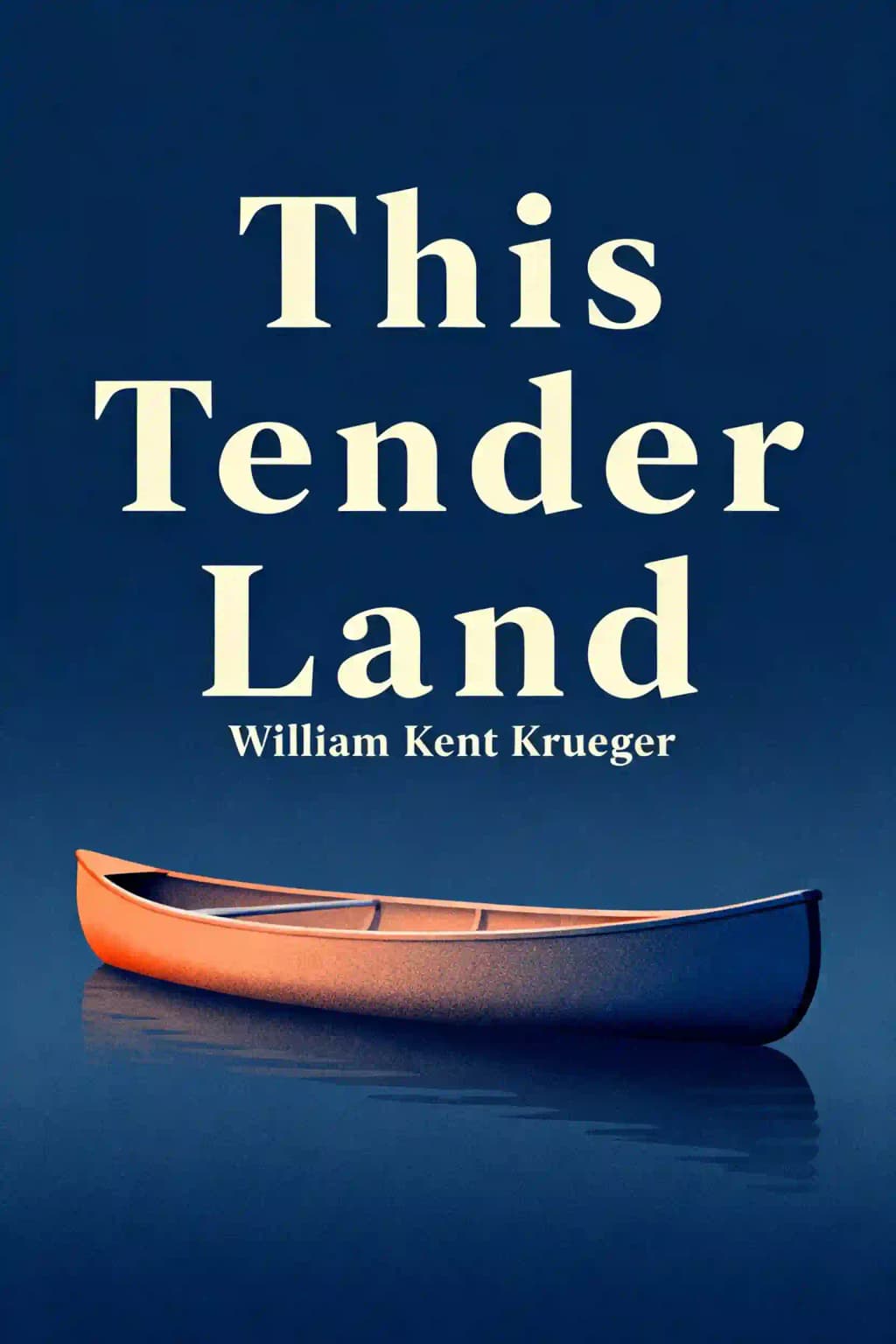
William Kent Krueger's "This Tender Land" offers no simple resolutions to its complex themes. Instead, it suggests that life itself is an ongoing odyssey, with each apparent ending revealing itself as merely another bend in the river. The elderly Odie who narrates the epilogue has gained wisdom but still grapples with the same essential questions that haunted his twelve-year-old self - questions of faith, justice, and the nature of belonging. His reflections reveal how certain fundamental human struggles remain constant across a lifetime, even as our perspective on them evolves.
What makes the novel resonate so deeply with readers is this refusal of easy answers coupled with a profound affirmation of human resilience. The four orphans face unimaginable hardships - institutional abuse, murder, pursuit, hunger, and betrayal - yet maintain their capacity for wonder, love, and hope. Their journey becomes a testament to the enduring human spirit. Through Albert's steadfast protection of his brother, Emmy's mysterious healing gifts, Moses's silent strength, and Odie's questioning spirit, we see different manifestations of courage and perseverance. Each character carries their wounds differently, yet each finds ways to keep moving forward.
In our own turbulent times, "This Tender Land" reminds us that previous generations weathered similar storms of economic uncertainty, social division, and personal loss. The Depression-era setting mirrors many contemporary concerns: economic disparity, racial injustice, religious conflict, and the displacement of vulnerable populations. Like the rivers that carry the children toward an uncertain future, the novel suggests that surrender to the journey itself - rather than desperate attempts to control outcomes - may be the truest path to peace. The Mississippi River serves as both literal pathway and metaphorical guide, teaching lessons about flow, persistence, and the inevitability of change.
As Sister Eve tells Odie near the journey's end: "All I've ever seen when I've looked at you is what you wanted most in your heart. And that's the easiest thing in the world to see, Odie. All you've ever wanted is home." This insight crystallizes the novel's central theme: the universal yearning for belonging. In following four orphans' search for home, we recognize our own deepest longing - and perhaps, like Odie, discover that home exists not in a place but in the stories we tell and the people we choose to love. The novel's conclusion suggests that while physical journeys may end, the spiritual quest for meaning and connection continues throughout our lives.
Through the interweaving of myth, history, and personal narrative, Krueger creates a story that speaks to the perpetual human search for identity and purpose. The river journey becomes a metaphor for life itself - sometimes peaceful, sometimes turbulent, but always moving forward, carrying us toward destinations we cannot fully foresee but must face with courage and hope.