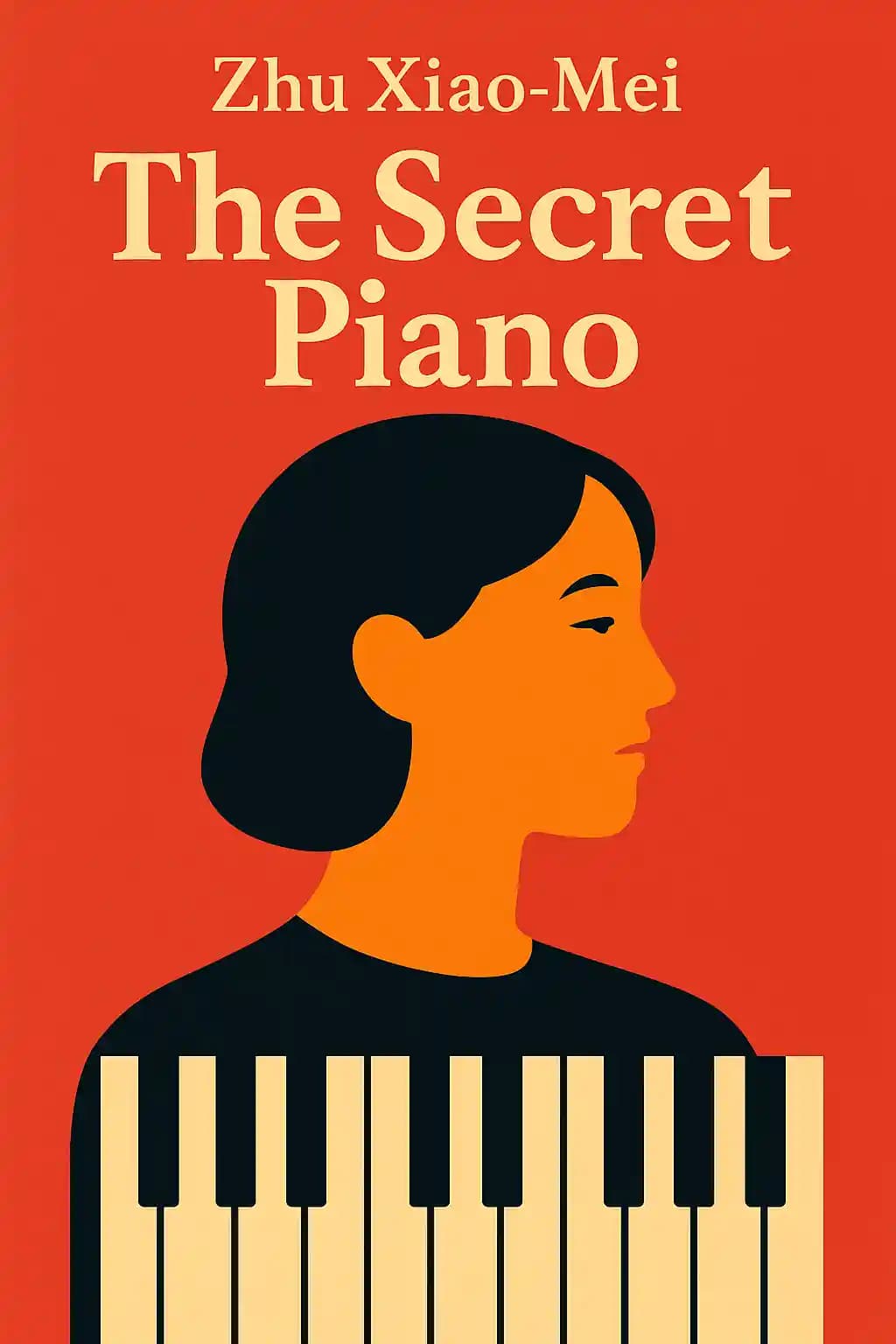
Chapter 4
When Music Becomes the Enemy
The Cultural Revolution erupted at the Conservatory in June 1966. A dazibao (big-character poster) by Nie Yuanzi denouncing revisionists sparked immediate division among students and faculty. Violence escalated rapidly as professors were forced to kneel on the running track, deliver self-criticisms, and endure brutal beatings from Red Guards who struck them with belt buckles until they bled.
We students were made to shout "He is guilty!" and "Long live Mao and the Revolution!" after each confession. The persecution intensified with endless dazibaos accusing professors of bourgeois education. Several renowned musicians couldn't bear the humiliation-piano teachers Gu Shengying and Li Cuizhen committed suicide. When soldiers briefly attempted to restore order, they were soon removed after Mao sided with the extremist students.
The violence claimed more victims: Mama Zheng, who had cared for us like a mother, hanged himself after being tortured by Red Guards. My schoolmate Cunzhi was savagely beaten after being falsely accused of possessing a rifle and Guomindang flag. Terrified, I rushed home where my mother and I tried desperately to hide our piano-a dangerous symbol of bourgeois culture-by covering it with blankets and hanging a dazibao on it declaring: "This piano was acquired by exploiting the people, through their sweat and blood. We want to return it to the people."
The People's Daily urged Red Guards to "drive out the old parasites, the bloodsuckers hiding in the shadows." This time, they would come for us at home. Studying Mao's thought became mandatory for everyone. Red Guards would quiz people on The Little Red Book before allowing them onto buses, ruthlessly turning away elderly people with poor memories. I witnessed a twenty-seven-year-old man beaten and humiliated in a Beijing stadium for suggesting one could be revolutionary despite having bad-class parents. He was later executed, reinforcing the slogan "Reactionary father, bastard son."
By late 1966, the "Conservatory without music" replaced education with political action. With all Western music destroyed, only Madame Mao's approved Yangbanxi "model works" remained. I learned piano transcriptions of these pieces and performed them in sixty concerts across China. Despite their revolutionary themes, these works ironically borrowed passages from condemned Western composers like Chopin.
Chapter 5
Prisoner of Camp 4619
By early 1969, my family began to scatter across China. My father was sent to a labor camp after officials used an old file as "proof" he was a spy. I received orders to leave for Zhangjiakou in northern Hebei Province, assigned to a military camp. On my departure day, my mother packed practical items for me, and we parted without formal goodbyes, as is Chinese custom. Walking away, I turned to see her staring palely into space, now left with only my sister Xiaoyen.
Beijing's streets were eerily empty while its railway station teemed with people and revolutionary banners. I joined fellow students from Beijing's art schools as we boarded trains for Camp 4619 in Yaozhanpu. The camp consisted of three low, red-brick military buildings around a square. Our quarters were cramped-ten narrow straw mattresses on the floor of a 200-square-foot room, covered with cockroaches.
Commander Tian addressed us: "Among you there are tigers and dragons, but your minds remain bourgeois. This is why you must be re-educated." My hope of becoming a real revolutionary quickly collapsed as I realized the camp's purpose was to break us. Each day followed the same brutal pattern for what would become five years: 6 AM wake-up, running exercises, studying Mao's Little Red Book, then working in unsuitable rice fields-digging irrigation ditches, spreading excrement, and standing in freezing water that left me feverish with stopped periods.
Evenings brought mandatory self-criticism sessions before we could wash, where we denounced each other to improve our chances of early release. We slept fully dressed for midnight emergency drills, endured sandstorms on laundry days, and found our only pleasures in occasional Albanian films with their forbidden kisses. Mail provided rare comfort, connecting me to my mother in Beijing and my fifteen-year-old sister, now sent to remote Manchuria.
Chapter 6
The Piano That Saved My Soul
In early 1971, we were transferred to our fourth camp, Dayu-a true prison with high walls topped with barbed wire. In this desolate place, I became obsessed with music, particularly Rachmaninoff's Second Concerto, which matched the bleak landscape. Despite warnings from friends that it was madness that could extend my imprisonment, I hatched a plan to have my piano sent from Beijing.
Through a friend, I arranged for a former movie actor named He, who lived in isolation near the camp, to house my piano. I wrote desperate letters to my mother until she finally relented, enlisting workers to disguise and ship the piano by train. After three anxious weeks, it miraculously arrived at Sha Lingzi station. Though blackened from the coal compartment and missing twenty strings, I was overjoyed.
When a new, simpler commander nicknamed "Thousand-Drops" arrived, we convinced him to let us practice the Yangbanxi. Soon, instruments appeared in the camp-my friend Like received a cello, and others obtained two pianos. Emboldened, I brought my own piano into the camp, finding a small soundproof room where I practiced after stealing coal to heat the freezing space.
Though we were officially permitted to play revolutionary Yangbanxi and even Beethoven's Appassionata (Lenin's favorite), we desperately needed more scores to replace those burned in the Conservatory courtyard. I approached my friend whose father lived in Hong Kong, hoping he might send us music.
His father, Zho Henli, sent packages of scores-many were intercepted, but some miraculously arrived containing Bach's Well-Tempered Clavier, Chopin's Scherzos and Ballades, Beethoven's Sonatas, and Rachmaninoff's Piano Concerto No. 2. We fought over these treasures, and I painstakingly copied them all onto precious music paper my mother somehow procured.
The refrigerator became my sanctuary where I could finally play whatever I wanted. My relationship with the piano was simple and pure-I felt weightless, balanced, completely detached from any purpose beyond the music itself. In late 1971, we gave our first concert. Though officially approved for Yangbanxi and Albanian music, we actually performed Tchaikovsky's Piano Trio, Dvorak's Cello Concerto, and concertos by Rachmaninoff and Tchaikovsky. The emotion was overwhelming-each face reflected our shared anguish at being denied our futures.
Our camp transformed into a "Villa Medici"-an artists' colony where I befriended Fu, a brilliant painter who taught me to see the seven colors of the sky, and Teng Wenji, a future film director who vividly explained cinema theory. The music revived our humanity and offered glimpses of spirituality. It taught us to love again-even literally, as five couples formed at Zhangjiakou. In camp, I understood music's power and my fortune in being a musician.
Chapter 7
From East to West: A New Beginning
After returning to Beijing and reconnecting with Professor Pan, I fought against bureaucratic age limits to apply to the Conservatory. When told I exceeded the maximum age of twenty-five, I followed Professor Pan's advice to petition the Ministry of Culture. With four classmates in the same situation, we staged a sit-in with a simple demand: "If we are at the same level as the younger students, take them. If we are better, take us!"
The ministry relented, allowing us to take the entrance exams. For my competition piece, I chose Huang Anlun's "Prelude," dedicated to a friend crushed by the Revolution-music describing "the rebellion of a caged animal." I played with such intensity that I broke a string on the Conservatory's Steinway, and the audience broke into forbidden applause. The next day, my name appeared among the four successful candidates.
As China normalized, cultural openness increased. Despite resistance from the Conservatory administration, I secured permission to study abroad, obtained sponsorship from the California Institute of the Arts, and eventually convinced the American ambassador to grant my visa. When my mother suggested selling our piano to fund my journey, she ultimately couldn't bear to part with it, saying "The piano is you. If you leave and the piano goes too, it will be as though you are leaving twice."
On February 1, 1980, I departed for China, my father's final words echoing: "Stay in America; don't come back. There is no justice here." On the train, I finally allowed myself to cry as I had never done as a child.
My introduction to America was filled with challenges. To support myself, I became a cleaning woman for wealthy Americans with a magnificent Steinway grand piano. Though I earned $300 monthly, the work was exhausting. The waste, superficial conversations, and obsession with money overwhelmed me. Even a trip to Disneyland felt like "mental torture" to me, shocking my hosts who believed I'd been "contaminated by Communism."
After developing an allergy to my employers' dog, I received a life-changing call from Like, urging me to audition in Boston. I was accepted at the New England Conservatory with a scholarship, finally seeing a path forward.
Chapter 8
The Power of Emptiness: Finding Bach and Laozi
In Boston, Gabriel Chodos proved to be an extraordinary teacher with clear artistic vision. His teaching method had one prerequisite: total respect for the score. "The only way to be faithful to the composer is to explore the score in depth," he would say, turning away students who used incorrect editions or added unindicated expressions.
He focused on two foundations of interpretation: phrasing and complete engagement. For phrasing, he made me stop at phrase endings and lift my hands from the keyboard-"like breathing." For engagement, he insisted I draw energy from my stomach and develop a more orchestral tone. We worked meticulously on Bach's Prelude and Fugue in B Minor for six months, then focused exclusively on Schumann's Davidsbundlertanze and Beethoven's Sonata No. 2.
Gabriel was humble before music, which he considered sacred. His most important lesson was that deep musical knowledge comes from exhaustive exploration of a single piece rather than studying many works-discovering the universal in the particular, reaching the infinite through patient exploration of the finite.
During this period, I received a letter from my father, who rarely wrote. In it, he revealed finding peace through studying Tibetan Buddhist texts, having "begun to comprehend the secret of the Tao." Despite his difficult life, he had discovered inner serenity and encouraged me to explore Chinese philosophy.
Inspired by his transformation, I began studying and meditating on ancient texts. This philosophical shift transformed my musical approach. Instead of forcing interpretation, I now play pieces attentively until I naturally love each passage. The tempo emerges organically through breathing with the music.
I discovered that music's horizontal progression often supersedes vertical harmony. Like Zhuangzi's "Dexterous Butcher" who transcended technique to find Tao, I learned to approach my piano not as something to struggle with but as an eternal friend. Before playing, I empty my mind in meditation, finding greater ease in entering the music.
This approach aligns with Chinese philosophy, where stillness-like calm water-allows one to see deeper. Following Laozi's teachings on emptiness, I apply this method to every musical work. During these years of hardship, I experienced profound happiness through daily meditation and "piano meditation"-working tirelessly with no other goal than the truth of music.
Chapter 9
The Goldberg Variations: A Musical Homecoming
I discovered Bach's Goldberg Variations while browsing a friend's music library in Boston. The piece became my salvation. The Goldberg Variations completely took over my existence. This music contained everything: the first variation gave me courage, the tenth made me smile, the thirteenth soothed me, the twenty-fourth had me dancing, and the fifteenth and twenty-fifth moved me to tears. The thirtieth, the famous Quodlibet, amazed me with how Bach blended popular songs into sublime counterpoint.
The final return of the aria became the most moving passage-after thirty variations exploring every human emotion, Bach returns to serene, comforting music that gently sinks into oblivion. As the music subsides, the spirit ascends.
I applied my new working methods to the Variations: emptying my mind before playing, finding the perfect tempo, uncovering the truth of the score, and disappearing behind the music as Laozi and Zhuangzi taught. Bach's horizontal thrust in music, with few rests and continuous overlapping lines, provides a perfect illustration of the flow I sought. The bass provides the life-giving pulse beneath this horizontal motion.
I was astounded to find elements of Chinese culture in Bach's work, as though he were the reincarnation of a Chinese sage. His counterpoint reminded me of calligraphy, the art of breathing and meditation. Like the great calligraphers who withdrew into solitude before creating masterpieces, I sought to disappear behind the composer, to show only Bach's genius.
The Goldberg Variations embodies the "golden mean" Professor Pan taught me-not a compromise between extremes but a point of equilibrium that reveals every dimension of the work. Through polyphony, Bach simultaneously expresses multiple contradictory emotions without one taking precedence. The return of the aria at the end reflects Laozi's teaching: "Returning is the movement of the Tao." Like water that flows, evaporates and returns as rain, the closing aria is both the same and transformed.
Chapter 10
A New Life in Paris
Despite my friends in America, I struggled financially and felt unchallenged. Paris called to me through old family connections-my mother's stories of the Louvre, memories of the French Quarter in Shanghai. I understood better now what connects the French and Chinese, as Lin Yutang described: a sense of humor, depth of feeling, and an artistic approach to life.
In France, I knew only one friend and spoke no French. When the day came to audition for Marian Rybicki, I carefully watched my time-having just enough money for one hour at 400 francs. After thirty minutes of conversation, he finally asked me to play. I placed my watch on the piano and began Schumann's Davidsbundlertanze. When my alarm sounded during the penultimate piece, I abruptly stopped playing.
Rybicki was astonished: "You're out of your mind! I've never heard Schumann played like that before!" He refused payment and instead miraculously arranged everything I needed: a scholarship, a maid's room on Avenue de Suffren, and seven students who offered their pianos for practice.
Through Rybicki's students, I formed a support network of fellow foreigners. Most significantly, Madame Aalam, daughter of the Shah's physician, took me in and refused to let me do housework: "I want you to practice without a thought of anything else."
The Chinese believe life begins at forty-exactly when my career finally gained momentum. After returning from a visit to China, I began receiving performance offers, thanks to my network of supportive friends. My first major Parisian venue was the Theatre de la Ville, where I performed the Goldberg Variations. Despite the concert's success, it made me ill for months-I felt incapable of achieving perfection, devastated by my powerlessness.
I've since developed a ritual before performances, paying honor to each venue as sacred space. My most successful concerts occur in theaters and churches where I sense something special-the Theatre de la Ville, Chapelle Sainte-Cecile, Lourmarin church, Martinu Hall in Prague, Teatro Bibiena in Mantua, and Teatro Colon in Buenos Aires.
Most moving of all was visiting the Thomaskirche in Leipzig, where Bach worked until his death. Standing before Bach's simple tomb marked only "JOHANN SEBASTIAN BACH"-no dates, no titles, just what was essential like his music-I was overwhelmed with emotion, silently thanking the master through whom I had once again become human.
Chapter 11
The Wounds That Never Heal
The Cultural Revolution scarred me permanently. Each morning I wonder how to continue living, how to find peace after what I've experienced. This period left me with severe psychological handicaps-perpetual fear of criticism and inability to trust myself or others. When you've been forced at twelve to criticize yourself-an age of innocence-what are friends and family but potential denouncers?
Before every performance, I question why the audience has come. Though grateful, I feel undeserving and suspect they're there to judge me, as in a self-criticism session. Only my faith in music gives me strength to continue.
I fear manipulation, having been indoctrinated during the Cultural Revolution. I try to understand how noble Communist ideals led to such catastrophe, or how I couldn't see or refused to believe what was happening, but comprehension eludes me.
The Cultural Revolution debased me, turning me into a perpetrator who criticized others, accused them of grave misdeeds, and investigated their pasts. I actively participated in collective destruction. Five years ago in Paris, I reunited with Shaohua, whom I had willingly informed on. After her concert performance, I begged forgiveness. She smiled tenderly: "You've already been forgiven a thousand times over. We were so young. We are all victims of the Revolution."
Hannah Arendt's writings on totalitarianism resonate deeply with me-particularly her description of "arbitrary selection of victims" and the "murder of the moral person." At thirteen, I was an innocent victim branded with "bad family background," then transformed into an active participant in the regime's crimes. I remain haunted by this past, released from physical prison only to become a prisoner of myself.
In 2003, I received a cancer diagnosis. Like my mother who had refused chemotherapy, I feared treatment would destroy my energy. When I asked how long I'd live without intervention-three years at most-I felt an odd relief rather than despair. I'd lived a rich, varied life, though happiness and peace had eluded me.
Sitting in the doctor's office, I realized what I still wanted to accomplish: play the entire piano repertoire and record as much as possible-Beethoven and Schubert's final sonatas to understand their messages as death approached, and the complete Well-Tempered Clavier, my constant companion since Zhangjiakou.
The outpouring of friendship touched me deeply. After difficult months of treatment, I returned home to my beloved Steinway and played the Goldberg Variations, experiencing an emotional reunion. Once again, music saved me.
Music unites people beyond politics or religion, instilling love of humanity that overcomes hardship. When playing, you give unconditionally-my definition of love. My Cultural Revolution experience taught me never to use music to impose anything on audiences. I suffered too much under servitude and prefer to speak rather than compel. I often recall Laozi's words about water-useful, serving, descending rather than rising, nestling in unloved hollows rather than heights of domination, competing with no one yet overcoming rock. Without water, life wouldn't exist.
This is why I've brought music to prisons, retirement homes, and hospitals-places of despair. Once, despite friends' skepticism, I performed the Goldberg Variations at a prison in Bergerac. When I told the inmates I'd been imprisoned in China where Bach's music was forbidden, they listened to the entire piece despite my initial plan to play only ten variations.
After everything I've experienced, I cannot approach music intellectually. When I play, I aim to speak to people, to move them, to share beauty. What matters most is reaching someone who isn't a musician, revealing part of their humanity they may not know exists-hoping someday this might help them speak out when essential values are threatened.