Chapter 4
The Children's Confidant: Bast's Unique Relationship with Youth
Perhaps the most fascinating aspect of Bast's character is his special relationship with the village children. Unlike most adults who dismiss children's concerns as trivial, Bast treats their problems with genuine seriousness. He listens attentively to their troubles, offers solutions (always for a price), and never talks down to them. This approach creates a unique dynamic where children trust Bast with secrets they would never share with their parents or other adults in the community.
The children who visit the lightning tree come with a wide range of concerns. Some are lighthearted, like Wilk wanting a riddle to stump another child, or his little sister Pem simply enjoying Bast's company and the honeycomb he offers as payment. Others are far more serious, like Rike's desperate plea for help protecting his mother from his father's violence-and potentially from himself.
What's remarkable about these interactions is how Bast adapts his approach to each child while maintaining his fundamental nature. With the chatty five-year-old Pem, he's playful and indulgent, smiling at her observations about him smelling like her grandfather's "medicine." With the more serious ten-year-old Wilk, he's challenging and sometimes stern, pushing the boy to think more creatively. And with Rike, whose situation requires genuine intervention, Bast shows surprising compassion while still operating within his system of exchange and obligation.
This relationship with the village children reveals something profound about Bast's character and about fae nature as Rothfuss conceives it. Despite his ancient origins and supernatural abilities, Bast connects with children because they share a certain perspective on the world. Both Bast and the children exist somewhat outside the rigid social structures that govern adult human behavior. They see magic where others see coincidence, they recognize the power of symbols and rituals that adults dismiss as superstition, and they understand intuitively that the world operates on principles deeper than those acknowledged by conventional society.
Through these interactions, Rothfuss suggests that children are naturally closer to the fae world than adults-more open to its possibilities, more willing to accept its rules. As humans age, they gradually lose this connection, becoming bound by social conventions and rational thinking that blind them to the magic still present in the world. Bast, eternal in his fae nature, maintains this childlike perspective while combining it with ancient wisdom-making him the perfect bridge between the human and fae realms.
Chapter 5
The Economy of Favors: Ancient Magic in Modern Times
The system of exchanges that Bast establishes around the lightning tree represents a form of magic older than spells or incantations-the magic of obligation, promise, and reciprocity. This "economy of favors" operates on principles fundamentally different from the monetary transactions that dominate human society. When Bast helps someone, the payment isn't simply a matter of settling accounts; it's about establishing connection, teaching lessons, and maintaining the delicate balance between giving and receiving that governs fae interactions.
Consider how Bast handles Rike's request for a charm to protect his mother. Rather than simply creating the charm and handing it over, Bast involves Rike in the process. They gather materials together, they both contribute blood to the ritual, and Bast gives specific instructions about how the charm must be delivered. This approach serves multiple purposes: it gives Rike agency in solving his own problem, it creates a stronger magical connection through personal involvement, and it teaches Rike about responsibility and the power of intention.
The tasks Bast assigns as payment often seem arbitrary but contain hidden wisdom. When he asks Wilk to fill a bottle with "naturally falling water" caught midair, he's not just being whimsical. He's teaching the boy to think creatively (as demonstrated when Pem cleverly suggests using the waterfall at Littlecliff) and to pay attention to the natural world in ways modern humans have forgotten. Similarly, the request for twenty-one perfect acorns requires careful observation, patience, and an appreciation for natural beauty-qualities that connect humans more deeply to the world around them.
This economy of favors extends beyond Bast's interactions with children. When he visits Nettie Williams to help with her beehives, their exchange is subtle but clear. She provides him with honey and beeswax; he offers his knowledge and assistance with the hives. When she sighs that having only two hives is "hardly worth the bother," Bast responds with unexpected wisdom: "A little sweetness is all any of us have sometimes. It's always worth it. Even if it takes some work." This statement, delivered with his voice "sweet as honey," reveals the philosophical underpinning of Bast's approach to exchange-that value isn't measured by quantity but by the effort and intention behind the giving and receiving.
In a world increasingly dominated by impersonal transactions and immediate gratification, Bast's economy of favors represents an ancient alternative-one that values relationship over convenience, process over product, and balance over profit. Through this system, Rothfuss suggests that true magic lies not in spectacular displays of power but in the careful maintenance of these fundamental principles of exchange that have governed human and fae interactions since time immemorial.
Chapter 6
Beneath the Mischief: Bast's Moral Code
Despite his playful, sometimes mischievous nature, Bast operates according to a sophisticated moral code that differs from human ethics in fascinating ways. While he doesn't adhere to conventional notions of right and wrong, his actions reveal consistent principles that guide his behavior. Understanding this moral framework is essential to appreciating the depth of his character and the subtle complexity of Rothfuss's worldbuilding.
First and foremost, Bast values balance and reciprocity. He never gives without receiving, never helps without extracting payment. This isn't greed or selfishness as humans would understand it-it's a fundamental belief that unbalanced exchanges create disorder in the world. When he helps Rike create a protective charm, he insists on proper payment not because he needs or wants anything from the boy, but because the exchange itself is necessary for the magic to function correctly. This principle extends even to small interactions, like sharing information or answering questions.
Second, Bast shows remarkable respect for autonomy and agency. He never solves problems directly for the children who seek his help; instead, he provides tools, knowledge, or guidance that enables them to address their own difficulties. Even when dealing with serious issues like Rike's fear of becoming violent like his father, Bast doesn't simply take over-he involves the boy in creating the solution, ensuring that Rike maintains ownership of both the problem and its resolution. This approach reflects a fae understanding that true change must come from within, not be imposed from without.
Third, Bast demonstrates a complex attitude toward truth and deception. He lies easily when it serves his purposes, as when he tells Rike that the protective charm requires the boy to tell his mother daily that he loves her. Yet this deception isn't malicious-it's what Bast calls "the easy way" to ensure that both mother and son benefit from regular expressions of affection. Similarly, when the innkeeper questions him about his skinned knuckles, Bast deflects with the obvious lie that he "fell out of a tree." These deceptions reveal a pragmatic approach to truth-valuing beneficial outcomes over rigid honesty.
Perhaps most surprisingly, Bast shows genuine compassion, particularly toward the vulnerable. When Rike breaks down in tears, overwhelmed by fear that he carries his father's violent nature in his blood, Bast embraces the boy gently, mindful of his injured back, and offers reassurance: "You're a good boy. Do you know that?" This moment of tenderness reveals depths to Bast's character that contradict the often amoral portrayal of fae beings in folklore. He may not follow human moral codes, but he recognizes suffering and responds to it with genuine care.
This moral complexity makes Bast far more than a simple trickster figure. He operates according to principles older and in some ways more sophisticated than human ethics-principles rooted in natural balance, personal responsibility, and the recognition that sometimes compassion requires methods that might seem questionable by conventional standards. Through this characterization, Rothfuss challenges readers to reconsider their own moral frameworks and to recognize that goodness can take forms very different from those prescribed by human society.
Chapter 7
The Hidden Protector: Bast's Secret Interventions
Beyond his role as confidant and advisor to the village children, Bast serves as a hidden protector of Newarre-intervening in situations that threaten the community's wellbeing while carefully concealing his involvement. These secret interventions reveal both his power and his complex relationship with the human world he inhabits.
The most significant example involves Jessom Williams, Rike's violent father. When Bast returns to the lightning tree in the afternoon, he's "limping slightly with dirt in his hair" and has cuts on his knuckles that "were nothing serious." Later, at the Waystone Inn, the villagers gossip about Jessom falling off Littlecliff while drunk, and we learn that Jessom has suddenly left town to join the army. The connection becomes clear: Bast engineered this "accident" and Jessom's subsequent departure to protect Rike and his mother from further abuse.
What makes this intervention particularly interesting is how Bast works within the existing social fabric rather than disrupting it. He doesn't use obvious magic or reveal his true nature; instead, he creates a situation that appears entirely plausible to the villagers. Jessom's fall seems like the natural consequence of his drunkenness, and his decision to join the army appears motivated by fear of Crazy Martin's wrath over stealing his moonshine. The villagers accept this explanation because it fits their understanding of the world-they have no reason to suspect supernatural involvement.
This approach reflects Bast's sophisticated understanding of human society. He recognizes that obvious magical intervention would create fear and disruption, potentially threatening his ability to remain in the community. Instead, he works subtly, using his knowledge of human nature and his physical abilities to nudge events in beneficial directions while maintaining his cover as the innkeeper's charming assistant.
Bast's protective role extends beyond dramatic interventions like removing Jessom from the village. When he helps Nettie with her beehives, he's ensuring the continuation of honey production that benefits the entire community. When he teaches children to observe their surroundings more carefully through the tasks he assigns, he's helping them develop skills that will serve them throughout their lives. Even his flirtatious interactions with village women like Emberlee (whom he proudly announces is "the third prettiest girl in twenty miles") can be seen as contributing to the social fabric of the community.
This hidden guardianship reveals much about Bast's character and his place in the world. Despite his fae nature and his occasional frustration with human limitations, he has chosen to invest himself in this community-to protect its vulnerable members, to maintain its traditions, and to add a touch of magic to lives that might otherwise be entirely ordinary. His protection operates not through grand gestures or heroic confrontations but through careful observation, strategic intervention, and a deep understanding of both human nature and the subtle magic that still flows through the world for those who know how to perceive it.
Chapter 8
The Master and Student: Bast's Relationship with the Innkeeper
The relationship between Bast and the red-haired innkeeper provides a fascinating counterpoint to his interactions with the villagers. While the full depth of their connection is only hinted at in this novella, their exchanges reveal a complex dynamic that combines elements of master and student, parent and child, and two beings from different worlds trying to understand each other.
From the opening scene, when the innkeeper catches Bast attempting to sneak out, their relationship appears hierarchical-the innkeeper is the "master" whose baritone voice stops Bast in his tracks. Yet this authority seems tempered by genuine affection. The innkeeper doesn't scold or punish Bast for his attempted escape; he simply reminds him about the book and asks him to pick up some supplies. This gentle approach suggests a relationship based more on respect than fear.
Their evening conversation provides further insight into this dynamic. When they share dinner alone after the inn closes, the innkeeper asks Bast what he learned today-a question that evokes a teacher's concern for a student's progress. Bast's excited announcement that he discovered where Emberlee takes her bath briefly lightens his master's mood, producing a "tired smile" that suggests the innkeeper appreciates Bast's youthful enthusiasm even if he doesn't fully share it.
When questioned about his skinned knuckles, Bast deflects with an obvious lie about falling out of a tree. The innkeeper doesn't press the issue, though he does suggest that Bast spend more time on his studies. This exchange reveals an interesting balance in their relationship-the innkeeper offers guidance but doesn't demand complete transparency or obedience. He seems to recognize that Bast needs a certain freedom to pursue his own interests and activities, even if they occasionally lead to trouble.
Bast's insistence that he "learned loads of things today" and his eagerness to share the story about Nettie Williams finding a wild beehive suggest that he genuinely values his master's approval and wants to demonstrate that his time away from formal studies wasn't wasted. This desire for approval, combined with his earlier careful attempt to avoid waking the innkeeper when sneaking out, indicates a deep respect beneath Bast's sometimes rebellious exterior.
What makes this relationship particularly intriguing is the reversal it represents. Throughout the day, Bast operates as the wise, experienced figure in his interactions with the villagers-dispensing advice, solving problems, and maintaining ancient traditions. But with the innkeeper, he becomes the younger, less experienced party seeking guidance and approval. This duality highlights Bast's liminal position-caught between the fae and human worlds, between ancient wisdom and youthful impulse, between being a teacher and being a student.
Through this relationship, Rothfuss explores themes of mentorship, growth, and the transmission of knowledge across different worlds and perspectives. The innkeeper and Bast may come from fundamentally different backgrounds, but they have found in each other something valuable-a connection that allows both to navigate a world that doesn't fully understand or accept either of them.
Chapter 9
Magic in the Mundane: The Extraordinary Hidden in Ordinary Life
Perhaps the most profound theme running through The Lightning Tree is the presence of magic in everyday life-not as spectacular displays of power but as subtle currents flowing beneath the surface of ordinary existence. Rothfuss creates a world where the extraordinary hides within the mundane, visible only to those who know how to look for it.
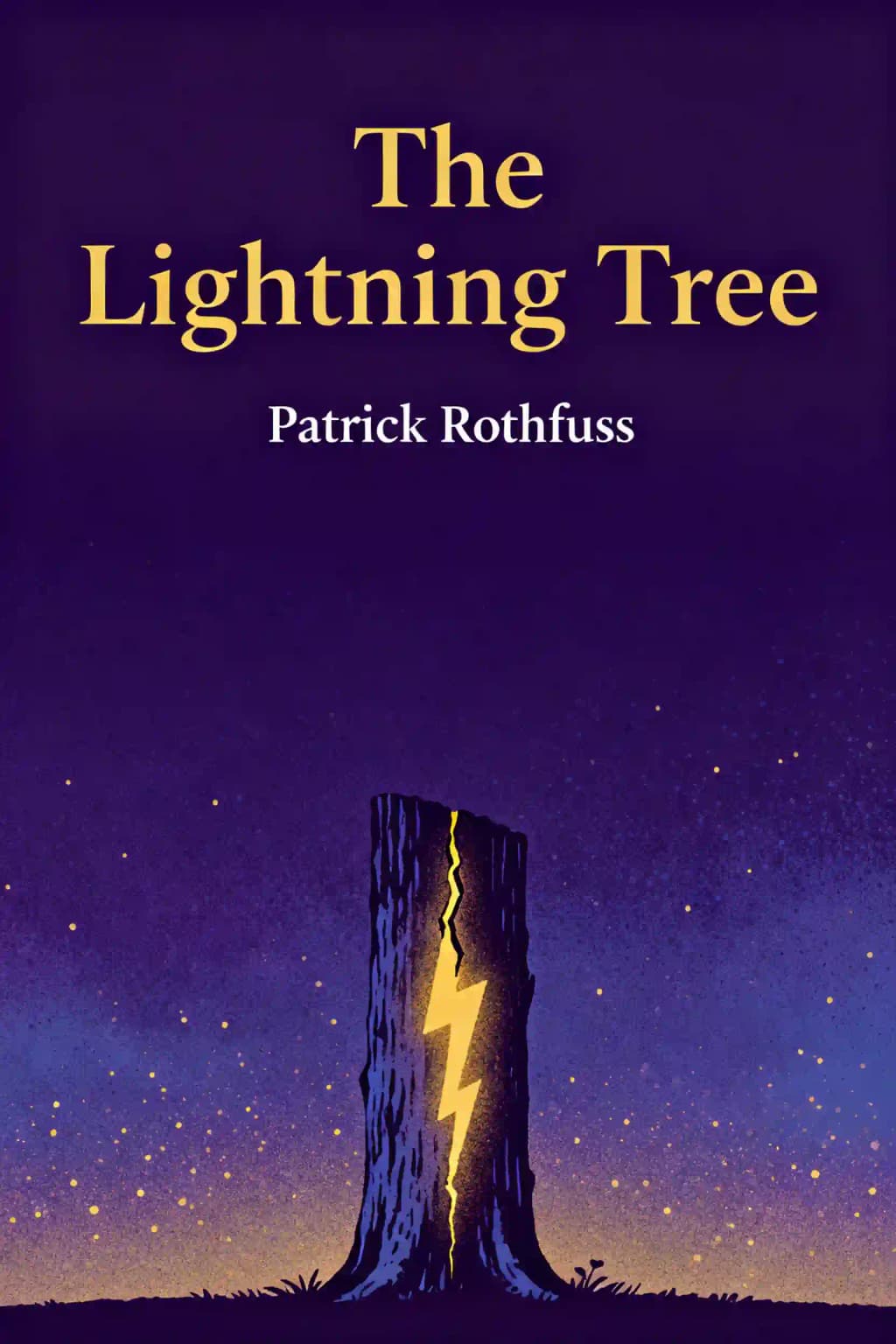
The lightning tree itself embodies this principle. To most villagers, it's simply an old hawthorn tree marked by lightning-unusual perhaps, but not magical. Yet for Bast and the children who seek him there, it's a place of power and possibility, a natural altar where ancient practices continue in the modern world. The tree stands as a physical reminder that magic doesn't announce itself with flashing lights or thunderous declarations; it exists quietly in places and objects that most people pass without a second glance.
This theme extends to Bast himself. When he moves through the village, most adults see only a charming young man who works at the local inn. They miss entirely his true nature-the fae being with ancient knowledge and supernatural abilities who walks among them. Even his name, "Bast," hints at connections to old gods and primal forces that the villagers would never suspect in their seemingly ordinary neighbor.
The rituals Bast performs with the children further illustrate this principle. When he helps Rike create a protective charm, the process involves gathering ordinary materials-a stone with a hole in it, some wax, a few drops of blood. There are no elaborate incantations or mystical ingredients, just common objects and simple actions imbued with intention and understanding. The magic doesn't lie in the materials themselves but in knowing how to use them, in recognizing the patterns and connections that most people overlook.
Even Bast's system of exchanges represents a form of magic hidden in plain sight. To casual observers, his interactions with the children might appear to be simple games or favors. But these exchanges follow principles older than human civilization-the magic of reciprocity, obligation, and balance that governs relationships between mortals and fae beings. When Bast assigns tasks as payment for his help, he's not just being whimsical; he's maintaining ancient traditions that connect the human world to realms beyond ordinary understanding.
This theme reaches its culmination in the final scene, when Bast begins telling the innkeeper about Nettie Williams finding a wild beehive. What appears to be casual conversation actually reveals Bast's deeper purpose throughout the day-strengthening the connections between human and natural worlds, preserving knowledge that might otherwise be lost, and bringing a touch of sweetness (both literal and metaphorical) to lives that need it.
Through this portrayal of magic in the mundane, Rothfuss offers a powerful message: the extraordinary doesn't exist separate from everyday life but within it. Magic isn't found by escaping reality but by looking more deeply into it, by recognizing the patterns and possibilities that exist all around us but that most people have forgotten how to see. In a world increasingly dominated by technology and rational thinking, The Lightning Tree reminds us that other ways of knowing and being still persist-if only we remember how to look for them.